
Alfa Romeo Giulia 1300 GTA Junior Corsa


Brand
Produced from
Portal
Vehicle category
Model line
Predecessor
Successor
Submodel Overview
There are legends, and then there is the Alleggerita. In the entire pantheon of motorsport, few acronyms command as much reverence as “GTA.” It is a name whispered with a mixture of awe and passion, a holy trinity of letters—Gran Turismo Alleggerita—that represents the absolute zenith of Alfa Romeo’s post-war racing philosophy. And while the original 1600 GTA of 1965 fired the first devastating shot, it was its smaller, angrier, higher-revving sibling, the 1968 Giulia 1300 GTA Junior, that perfected the formula and created an untouchable dynasty. This car is not merely a “submodel”; it is a thoroughbred champion, a giant-killer, and arguably the most soulful expression of Carlo Chiti’s engineering genius at Autodelta. It is, quite simply, one of the greatest touring cars ever conceived. To understand it, you must first understand its purpose: not just to compete, but to dominate the 1300cc class, a category that Alfa Romeo decided was its own personal property.
The “Junior” in its name was a stroke of pure marketing brilliance. On the civilian market, the Giulia GT 1300 Junior was the affordable, entry-level version of the stunning Bertone-designed 105-series coupe. It offered the same million-dollar looks as its bigger-engined brothers but with a smaller 1.3-liter engine, making it accessible to a younger, less affluent audience. By basing their new 1300cc race car on this “Junior” model, Alfa Romeo created an unbreakable link between their showroom and the podium. They weren’t just selling a car; they were selling a dream. Every young Italian who bought a standard GT Junior could see his car, the Alleggerita version, humiliating BMWs and Fords on the racetracks of Europe. It was the ultimate “win on Sunday, sell on Monday” strategy, and it worked to perfection.
The magic of the GTA, however, lay in that final “A.” Alleggerita, meaning “lightened.” This was not a token effort. Autodelta, Alfa’s legendary competition department, subjected the beautiful Bertone body to the most extreme diet imaginable. The standard steel bonnet, doors, and boot lid were all ripped off and meticulously recreated in a wafer-thin, exotic aerospace alloy called Peraluman 25. These panels were so thin you could practically dent them by leaning too hard, and they contributed to the car’s signature “ping” sound when tapped, a noise that instantly identified it as a true Alleggerita. The floorpan and other structural elements were made from thinner-gauge steel than the road car. The standard glass side and rear windows were replaced with featherweight plexiglass. Inside, it was a spartan cathedral of speed. All sound deadening, carpets, rear seats, and creature comforts were unceremoniously thrown in the bin. In their place were two thin, lightweight bucket seats, a simple rubber mat, and the smell of raw glue, hot oil, and high-octane gasoline. Even the door handles were replaced with simple pull-cords. The result was a car that tipped the scales at a scarcely believable 740-760 kilograms (around 1,650 lbs), nearly 200 kg lighter than its standard steel counterpart.
But lightness alone doesn’t win championships. The second, unspoken “A” in GTA could have stood for Aggiornata (updated), because the engine was a work of art. The standard 1290cc Alfa Romeo twin-cam four-cylinder was already a jewel, but Autodelta’s engineers disassembled it and rebuilt it as a high-strung racing weapon. The Stradale (road) versions, built purely for homologation, were relatively tame, producing around 95 horsepower. The Corsa (race) versions were a different beast entirely. The block was fitted with high-compression pistons, exotic camshafts with wild profiles, a lightened flywheel, and a bespoke exhaust manifold that sang a metallic bark. But the true secret, the heart of its power and its legend, was the cylinder head. Autodelta developed a new head with two spark plugs per cylinder: the immortal “Twin Spark.” This wasn’t a gimmick; it was a pure racing solution. The twin plugs provided a more complete and efficient combustion of the fuel-air mixture, allowing for extremely high compression ratios and aggressive ignition timing without detonation. This, in turn, allowed the engine to rev safely and reliably to an astonishing 8,000-8,500 RPM. Fed by a pair of massive, side-draught Weber 45 DCOE carburetors—gargantuan for a 1.3-liter engine—this tiny motor screamed out between 160 and 170 horsepower. In its ultimate 1970s evolution, it was rumored to be touching 180 horsepower. This was a specific output of over 130 hp-per-liter, from a naturally-aspirated, production-based block in 1968. It was pure magic.
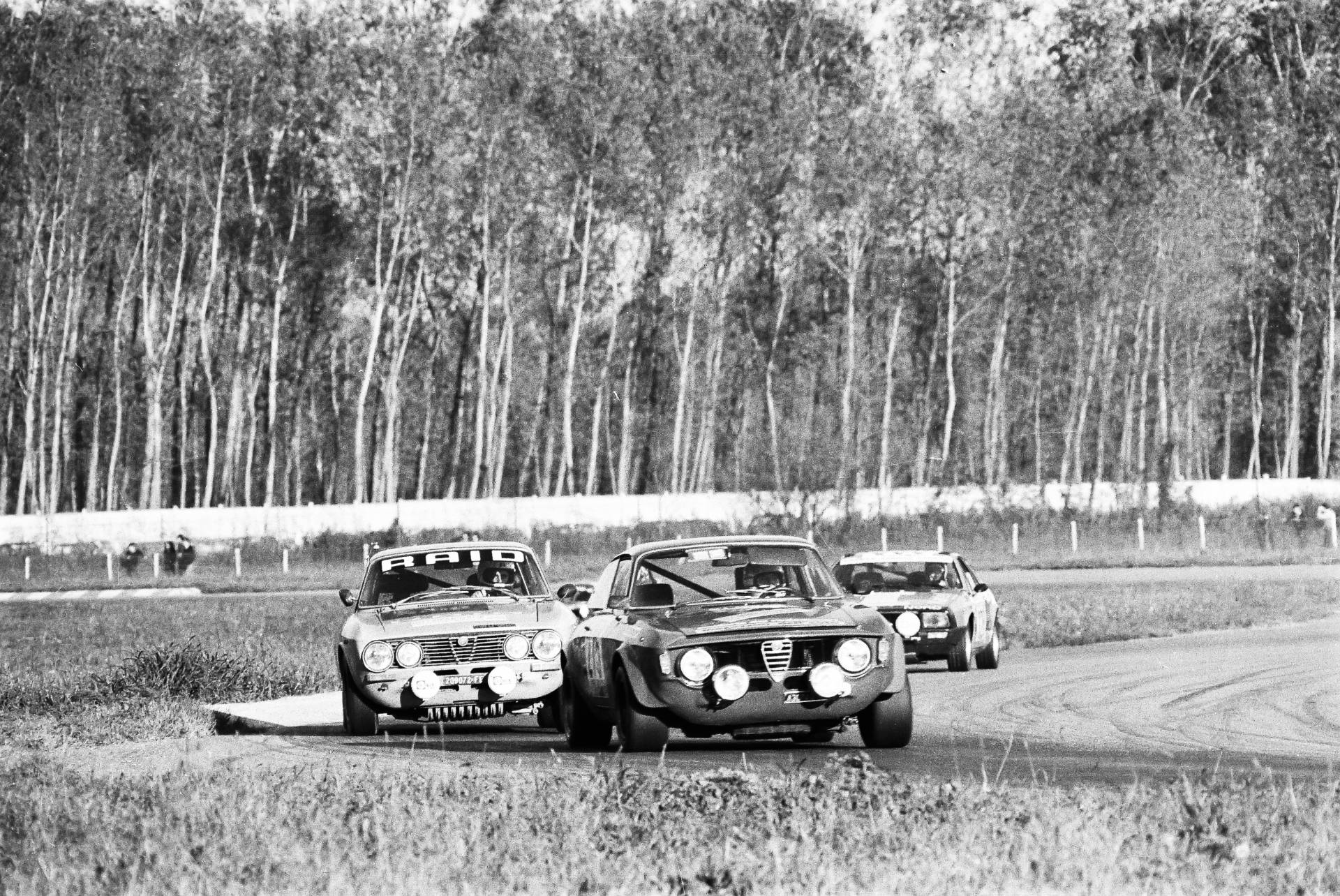
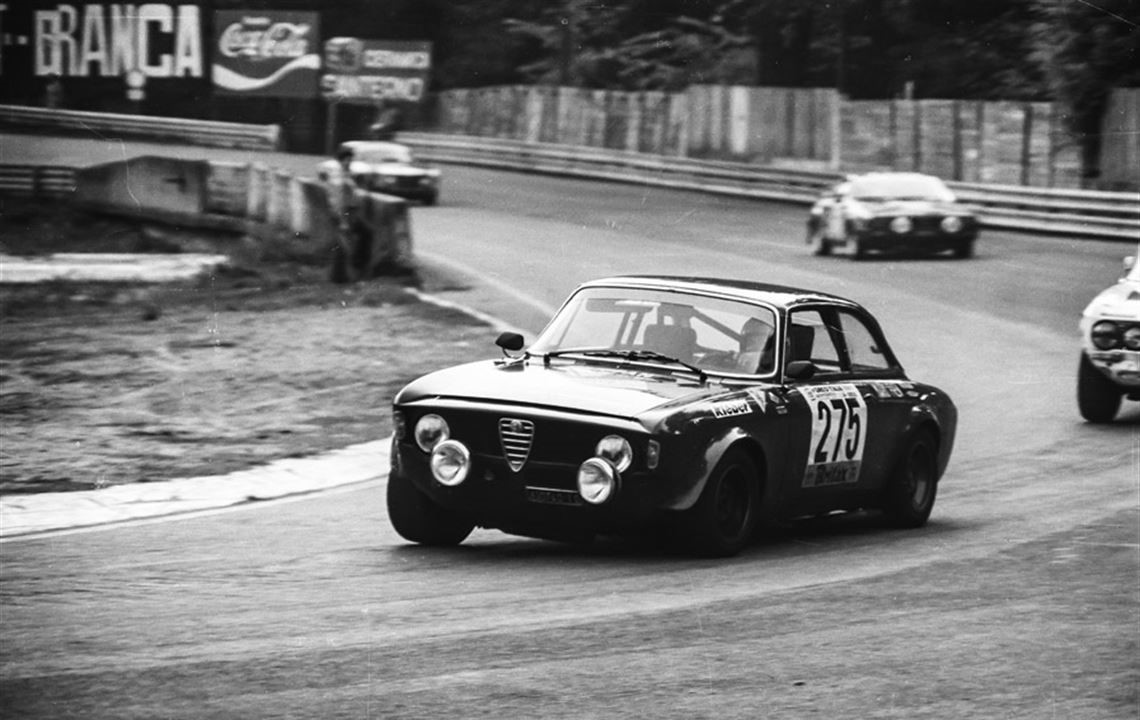
To watch a GTA Junior race was to witness a symphony of mechanical rage. The sound was unforgettable: not a deep rumble, but a high-pitched, angry, metallic shriek that ripped the air apart. And then there was the stance. The GTA Junior became famous for its bizarre and iconic three-wheeling cornering posture. As it dove into a corner, the car would hike its inside front wheel several inches off the tarmac, looking like an over-excited dog. This was not a flaw; it was a deliberate, brilliant, and slightly unhinged piece of chassis tuning by Autodelta. To get the power from that screaming 1.3L engine to the ground, they needed to overcome the limitations of the standard 105-series’ live rear axle. Their solution was the famous “sliding-block” rear suspension. They modified the rear axle’s T-shaped trailing arm mount, allowing the entire axle to pivot and articulate. Under hard cornering, this system effectively “jacked up” the inside of the car, forcing the outside rear tire to bite into the pavement with ferocious grip. It looked impossible, but it gave the GTA Junior phenomenal traction on corner exit, allowing it to rocket out of turns and carry absurd momentum.
The result of this fanatical engineering was not just success; it was total, crushing, and absolute domination. The 1300 GTA Junior was unleashed on the European Touring Car Championship, and it was a wolf set upon a field of sheep. It won its 1300cc division championship seven years in a row, from 1968 to 1975. But its true impact was even greater. The Junior’s relentless, perfect accumulation of class points was the unshakeable foundation for Alfa Romeo’s overall European Manufacturers’ Championship victories in both 1971 and 1972. While the big-bore Ford Capris and BMW CSL “Batmobiles” were busy battling each other for the outright Drivers’ titles, it was the combined, two-pronged attack of the mighty 1300 GTA Junior in Division 2 and its 2000 GTAm sibling in Division 3 that secured the ultimate prize for the costruttore from Milan. It was the ultimate testament to the fact that a team of lightweight, high-RPM assassins could strategically dismantle and defeat the brute-force, big-engine horsepower of its rivals. Drivers like Gianluigi Picchi and Spartaco Dini became legends at its wheel, their names forever intertwined with the little Bertone coupe that could. With only around 450 examples ever built, the GTA Junior is now one of the most sought-after and revered Alfas in history, a perfect storm of Bertone’s timeless beauty and Autodelta’s savage, winning soul.
Brand
Produced from
Portal
Vehicle category
Model line
Predecessor
Sucessor
Brand
Produced from
Portal
Vehicle category
Model line
Model generation
Predecessor
Sucessor
Submodel Overview
There are legends, and then there is the Alleggerita. In the entire pantheon of motorsport, few acronyms command as much reverence as “GTA.” It is a name whispered with a mixture of awe and passion, a holy trinity of letters—Gran Turismo Alleggerita—that represents the absolute zenith of Alfa Romeo’s post-war racing philosophy. And while the original 1600 GTA of 1965 fired the first devastating shot, it was its smaller, angrier, higher-revving sibling, the 1968 Giulia 1300 GTA Junior, that perfected the formula and created an untouchable dynasty. This car is not merely a “submodel”; it is a thoroughbred champion, a giant-killer, and arguably the most soulful expression of Carlo Chiti’s engineering genius at Autodelta. It is, quite simply, one of the greatest touring cars ever conceived. To understand it, you must first understand its purpose: not just to compete, but to dominate the 1300cc class, a category that Alfa Romeo decided was its own personal property.
The “Junior” in its name was a stroke of pure marketing brilliance. On the civilian market, the Giulia GT 1300 Junior was the affordable, entry-level version of the stunning Bertone-designed 105-series coupe. It offered the same million-dollar looks as its bigger-engined brothers but with a smaller 1.3-liter engine, making it accessible to a younger, less affluent audience. By basing their new 1300cc race car on this “Junior” model, Alfa Romeo created an unbreakable link between their showroom and the podium. They weren’t just selling a car; they were selling a dream. Every young Italian who bought a standard GT Junior could see his car, the Alleggerita version, humiliating BMWs and Fords on the racetracks of Europe. It was the ultimate “win on Sunday, sell on Monday” strategy, and it worked to perfection.
The magic of the GTA, however, lay in that final “A.” Alleggerita, meaning “lightened.” This was not a token effort. Autodelta, Alfa’s legendary competition department, subjected the beautiful Bertone body to the most extreme diet imaginable. The standard steel bonnet, doors, and boot lid were all ripped off and meticulously recreated in a wafer-thin, exotic aerospace alloy called Peraluman 25. These panels were so thin you could practically dent them by leaning too hard, and they contributed to the car’s signature “ping” sound when tapped, a noise that instantly identified it as a true Alleggerita. The floorpan and other structural elements were made from thinner-gauge steel than the road car. The standard glass side and rear windows were replaced with featherweight plexiglass. Inside, it was a spartan cathedral of speed. All sound deadening, carpets, rear seats, and creature comforts were unceremoniously thrown in the bin. In their place were two thin, lightweight bucket seats, a simple rubber mat, and the smell of raw glue, hot oil, and high-octane gasoline. Even the door handles were replaced with simple pull-cords. The result was a car that tipped the scales at a scarcely believable 740-760 kilograms (around 1,650 lbs), nearly 200 kg lighter than its standard steel counterpart.
But lightness alone doesn’t win championships. The second, unspoken “A” in GTA could have stood for Aggiornata (updated), because the engine was a work of art. The standard 1290cc Alfa Romeo twin-cam four-cylinder was already a jewel, but Autodelta’s engineers disassembled it and rebuilt it as a high-strung racing weapon. The Stradale (road) versions, built purely for homologation, were relatively tame, producing around 95 horsepower. The Corsa (race) versions were a different beast entirely. The block was fitted with high-compression pistons, exotic camshafts with wild profiles, a lightened flywheel, and a bespoke exhaust manifold that sang a metallic bark. But the true secret, the heart of its power and its legend, was the cylinder head. Autodelta developed a new head with two spark plugs per cylinder: the immortal “Twin Spark.” This wasn’t a gimmick; it was a pure racing solution. The twin plugs provided a more complete and efficient combustion of the fuel-air mixture, allowing for extremely high compression ratios and aggressive ignition timing without detonation. This, in turn, allowed the engine to rev safely and reliably to an astonishing 8,000-8,500 RPM. Fed by a pair of massive, side-draught Weber 45 DCOE carburetors—gargantuan for a 1.3-liter engine—this tiny motor screamed out between 160 and 170 horsepower. In its ultimate 1970s evolution, it was rumored to be touching 180 horsepower. This was a specific output of over 130 hp-per-liter, from a naturally-aspirated, production-based block in 1968. It was pure magic.
To watch a GTA Junior race was to witness a symphony of mechanical rage. The sound was unforgettable: not a deep rumble, but a high-pitched, angry, metallic shriek that ripped the air apart. And then there was the stance. The GTA Junior became famous for its bizarre and iconic three-wheeling cornering posture. As it dove into a corner, the car would hike its inside front wheel several inches off the tarmac, looking like an over-excited dog. This was not a flaw; it was a deliberate, brilliant, and slightly unhinged piece of chassis tuning by Autodelta. To get the power from that screaming 1.3L engine to the ground, they needed to overcome the limitations of the standard 105-series’ live rear axle. Their solution was the famous “sliding-block” rear suspension. They modified the rear axle’s T-shaped trailing arm mount, allowing the entire axle to pivot and articulate. Under hard cornering, this system effectively “jacked up” the inside of the car, forcing the outside rear tire to bite into the pavement with ferocious grip. It looked impossible, but it gave the GTA Junior phenomenal traction on corner exit, allowing it to rocket out of turns and carry absurd momentum.
The result of this fanatical engineering was not just success; it was total, crushing, and absolute domination. The 1300 GTA Junior was unleashed on the European Touring Car Championship, and it was a wolf set upon a field of sheep. It won its 1300cc division championship seven years in a row, from 1968 to 1975. But its true impact was even greater. The Junior’s relentless, perfect accumulation of class points was the unshakeable foundation for Alfa Romeo’s overall European Manufacturers’ Championship victories in both 1971 and 1972. While the big-bore Ford Capris and BMW CSL “Batmobiles” were busy battling each other for the outright Drivers’ titles, it was the combined, two-pronged attack of the mighty 1300 GTA Junior in Division 2 and its 2000 GTAm sibling in Division 3 that secured the ultimate prize for the costruttore from Milan. It was the ultimate testament to the fact that a team of lightweight, high-RPM assassins could strategically dismantle and defeat the brute-force, big-engine horsepower of its rivals. Drivers like Gianluigi Picchi and Spartaco Dini became legends at its wheel, their names forever intertwined with the little Bertone coupe that could. With only around 450 examples ever built, the GTA Junior is now one of the most sought-after and revered Alfas in history, a perfect storm of Bertone’s timeless beauty and Autodelta’s savage, winning soul.
Tech Specs
Technical Specifications
Tech Specs
Technical Specifications
Engine
01
03
Internal combustion engine
Configuration
Inline-4
Location
Front, longitudinally mounted
Construction
Aluminium alloy block and head
Displacement (cc)
1,290 cc
Displacement (cu in)
78.7 cu in
Compression
9.0:1
Bore x Stroke
78.0 mm x 67.5 mm
Valvetrain
2 valves per cylinder, DOHC
Fuel feed
2 Weber 45 DCOE 14 carburettors
Lubrication
Wet sump
Aspiration
Naturally aspirated
Output
Power (hp)
150 hp
Power (kW)
112 kW
Max power at
-
Torque (Nm)
-
Torque (ft lbs)
-
Max torque at
-
Drivetrain
02
03
Chassis
Type
Monocoque unibody
Material
Steel
Body
Material
Aluminium alloy
Transmission
Gearbox
5-speed manual
Drive
Rear Wheel Drive
Suspension
Front
Independent with double wishbones and coil springs, anti-roll bar
Rear
Live axle with trailing arms and coil springs
Steering
Type
Worm and roller
Brakes
Front
Discs
Rear
Discs
Wheels
Front
-
Rear
-
Tires
Front
-
Rear
-
Dimensions and performance
03
03
Dimensions
Length (mm)
4,080 mm
Length (in)
160.6 in
Width (mm)
1,580 mm
Width (in)
62.2 in
Height (mm)
1,310 mm
Height (in)
51.5 in
Wheelbase (mm)
2,350 mm
Wheelbase (in)
92.5 in
Weight (kg)
790 kg
Weight (lbs)
1,742 lbs
Performance
Power to weight
0.22 hp/kg
Top speed (km/h)
210 km/h
Top speed (mph)
130 mph
0-100 km/h (0-60 mph)
-