
Chevron B16 Mazda 10A R2
Brand
Produced from
Portal
Model line
Predecessor
Successor
Submodel Overview
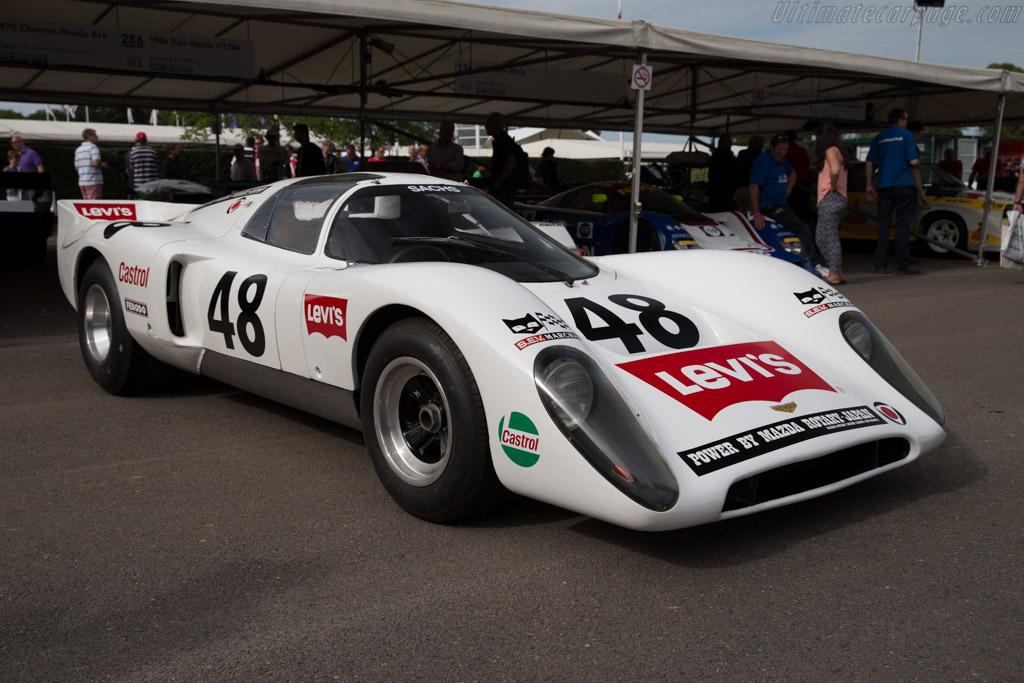
In the rich, diverse history of the Chevron B16, there is one variant that stands apart not for its dominance, but for its sheer, audacious exoticism. By 1969, the B16 had already established itself as the most beautiful sports prototype in the world, usually found humming with the precision of a BMW four-cylinder or screaming with the urgency of a Cosworth FVA. But deep within the entry lists of the 1970 endurance season, specifically in the hands of the Belgian Levi’s International Racing Team, lurked a machine that sounded like nothing else on the grid. It was a cultural collision of the highest order: the quintessential British privateer chassis mated to the futuristic, experimental heart of Hiroshima. This was the Chevron B16 Mazda, a car that represented the rotary engine’s first serious assault on the European sports car establishment.
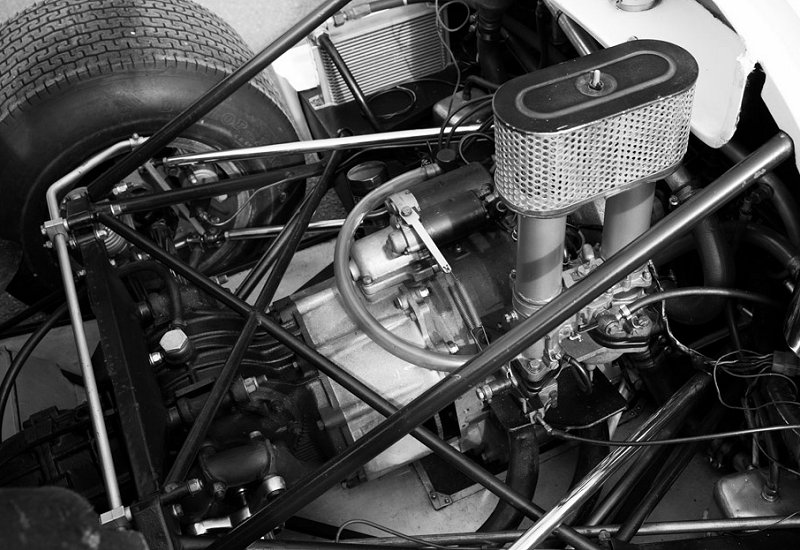
To understand this car, one must understand the era’s obsession with the Wankel rotary engine. Mazda, led by the visionary Kenichi Yamamoto, had bet the company’s future on this technology. They needed to prove its durability on the world stage, specifically in Europe. They found a willing partner in Yves Deprez’s Belgian team, who took Derek Bennett’s masterpiece chassis and prepared it for a heart transplant. The standard subframe was modified to accept the Mazda 10A R2. This was a twin-rotor engine, displacing a mere 982cc geometrically, but rated as a 2.0-litre equivalent by the FIA. It was a marvel of compact engineering. In race trim, with peripheral porting and a Weber 48 IDA carburetor, it produced around 200 to 230 bhp. But the numbers tell only half the story. The rotary delivered its power in a linear, turbine-like surge that didn’t stop until 10,000 rpm.
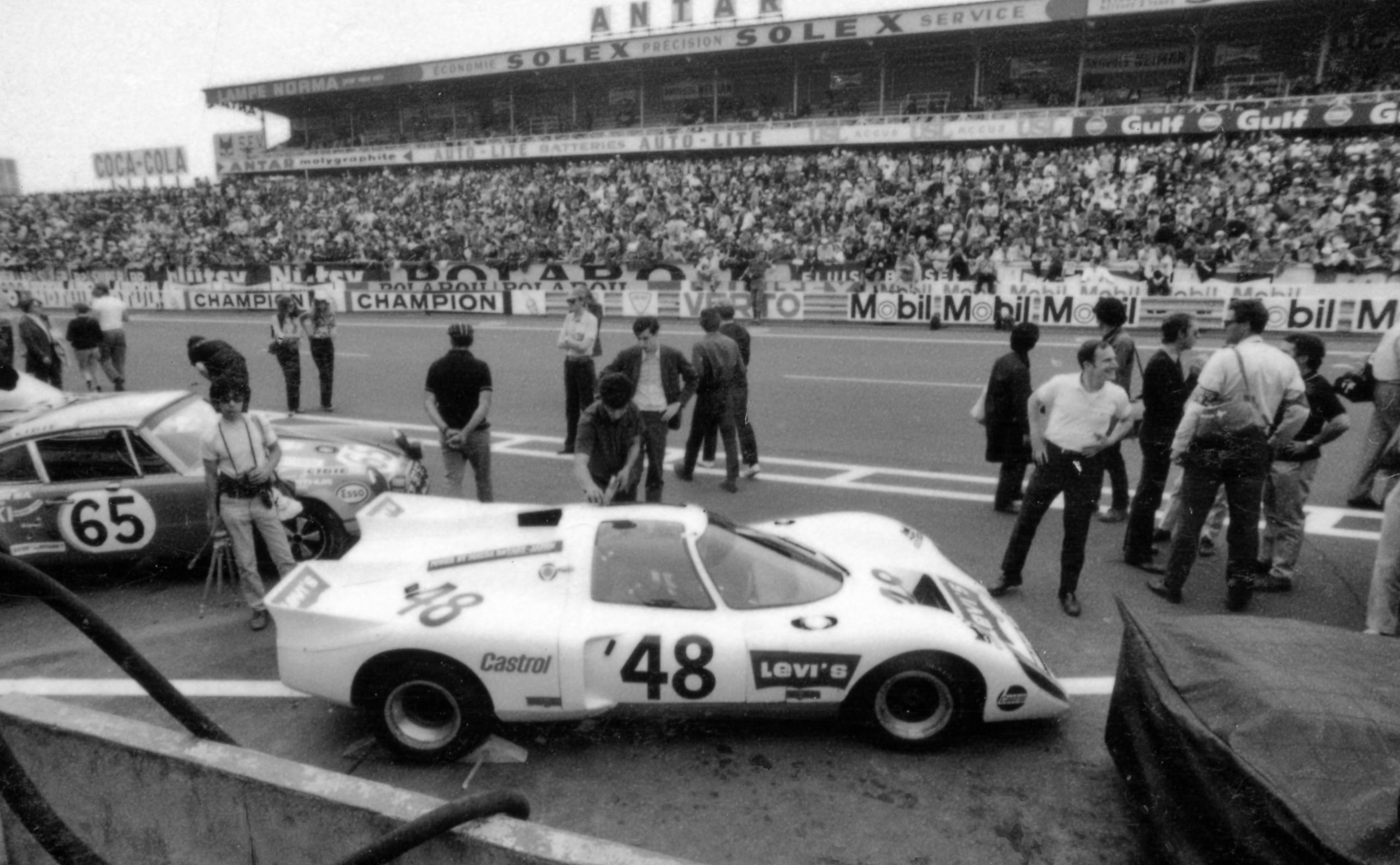
The installation was neat, as the 10A was significantly smaller and lighter than the reciprocating engines it replaced, lowering the B16’s already subterranean centre of gravity. However, the defining characteristic of the B16 Mazda was its noise. It was an ear-splitting, high-frequency buzz-saw shriek that could be heard miles away, a sound that cut through the deep bellow of the V8s and the rasp of the Porsches like a dentist’s drill. Wrapped in the iconic, denim-inspired blue and white Levi’s livery, the car was a visual and auditory sensation. It retained the B16’s stunning, low-drag fibreglass bodywork by Specialised Mouldings, but the massive exhaust pipe protruding from the rear hinted at the fire-spitting flamethrower within.
The B16 Mazda’s competition history is a tale of speed and fragility, played out on the most dangerous circuits in Europe. Its primary target was the 24 Hours of Spa-Francorchamps in 1970. In qualifying, the car was impressively fast, the rotary’s high-rpm power exploiting the B16’s low drag on the long straights of the old, 14km Spa circuit. It proved that the concept worked; the Wankel engine could propel a prototype at competitive speeds. However, reliability was the rotary’s Achilles’ heel in these early days. The apex seals, the peripheral ports, and the sheer thermal stress of racing often led to retirements. At the Nürburgring 500km and the 1000km of Spa, the car showed flashes of brilliance, often running well within the top 10 of the 2.0-litre class before mechanical gremlins—or the inherent thirst of the rotary engine—intervened.
Yet, the car’s significance outweighs its trophy cabinet. The Chevron B16 Mazda was a pioneer. It was the bridge that allowed Mazda to gather the critical data on European circuits that would eventually lead to the 787B’s victory at Le Mans twenty years later. It was a brave experiment by a privateer team that dared to be different, taking the “safe” option of a Ford or BMW engine and discarding it for the “magic spinning triangle.” Today, the B16 Mazda is a cult icon. It is remembered as the loudest, strangest, and perhaps most fascinating iteration of Derek Bennett’s design, a fleeting moment when British chassis engineering and Japanese rotary ambition screamed in perfect, deafening harmony.
Brand
Produced from
Portal
Model line
Predecessor
Sucessor
Brand
Produced from
Portal
Model line
Model generation
Predecessor
Sucessor
Submodel Overview
In the rich, diverse history of the Chevron B16, there is one variant that stands apart not for its dominance, but for its sheer, audacious exoticism. By 1969, the B16 had already established itself as the most beautiful sports prototype in the world, usually found humming with the precision of a BMW four-cylinder or screaming with the urgency of a Cosworth FVA. But deep within the entry lists of the 1970 endurance season, specifically in the hands of the Belgian Levi’s International Racing Team, lurked a machine that sounded like nothing else on the grid. It was a cultural collision of the highest order: the quintessential British privateer chassis mated to the futuristic, experimental heart of Hiroshima. This was the Chevron B16 Mazda, a car that represented the rotary engine’s first serious assault on the European sports car establishment.
To understand this car, one must understand the era’s obsession with the Wankel rotary engine. Mazda, led by the visionary Kenichi Yamamoto, had bet the company’s future on this technology. They needed to prove its durability on the world stage, specifically in Europe. They found a willing partner in Yves Deprez’s Belgian team, who took Derek Bennett’s masterpiece chassis and prepared it for a heart transplant. The standard subframe was modified to accept the Mazda 10A R2. This was a twin-rotor engine, displacing a mere 982cc geometrically, but rated as a 2.0-litre equivalent by the FIA. It was a marvel of compact engineering. In race trim, with peripheral porting and a Weber 48 IDA carburetor, it produced around 200 to 230 bhp. But the numbers tell only half the story. The rotary delivered its power in a linear, turbine-like surge that didn’t stop until 10,000 rpm.
The installation was neat, as the 10A was significantly smaller and lighter than the reciprocating engines it replaced, lowering the B16’s already subterranean centre of gravity. However, the defining characteristic of the B16 Mazda was its noise. It was an ear-splitting, high-frequency buzz-saw shriek that could be heard miles away, a sound that cut through the deep bellow of the V8s and the rasp of the Porsches like a dentist’s drill. Wrapped in the iconic, denim-inspired blue and white Levi’s livery, the car was a visual and auditory sensation. It retained the B16’s stunning, low-drag fibreglass bodywork by Specialised Mouldings, but the massive exhaust pipe protruding from the rear hinted at the fire-spitting flamethrower within.
The B16 Mazda’s competition history is a tale of speed and fragility, played out on the most dangerous circuits in Europe. Its primary target was the 24 Hours of Spa-Francorchamps in 1970. In qualifying, the car was impressively fast, the rotary’s high-rpm power exploiting the B16’s low drag on the long straights of the old, 14km Spa circuit. It proved that the concept worked; the Wankel engine could propel a prototype at competitive speeds. However, reliability was the rotary’s Achilles’ heel in these early days. The apex seals, the peripheral ports, and the sheer thermal stress of racing often led to retirements. At the Nürburgring 500km and the 1000km of Spa, the car showed flashes of brilliance, often running well within the top 10 of the 2.0-litre class before mechanical gremlins—or the inherent thirst of the rotary engine—intervened.
Yet, the car’s significance outweighs its trophy cabinet. The Chevron B16 Mazda was a pioneer. It was the bridge that allowed Mazda to gather the critical data on European circuits that would eventually lead to the 787B’s victory at Le Mans twenty years later. It was a brave experiment by a privateer team that dared to be different, taking the “safe” option of a Ford or BMW engine and discarding it for the “magic spinning triangle.” Today, the B16 Mazda is a cult icon. It is remembered as the loudest, strangest, and perhaps most fascinating iteration of Derek Bennett’s design, a fleeting moment when British chassis engineering and Japanese rotary ambition screamed in perfect, deafening harmony.
Tech Specs
Technical Specifications
Tech Specs
Technical Specifications
Engine
01
03
Internal combustion engine
Configuration
Mazda 10A R2, 2-Rotor Wankel
Location
Mid, longitudinally mounted
Construction
Sand-cast aluminium plated with chrome rotor housing, cast iron rotors
Displacement (cc)
982 cc
Displacement (cu in)
59.9 cu in
Compression
-
Bore x Stroke
-
Valvetrain
-
Fuel feed
Carburettor
Lubrication
-
Aspiration
Naturally aspirated
Output
Power (hp)
200 hp
Power (kW)
149 kW
Max power at
-
Torque (Nm)
-
Torque (ft lbs)
-
Max torque at
-
Drivetrain
02
03
Chassis
Type
Tubular frame
Material
Duraluminium and steel
Body
Material
Fibreglass
Transmission
Gearbox
5-speed manual
Drive
Rear Wheel Drive
Suspension
Front
Double wishbones, coil springs over dampers, anti-roll bar
Rear
Reversed lower wishbones, top links, twin trailing arms, coil springs over dampers, anti-roll bar
Steering
Type
Rack and pinion
Brakes
Front
Discs
Rear
Discs
Wheels
Front
-
Rear
-
Tires
Front
-
Rear
-
Dimensions and performance
03
03
Dimensions
Length (mm)
3,937 mm
Length (in)
155 in
Width (mm)
1,778 mm
Width (in)
70 in
Height (mm)
940 mm
Height (in)
37 in
Wheelbase (mm)
2,362 mm
Wheelbase (in)
93 in
Weight (kg)
590 kg
Weight (lbs)
1,301 lbs
Performance
Power to weight
0.34 hp/kg
Top speed (km/h)
-
Top speed (mph)
-
0-100 km/h (0-60 mph)
-