
Ferrari Dino 308 GT4 Group 3
Brand
Produced from
Portal
Vehicle category
Model line
Predecessor
Successor
Submodel Overview
In the pantheon of Maranello’s racing history, the spotlight is almost exclusively monopolized by the scarlet prototypes and the V12 Berlinettas. However, tucked away in the shadows of the mid-1970s, during a period of intense corporate transition and an energy crisis, lies the 1974 Ferrari Dino 308 GT4 Group 3. To understand this car, one must first appreciate the controversy of its birth. The road-going 308 GT4 was already an act of rebellion—the first production V8 Ferrari, the first mid-engined 2+2, and the first to be penned by Bertone’s Marcello Gandini rather than the house of Pininfarina. While the purists recoiled at its angular “folded paper” aesthetics, keen drivers, including Niki Lauda, recognized a chassis of immense potential. The Group 3 variant was the inevitable manifestation of this potential, a machine built not for the glory of the Scuderia factory team—who had abandoned sports car racing to focus on Formula 1—but for the privateer who needed a weapon to fight the omnipresent Porsche 911s in the Grand Touring categories.
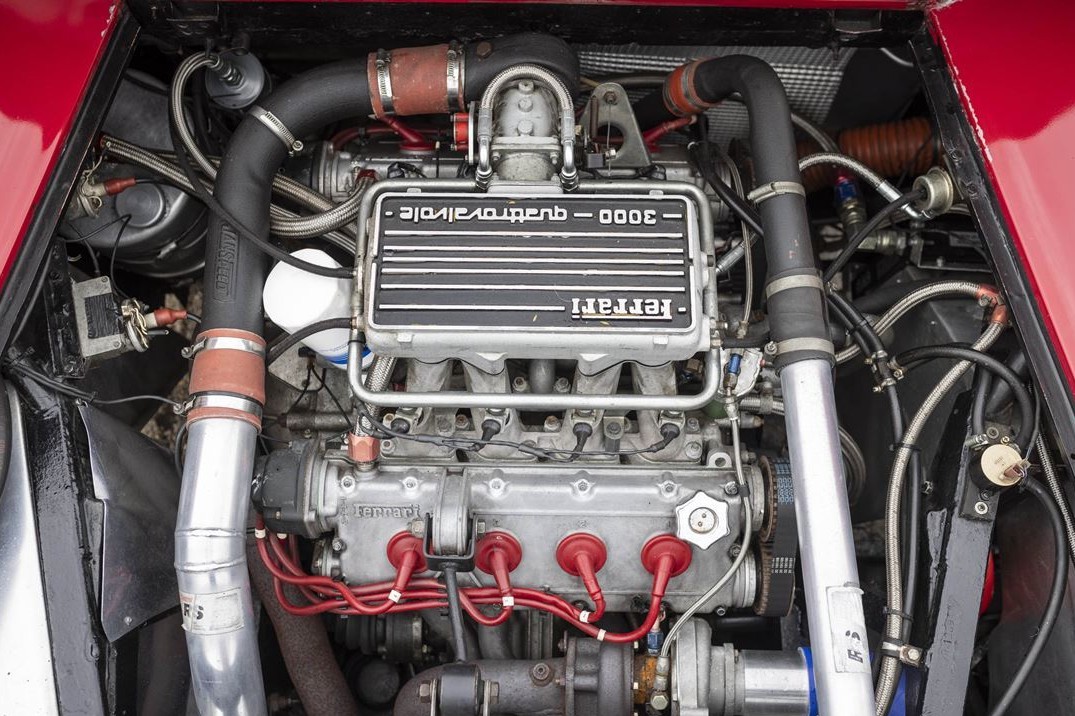
Technically, the Dino 308 GT4 Group 3 was a study in maximizing the inherent advantages of a superb road car within the strict confines of FIA homologation. The heart of the beast was the Tipo F106 V8 engine. Unlike the longitudinal layout of its predecessors, this 3.0-liter, quad-cam unit was mounted transversely, creating a compact powertrain mass that centered the weight perfectly within the wheelbase. In Group 3 tune, which mandated that the car remain largely recognizable as a production vehicle, the engine was blueprinted and balanced. Breathing through four twin-choke Weber 40 DCNF carburetors, often running without air cleaners to maximize airflow (and noise), the output was nudged from the stock 255 bhp to nearly 280 bhp. This was not the fire-breathing horsepower of a prototype, but it was delivered with a flat-plane crank scream that was distinctively Ferrari. The chassis, a tubular steel spaceframe, remained largely standard but was stiffened by the addition of a roll cage. The suspension, fully independent double wishbones, was upgraded with stiffer springs, adjustable Koni shock absorbers, and thicker anti-roll bars to eliminate the body roll inherent in a road-biased 2+2.
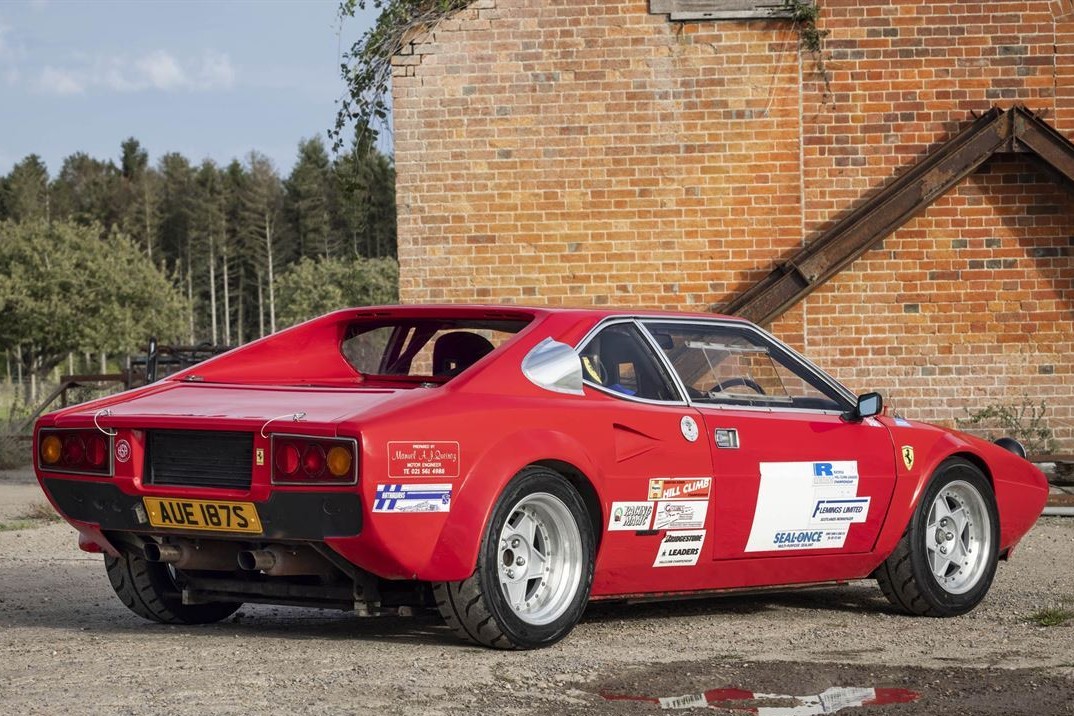
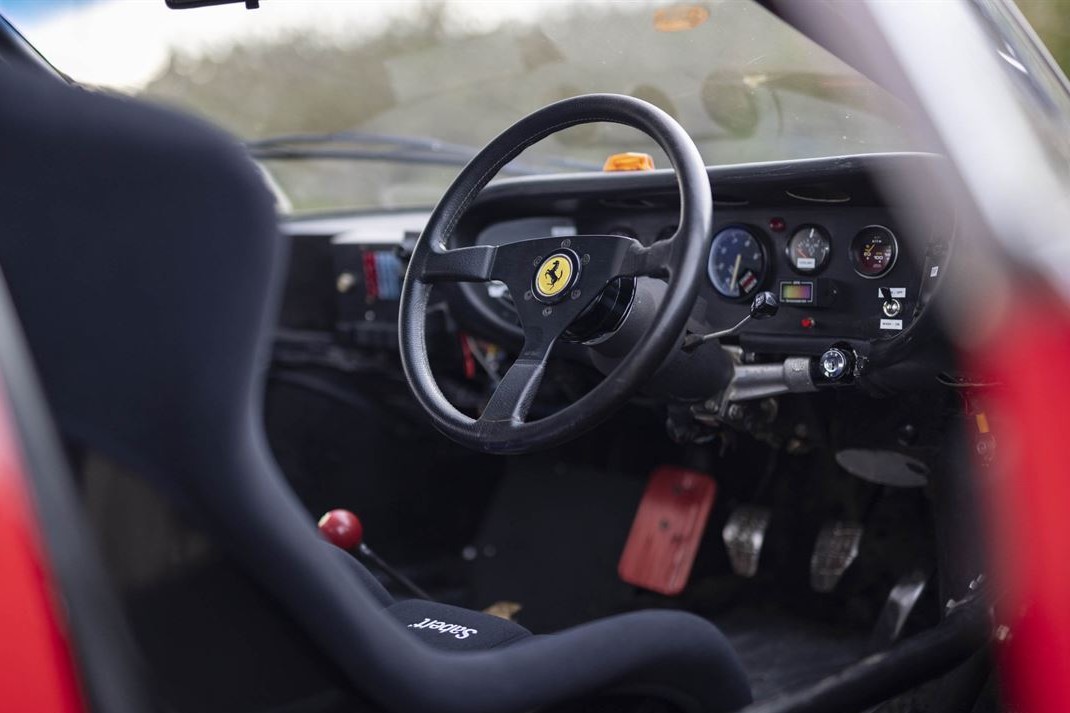
Visually, the Group 3 car is perhaps the most honest expression of Gandini’s wedge design. Stripped of the delicate bumpers and chrome trim of the street version, and sitting lower on wider Campagnolo alloy wheels wrapped in racing rubber, the car shed its awkward stance. It looked purposeful, a geometric arrow designed to pierce the air. Inside, the leather luxury was gutted in favor of lightweight bucket seats, racing harnesses, and a plumbed-in fire suppression system. The “plus two” rear seats, useless even in the road car, were removed to make space for the roll cage and sometimes a spare wheel, highlighting the car’s dual-purpose nature for events like the Tour de France Automobile.
The competition history of the 308 GT4 Group 3 is a tale of privateer grit rather than factory dominance. Ferrari did not officially campaign the car, leaving its honor in the hands of importers and wealthy amateurs. Its most significant champion was Luigi Chinetti’s North American Racing Team (NART). While NART is famous for the heavily modified 308 GT4 LM that attempted Le Mans in 1974, that car was built upon the foundation of the Group 3 homologation. In Europe, the Group 3 cars found a niche in national hill climbs and tarmac rallies, particularly in Italy and France. The car possessed a distinct advantage over the Lancia Stratos—which shared the same engine—in terms of stability. The longer wheelbase of the GT4 made it less twitchy on high-speed sections, though it lacked the agility of the Lancia on the tightest switchbacks. It was a car that required a precise hand; without the massive downforce aids of later Group 4 and Group 5 cars, the driver had to rely on mechanical grip and chassis balance.
Ultimately, the 1974 Dino 308 GT4 Group 3 serves as the critical “Chapter One” in the history of Ferrari’s mid-engined V8 racers. It was the proof of concept. It demonstrated that the transverse V8 layout could endure the rigors of competition, paving the way for the far more successful 308 GTB Group 4 rally cars developed by Michelotto and, decades later, the 360, 430, and 458 Challenge cars. It remains a fascinating anomaly: a four-seater Ferrari race car that looked like a doorstop, sounded like an F1 car, and fought the Porsche armada with nothing but Italian verve and privateer money. Today, these cars are cherished not for their trophy haul, but for their mechanical purity and their role as the misunderstood pioneer of the modern Ferrari racing bloodline.
Brand
Produced from
Portal
Vehicle category
Model line
Predecessor
Sucessor
Brand
Produced from
Portal
Vehicle category
Model line
Model generation
Predecessor
Sucessor
Submodel Overview
In the pantheon of Maranello’s racing history, the spotlight is almost exclusively monopolized by the scarlet prototypes and the V12 Berlinettas. However, tucked away in the shadows of the mid-1970s, during a period of intense corporate transition and an energy crisis, lies the 1974 Ferrari Dino 308 GT4 Group 3. To understand this car, one must first appreciate the controversy of its birth. The road-going 308 GT4 was already an act of rebellion—the first production V8 Ferrari, the first mid-engined 2+2, and the first to be penned by Bertone’s Marcello Gandini rather than the house of Pininfarina. While the purists recoiled at its angular “folded paper” aesthetics, keen drivers, including Niki Lauda, recognized a chassis of immense potential. The Group 3 variant was the inevitable manifestation of this potential, a machine built not for the glory of the Scuderia factory team—who had abandoned sports car racing to focus on Formula 1—but for the privateer who needed a weapon to fight the omnipresent Porsche 911s in the Grand Touring categories.
Technically, the Dino 308 GT4 Group 3 was a study in maximizing the inherent advantages of a superb road car within the strict confines of FIA homologation. The heart of the beast was the Tipo F106 V8 engine. Unlike the longitudinal layout of its predecessors, this 3.0-liter, quad-cam unit was mounted transversely, creating a compact powertrain mass that centered the weight perfectly within the wheelbase. In Group 3 tune, which mandated that the car remain largely recognizable as a production vehicle, the engine was blueprinted and balanced. Breathing through four twin-choke Weber 40 DCNF carburetors, often running without air cleaners to maximize airflow (and noise), the output was nudged from the stock 255 bhp to nearly 280 bhp. This was not the fire-breathing horsepower of a prototype, but it was delivered with a flat-plane crank scream that was distinctively Ferrari. The chassis, a tubular steel spaceframe, remained largely standard but was stiffened by the addition of a roll cage. The suspension, fully independent double wishbones, was upgraded with stiffer springs, adjustable Koni shock absorbers, and thicker anti-roll bars to eliminate the body roll inherent in a road-biased 2+2.
Visually, the Group 3 car is perhaps the most honest expression of Gandini’s wedge design. Stripped of the delicate bumpers and chrome trim of the street version, and sitting lower on wider Campagnolo alloy wheels wrapped in racing rubber, the car shed its awkward stance. It looked purposeful, a geometric arrow designed to pierce the air. Inside, the leather luxury was gutted in favor of lightweight bucket seats, racing harnesses, and a plumbed-in fire suppression system. The “plus two” rear seats, useless even in the road car, were removed to make space for the roll cage and sometimes a spare wheel, highlighting the car’s dual-purpose nature for events like the Tour de France Automobile.
The competition history of the 308 GT4 Group 3 is a tale of privateer grit rather than factory dominance. Ferrari did not officially campaign the car, leaving its honor in the hands of importers and wealthy amateurs. Its most significant champion was Luigi Chinetti’s North American Racing Team (NART). While NART is famous for the heavily modified 308 GT4 LM that attempted Le Mans in 1974, that car was built upon the foundation of the Group 3 homologation. In Europe, the Group 3 cars found a niche in national hill climbs and tarmac rallies, particularly in Italy and France. The car possessed a distinct advantage over the Lancia Stratos—which shared the same engine—in terms of stability. The longer wheelbase of the GT4 made it less twitchy on high-speed sections, though it lacked the agility of the Lancia on the tightest switchbacks. It was a car that required a precise hand; without the massive downforce aids of later Group 4 and Group 5 cars, the driver had to rely on mechanical grip and chassis balance.
Ultimately, the 1974 Dino 308 GT4 Group 3 serves as the critical “Chapter One” in the history of Ferrari’s mid-engined V8 racers. It was the proof of concept. It demonstrated that the transverse V8 layout could endure the rigors of competition, paving the way for the far more successful 308 GTB Group 4 rally cars developed by Michelotto and, decades later, the 360, 430, and 458 Challenge cars. It remains a fascinating anomaly: a four-seater Ferrari race car that looked like a doorstop, sounded like an F1 car, and fought the Porsche armada with nothing but Italian verve and privateer money. Today, these cars are cherished not for their trophy haul, but for their mechanical purity and their role as the misunderstood pioneer of the modern Ferrari racing bloodline.
Tech Specs
Technical Specifications
Tech Specs
Technical Specifications
Engine
01
03
Internal combustion engine
Configuration
Ferrari Dino F106AL, V8 - 90º
Location
Mid, transversely mounted
Construction
Aluminium alloy block and heads
Displacement (cc)
2,927 cc
Displacement (cu in)
178.6 cu in
Compression
8.8:1
Bore x Stroke
81.0 mm x 71.0 mm
Valvetrain
2 valves per cylinder, DOHC
Fuel feed
4 x Weber 40 DCNF carburetors
Lubrication
Wet sump
Aspiration
Naturally aspirated
Output
Power (hp)
~255 hp
Power (kW)
~190 kW
Max power at
7,700 RPM
Torque (Nm)
~284 Nm
Torque (ft lbs)
~209 ft lbs
Max torque at
5,000 RPM
Drivetrain
02
03
Chassis
Type
Tubular spaceframe
Material
Steel
Body
Material
Steel body panels
Transmission
Gearbox
Ferrari 5-speed manual
Drive
Rear Wheel Drive
Suspension
Front
Independent, double wishbones, coil springs, telescopic dampers, anti-roll bar
Rear
Independent, double wishbones, coil springs, telescopic dampers, anti-roll bar
Steering
Type
Rack and pinion
Brakes
Front
Ventilated discs Ø272 mm
Rear
Ventilated discs Ø267 mm
Wheels
Front
7.5" x 14" (Campagnolo alloy)
Rear
7.5" x 14" (Campagnolo alloy)
Tires
Front
205/70 VR 14
Rear
205/70 VR 14
Dimensions and performance
03
03
Dimensions
Length (mm)
4,300 mm
Length (in)
169.3 in
Width (mm)
1,791 mm
Width (in)
70.5 in
Height (mm)
1,210 mm
Height (in)
47.6 in
Wheelbase (mm)
2,550 mm
Wheelbase (in)
100.4 in
Weight (kg)
1,150 kg
Weight (lbs)
2,535 lbs
Performance
Power to weight
~0.22 hp/kg
Top speed (km/h)
250 km/h
Top speed (mph)
155 mph
0-100 km/h (0-60 mph)
~6.4 s