
Ford Shelby Mustang GT350R
Brand
Produced from
Portal
Vehicle category
Model line
Model generation
Predecessor
Successor
Submodel Overview
In the winter of 1964, the Ford Mustang was already a commercial supernova, shattering sales records and capturing the zeitgeist of a youthful America. However, in the eyes of the automotive cognoscenti and the burgeoning road racing community, it remained a “secretary’s car”—a softly sprung, Falcon-based fashion accessory with zero competition credibility. Lee Iacocca, the Mustang’s father, knew that to capture the hearts of serious enthusiasts, the car needed to do more than just look good; it needed to win. He turned to Carroll Shelby, the chicken farmer turned Le Mans winner who had already stuffed Ford V8s into AC Aces to humiliate Corvettes. Shelby’s remit was simple yet daunting: turn this mule into a racehorse. The result was the GT350, a sharpened road car, but the true weapon, the distillation of Shelby’s “hot rod” philosophy, was the 1965 Ford Shelby Mustang GT350R. Produced in a microscopic run of just 34 production units (plus two prototypes), the “R-Model” was not a marketing exercise; it was a homologation special built with the singular intent of destroying the Chevrolet Corvette in the SCCA B-Production class.
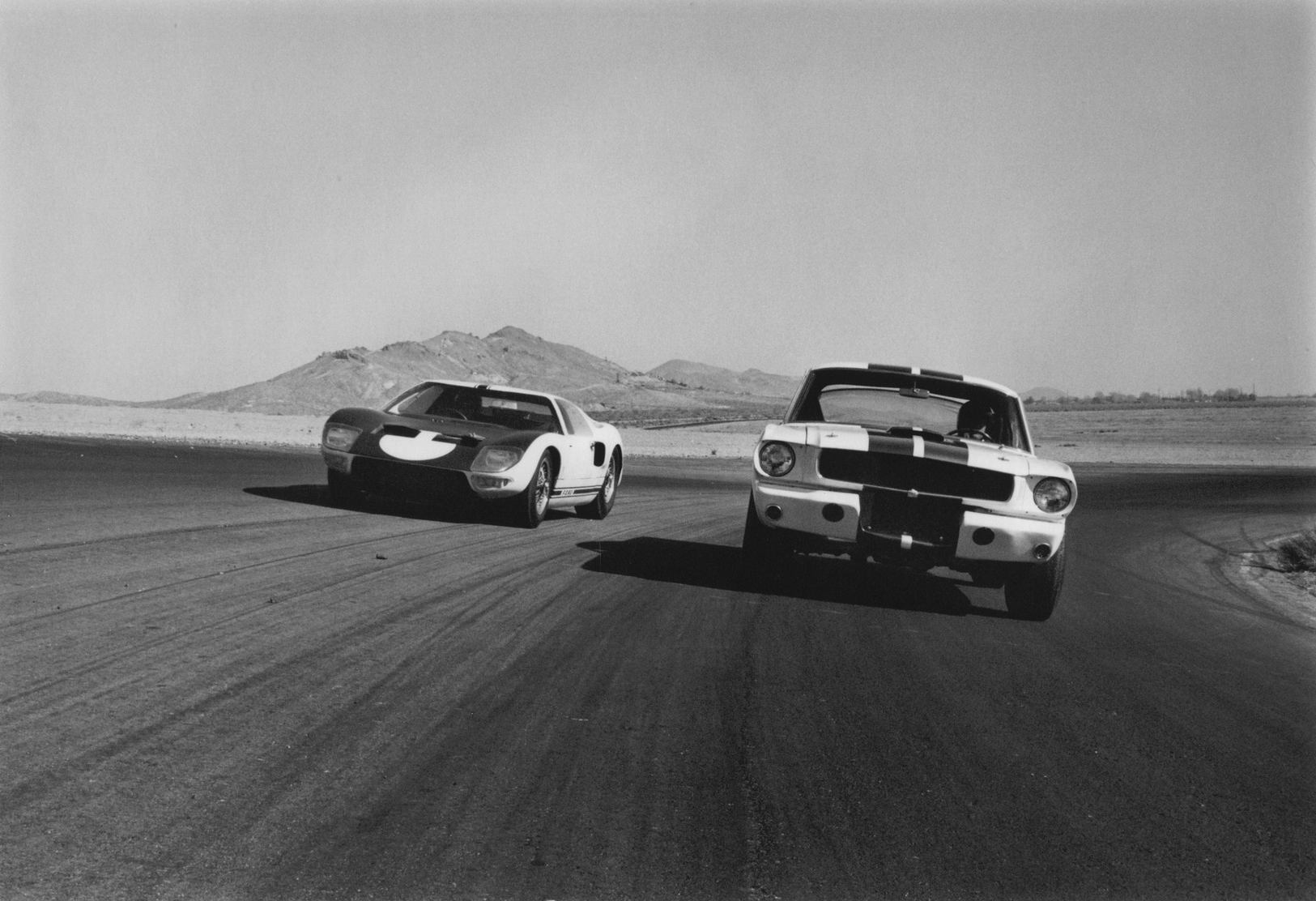
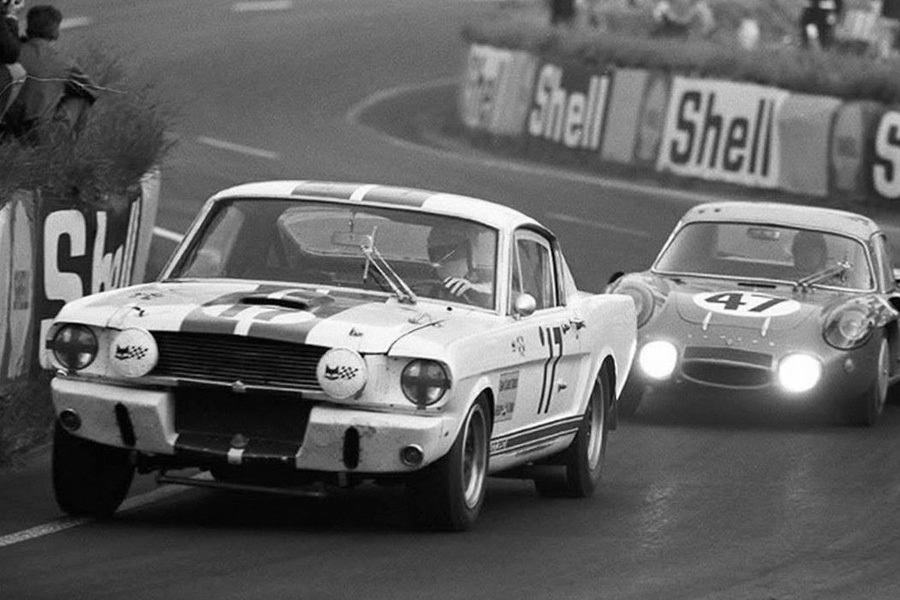
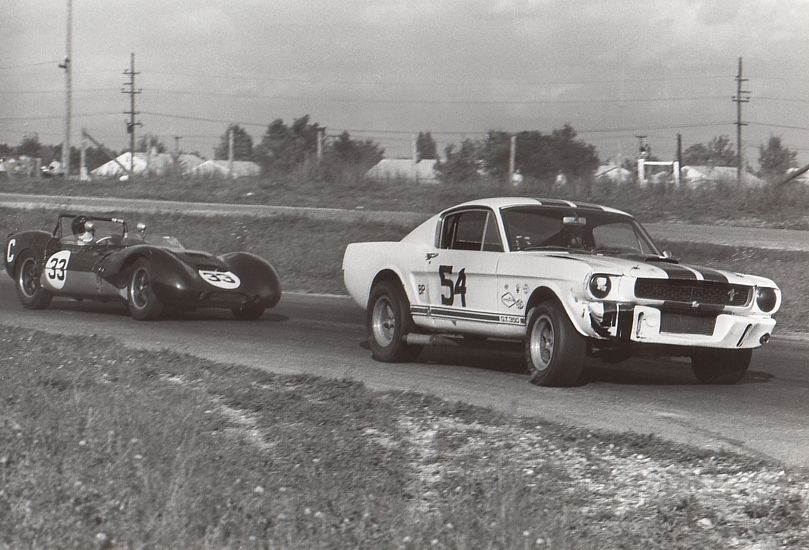
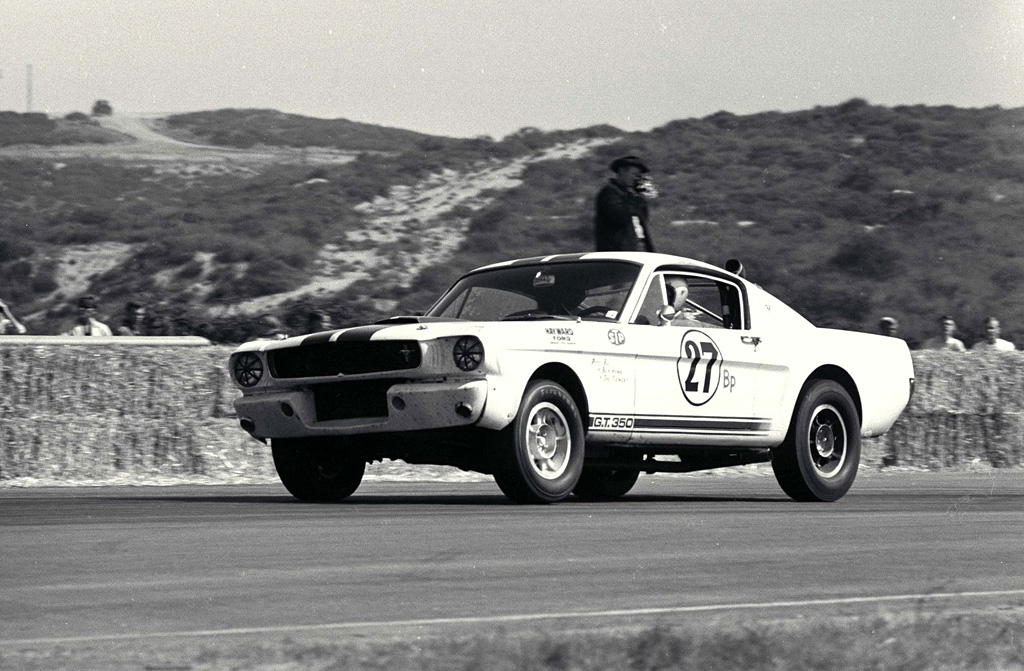
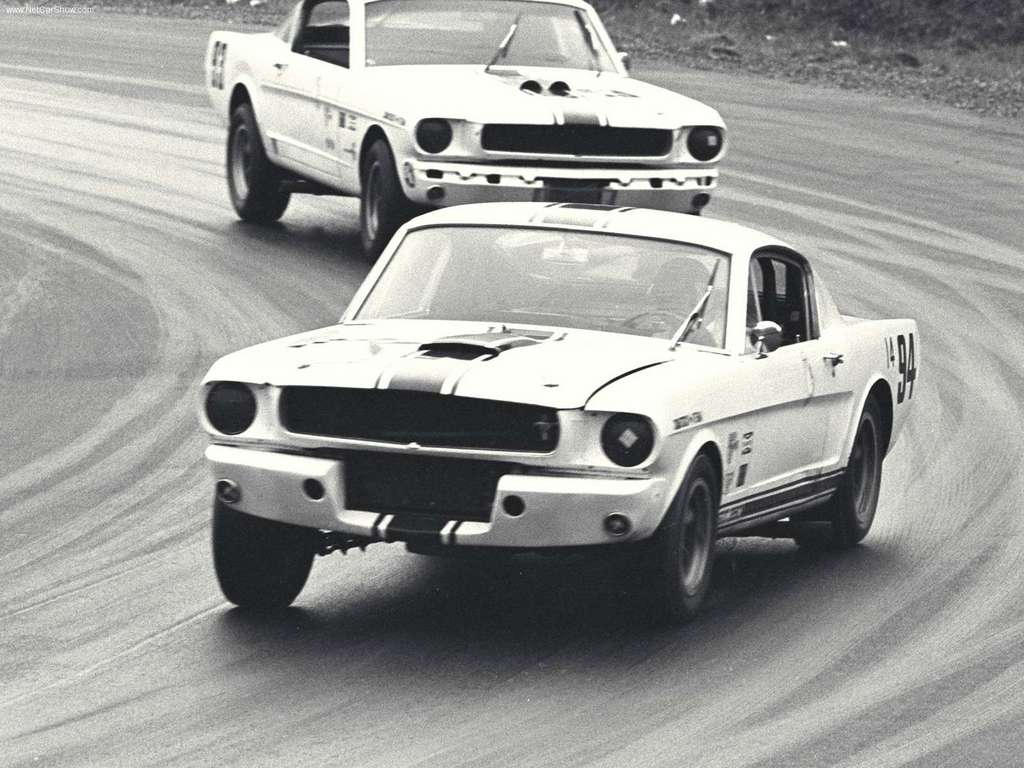
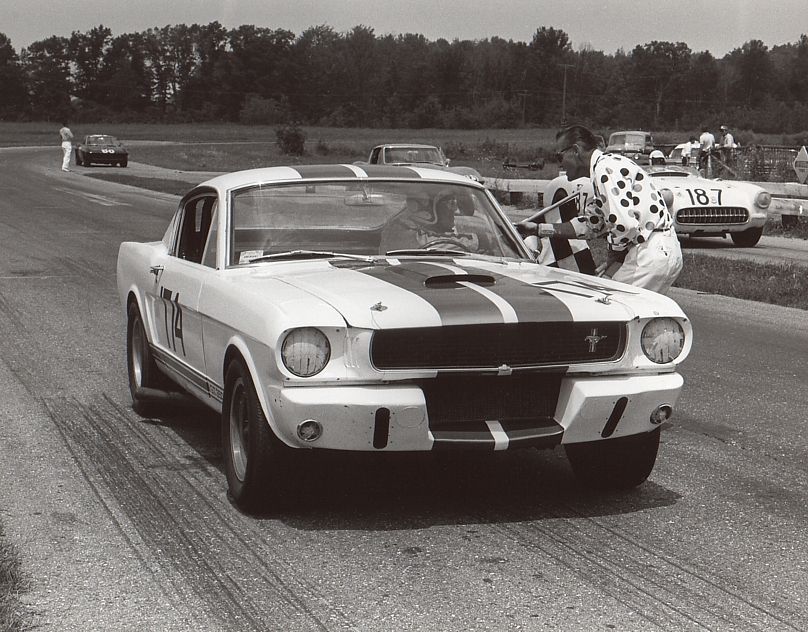
Technically, the GT350R was a study in ruthless subtraction and focused addition. While the street GT350 was raw, the R-Model was barbaric. Shelby’s team, led by project engineer Chuck Cantwell and competition director Ken Miles, stripped the unibody shell of everything deemed non-essential. Sound deadening, insulation, heaters, upholstery, and the rear seats were banished. The glass side windows were replaced with aluminium frames holding plexiglass sliders (or simply open nets), and the rear window was swapped for a vented plexiglass unit designed to extract air from the cabin at speed. Visually, the R-Model was distinguished by a fiberglass front apron with a large central cooling duct for the oil cooler and brake cooling vents, completely deleting the front bumper. The steel hood was replaced with a fiberglass unit held down by pins, featuring a functional scoop to feed the voracious carburettor.
Under that hood lay the “K-Code” 289 cubic inch (4.7-litre) Windsor V8, but it was blueprinted and massaged far beyond factory tolerances. Fitted with a high-rise aluminium intake manifold, a massive 715 cfm Holley carburettor, and Tri-Y headers feeding into unmuffled side-exit exhausts, the engine officially produced 350 horsepower, though dyno sheets often whispered numbers closer to 360 or 370. This power was routed through an aluminium-case BorgWarner T-10 four-speed manual transmission to a Detroit Locker rear end with steep 3.89 or 4.11 gears. The chassis was stiffened with an export brace and a “Monte Carlo” bar, while the suspension geometry was radically altered. The front upper control arms were relocated downward (the famous “Shelby drop”) to improve camber gain, and Koni adjustable shocks were fitted at all four corners. In the rear, massive override traction bars were installed above the axle to eliminate wheel hop, a setup effective on the track but so harsh it was deemed unsuitable for the street cars. Rolling on 15×7 American Racing Torq Thrust magnesium wheels shod with Goodyear Blue Streak racing tires, the GT350R was a visceral, vibrating, deafening machine that weighed just 2,550 lbs.
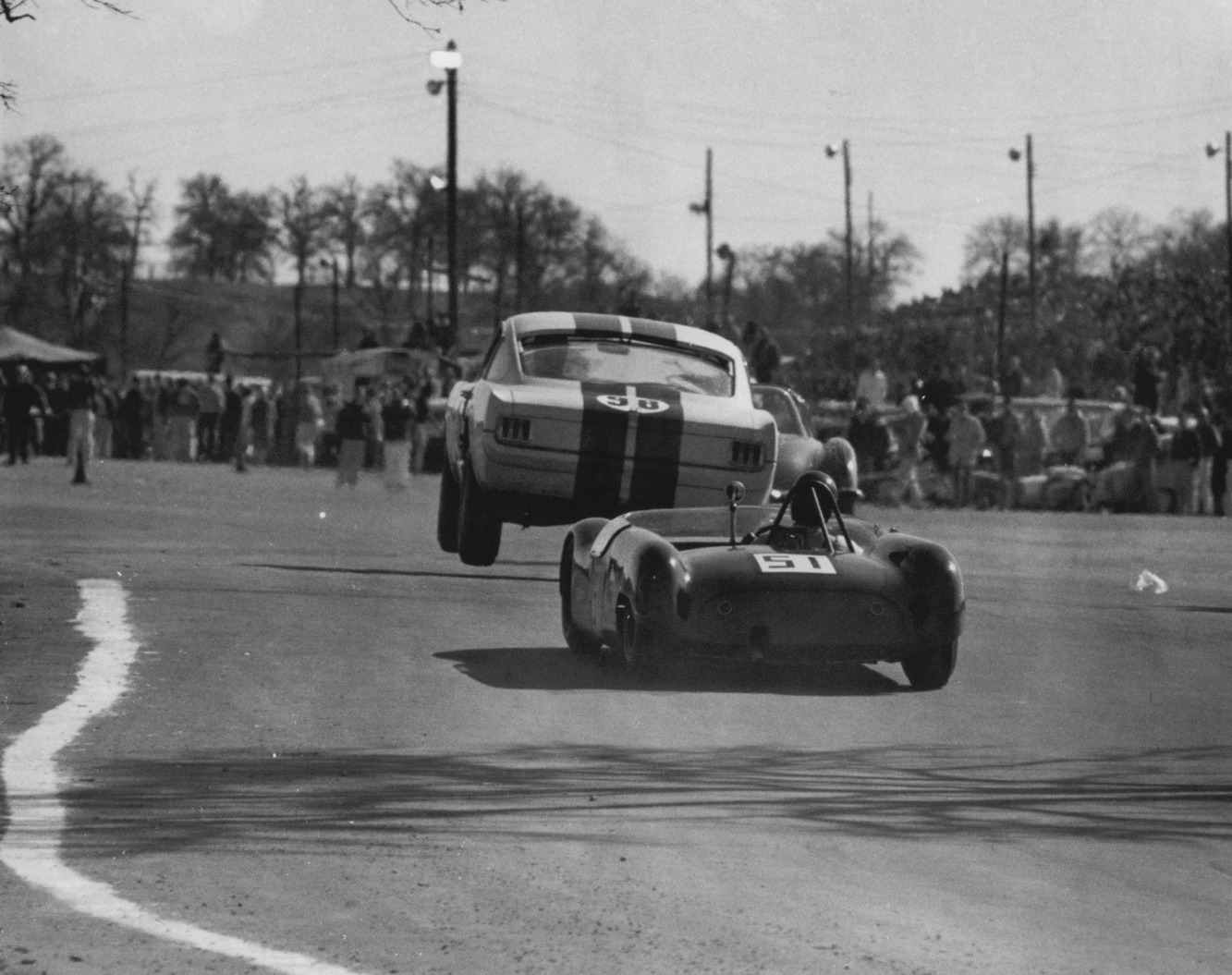
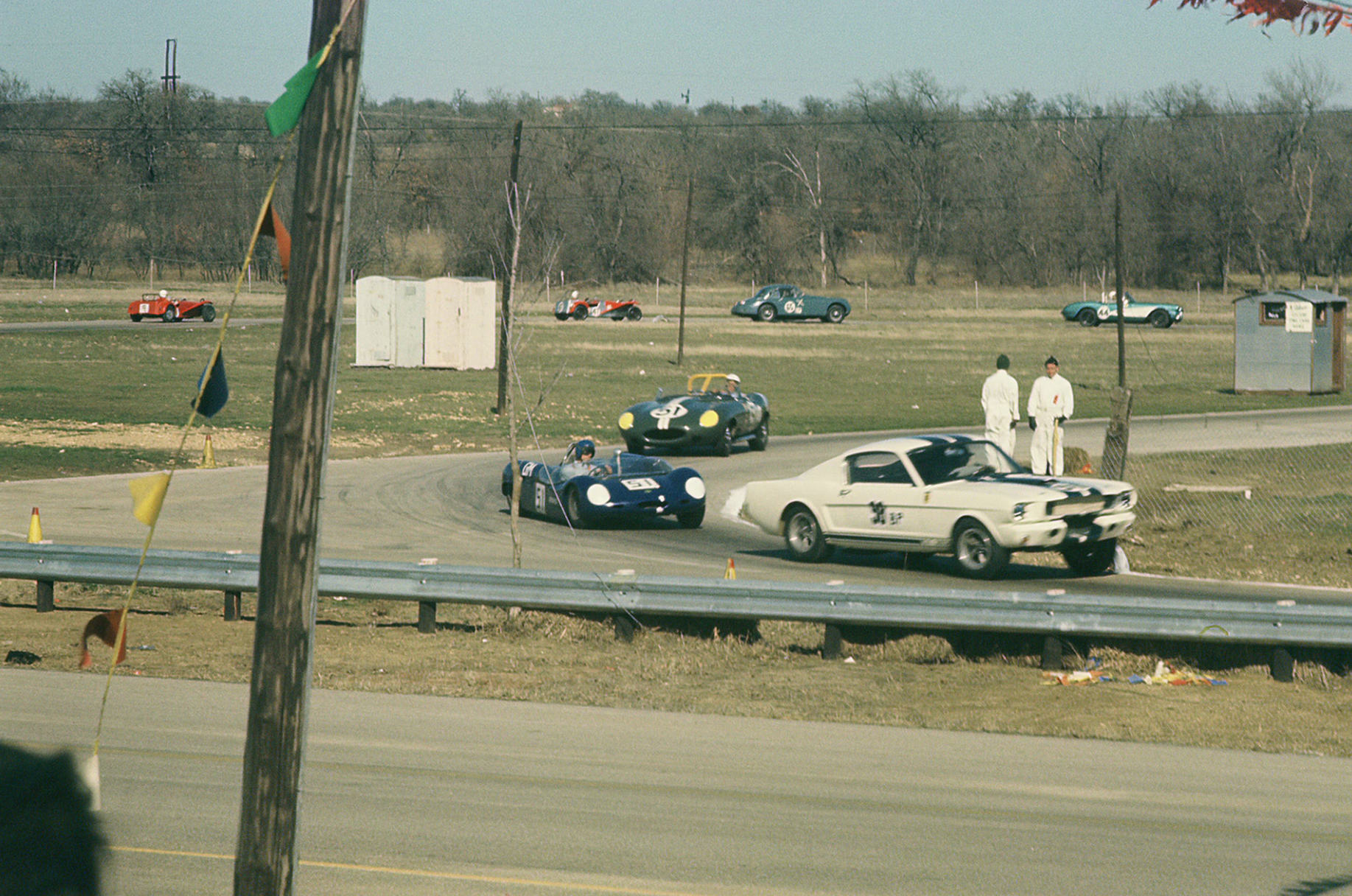
The impact of the GT350R on American motorsport was instantaneous and total. Its debut on Valentine’s Day, 1965, at Green Valley Raceway in Texas, is the stuff of legend. Driven by Ken Miles, the prototype (chassis 5R002) didn’t just win; it terrified the competition. Miles drove the car with such ferocity that he famously got all four wheels off the ground over a crest, earning the car the nickname “The Flying Mule”. Throughout the 1965 season, the GT350R wreaked havoc on the SCCA B-Production class. It obliterated the Jaguar E-Types, Sunbeam Tigers, and, most importantly, the Corvette Sting Rays that had owned the class for nearly a decade. Jerry Titus, driving for the factory team, secured the SCCA National Championship, proving that the Mustang was no longer just a pretty face. The R-Model turned the SCCA runoffs into a Ford benefit, establishing a dominance so complete that it fundamentally altered the perception of the Mustang brand forever.
The GT350R’s career was relatively brief in factory hands, as the rules and car evolved, but its shadow is long. It validated the entire “Pony Car” genre as a legitimate platform for road racing, paving the way for the Trans-Am glory years of the Boss 302. It proved that a live-axle, production-based American coupe could be made to handle with the precision of a European sports car, provided you were willing to sacrifice every ounce of comfort. Today, the 1965 GT350R is the Holy Grail of Mustangs. It is the purest expression of the breed—uncompromised, uncomfortable, and unapologetic. It represents the moment when the Mustang stopped being a car for the secretary and started being a car for the racer, a fiberglass-clad, side-pipe-spitting brute that looked the European aristocracy in the eye and didn’t blink.
Brand
Produced from
Portal
Vehicle category
Model line
Predecessor
Sucessor
Brand
Produced from
Portal
Vehicle category
Model line
Model generation
Predecessor
Sucessor
Submodel Overview
In the winter of 1964, the Ford Mustang was already a commercial supernova, shattering sales records and capturing the zeitgeist of a youthful America. However, in the eyes of the automotive cognoscenti and the burgeoning road racing community, it remained a “secretary’s car”—a softly sprung, Falcon-based fashion accessory with zero competition credibility. Lee Iacocca, the Mustang’s father, knew that to capture the hearts of serious enthusiasts, the car needed to do more than just look good; it needed to win. He turned to Carroll Shelby, the chicken farmer turned Le Mans winner who had already stuffed Ford V8s into AC Aces to humiliate Corvettes. Shelby’s remit was simple yet daunting: turn this mule into a racehorse. The result was the GT350, a sharpened road car, but the true weapon, the distillation of Shelby’s “hot rod” philosophy, was the 1965 Ford Shelby Mustang GT350R. Produced in a microscopic run of just 34 production units (plus two prototypes), the “R-Model” was not a marketing exercise; it was a homologation special built with the singular intent of destroying the Chevrolet Corvette in the SCCA B-Production class.
Technically, the GT350R was a study in ruthless subtraction and focused addition. While the street GT350 was raw, the R-Model was barbaric. Shelby’s team, led by project engineer Chuck Cantwell and competition director Ken Miles, stripped the unibody shell of everything deemed non-essential. Sound deadening, insulation, heaters, upholstery, and the rear seats were banished. The glass side windows were replaced with aluminium frames holding plexiglass sliders (or simply open nets), and the rear window was swapped for a vented plexiglass unit designed to extract air from the cabin at speed. Visually, the R-Model was distinguished by a fiberglass front apron with a large central cooling duct for the oil cooler and brake cooling vents, completely deleting the front bumper. The steel hood was replaced with a fiberglass unit held down by pins, featuring a functional scoop to feed the voracious carburettor.
Under that hood lay the “K-Code” 289 cubic inch (4.7-litre) Windsor V8, but it was blueprinted and massaged far beyond factory tolerances. Fitted with a high-rise aluminium intake manifold, a massive 715 cfm Holley carburettor, and Tri-Y headers feeding into unmuffled side-exit exhausts, the engine officially produced 350 horsepower, though dyno sheets often whispered numbers closer to 360 or 370. This power was routed through an aluminium-case BorgWarner T-10 four-speed manual transmission to a Detroit Locker rear end with steep 3.89 or 4.11 gears. The chassis was stiffened with an export brace and a “Monte Carlo” bar, while the suspension geometry was radically altered. The front upper control arms were relocated downward (the famous “Shelby drop”) to improve camber gain, and Koni adjustable shocks were fitted at all four corners. In the rear, massive override traction bars were installed above the axle to eliminate wheel hop, a setup effective on the track but so harsh it was deemed unsuitable for the street cars. Rolling on 15×7 American Racing Torq Thrust magnesium wheels shod with Goodyear Blue Streak racing tires, the GT350R was a visceral, vibrating, deafening machine that weighed just 2,550 lbs.
The impact of the GT350R on American motorsport was instantaneous and total. Its debut on Valentine’s Day, 1965, at Green Valley Raceway in Texas, is the stuff of legend. Driven by Ken Miles, the prototype (chassis 5R002) didn’t just win; it terrified the competition. Miles drove the car with such ferocity that he famously got all four wheels off the ground over a crest, earning the car the nickname “The Flying Mule”. Throughout the 1965 season, the GT350R wreaked havoc on the SCCA B-Production class. It obliterated the Jaguar E-Types, Sunbeam Tigers, and, most importantly, the Corvette Sting Rays that had owned the class for nearly a decade. Jerry Titus, driving for the factory team, secured the SCCA National Championship, proving that the Mustang was no longer just a pretty face. The R-Model turned the SCCA runoffs into a Ford benefit, establishing a dominance so complete that it fundamentally altered the perception of the Mustang brand forever.
The GT350R’s career was relatively brief in factory hands, as the rules and car evolved, but its shadow is long. It validated the entire “Pony Car” genre as a legitimate platform for road racing, paving the way for the Trans-Am glory years of the Boss 302. It proved that a live-axle, production-based American coupe could be made to handle with the precision of a European sports car, provided you were willing to sacrifice every ounce of comfort. Today, the 1965 GT350R is the Holy Grail of Mustangs. It is the purest expression of the breed—uncompromised, uncomfortable, and unapologetic. It represents the moment when the Mustang stopped being a car for the secretary and started being a car for the racer, a fiberglass-clad, side-pipe-spitting brute that looked the European aristocracy in the eye and didn’t blink.
Tech Specs
Technical Specifications
Tech Specs
Technical Specifications
Engine
01
03
Internal combustion engine
Configuration
Ford Windsor 289 "K-Code" High Performance, V8 - 90º
Location
Front, longitudinally mounted
Construction
Cast iron block and heads
Displacement (cc)
4,727 cc
Displacement (cu in)
288.5 cu in
Compression
11.0:1
Bore x Stroke
101.6 mm x 72.9 mm
Valvetrain
2 valves per cylinder, OHV
Fuel feed
1 x Holley 715 CFM "Le Mans" 4-barrel carburetor
Lubrication
Wet sump
Aspiration
Naturally aspirated
Output
Power (hp)
350 hp
Power (kW)
261 kW
Max power at
7,000 RPM
Torque (Nm)
447 Nm
Torque (ft lbs)
329.7 ft lbs
Max torque at
4,500 RPM
Drivetrain
02
03
Chassis
Type
Unibody (Reinforced)
Material
Steel
Body
Material
Steel with Fiberglass hood and front apron (valance)
Transmission
Gearbox
Borg Warner T-10M, 4-speed manual
Drive
Rear Wheel Drive
Suspension
Front
Independent, modified upper control arms ("Shelby drop"), stiff coil springs, Koni adjustable shocks, 1-inch anti-roll bar
Rear
Live axle, semi-elliptic leaf springs, over-ride traction bars, Koni adjustable shocks
Steering
Type
Recirculating ball, quick-ratio
Brakes
Front
Kelsey-Hayes ventilated discs Ø287 mm, 4-piston calipers
Rear
Drum Ø254 mm
Wheels
Front
7" x 15
Rear
7" x 15
Tires
Front
6.00-15 or 7.75-15
Rear
6.00-15 or 7.75-15
Dimensions and performance
03
03
Dimensions
Length (mm)
4,613 mm
Length (in)
181.6 in
Width (mm)
1,732 mm
Width (in)
68.2 in
Height (mm)
1,300 mm
Height (in)
51.2 in
Wheelbase (mm)
2,743 mm
Wheelbase (in)
108.0 in
Weight (kg)
~1,155 kg
Weight (lbs)
~2,550 lbs
Performance
Power to weight
~0.30 hp/kg
Top speed (km/h)
~250 km/h
Top speed (mph)
~155 mph
0-100 km/h (0-60 mph)
~5.5 s