
MG
Type
Foundation Year
Founder/s
Country
Headquarters
Brand Overview
To speak of MG is to evoke a very specific, deeply romantic flavour of motoring. Close your eyes, and you can almost smell the heady mixture of hot engine oil, Connolly leather, and damp British tweed. You can hear the raspy, unsilenced bark of a small-capacity four-cylinder engine echoing off a dry stone wall on a winding country lane. MG—originally standing for Morris Garages—is not a brand built on the pursuit of outright, terrifying horsepower, nor is it a marque defined by multi-million-pound hypercars. Instead, the sacred octagon badge represents the absolute democratization of the sports car. It is the brand that took the visceral, wind-in-the-hair thrill of the racing circuit and packaged it into something the everyday enthusiast could afford, maintain, and drive to the absolute limit. MG taught generations of drivers what it meant to heel-and-toe, to balance a car on the throttle, and to understand that a car is not merely a transport appliance, but a living, breathing mechanical companion.
The story begins in the 1920s in the university city of Oxford, under the shrewd and visionary eye of Cecil Kimber. Employed as a sales manager for William Morris, Kimber was an enthusiast who realised that by lowering the chassis, tweaking the engine, and fitting sleek, sporty coachwork to standard, reliable Morris saloon underpinnings, he could create something magical. These early ‘Morris Garage Specials’ culminated in the famous ‘Old Number One’, and by 1924, the MG marque was officially born. Kimber moved the operation to the town of Abingdon, Berkshire, transforming it into the spiritual home of the British sports car. The Abingdon factory wasn’t just a manufacturing plant; it was a cathedral of enthusiasm, where the workers felt a deep, personal connection to the cars they were hand-assembling.
In the pre-war era, MG established a reputation as a fierce giant-killer. They built lightweight, small-capacity sports cars—the Midgets and Magnettes—that embarrassed massive, supercharged leviathans on the race tracks of Europe. The pinnacle of this era was the MG K3 Magnette. Powered by a supercharged six-cylinder engine, the K3 was an absolute weapon in the 1100cc class. In 1933, the legendary Italian maestro Tazio Nuvolari—arguably the greatest driver who ever lived—was invited to drive a K3 at the RAC Tourist Trophy in Northern Ireland. Despite never having driven the car before, and driving a pre-selector gearbox for the first time, Nuvolari utterly decimated the field, winning outright. That same year, the K3 scored a historic class victory at the Mille Miglia. MG had proven that British ingenuity and lightweight agility could conquer the world’s most grueling road races.
However, the event that truly catapulted MG from a successful British niche into a global cultural phenomenon occurred at the end of the Second World War. When American GIs were stationed in Britain, they encountered the MG T-Series, specifically the MG TC. Accustomed to vast, softly sprung, heavy American sedans with slow steering, the GIs were utterly captivated by these tiny, stiffly sprung roadsters. The TC featured a spindly ladder chassis, sweeping fenders, a fold-down windshield, and cutaway doors that allowed you to drag your knuckles on the tarmac. It was crude, it was drafty, and it was brilliant. The Americans bought them in droves, loading them onto troop ships heading back to the States. In doing so, the MG TC almost single-handedly ignited the American sports car craze, leading to the formation of the Sports Car Club of America (SCCA) and laying the cultural groundwork for cars like the Chevrolet Corvette.
While the T-Series cemented the romance, MG was simultaneously pursuing the absolute limits of velocity. On the blindingly white expanses of the Bonneville Salt Flats in Utah, MG’s “EX” series of record-breakers pushed the boundaries of aerodynamics and forced-induction engineering. Driven by immensely brave men like Captain George Eyston and Major Goldie Gardner, these teardrop-shaped cars achieved staggering speeds. The most famous of these was the EX181, known as the ‘Roaring Raindrop’. In 1957, sitting in a claustrophobic cockpit ahead of a supercharged, mid-mounted 1.5-litre twin-cam engine running on an exotic methanol fuel mix, a young Stirling Moss piloted the EX181 to 245.64 mph. Two years later, American Phil Hill pushed it over 254 mph. It was a breathtaking display of engineering prowess, proving that the Abingdon boys were masters of aerodynamic efficiency.
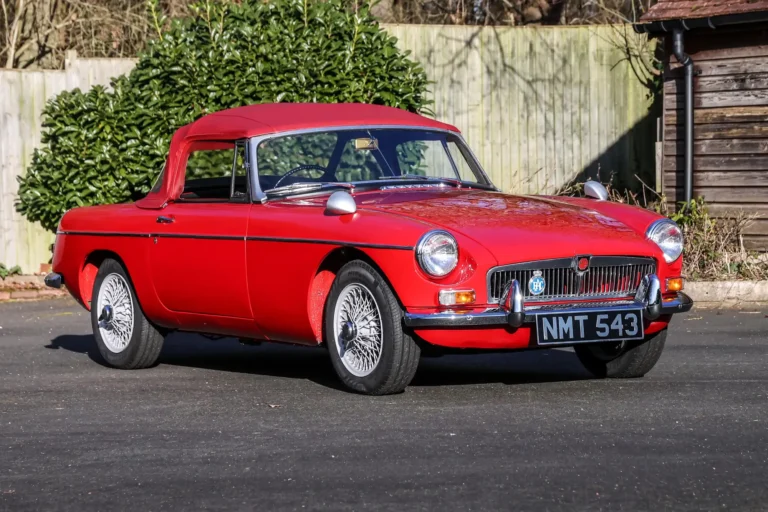
Back on the public roads, the 1950s saw the marque undergo a radical modernization. The upright, pre-war radiator grille of the TF was banished, replaced by the swooping, aerodynamic curves of the MGA. Derived directly from the EX156 Le Mans prototypes, the MGA was stunningly beautiful. It looked like it was doing a hundred miles per hour while standing still. It was a massive export success and paved the way for what is arguably the most famous British sports car of all time: the MGB. Introduced in 1962, the MGB abandoned the separate chassis for a modern monocoque construction. It was the quintessential sports car, featuring a robust B-Series engine, a perfectly judged driving position, and timeless styling that featured input from Pininfarina. It wasn’t the fastest car in the world, but it was reliable, affordable, and possessed a raspy exhaust note that defined the 1960s motoring experience. It was the benchmark by which all other affordable roadsters were measured.
Tragically, the story of MG in the 1970s is inextricably linked to the slow, agonizing collapse of the British motor industry under the umbrella of British Leyland. Starved of development budget and plagued by industrial disputes, the MGB was forced to soldier on far past its natural lifespan. The darkest blow came from across the Atlantic, where strict new US safety and emissions regulations forced the factory to raise the car’s ride height by an inch and a half and fit massive, heavy, black polyurethane “rubber bumpers”. These changes ruined the elegant lines and compromised the sublime handling that had made the car famous. Despite the dedicated workforce at Abingdon building cars to the bitter end, the factory doors were permanently closed in 1980. For many enthusiasts, this marked the death of the true British sports car.
Yet, the octagon badge refused to die. The 1980s saw the badge slapped onto spiced-up Austin hatchbacks—the MG Metro, Maestro, and Montego—which, while lacking the romance of a roadster, were genuinely brilliant, turbocharged hot hatches that terrorised the streets of Britain. Then, in 1995, MG achieved the impossible with the launch of the MGF. It was a completely new, mid-engined, rear-wheel-drive roadster featuring innovative Hydragas suspension and a high-revving K-Series engine. It proved that the spirit of Cecil Kimber was still alive, demonstrating that MG could still build a sports car that prioritized handling and driver engagement over raw power. Even in the dying days of the MG Rover group in the early 2000s, the chassis engineers worked miracles, turning comfortable Rover sedans into the aggressive, sharp-handling “Z” cars (ZR, ZS, ZT).
Today, the MG badge sits on the grilles of vehicles manufactured by the massive Chinese conglomerate SAIC. While the purists may lament the shift from Abingdon to Shanghai, and the transition from leaky twin-carburettors to electric powertrains, the brand has found unprecedented global success. Furthermore, the launch of the electric Cyberster roadster proves that the desire to build open-top, dramatic sports cars is finally returning to the marque’s core. But for the true aficionado, the soul of MG will always reside in the past. It lives in the smell of Castrol R oil, the metallic clink of a knock-off wire wheel spinner, and the pure, unadulterated joy of tackling a country B-road in an MGB with the top down, the heater on full blast, and the exhaust singing a raspy baritone song into the crisp autumn air.
Type
Foundation Year
Country
Founder/s
Headquarters

Type
Foundation Year
Country
Founder/s
Headquarters
About this brand
To speak of MG is to evoke a very specific, deeply romantic flavour of motoring. Close your eyes, and you can almost smell the heady mixture of hot engine oil, Connolly leather, and damp British tweed. You can hear the raspy, unsilenced bark of a small-capacity four-cylinder engine echoing off a dry stone wall on a winding country lane. MG—originally standing for Morris Garages—is not a brand built on the pursuit of outright, terrifying horsepower, nor is it a marque defined by multi-million-pound hypercars. Instead, the sacred octagon badge represents the absolute democratization of the sports car. It is the brand that took the visceral, wind-in-the-hair thrill of the racing circuit and packaged it into something the everyday enthusiast could afford, maintain, and drive to the absolute limit. MG taught generations of drivers what it meant to heel-and-toe, to balance a car on the throttle, and to understand that a car is not merely a transport appliance, but a living, breathing mechanical companion.
The story begins in the 1920s in the university city of Oxford, under the shrewd and visionary eye of Cecil Kimber. Employed as a sales manager for William Morris, Kimber was an enthusiast who realised that by lowering the chassis, tweaking the engine, and fitting sleek, sporty coachwork to standard, reliable Morris saloon underpinnings, he could create something magical. These early ‘Morris Garage Specials’ culminated in the famous ‘Old Number One’, and by 1924, the MG marque was officially born. Kimber moved the operation to the town of Abingdon, Berkshire, transforming it into the spiritual home of the British sports car. The Abingdon factory wasn’t just a manufacturing plant; it was a cathedral of enthusiasm, where the workers felt a deep, personal connection to the cars they were hand-assembling.
In the pre-war era, MG established a reputation as a fierce giant-killer. They built lightweight, small-capacity sports cars—the Midgets and Magnettes—that embarrassed massive, supercharged leviathans on the race tracks of Europe. The pinnacle of this era was the MG K3 Magnette. Powered by a supercharged six-cylinder engine, the K3 was an absolute weapon in the 1100cc class. In 1933, the legendary Italian maestro Tazio Nuvolari—arguably the greatest driver who ever lived—was invited to drive a K3 at the RAC Tourist Trophy in Northern Ireland. Despite never having driven the car before, and driving a pre-selector gearbox for the first time, Nuvolari utterly decimated the field, winning outright. That same year, the K3 scored a historic class victory at the Mille Miglia. MG had proven that British ingenuity and lightweight agility could conquer the world’s most grueling road races.
However, the event that truly catapulted MG from a successful British niche into a global cultural phenomenon occurred at the end of the Second World War. When American GIs were stationed in Britain, they encountered the MG T-Series, specifically the MG TC. Accustomed to vast, softly sprung, heavy American sedans with slow steering, the GIs were utterly captivated by these tiny, stiffly sprung roadsters. The TC featured a spindly ladder chassis, sweeping fenders, a fold-down windshield, and cutaway doors that allowed you to drag your knuckles on the tarmac. It was crude, it was drafty, and it was brilliant. The Americans bought them in droves, loading them onto troop ships heading back to the States. In doing so, the MG TC almost single-handedly ignited the American sports car craze, leading to the formation of the Sports Car Club of America (SCCA) and laying the cultural groundwork for cars like the Chevrolet Corvette.
While the T-Series cemented the romance, MG was simultaneously pursuing the absolute limits of velocity. On the blindingly white expanses of the Bonneville Salt Flats in Utah, MG’s “EX” series of record-breakers pushed the boundaries of aerodynamics and forced-induction engineering. Driven by immensely brave men like Captain George Eyston and Major Goldie Gardner, these teardrop-shaped cars achieved staggering speeds. The most famous of these was the EX181, known as the ‘Roaring Raindrop’. In 1957, sitting in a claustrophobic cockpit ahead of a supercharged, mid-mounted 1.5-litre twin-cam engine running on an exotic methanol fuel mix, a young Stirling Moss piloted the EX181 to 245.64 mph. Two years later, American Phil Hill pushed it over 254 mph. It was a breathtaking display of engineering prowess, proving that the Abingdon boys were masters of aerodynamic efficiency.
Back on the public roads, the 1950s saw the marque undergo a radical modernization. The upright, pre-war radiator grille of the TF was banished, replaced by the swooping, aerodynamic curves of the MGA. Derived directly from the EX156 Le Mans prototypes, the MGA was stunningly beautiful. It looked like it was doing a hundred miles per hour while standing still. It was a massive export success and paved the way for what is arguably the most famous British sports car of all time: the MGB. Introduced in 1962, the MGB abandoned the separate chassis for a modern monocoque construction. It was the quintessential sports car, featuring a robust B-Series engine, a perfectly judged driving position, and timeless styling that featured input from Pininfarina. It wasn’t the fastest car in the world, but it was reliable, affordable, and possessed a raspy exhaust note that defined the 1960s motoring experience. It was the benchmark by which all other affordable roadsters were measured.
Tragically, the story of MG in the 1970s is inextricably linked to the slow, agonizing collapse of the British motor industry under the umbrella of British Leyland. Starved of development budget and plagued by industrial disputes, the MGB was forced to soldier on far past its natural lifespan. The darkest blow came from across the Atlantic, where strict new US safety and emissions regulations forced the factory to raise the car’s ride height by an inch and a half and fit massive, heavy, black polyurethane “rubber bumpers”. These changes ruined the elegant lines and compromised the sublime handling that had made the car famous. Despite the dedicated workforce at Abingdon building cars to the bitter end, the factory doors were permanently closed in 1980. For many enthusiasts, this marked the death of the true British sports car.
Yet, the octagon badge refused to die. The 1980s saw the badge slapped onto spiced-up Austin hatchbacks—the MG Metro, Maestro, and Montego—which, while lacking the romance of a roadster, were genuinely brilliant, turbocharged hot hatches that terrorised the streets of Britain. Then, in 1995, MG achieved the impossible with the launch of the MGF. It was a completely new, mid-engined, rear-wheel-drive roadster featuring innovative Hydragas suspension and a high-revving K-Series engine. It proved that the spirit of Cecil Kimber was still alive, demonstrating that MG could still build a sports car that prioritized handling and driver engagement over raw power. Even in the dying days of the MG Rover group in the early 2000s, the chassis engineers worked miracles, turning comfortable Rover sedans into the aggressive, sharp-handling “Z” cars (ZR, ZS, ZT).
Today, the MG badge sits on the grilles of vehicles manufactured by the massive Chinese conglomerate SAIC. While the purists may lament the shift from Abingdon to Shanghai, and the transition from leaky twin-carburettors to electric powertrains, the brand has found unprecedented global success. Furthermore, the launch of the electric Cyberster roadster proves that the desire to build open-top, dramatic sports cars is finally returning to the marque’s core. But for the true aficionado, the soul of MG will always reside in the past. It lives in the smell of Castrol R oil, the metallic clink of a knock-off wire wheel spinner, and the pure, unadulterated joy of tackling a country B-road in an MGB with the top down, the heater on full blast, and the exhaust singing a raspy baritone song into the crisp autumn air.
Submodels
Latest Variants

Model Lines