
ALD
Type
Foundation Year
Founder/s
Country
Headquarters
Brand Overview
In the high-octane, impossibly glamorous theatre of 1980s Group C endurance racing, the spotlight was invariably hogged by the corporate titans. Porsche, Jaguar, Mercedes-Benz, and Lancia poured millions into aerodynamic wind tunnels and exotic materials, fighting a high-altitude war for overall supremacy. But if you walk down the pit lane, past the pristine factory garages and the armies of uniformed mechanics, you find the true, beating heart of endurance racing. This is the domain of the C2 class, the privateers, the dreamers, and the madmen who believed that passion could somehow outrun a factory budget. Among these heroic underdogs, one French marque stood out for its sheer romantic audacity, its undeniable national pride, and its tragic, poetic brevity. That marque was ALD, or Automobiles Louis Descartes, and it represents the very last breath of the true French garagista.
To understand ALD is to understand the man whose name adorned the nose of the cars. Louis Descartes was not a billionaire playboy, nor was he the heir to an automotive empire. He was a deeply passionate French racing driver and a successful businessman who ran a plastics and packaging company. For a French driver in the 1970s and 80s, the 24 Hours of Le Mans was not just a motor race; it was a pilgrimage. Descartes had raced at La Sarthe as a driver, but like many men inflicted with the incurable disease of motorsport, simply driving was not enough. He didn’t just want to participate in the legend of Le Mans; he wanted to build the chariot himself. It is a terrifying, almost hubristic ambition to decide to construct a Group C prototype from scratch, but Descartes was fueled by an intoxicating cocktail of ambition, mechanical obsession, and absolute fearlessness.
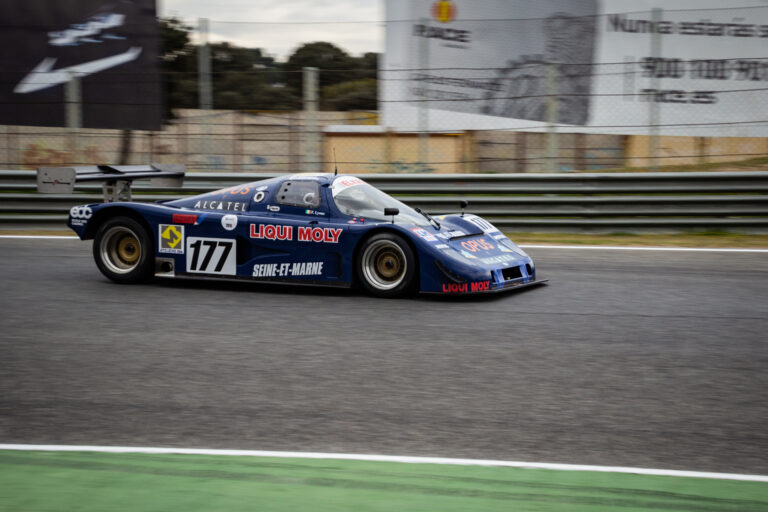
In the early 1980s, Descartes partnered with a brilliant, pragmatic engineer named Jean-Paul Sauvée. Operating out of workshops near Paris—initially in Colombes and later in Lagny-sur-Marne—they began to sketch a dream. The goal was to build a car for the World Sportscar Championship’s C2 category, a class specifically designed for privateers to run naturally aspirated or smaller turbocharged engines with strict fuel consumption limits. In 1985, their dream became metal, fiberglass, and noise. The ALD 01 was born. It was a classic aluminium honeycomb tub, rudimentary by the standards of a Porsche 962, but beautifully functional, painted in a striking blue livery that screamed of French racing heritage. Powered by a 3.5-liter BMW M1 inline-six engine, the ALD 01 arrived at the 1985 24 Hours of Le Mans. It was heavy, and it ultimately failed to finish due to mechanical gremlins, but for Descartes, crossing the starting line in a car of his own creation was a spiritual victory that defied logic.
The ALD philosophy was defined by a restless, relentless pursuit of improvement. Descartes and Sauvée knew they could not outspend the British specialists like Spice Engineering or Tiga Race Cars, so they had to outwork them. The ALD chassis evolved rapidly. The ALD 02 and 03 followed in quick succession, refining the aerodynamics and shaving crucial weight from the tub. What made ALD so fascinating to the paddock was their sheer, chaotic variety in the engine bay. While a Spice chassis was almost universally married to a Cosworth DFL V8, Louis Descartes was an automotive polyamorist. Over the short lifespan of the company, ALD prototypes were powered by a staggering array of engines. They used the Bavarian grunt of the BMW M1 six-cylinder, they experimented with the explosive, lag-heavy thrust of an Audi turbocharged inline-four, they utilized the ubiquitous Ford Cosworth V8, and they even bolted in the French PRV V6 engine. This mechanical promiscuity meant that ALD cars were the ultimate testbeds, wildly unpredictable but always deeply intriguing to the fans and mechanics alike.
The late 1980s were the golden years for the small French outfit. The ALD cars became fixtures on the World Sportscar Championship grid, traveling to fast, terrifying tracks like Monza, Spa-Francorchamps, and Silverstone. They were never the absolute fastest cars in C2—Gordon Spice had that category largely locked down—but they were doggedly reliable on a good day, and they possessed an inherent, undeniable charm. At the 24 Hours of Le Mans, the ALD entries were local heroes. When the blue and white, or later fluorescent yellow and red, ALD prototypes thundered down the Mulsanne straight, the French crowd roared with a parochial pride that no factory Porsche could ever elicit. Drivers like Jacques Heuclin, Dominique Lacaud, and François Migault wrestled these machines through the dark, rainy nights of La Sarthe, cementing the brand’s reputation as a tough, uncompromising combatant in the world’s hardest motor race.
By the dawn of the 1990s, the political landscape of sports car racing shifted dramatically. The FIA introduced the new 3.5-liter engine formula, effectively outlawing the old Group C cars and trying to turn endurance racing into a two-seater Formula 1 sprint series. The costs skyrocketed overnight, bankrupting dozens of privateer teams. But Louis Descartes refused to fold. Instead, he doubled down on his dream. He commissioned the ALD C91, a breathtaking leap forward for his small company. For the first time, ALD abandoned the aluminium tub and built a state-of-the-art carbon-fiber chassis. Fitted with a 3.5-liter Ford Cosworth V8, it was designed to compete in the top-tier Category 1 against the mighty Peugeot 905s and Jaguar XJR-14s. It featured a striking, high-downforce aerodynamic profile, a massive rear wing, and a low, purposeful stance that looked every bit as fast as the factory entries. It was a David versus Goliath scenario, a privateer pushing all his chips to the center of the table. The car was stunning, modern, and possessed immense potential.
But the story of Automobiles Louis Descartes does not end with a checkered flag or a glorious podium. It ends with a sudden, devastating silence. On December 27, 1991, Louis Descartes was driving his road car near Paris when he was involved in a horrific, fatal traffic accident. He was just 40 years old.
The death of the founder was the instantaneous death of the brand. Without the inexhaustible energy, the financial backing, and the passionate, beating heart of Louis Descartes, the ALD workshop fell silent. The brilliant carbon-fiber C91 barely had a chance to show its true pace before the covers were thrown over it. The team was dissolved, and the cars were sold off to collectors and historic racers, scattering the legacy of the quintessential French privateer to the winds.
Louis Descartes never won Le Mans, but by sheer force of will, he ensured that his name is forever woven into the sacred, oil-stained tapestry of La Sarthe.
Type
Foundation Year
Country
Founder/s
Headquarters

Type
Foundation Year
Country
Founder/s
Headquarters
About this brand
In the high-octane, impossibly glamorous theatre of 1980s Group C endurance racing, the spotlight was invariably hogged by the corporate titans. Porsche, Jaguar, Mercedes-Benz, and Lancia poured millions into aerodynamic wind tunnels and exotic materials, fighting a high-altitude war for overall supremacy. But if you walk down the pit lane, past the pristine factory garages and the armies of uniformed mechanics, you find the true, beating heart of endurance racing. This is the domain of the C2 class, the privateers, the dreamers, and the madmen who believed that passion could somehow outrun a factory budget. Among these heroic underdogs, one French marque stood out for its sheer romantic audacity, its undeniable national pride, and its tragic, poetic brevity. That marque was ALD, or Automobiles Louis Descartes, and it represents the very last breath of the true French garagista.
To understand ALD is to understand the man whose name adorned the nose of the cars. Louis Descartes was not a billionaire playboy, nor was he the heir to an automotive empire. He was a deeply passionate French racing driver and a successful businessman who ran a plastics and packaging company. For a French driver in the 1970s and 80s, the 24 Hours of Le Mans was not just a motor race; it was a pilgrimage. Descartes had raced at La Sarthe as a driver, but like many men inflicted with the incurable disease of motorsport, simply driving was not enough. He didn’t just want to participate in the legend of Le Mans; he wanted to build the chariot himself. It is a terrifying, almost hubristic ambition to decide to construct a Group C prototype from scratch, but Descartes was fueled by an intoxicating cocktail of ambition, mechanical obsession, and absolute fearlessness.
In the early 1980s, Descartes partnered with a brilliant, pragmatic engineer named Jean-Paul Sauvée. Operating out of workshops near Paris—initially in Colombes and later in Lagny-sur-Marne—they began to sketch a dream. The goal was to build a car for the World Sportscar Championship’s C2 category, a class specifically designed for privateers to run naturally aspirated or smaller turbocharged engines with strict fuel consumption limits. In 1985, their dream became metal, fiberglass, and noise. The ALD 01 was born. It was a classic aluminium honeycomb tub, rudimentary by the standards of a Porsche 962, but beautifully functional, painted in a striking blue livery that screamed of French racing heritage. Powered by a 3.5-liter BMW M1 inline-six engine, the ALD 01 arrived at the 1985 24 Hours of Le Mans. It was heavy, and it ultimately failed to finish due to mechanical gremlins, but for Descartes, crossing the starting line in a car of his own creation was a spiritual victory that defied logic.
The ALD philosophy was defined by a restless, relentless pursuit of improvement. Descartes and Sauvée knew they could not outspend the British specialists like Spice Engineering or Tiga Race Cars, so they had to outwork them. The ALD chassis evolved rapidly. The ALD 02 and 03 followed in quick succession, refining the aerodynamics and shaving crucial weight from the tub. What made ALD so fascinating to the paddock was their sheer, chaotic variety in the engine bay. While a Spice chassis was almost universally married to a Cosworth DFL V8, Louis Descartes was an automotive polyamorist. Over the short lifespan of the company, ALD prototypes were powered by a staggering array of engines. They used the Bavarian grunt of the BMW M1 six-cylinder, they experimented with the explosive, lag-heavy thrust of an Audi turbocharged inline-four, they utilized the ubiquitous Ford Cosworth V8, and they even bolted in the French PRV V6 engine. This mechanical promiscuity meant that ALD cars were the ultimate testbeds, wildly unpredictable but always deeply intriguing to the fans and mechanics alike.
The late 1980s were the golden years for the small French outfit. The ALD cars became fixtures on the World Sportscar Championship grid, traveling to fast, terrifying tracks like Monza, Spa-Francorchamps, and Silverstone. They were never the absolute fastest cars in C2—Gordon Spice had that category largely locked down—but they were doggedly reliable on a good day, and they possessed an inherent, undeniable charm. At the 24 Hours of Le Mans, the ALD entries were local heroes. When the blue and white, or later fluorescent yellow and red, ALD prototypes thundered down the Mulsanne straight, the French crowd roared with a parochial pride that no factory Porsche could ever elicit. Drivers like Jacques Heuclin, Dominique Lacaud, and François Migault wrestled these machines through the dark, rainy nights of La Sarthe, cementing the brand’s reputation as a tough, uncompromising combatant in the world’s hardest motor race.
By the dawn of the 1990s, the political landscape of sports car racing shifted dramatically. The FIA introduced the new 3.5-liter engine formula, effectively outlawing the old Group C cars and trying to turn endurance racing into a two-seater Formula 1 sprint series. The costs skyrocketed overnight, bankrupting dozens of privateer teams. But Louis Descartes refused to fold. Instead, he doubled down on his dream. He commissioned the ALD C91, a breathtaking leap forward for his small company. For the first time, ALD abandoned the aluminium tub and built a state-of-the-art carbon-fiber chassis. Fitted with a 3.5-liter Ford Cosworth V8, it was designed to compete in the top-tier Category 1 against the mighty Peugeot 905s and Jaguar XJR-14s. It featured a striking, high-downforce aerodynamic profile, a massive rear wing, and a low, purposeful stance that looked every bit as fast as the factory entries. It was a David versus Goliath scenario, a privateer pushing all his chips to the center of the table. The car was stunning, modern, and possessed immense potential.
But the story of Automobiles Louis Descartes does not end with a checkered flag or a glorious podium. It ends with a sudden, devastating silence. On December 27, 1991, Louis Descartes was driving his road car near Paris when he was involved in a horrific, fatal traffic accident. He was just 40 years old.
The death of the founder was the instantaneous death of the brand. Without the inexhaustible energy, the financial backing, and the passionate, beating heart of Louis Descartes, the ALD workshop fell silent. The brilliant carbon-fiber C91 barely had a chance to show its true pace before the covers were thrown over it. The team was dissolved, and the cars were sold off to collectors and historic racers, scattering the legacy of the quintessential French privateer to the winds.
Louis Descartes never won Le Mans, but by sheer force of will, he ensured that his name is forever woven into the sacred, oil-stained tapestry of La Sarthe.
Submodels
Latest Variants

Model Lines