
Morgan
Type
Foundation Year
Founder/s
Country
Headquarters
Brand Overview
In an automotive world obsessed with disruption, autonomy, and the relentless march of digitization, the Morgan Motor Company stands as a magnificent, defiant anachronism. To visit their red-brick factory on Pickersleigh Road in Malvern Link is to step out of the timeline of modern manufacturing and into a world where time moves at the speed of a craftsman’s hands. Here, there are no robots welding chassis in sparks of automated fury. Instead, there is the smell of shavings, the sound of hammers shaping aluminium over wooden bucks, and the quiet concentration of men and women who treat car building not as a process, but as a vocation. Morgan is the oldest privately owned motor manufacturer in the world, and it survives not by clinging to the past, but by understanding that the past holds a sensory value that the future can never replicate.
The Morgan story is a family saga that begins in 1909 with Henry Frederick Stanley (H.F.S.) Morgan. A vicar’s son with an engineering mind, H.F.S. didn’t set out to build a car; he set out to build a solution. He wanted a vehicle that was lighter than a car, more stable than a motorcycle, and crucially, cheap to tax. The result was the Morgan Runabout, a three-wheeler powered by a V-twin motorcycle engine sitting proudly exposed at the front. It was manic, it was loud, and it was fast. In 1913, a Morgan won the French Grand Prix for Cyclecars at Amiens, averaging speeds that terrified the establishment. For the first twenty-five years of its existence, Morgan didn’t build a car with four wheels. They built “Trikes”, land-bound Spitfires that offered the most exhilarating power-to-weight ratio money could buy.
It wasn’t until 1936 that the company bowed to convention—or perhaps, simply evolved—and introduced the 4/4 (meaning four wheels, four cylinders). This car established the template that, incredibly, remained largely unchanged for the next 83 years: a steel ladder-frame chassis, a sliding pillar front suspension (a design H.F.S. patented in 1909), and a body frame constructed not of metal, but of ash wood.
Let us pause to address the most pervasive myth in motoring. Morgan cars do not have a chassis made of wood. They have a steel (and now aluminium) chassis. The wood is the frame for the bodywork, a coachbuilding technique that dates back to the horse-drawn carriage. Ash is used because it is light, durable, and possesses a natural flexibility that absorbs vibration. In a crash, it doesn’t shatter; it absorbs energy. It is nature’s own carbon fibre. To drive a Morgan is to feel this organic construction; the car doesn’t crash over bumps, it flows over them, the whole structure breathing with the road.
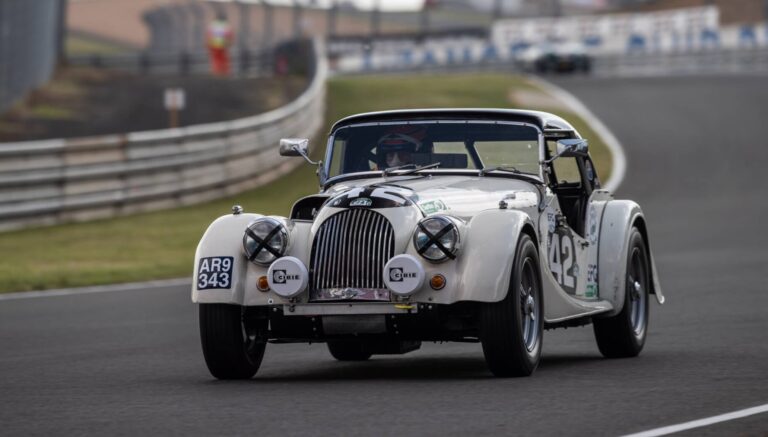
The post-war era saw the reins pass to H.F.S.’s son, Peter Morgan. Peter was a custodian of the flame, a man who famously resisted the urge to modernize for the sake of fashion. Under his stewardship, the Plus 4 became a club racing weapon. The crowning glory came at the 1962 24 Hours of Le Mans. A Morgan Plus 4 Super Sports, registered TOK 258, driven by Chris Lawrence and Richard Shepherd-Barron, won the 2.0-litre class. They beat the factory Porsches and Abarths. They drove the car to France, won the race, and drove it home. It is the definitive Morgan story: the plucky British garagista beating the corporate giants with a car built in a shed.
But the real transformation—the moment Morgan went from a quaint roadster to a supercar killer—happened in 1968. Rover had just acquired the rights to the Buick 215 aluminium V8 engine. Peter Morgan, with the help of race engineer Maurice Owen, decided to shoehorn this massive engine into the slender Morgan chassis. The result was the Plus 8. It was a hot rod in tweed. Because the car weighed less than a wet towel, the V8 gave it acceleration that embarrassed Ferraris and Jaguars of the day. The Plus 8 became the company’s flagship, a thundering, burbling brute that demanded respect and strong forearms. It remained in production for 50 years, arguably the longest-running production car with the same powertrain layout in history.
By the turn of the millennium, even Morgan knew it had to look forward. Enter Charles Morgan, Peter’s son. A cameraman and news reporter by trade, Charles brought a flair for drama and a desire to prove that Morgan could engineer its way into the 21st century. The result was the Aero 8, launched in 2000. It was the biggest shock in the company’s history. It featured a bonded aluminium chassis (derived from race car technology) and a controversial “cross-eyed” design that was aerodynamically efficient if aesthetically challenging. But underneath, it was a revolution. It proved that Morgan could build a car with modern stiffness and handling. The Aero 8 raced at Le Mans, battling the Porsche 911 GT3s, and while it eventually evolved into the more conventionally beautiful Aeromax and Aero Supersports, it secured the factory’s future.
In 2011, the company did something delightfully circular: they brought back the 3-Wheeler. Powered by an S&S V-twin engine usually found in American custom motorcycles, it was designed for no other purpose than pure joy. It had no roof, no doors, and a start button inspired by a bomb release toggle. It became an instant hit, selling to a new generation of hipsters and enthusiasts who realized that 80 horsepower in a 500kg bathtub was more fun than 800 horsepower in a sanitized hypercar.
Today, Morgan has entered a new era, the “CX-Generation.” The steel ladder frame is finally gone, replaced by a sophisticated bonded aluminium platform. The engines are now turbocharged units from BMW. But look closely. The body is still hand-beaten aluminium. The frame underneath that skin is still English ash wood, hand-cut and sanded by craftsmen who have worked at Malvern for decades. The leather is still stitched by hand. You can still order your car in any colour you can imagine, with any piping, any veneer.
A Morgan is not a rational purchase. It has no airbags (mostly), the roof is a complex puzzle of canvas and studs, and the suspension travel can be described as “optimistic”. But rationality is the enemy of romance. Driving a Morgan is a conversation. You feel the grain of the road through the thin steering wheel; you look down the long, louvred bonnet and see the heat haze rising; you hear the wind rushing past your ears. It is a time machine that connects you to the heroic age of motoring, a reminder that driving used to be an active sport, not a passive commute. In a world of homogenous white goods, the Morgan Motor Company stands on its Malvern hillside, planing wood, beating metal, and keeping the soul of the automobile alive.
Type
Foundation Year
Country
Founder/s
Headquarters

Type
Foundation Year
Country
Founder/s
Headquarters
About this brand
In an automotive world obsessed with disruption, autonomy, and the relentless march of digitization, the Morgan Motor Company stands as a magnificent, defiant anachronism. To visit their red-brick factory on Pickersleigh Road in Malvern Link is to step out of the timeline of modern manufacturing and into a world where time moves at the speed of a craftsman’s hands. Here, there are no robots welding chassis in sparks of automated fury. Instead, there is the smell of shavings, the sound of hammers shaping aluminium over wooden bucks, and the quiet concentration of men and women who treat car building not as a process, but as a vocation. Morgan is the oldest privately owned motor manufacturer in the world, and it survives not by clinging to the past, but by understanding that the past holds a sensory value that the future can never replicate.
The Morgan story is a family saga that begins in 1909 with Henry Frederick Stanley (H.F.S.) Morgan. A vicar’s son with an engineering mind, H.F.S. didn’t set out to build a car; he set out to build a solution. He wanted a vehicle that was lighter than a car, more stable than a motorcycle, and crucially, cheap to tax. The result was the Morgan Runabout, a three-wheeler powered by a V-twin motorcycle engine sitting proudly exposed at the front. It was manic, it was loud, and it was fast. In 1913, a Morgan won the French Grand Prix for Cyclecars at Amiens, averaging speeds that terrified the establishment. For the first twenty-five years of its existence, Morgan didn’t build a car with four wheels. They built “Trikes”, land-bound Spitfires that offered the most exhilarating power-to-weight ratio money could buy.
It wasn’t until 1936 that the company bowed to convention—or perhaps, simply evolved—and introduced the 4/4 (meaning four wheels, four cylinders). This car established the template that, incredibly, remained largely unchanged for the next 83 years: a steel ladder-frame chassis, a sliding pillar front suspension (a design H.F.S. patented in 1909), and a body frame constructed not of metal, but of ash wood.
Let us pause to address the most pervasive myth in motoring. Morgan cars do not have a chassis made of wood. They have a steel (and now aluminium) chassis. The wood is the frame for the bodywork, a coachbuilding technique that dates back to the horse-drawn carriage. Ash is used because it is light, durable, and possesses a natural flexibility that absorbs vibration. In a crash, it doesn’t shatter; it absorbs energy. It is nature’s own carbon fibre. To drive a Morgan is to feel this organic construction; the car doesn’t crash over bumps, it flows over them, the whole structure breathing with the road.
The post-war era saw the reins pass to H.F.S.’s son, Peter Morgan. Peter was a custodian of the flame, a man who famously resisted the urge to modernize for the sake of fashion. Under his stewardship, the Plus 4 became a club racing weapon. The crowning glory came at the 1962 24 Hours of Le Mans. A Morgan Plus 4 Super Sports, registered TOK 258, driven by Chris Lawrence and Richard Shepherd-Barron, won the 2.0-litre class. They beat the factory Porsches and Abarths. They drove the car to France, won the race, and drove it home. It is the definitive Morgan story: the plucky British garagista beating the corporate giants with a car built in a shed.
But the real transformation—the moment Morgan went from a quaint roadster to a supercar killer—happened in 1968. Rover had just acquired the rights to the Buick 215 aluminium V8 engine. Peter Morgan, with the help of race engineer Maurice Owen, decided to shoehorn this massive engine into the slender Morgan chassis. The result was the Plus 8. It was a hot rod in tweed. Because the car weighed less than a wet towel, the V8 gave it acceleration that embarrassed Ferraris and Jaguars of the day. The Plus 8 became the company’s flagship, a thundering, burbling brute that demanded respect and strong forearms. It remained in production for 50 years, arguably the longest-running production car with the same powertrain layout in history.
By the turn of the millennium, even Morgan knew it had to look forward. Enter Charles Morgan, Peter’s son. A cameraman and news reporter by trade, Charles brought a flair for drama and a desire to prove that Morgan could engineer its way into the 21st century. The result was the Aero 8, launched in 2000. It was the biggest shock in the company’s history. It featured a bonded aluminium chassis (derived from race car technology) and a controversial “cross-eyed” design that was aerodynamically efficient if aesthetically challenging. But underneath, it was a revolution. It proved that Morgan could build a car with modern stiffness and handling. The Aero 8 raced at Le Mans, battling the Porsche 911 GT3s, and while it eventually evolved into the more conventionally beautiful Aeromax and Aero Supersports, it secured the factory’s future.
In 2011, the company did something delightfully circular: they brought back the 3-Wheeler. Powered by an S&S V-twin engine usually found in American custom motorcycles, it was designed for no other purpose than pure joy. It had no roof, no doors, and a start button inspired by a bomb release toggle. It became an instant hit, selling to a new generation of hipsters and enthusiasts who realized that 80 horsepower in a 500kg bathtub was more fun than 800 horsepower in a sanitized hypercar.
Today, Morgan has entered a new era, the “CX-Generation.” The steel ladder frame is finally gone, replaced by a sophisticated bonded aluminium platform. The engines are now turbocharged units from BMW. But look closely. The body is still hand-beaten aluminium. The frame underneath that skin is still English ash wood, hand-cut and sanded by craftsmen who have worked at Malvern for decades. The leather is still stitched by hand. You can still order your car in any colour you can imagine, with any piping, any veneer.
A Morgan is not a rational purchase. It has no airbags (mostly), the roof is a complex puzzle of canvas and studs, and the suspension travel can be described as “optimistic”. But rationality is the enemy of romance. Driving a Morgan is a conversation. You feel the grain of the road through the thin steering wheel; you look down the long, louvred bonnet and see the heat haze rising; you hear the wind rushing past your ears. It is a time machine that connects you to the heroic age of motoring, a reminder that driving used to be an active sport, not a passive commute. In a world of homogenous white goods, the Morgan Motor Company stands on its Malvern hillside, planing wood, beating metal, and keeping the soul of the automobile alive.
Submodels
Latest Variants

Model Lines