Peugeot
Type
Foundation Year
Founder/s
Country
Headquarters
Brand Overview
To speak of Peugeot is to speak of the very bedrock of industrial civilization. Long before the internal combustion engine was a glint in the eye of Karl Benz, the Peugeot family of Sochaux was forging steel. Since 1810, the “Lion” has stamped its authority on everything from saw blades and coffee grinders to crinoline dresses and pepper mills. This deep, metallurgical heritage is not a footnote; it is the essence of the brand. Unlike the artisan workshops of Italy or the frantic startups of Detroit, Peugeot approaches the automobile with the heavy, deliberate confidence of a company that has survived revolutions, wars, and economic collapses for two centuries. It is a brand of immense, fascinating contradictions: the maker of the world’s most sensible, indestructible taxis, and simultaneously, the creator of the most violent, effective, and terrifying racing cars ever to grace a special stage or a race track. To understand Peugeot is to understand that beneath the conservative, bourgeois exterior of a family sedan lies the heart of a savage, competitive beast.
The automotive story proper begins in 1889 with a steam tricycle, but the true spirit of the Lion was revealed in 1912. This was the year of “The Charlatans”. This group of rebel engineers, led by Jules Goux and Georges Boillot, defied the conservative management to build a revolutionary race car. The Peugeot L76. It was the first car in the world to feature a dual overhead camshaft (DOHC) engine with four valves per cylinder. This architecture—the blueprint for every high-performance engine that followed, from Ferrari to Honda—was invented by Peugeot. In 1913, Jules Goux took this machine to America and won the Indianapolis 500, famously consuming six bottles of Champagne during the race. From the very beginning, Peugeot was not just participating in motorsport; they were reinventing it.
For much of the mid-20th century, however, Peugeot cultivated a different reputation: indestructibility. The launch of the 203, 403, and the legendary 404 and 504 created the myth of the “African Queen”. These cars were built with a suspension compliance and mechanical robustness that made them the kings of the developing world. While Land Rovers broke down, the Peugeot 504 Taxis of Cairo and Lagos kept running. They were the French Mercedes, offering a ride quality that was the envy of Rolls-Royce, achieved through the brand’s proprietary shock absorbers, which they manufactured in-house because they trusted no one else to do it right.
But in the early 1980s, the company faced a crisis. Stodgy, reliable sedans were no longer enough. The company was financially ailing. They needed a savior. They needed a number. That number was 205. Launched in 1983, the 205 was a styling masterpiece by Gerard Welter (not Pininfarina, as often cited, though they did the Cabriolet). It saved the company. But to sell the 205, Peugeot turned to a man who would become a Napoleon of motorsport: Jean Todt. Todt founded Peugeot Talbot Sport and decided that the best way to market the new hatchback was to unleash hell on the World Rally Championship.
The result was the 205 Turbo 16 (T16). It was a Group B monster. While Audi had revolutionized rallying with 4WD, their Quattro was a heavy, front-heavy sedan. The 205 T16 was a purpose-built weapon: a mid-engined, spaceframe chassis wrapped in a silhouette body that vaguely resembled the road car. It was compact, agile, and terrifyingly fast. In the hands of Ari Vatanen and Timo Salonen, it decimated the opposition. It won the WRC titles in 1985 and 1986, forcing the cancellation of Group B because the cars had simply become too fast for human reflexes. When Group B was banned, Peugeot didn’t retire; they just made the car longer, called it the 405 T16, and went to the desert. They won the Paris-Dakar Rally four times in a row. They went to Colorado and smashed the Pikes Peak record with the award-winning film Climb Dance immortalizing Ari Vatanen’s sun-blinded steering.
While the rally team was conquering the dirt, the road car division was quietly perfecting the art of the “Hot Hatch”. The 205 GTI became the benchmark against which all others were measured. It wasn’t the most powerful, but it was the most alive. It introduced a generation of drivers to the concept of “lift-off oversteer”—the ability to steer the car with the throttle pedal. This chassis wizardry continued with the 306 GTI-6 and the 106 Rallye, cementing Peugeot’s reputation as the master of front-wheel-drive handling. They built cars that breathed with the road, communicating every ripple through the steering wheel.
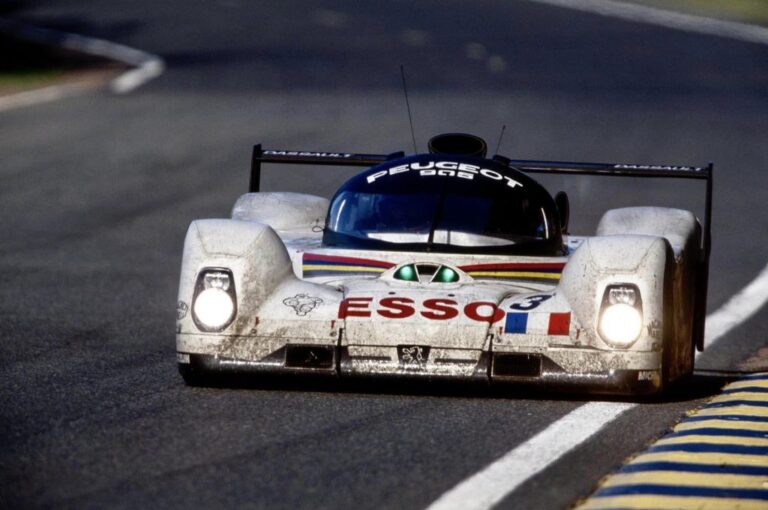
In the 1990s, the Lion turned its gaze to La Sarthe. Under the Group C regulations, they built the 905. It was a spaceship, powered by a screaming 3.5-litre V10 engine that sounded like an F1 car because, essentially, it was. The 905 Evo 1B victory at the 24 Hours of Le Mans in 1992 and a 1-2-3 finish in 1993 were displays of crushing superiority. It was the bridge that allowed Peugeot to become an F1 engine supplier (to McLaren and Jordan), although that venture never reached the heights of their sports car program.
The endurance flame was rekindled in the late 2000s, this time with a very different technology: Diesel. The 908 HDi FAP was a stealth bomber, a closed-cockpit prototype with a massive V12 twin-turbo diesel engine producing earth-rotating torque. The battles between the Peugeot 908s and the Audi R10/R15s were the defining conflicts of the modern Le Mans era. In 2009, Peugeot finally broke the Audi stranglehold, taking a famous 1-2 victory. It was a vindication of French engineering pride, proving they could beat the Germans at their own game of efficiency and technology.
Even in design, Peugeot has often been underrated. The 406 Coupé, designed by Pininfarina in the late 90s, is widely regarded as one of the most beautiful cars of the modern era, often called the “French Ferrari”. It proved that a mass-market manufacturer could produce haute couture elegance. In recent years, the brand has found a new, aggressive confidence with the “Sabertooth” design language and the 9X8 Hypercar, a wingless Le Mans racer that challenges aerodynamic orthodoxy just as the 1913 Indy car challenged engine design.
Peugeot is a brand that demands respect not just for its longevity, but for its peaks. It is the brand of the artisan steelworker and the rally-driving maniac. It is the smell of Gauloises in the service park and the sound of a V10 screaming down the Mulsanne Straight. From the unbreakable 504 traversing the Sahara to the 208 T16 obliterating the Pikes Peak record with Sébastien Loeb, the Lion does not just survive; it hunts. It remains a testament to the idea that a car can be rational, comfortable, and affordable, and yet, in the right hands, absolutely unbeatable.
Type
Foundation Year
Country
Founder/s
Headquarters
Type
Foundation Year
Country
Founder/s
Headquarters
About this brand
To speak of Peugeot is to speak of the very bedrock of industrial civilization. Long before the internal combustion engine was a glint in the eye of Karl Benz, the Peugeot family of Sochaux was forging steel. Since 1810, the “Lion” has stamped its authority on everything from saw blades and coffee grinders to crinoline dresses and pepper mills. This deep, metallurgical heritage is not a footnote; it is the essence of the brand. Unlike the artisan workshops of Italy or the frantic startups of Detroit, Peugeot approaches the automobile with the heavy, deliberate confidence of a company that has survived revolutions, wars, and economic collapses for two centuries. It is a brand of immense, fascinating contradictions: the maker of the world’s most sensible, indestructible taxis, and simultaneously, the creator of the most violent, effective, and terrifying racing cars ever to grace a special stage or a race track. To understand Peugeot is to understand that beneath the conservative, bourgeois exterior of a family sedan lies the heart of a savage, competitive beast.
The automotive story proper begins in 1889 with a steam tricycle, but the true spirit of the Lion was revealed in 1912. This was the year of “The Charlatans”. This group of rebel engineers, led by Jules Goux and Georges Boillot, defied the conservative management to build a revolutionary race car. The Peugeot L76. It was the first car in the world to feature a dual overhead camshaft (DOHC) engine with four valves per cylinder. This architecture—the blueprint for every high-performance engine that followed, from Ferrari to Honda—was invented by Peugeot. In 1913, Jules Goux took this machine to America and won the Indianapolis 500, famously consuming six bottles of Champagne during the race. From the very beginning, Peugeot was not just participating in motorsport; they were reinventing it.
For much of the mid-20th century, however, Peugeot cultivated a different reputation: indestructibility. The launch of the 203, 403, and the legendary 404 and 504 created the myth of the “African Queen”. These cars were built with a suspension compliance and mechanical robustness that made them the kings of the developing world. While Land Rovers broke down, the Peugeot 504 Taxis of Cairo and Lagos kept running. They were the French Mercedes, offering a ride quality that was the envy of Rolls-Royce, achieved through the brand’s proprietary shock absorbers, which they manufactured in-house because they trusted no one else to do it right.
But in the early 1980s, the company faced a crisis. Stodgy, reliable sedans were no longer enough. The company was financially ailing. They needed a savior. They needed a number. That number was 205. Launched in 1983, the 205 was a styling masterpiece by Gerard Welter (not Pininfarina, as often cited, though they did the Cabriolet). It saved the company. But to sell the 205, Peugeot turned to a man who would become a Napoleon of motorsport: Jean Todt. Todt founded Peugeot Talbot Sport and decided that the best way to market the new hatchback was to unleash hell on the World Rally Championship.
The result was the 205 Turbo 16 (T16). It was a Group B monster. While Audi had revolutionized rallying with 4WD, their Quattro was a heavy, front-heavy sedan. The 205 T16 was a purpose-built weapon: a mid-engined, spaceframe chassis wrapped in a silhouette body that vaguely resembled the road car. It was compact, agile, and terrifyingly fast. In the hands of Ari Vatanen and Timo Salonen, it decimated the opposition. It won the WRC titles in 1985 and 1986, forcing the cancellation of Group B because the cars had simply become too fast for human reflexes. When Group B was banned, Peugeot didn’t retire; they just made the car longer, called it the 405 T16, and went to the desert. They won the Paris-Dakar Rally four times in a row. They went to Colorado and smashed the Pikes Peak record with the award-winning film Climb Dance immortalizing Ari Vatanen’s sun-blinded steering.
While the rally team was conquering the dirt, the road car division was quietly perfecting the art of the “Hot Hatch”. The 205 GTI became the benchmark against which all others were measured. It wasn’t the most powerful, but it was the most alive. It introduced a generation of drivers to the concept of “lift-off oversteer”—the ability to steer the car with the throttle pedal. This chassis wizardry continued with the 306 GTI-6 and the 106 Rallye, cementing Peugeot’s reputation as the master of front-wheel-drive handling. They built cars that breathed with the road, communicating every ripple through the steering wheel.
In the 1990s, the Lion turned its gaze to La Sarthe. Under the Group C regulations, they built the 905. It was a spaceship, powered by a screaming 3.5-litre V10 engine that sounded like an F1 car because, essentially, it was. The 905 Evo 1B victory at the 24 Hours of Le Mans in 1992 and a 1-2-3 finish in 1993 were displays of crushing superiority. It was the bridge that allowed Peugeot to become an F1 engine supplier (to McLaren and Jordan), although that venture never reached the heights of their sports car program.
The endurance flame was rekindled in the late 2000s, this time with a very different technology: Diesel. The 908 HDi FAP was a stealth bomber, a closed-cockpit prototype with a massive V12 twin-turbo diesel engine producing earth-rotating torque. The battles between the Peugeot 908s and the Audi R10/R15s were the defining conflicts of the modern Le Mans era. In 2009, Peugeot finally broke the Audi stranglehold, taking a famous 1-2 victory. It was a vindication of French engineering pride, proving they could beat the Germans at their own game of efficiency and technology.
Even in design, Peugeot has often been underrated. The 406 Coupé, designed by Pininfarina in the late 90s, is widely regarded as one of the most beautiful cars of the modern era, often called the “French Ferrari”. It proved that a mass-market manufacturer could produce haute couture elegance. In recent years, the brand has found a new, aggressive confidence with the “Sabertooth” design language and the 9X8 Hypercar, a wingless Le Mans racer that challenges aerodynamic orthodoxy just as the 1913 Indy car challenged engine design.
Peugeot is a brand that demands respect not just for its longevity, but for its peaks. It is the brand of the artisan steelworker and the rally-driving maniac. It is the smell of Gauloises in the service park and the sound of a V10 screaming down the Mulsanne Straight. From the unbreakable 504 traversing the Sahara to the 208 T16 obliterating the Pikes Peak record with Sébastien Loeb, the Lion does not just survive; it hunts. It remains a testament to the idea that a car can be rational, comfortable, and affordable, and yet, in the right hands, absolutely unbeatable.
Submodels
Latest Variants

Model Lines