Aston Martin AMR1
Brand
Produced from
Vehicle category
Portal
Model line
Model generation
Predecessor
Sucessor
Model Overview
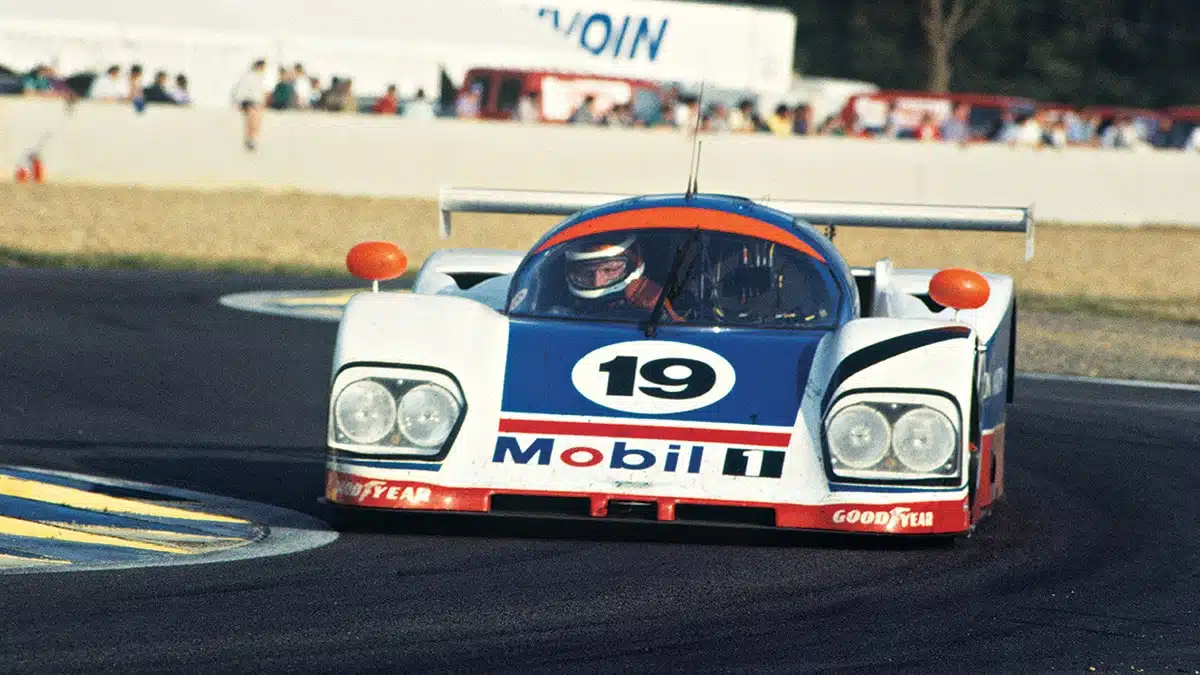
To fully comprehend the magnificent, brutalist spectacle that is the 1989 Aston Martin AMR1, one must transport themselves to the absolute zenith of the Group C era. The late 1980s World Sports Prototype Championship was a battlefield of mythological proportions, echoing with the shrieks of turbocharged Porsches, the guttural roar of Sauber-Mercedes V8s, and the howling V12s of Tom Walkinshaw’s Jaguars. Aston Martin, steeped in the romantic lore of their 1959 Le Mans victory with the legendary DBR1, had been largely absent from top-tier endurance racing as a factory effort, save for the valiant but underfunded semi-works Nimrod and EMKA projects of the early decade. However, under the passionate, fiercely patriotic leadership of Victor Gauntlett and Peter Livanos, a genuine desire to return to the pinnacle of motorsport took hold. To achieve this, Aston Martin forged a formidable alliance with Ecurie Ecosse, led by Hugh Chamberlain and Ray Mallock, creating a new entity known as Proteus Technology, or Protech. The singular objective of this venture was the creation of the AMR1, a machine designed to fly the Union Jack and dismantle the German and domestic establishment. The AMR1 stepped into an arena dominated by the all-conquering Sauber-Mercedes C9, the refined Porsche 962C, and the beloved Jaguar XJR-9. It was a monumental undertaking, entering the most fiercely contested era of sports car racing with a completely clean-sheet design and a naturally aspirated engine philosophy in a grid increasingly dominated by forced induction.
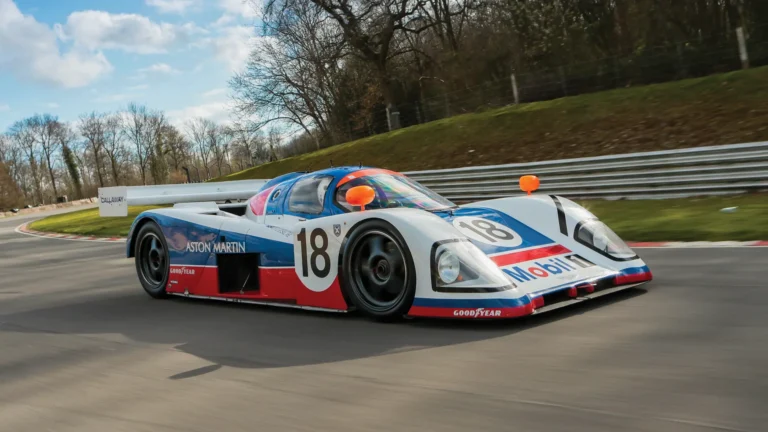
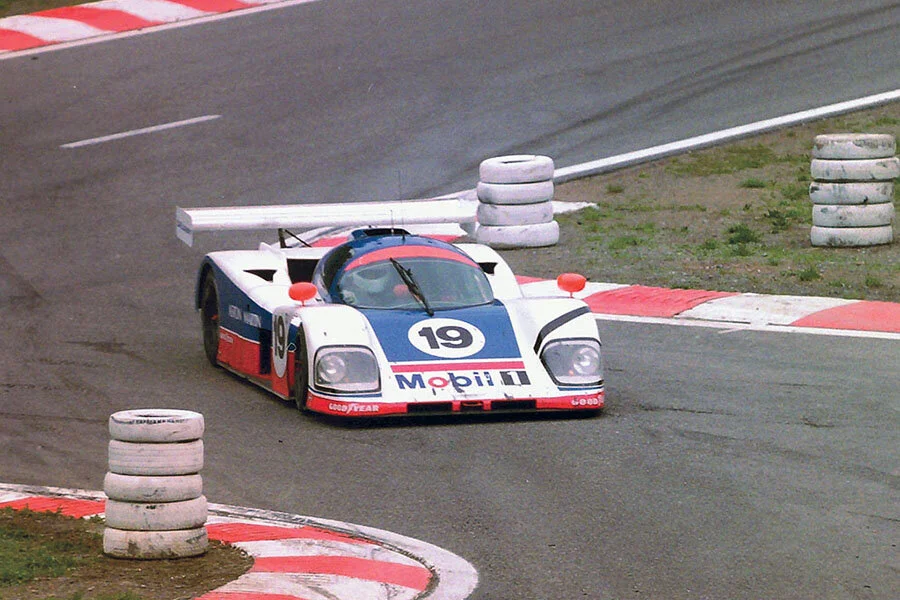
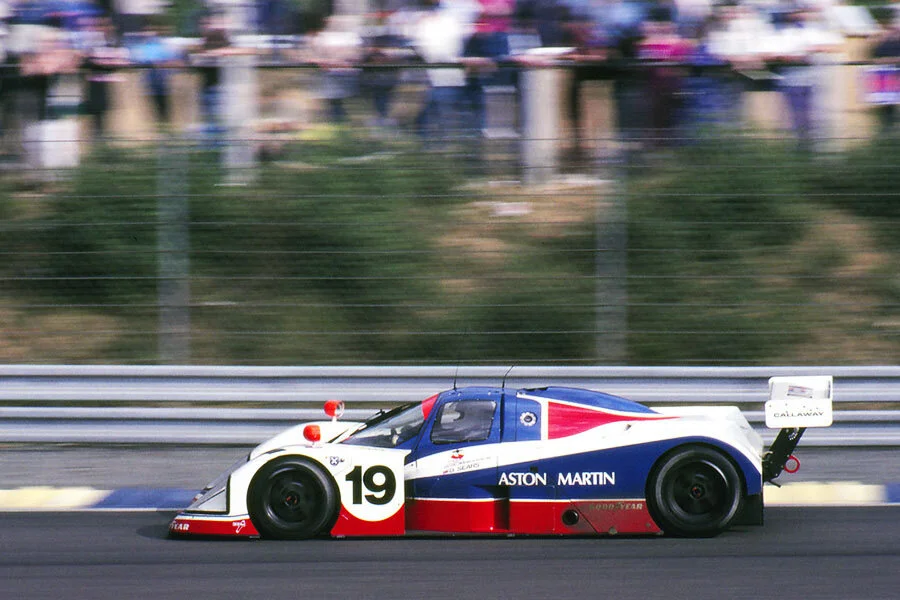
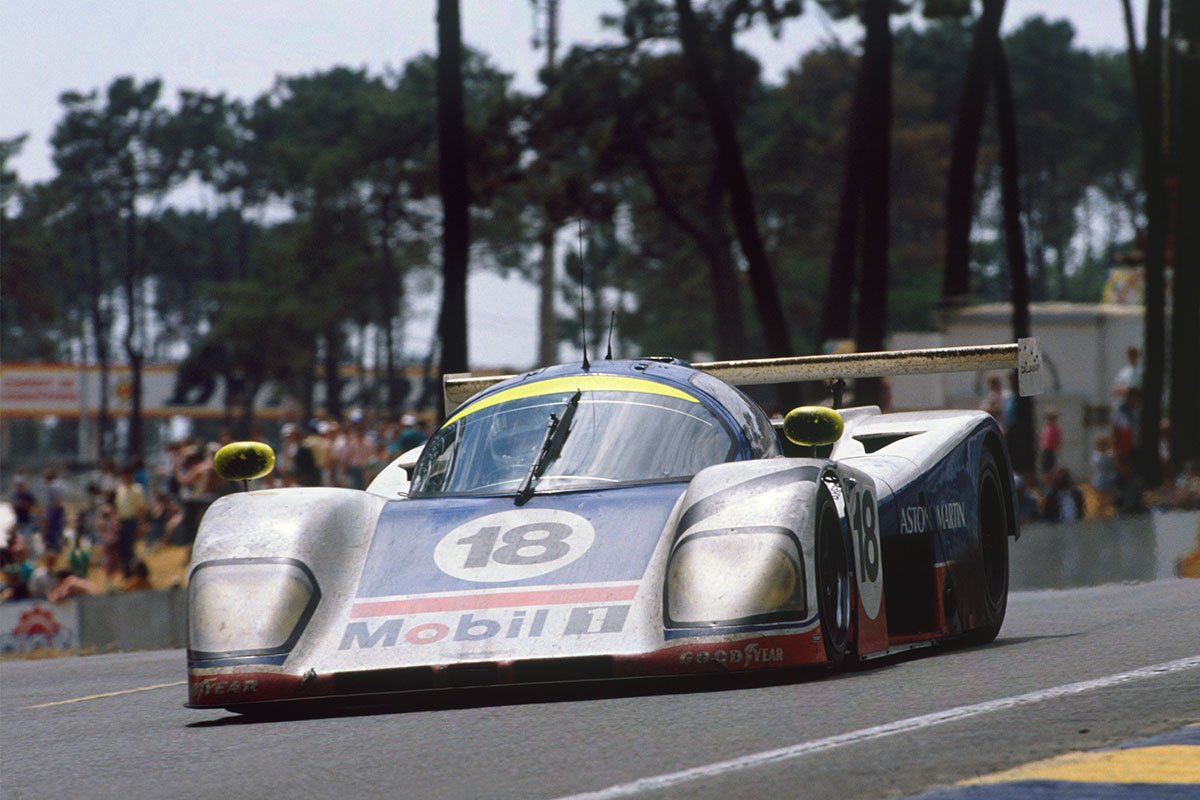
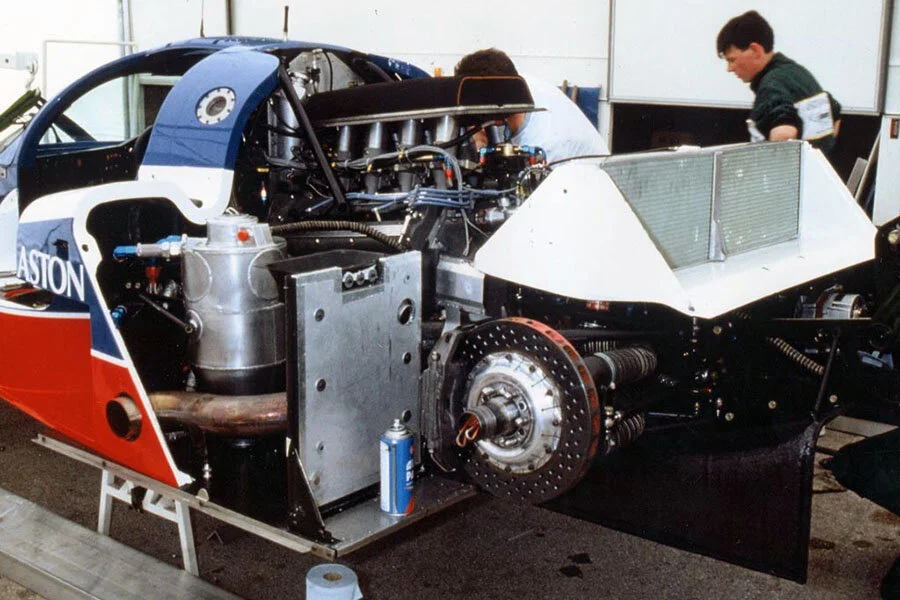
To walk around the Aston Martin AMR1 is to behold an uncompromising exercise in extreme aerodynamic packaging and composite innovation. Penned by the brilliant and eccentric designer Max Boxstrom, the AMR1 eschewed the slippery, teardrop aesthetics of its rivals for a monolithic, sharply creased silhouette that looked as though it had been carved from a solid block of carbon. This visual brutality was entirely functional. Boxstrom’s philosophy prioritized ground effect above all else. To maximize the size and efficiency of the underbody venturi tunnels, he mandated that the massive water and oil radiators be relocated from the front of the car to the rear. This allowed the front of the AMR1 to slice through the air and channel an immense volume of airflow underneath the incredibly stiff carbon-fiber and Kevlar monocoque chassis—one of the most advanced and rigid tubs of its era, manufactured by Courtaulds.
The beating heart of the AMR1 was a glorious defiance of the turbocharged status quo. Aston Martin possessed a brand-new, 32-valve, 5.3-liter V8 engine destined for the upcoming Virage road car, and they believed this architecture possessed the fundamental strength for endurance racing. To transform a luxury grand touring engine into a Group C weapon, Protech enlisted the expertise of Reeves Callaway in Connecticut, USA. Callaway Engineering comprehensively reworked the all-alloy V8, increasing the displacement to 6.0 liters for the initial AMR1 submodel. Breathing through bespoke intakes and utilizing a specialized dry-sump lubrication system, this naturally aspirated 6.0-liter leviathan produced roughly 700 brake horsepower. It emitted a thunderous, concussive baritone roar that rattled the grandstands and stood in stark auditory contrast to the whistling turbos of the Porsches and Nissans. Mated to a bespoke five-speed manual transaxle, the AMR1 was a highly physical, demanding machine. Massive ventilated carbon-ceramic disc brakes—still a relatively nascent technology—were employed to haul the heavy, downforce-laden prototype down from speeds approaching 350 km/h (215 mph) on the Mulsanne Straight.
As the 1989 season progressed, the intense developmental pressure of Group C necessitated continuous evolution. The 6.0L AMR1 proved to be structurally sound and aerodynamically potent, but the naturally aspirated V8 struggled to match the sheer, explosive corner-exit punch of the turbocharged Mercedes and Porsches on tighter circuits. In response, Protech and Callaway introduced the ultimate evolution of the powerplant: the 6.3-liter AMR1 submodel. By stroking the engine to 6.3 liters, horsepower was nudged to roughly 740 bhp, but more importantly, the torque curve was significantly fattened. This 6.3L variant transformed the AMR1 into a much more tractable and ferocious competitor during the latter half of the 1989 World Sports Prototype Championship, allowing drivers like Brian Redman, David Leslie, and Ray Mallock to extract maximum performance from Boxstrom’s ground-effect chassis.
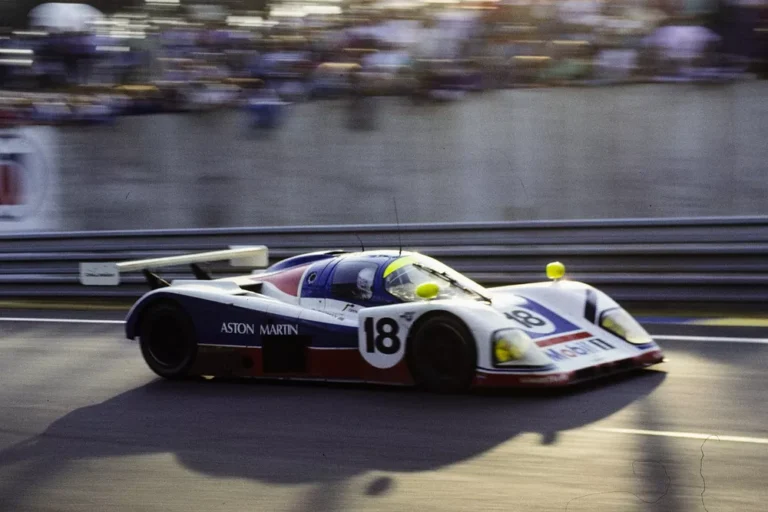
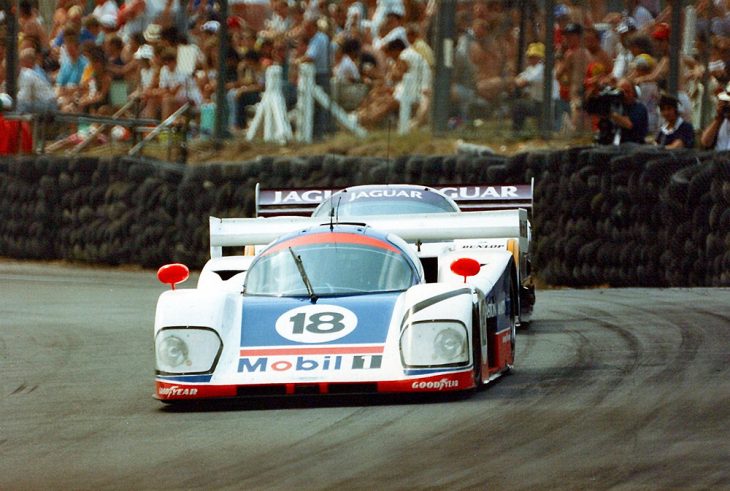
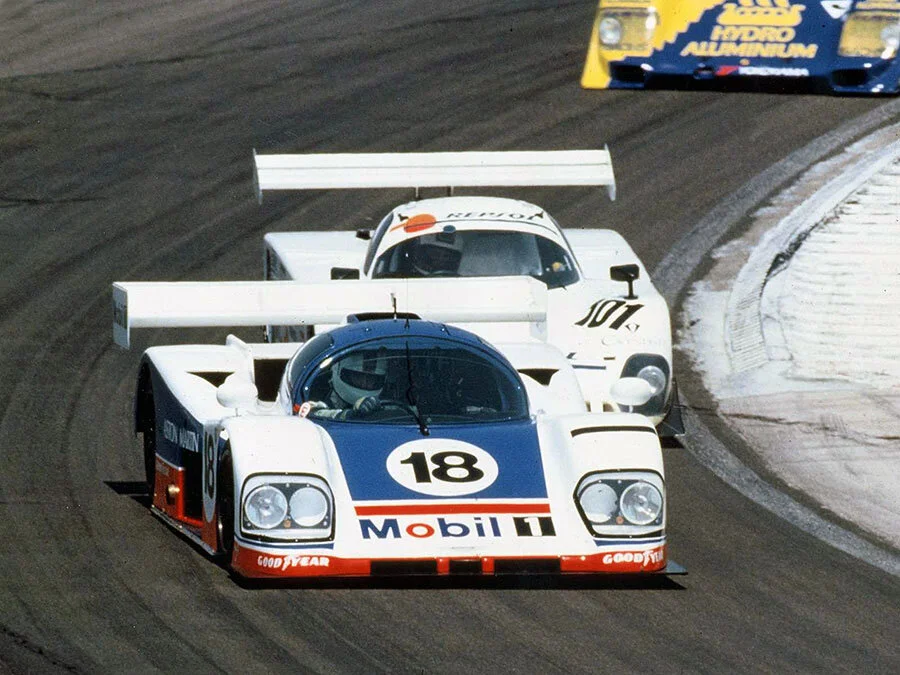
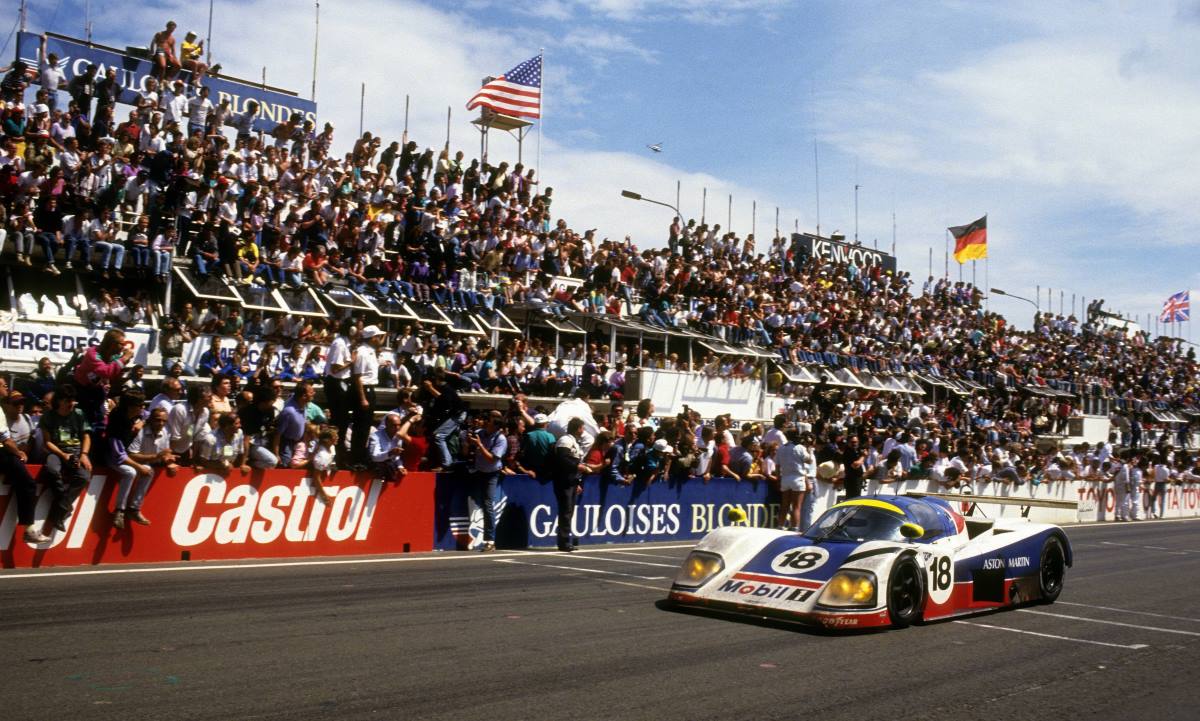
The competitive history of the AMR1 is a tale of immense promise, heroic underdog performances, and heartbreaking corporate politics. The car debuted at the 1989 Dijon-Prenois round, suffering typical teething issues and finishing 17th. However, the holy grail for Aston Martin was always the 24 Hours of Le Mans. Arriving at the Circuit de la Sarthe, the team fielded two 6.0L cars. While one succumbed to electrical failure, the #18 AMR1 piloted by Brian Redman, Costas Los, and Michael Roe ran a meticulously paced, reliable race. Against the overwhelming financial and technical might of the factory Mercedes and Jaguar squads, the thunderous Aston Martin crossed the finish line in a highly credible 11th place overall. It was a staggering achievement for a brand-new, naturally aspirated car in its first 24-hour marathon. Bolstered by the Le Mans finish, the team introduced the 6.3L engine for the sprint rounds of the championship. The AMR1 truly began to bare its teeth at Brands Hatch, where the high-downforce chassis and the torquey 6.3L V8 propelled David Leslie and Brian Redman to a magnificent 4th place overall finish. The team consistently scored points throughout the remainder of the season, securing 6th place overall in the World Championship standings—a remarkable foundation for a debut year.
Yet, just as the AMR1 hit its stride, and as Protech feverishly developed the lighter, more aerodynamically refined AMR2 for the 1990 season, the hammer fell. In late 1989, the Ford Motor Company acquired a controlling stake in Aston Martin. The corporate reality was stark: Ford had also recently purchased Jaguar, and Tom Walkinshaw’s Silk Cut Jaguar team was already a proven, Le Mans-winning marketing juggernaut. From a boardroom perspective, funding two rival, in-house British Group C programs was an unacceptable redundancy. Despite the immense promise of the 6.3L AMR1 and the impending AMR2, the Aston Martin Group C program was unceremoniously cancelled, the workshop doors shuttered, and the AMR2 prototype relegated to a museum piece without ever turning a wheel in anger.
The legacy of the 1989 Aston Martin AMR1 is that of a magnificent, roaring “what if”. It sits in the pantheon of motorsport as one of the most characterful, distinct, and beloved prototypes of the golden era of Group C. It proved that a dedicated team of British engineers, armed with a radical aerodynamic philosophy and a thunderous Callaway V8, could legitimately challenge the greatest automotive conglomerates on earth. While its racing life was tragically cut short by corporate consolidation, the AMR1 successfully reignited the competitive fire within Newport Pagnell. It laid the spiritual groundwork for Aston Martin’s eventual, triumphant return to international sports car racing in the 21st century with the DBR9. Today, when an AMR1 takes to the track at historic events like the Goodwood Festival of Speed or the Le Mans Classic, its monolithic silhouette and earth-shaking V8 roar command absolute reverence, serving as a visceral reminder of Aston Martin’s brief, glorious crusade in the Group C wars.
Portal
Model line
Model generation
Predecessor
Sucessor
Brand
Produced from
Vehicle category
Portal
Model line
Model generation
Predecessor
Sucessor
Model Overview
To fully comprehend the magnificent, brutalist spectacle that is the 1989 Aston Martin AMR1, one must transport themselves to the absolute zenith of the Group C era. The late 1980s World Sports Prototype Championship was a battlefield of mythological proportions, echoing with the shrieks of turbocharged Porsches, the guttural roar of Sauber-Mercedes V8s, and the howling V12s of Tom Walkinshaw’s Jaguars. Aston Martin, steeped in the romantic lore of their 1959 Le Mans victory with the legendary DBR1, had been largely absent from top-tier endurance racing as a factory effort, save for the valiant but underfunded semi-works Nimrod and EMKA projects of the early decade. However, under the passionate, fiercely patriotic leadership of Victor Gauntlett and Peter Livanos, a genuine desire to return to the pinnacle of motorsport took hold. To achieve this, Aston Martin forged a formidable alliance with Ecurie Ecosse, led by Hugh Chamberlain and Ray Mallock, creating a new entity known as Proteus Technology, or Protech. The singular objective of this venture was the creation of the AMR1, a machine designed to fly the Union Jack and dismantle the German and domestic establishment. The AMR1 stepped into an arena dominated by the all-conquering Sauber-Mercedes C9, the refined Porsche 962C, and the beloved Jaguar XJR-9. It was a monumental undertaking, entering the most fiercely contested era of sports car racing with a completely clean-sheet design and a naturally aspirated engine philosophy in a grid increasingly dominated by forced induction.
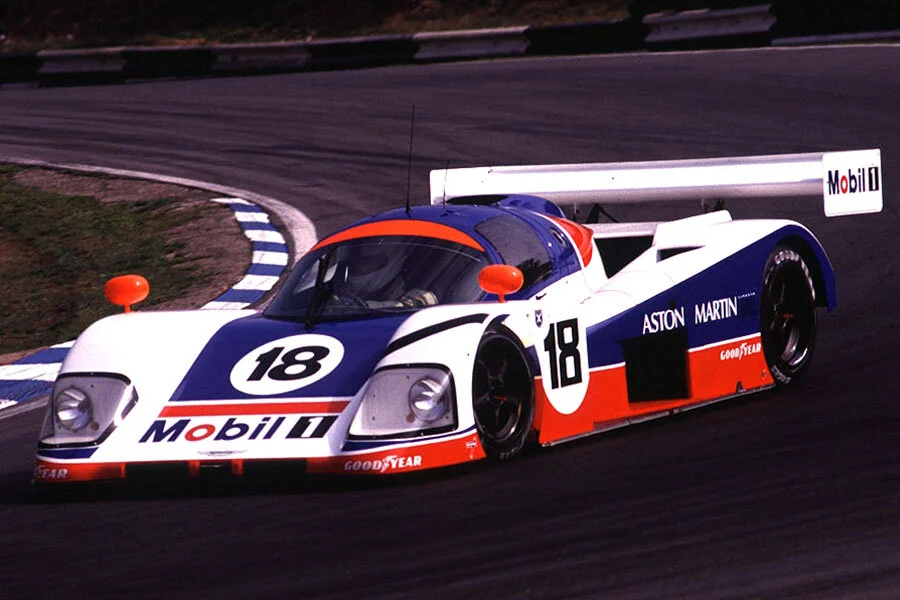
To walk around the Aston Martin AMR1 is to behold an uncompromising exercise in extreme aerodynamic packaging and composite innovation. Penned by the brilliant and eccentric designer Max Boxstrom, the AMR1 eschewed the slippery, teardrop aesthetics of its rivals for a monolithic, sharply creased silhouette that looked as though it had been carved from a solid block of carbon. This visual brutality was entirely functional. Boxstrom’s philosophy prioritized ground effect above all else. To maximize the size and efficiency of the underbody venturi tunnels, he mandated that the massive water and oil radiators be relocated from the front of the car to the rear. This allowed the front of the AMR1 to slice through the air and channel an immense volume of airflow underneath the incredibly stiff carbon-fiber and Kevlar monocoque chassis—one of the most advanced and rigid tubs of its era, manufactured by Courtaulds.
The beating heart of the AMR1 was a glorious defiance of the turbocharged status quo. Aston Martin possessed a brand-new, 32-valve, 5.3-liter V8 engine destined for the upcoming Virage road car, and they believed this architecture possessed the fundamental strength for endurance racing. To transform a luxury grand touring engine into a Group C weapon, Protech enlisted the expertise of Reeves Callaway in Connecticut, USA. Callaway Engineering comprehensively reworked the all-alloy V8, increasing the displacement to 6.0 liters for the initial AMR1 submodel. Breathing through bespoke intakes and utilizing a specialized dry-sump lubrication system, this naturally aspirated 6.0-liter leviathan produced roughly 700 brake horsepower. It emitted a thunderous, concussive baritone roar that rattled the grandstands and stood in stark auditory contrast to the whistling turbos of the Porsches and Nissans. Mated to a bespoke five-speed manual transaxle, the AMR1 was a highly physical, demanding machine. Massive ventilated carbon-ceramic disc brakes—still a relatively nascent technology—were employed to haul the heavy, downforce-laden prototype down from speeds approaching 350 km/h (215 mph) on the Mulsanne Straight.
As the 1989 season progressed, the intense developmental pressure of Group C necessitated continuous evolution. The 6.0L AMR1 proved to be structurally sound and aerodynamically potent, but the naturally aspirated V8 struggled to match the sheer, explosive corner-exit punch of the turbocharged Mercedes and Porsches on tighter circuits. In response, Protech and Callaway introduced the ultimate evolution of the powerplant: the 6.3-liter AMR1 submodel. By stroking the engine to 6.3 liters, horsepower was nudged to roughly 740 bhp, but more importantly, the torque curve was significantly fattened. This 6.3L variant transformed the AMR1 into a much more tractable and ferocious competitor during the latter half of the 1989 World Sports Prototype Championship, allowing drivers like Brian Redman, David Leslie, and Ray Mallock to extract maximum performance from Boxstrom’s ground-effect chassis.
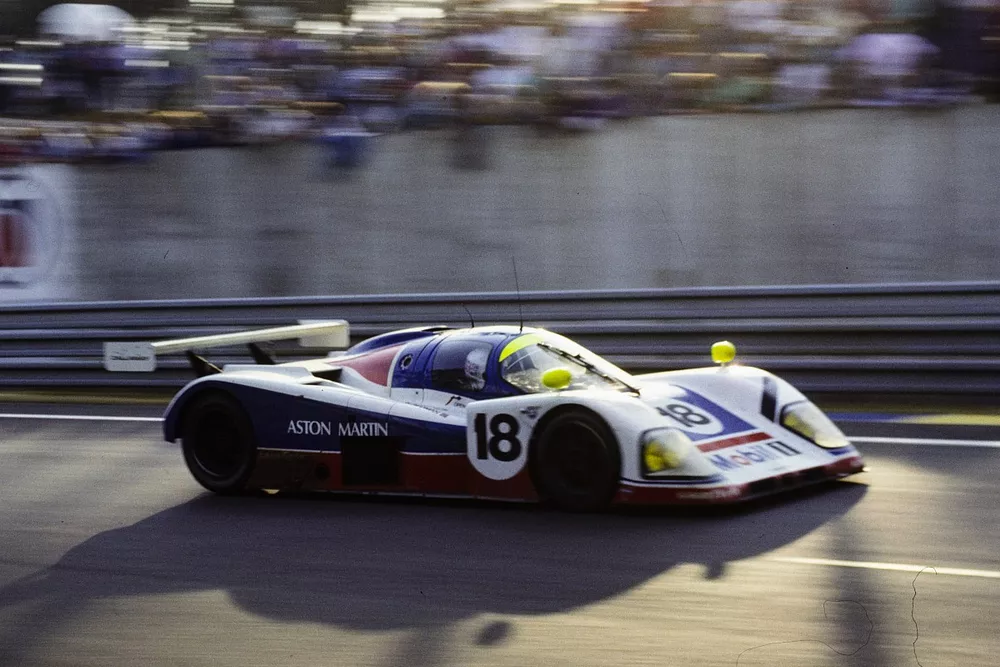
The competitive history of the AMR1 is a tale of immense promise, heroic underdog performances, and heartbreaking corporate politics. The car debuted at the 1989 Dijon-Prenois round, suffering typical teething issues and finishing 17th. However, the holy grail for Aston Martin was always the 24 Hours of Le Mans. Arriving at the Circuit de la Sarthe, the team fielded two 6.0L cars. While one succumbed to electrical failure, the #18 AMR1 piloted by Brian Redman, Costas Los, and Michael Roe ran a meticulously paced, reliable race. Against the overwhelming financial and technical might of the factory Mercedes and Jaguar squads, the thunderous Aston Martin crossed the finish line in a highly credible 11th place overall. It was a staggering achievement for a brand-new, naturally aspirated car in its first 24-hour marathon. Bolstered by the Le Mans finish, the team introduced the 6.3L engine for the sprint rounds of the championship. The AMR1 truly began to bare its teeth at Brands Hatch, where the high-downforce chassis and the torquey 6.3L V8 propelled David Leslie and Brian Redman to a magnificent 4th place overall finish. The team consistently scored points throughout the remainder of the season, securing 6th place overall in the World Championship standings—a remarkable foundation for a debut year.
Yet, just as the AMR1 hit its stride, and as Protech feverishly developed the lighter, more aerodynamically refined AMR2 for the 1990 season, the hammer fell. In late 1989, the Ford Motor Company acquired a controlling stake in Aston Martin. The corporate reality was stark: Ford had also recently purchased Jaguar, and Tom Walkinshaw’s Silk Cut Jaguar team was already a proven, Le Mans-winning marketing juggernaut. From a boardroom perspective, funding two rival, in-house British Group C programs was an unacceptable redundancy. Despite the immense promise of the 6.3L AMR1 and the impending AMR2, the Aston Martin Group C program was unceremoniously cancelled, the workshop doors shuttered, and the AMR2 prototype relegated to a museum piece without ever turning a wheel in anger.
The legacy of the 1989 Aston Martin AMR1 is that of a magnificent, roaring “what if”. It sits in the pantheon of motorsport as one of the most characterful, distinct, and beloved prototypes of the golden era of Group C. It proved that a dedicated team of British engineers, armed with a radical aerodynamic philosophy and a thunderous Callaway V8, could legitimately challenge the greatest automotive conglomerates on earth. While its racing life was tragically cut short by corporate consolidation, the AMR1 successfully reignited the competitive fire within Newport Pagnell. It laid the spiritual groundwork for Aston Martin’s eventual, triumphant return to international sports car racing in the 21st century with the DBR9. Today, when an AMR1 takes to the track at historic events like the Goodwood Festival of Speed or the Le Mans Classic, its monolithic silhouette and earth-shaking V8 roar command absolute reverence, serving as a visceral reminder of Aston Martin’s brief, glorious crusade in the Group C wars.
Submodels