
Alba Engineering
Type
Foundation Year
Founder/s
Country
Headquarters
Brand Overview
In the intoxicating, fuel-soaked theater of 1980s endurance racing, the Group C era is almost exclusively remembered for the earth-shattering battles between the factory titans. The Rothmans Porsches, the Martini Lancias, and the Silk Cut Jaguars dominate the historical tapestry, their multi-million-dollar budgets and star-studded driver lineups casting a long, imposing shadow over the rest of the grid. Yet, to look only at the overall victors is to miss the true, beating heart of the World Sportscar Championship. Beneath the heavyweight division lay the Group C Junior category—later renamed Group C2—a fiercely contested battlefield populated by resourceful privateers, ambitious engineers, and dreamers operating on shoestring budgets. This was traditionally the domain of the British “garagistas”, the shed-builders from the home counties who bolted Cosworth engines to aluminium tubs. But in 1983, a sleek, technologically advanced interloper arrived from the foothills of the Italian Alps to shatter the British monopoly. That interloper was Alba Engineering, a brand that proved Italian passion and cutting-edge composite technology could build a world-beater.
The origins of Alba Engineering read like a classic motorsport fairytale, born not in a corporate boardroom, but out of necessity, friendship, and a shared obsession with speed. The story begins with two veterans of the Italian racing scene: Carlo Facetti and Martino Finotto. Facetti was a fiery, immensely talented driver and a gifted mechanic, while Finotto was a wealthy gentleman racer with an insatiable appetite for competition. Together, they had developed a ferocious racing engine under the banner of “Carma” (a portmanteau of Carlo and Martino). The Carma FF was a 1.9-liter, four-cylinder, twin-turbocharged brute, loosely based on a Giannini block. It was light, it was angry, and it produced immense power, but it had a fatal flaw: it didn’t have a chassis worthy of its potential. To solve this, Facetti and Finotto turned to a brilliant young aerodynamicist and engineer named Giorgio Stirano. Operating out of the town of Moncalieri, just south of Turin, Stirano founded Alba Engineering in 1983 with one singular, uncompromising mandate: to build a Group C Junior chassis that would house the Carma engine and decimate the opposition.
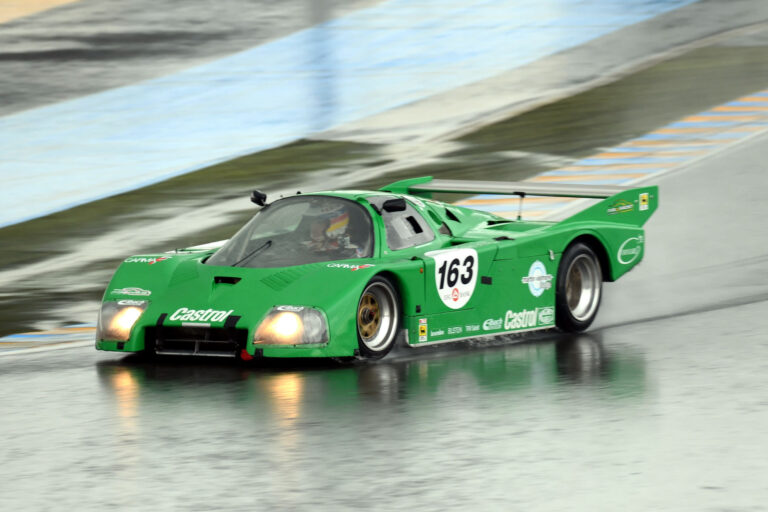
What Stirano created in the small Moncalieri workshop was nothing short of a technological marvel for a privateer outfit. While his British rivals at Spice, Tiga, and Ecurie Ecosse were still relying on traditional riveted aluminium honeycomb construction, Stirano looked to the future. The very first Alba, the AR2, featured a tub constructed from a highly advanced mix of carbon fiber and Kevlar. It was an astonishingly ambitious leap for a nascent manufacturer, resulting in a chassis that was exceptionally stiff, incredibly light, and inherently safe. Clothed in beautifully smooth, purposeful aerodynamic bodywork that maximized ground-effect tunnels within the strict dimensional limits of the C-Junior regulations, the Alba AR2 looked fast even while stationary in the Piedmontese workshop. It possessed a distinctively Italian aesthetic—compact, aggressive, and devoid of the agricultural crudeness that often plagued low-budget prototype racers.
When the Alba AR2, proudly sporting the Jolly Club banner, arrived on the World Sportscar Championship grid for the 1983 season, the establishment was caught off guard. The pairing of Stirano’s bleeding-edge chassis and the explosive Carma turbo engine proved to be a revelation. Facetti and Finotto wrestled the turbocharged machine around the fastest, most dangerous circuits in Europe. The power delivery of the Carma engine was notoriously sudden—a massive wave of turbo lag followed by a violent surge of acceleration—but the carbon-Kevlar chassis was more than capable of handling the brutality. Against the established might of Mazda’s factory-supported rotaries and the emerging British chassis, the Alba AR2 was a giant-killer. In its debut season, defying all realistic expectations for a brand-new constructor, Alba Engineering won the 1983 Group C Junior Cup. It was a triumph of Italian ingenuity, a testament to Stirano’s design brilliance and the sheer driving tenacity of Facetti and Finotto.
Buoyed by this miraculous debut, Alba Engineering entered 1984 not as the plucky underdog, but as the reigning champion with a target on its back. The World Sportscar Championship renamed the class to Group C2, and the grids swelled with new challengers. Stirano responded by refining his design, introducing the AR3. The 1984 season evolved into a grueling, season-long war of attrition. The turbocharged Carma engines, while staggeringly fast in qualifying, often proved fragile over the punishing distances of 1000-kilometer races. Yet, the inherent pace of the Alba chassis kept them at the sharp end of the field. Through a combination of strategic brilliance, raw speed, and relentless perseverance, Alba Engineering defended its crown, winning the 1984 Group C2 World Cup. In just two years of existence, Giorgio Stirano’s small company from Moncalieri had established itself as the absolute gold standard of junior prototype racing.
The sheer capability of the Alba chassis did not go unnoticed, and soon Stirano found his order books filling with requests from privateer teams across the globe. However, this expansion necessitated a shift in the brand’s mechanical philosophy. While the Carma FF engine was the soul of the factory Jolly Club effort, customer teams demanded reliability and ease of use over explosive, fragile speed. Alba began adapting its subsequent chassis—the AR4, AR5, and AR6—to accept a wide variety of powerplants. The most popular choice became the naturally aspirated 3.3-liter Cosworth DFL V8, an endurance-focused derivative of the legendary Formula 1 DFV. Fitting the vibrating, torquey Cosworth into the rear of the Alba transformed the car’s character, creating a reliable, beautifully balanced endurance weapon that became a staple of the C2 grid at Le Mans and Silverstone.
The brand’s adaptability also led them across the Atlantic to the sun-baked, bumpy circuits of the American IMSA GT Championship. In the Camel Lights category—the US equivalent of Group C2—Alba chassis became a weapon of choice for ambitious privateers. In America, the cars were fitted with everything from Buick V6s to Pontiac inline-fours. Perhaps the most fascinating and quintessentially Italian chapter of Alba’s history occurred when a customer team acquired an Alba AR4 and decided that the only fitting propulsion for an Italian prototype was a Ferrari engine. They wedged a 3.0-liter Ferrari V8, derived from the 308 GTB, into the engine bay. While it wasn’t the most successful combination on the grid, the sheer auditory spectacle of a flat-plane Ferrari V8 screaming from the back of an Alba prototype at the 24 Hours of Daytona remains one of the great, unsung romantic moments of 1980s endurance racing.
However, the golden era of the independent constructor is always painfully brief. By the late 1980s, the landscape of Group C2 had shifted dramatically. Gordon Spice and his Spice Engineering outfit had perfected the formula, producing highly developed, Cosworth-powered chassis in volume that slowly squeezed the smaller European manufacturers out of the winner’s circle. The costs of composite manufacturing were skyrocketing, and the technical regulations were changing. Alba Engineering eventually faded from the endurance racing grids as the decade came to a close, and Giorgio Stirano transitioned his immense engineering talents into consulting roles within Formula 1, touring cars, and motorsport safety, leaving behind his days as a prototype constructor.
Type
Foundation Year
Country
Founder/s
Headquarters
Type
Foundation Year
Country
Founder/s
Headquarters
About this brand
In the intoxicating, fuel-soaked theater of 1980s endurance racing, the Group C era is almost exclusively remembered for the earth-shattering battles between the factory titans. The Rothmans Porsches, the Martini Lancias, and the Silk Cut Jaguars dominate the historical tapestry, their multi-million-dollar budgets and star-studded driver lineups casting a long, imposing shadow over the rest of the grid. Yet, to look only at the overall victors is to miss the true, beating heart of the World Sportscar Championship. Beneath the heavyweight division lay the Group C Junior category—later renamed Group C2—a fiercely contested battlefield populated by resourceful privateers, ambitious engineers, and dreamers operating on shoestring budgets. This was traditionally the domain of the British “garagistas”, the shed-builders from the home counties who bolted Cosworth engines to aluminium tubs. But in 1983, a sleek, technologically advanced interloper arrived from the foothills of the Italian Alps to shatter the British monopoly. That interloper was Alba Engineering, a brand that proved Italian passion and cutting-edge composite technology could build a world-beater.
The origins of Alba Engineering read like a classic motorsport fairytale, born not in a corporate boardroom, but out of necessity, friendship, and a shared obsession with speed. The story begins with two veterans of the Italian racing scene: Carlo Facetti and Martino Finotto. Facetti was a fiery, immensely talented driver and a gifted mechanic, while Finotto was a wealthy gentleman racer with an insatiable appetite for competition. Together, they had developed a ferocious racing engine under the banner of “Carma” (a portmanteau of Carlo and Martino). The Carma FF was a 1.9-liter, four-cylinder, twin-turbocharged brute, loosely based on a Giannini block. It was light, it was angry, and it produced immense power, but it had a fatal flaw: it didn’t have a chassis worthy of its potential. To solve this, Facetti and Finotto turned to a brilliant young aerodynamicist and engineer named Giorgio Stirano. Operating out of the town of Moncalieri, just south of Turin, Stirano founded Alba Engineering in 1983 with one singular, uncompromising mandate: to build a Group C Junior chassis that would house the Carma engine and decimate the opposition.
What Stirano created in the small Moncalieri workshop was nothing short of a technological marvel for a privateer outfit. While his British rivals at Spice, Tiga, and Ecurie Ecosse were still relying on traditional riveted aluminium honeycomb construction, Stirano looked to the future. The very first Alba, the AR2, featured a tub constructed from a highly advanced mix of carbon fiber and Kevlar. It was an astonishingly ambitious leap for a nascent manufacturer, resulting in a chassis that was exceptionally stiff, incredibly light, and inherently safe. Clothed in beautifully smooth, purposeful aerodynamic bodywork that maximized ground-effect tunnels within the strict dimensional limits of the C-Junior regulations, the Alba AR2 looked fast even while stationary in the Piedmontese workshop. It possessed a distinctively Italian aesthetic—compact, aggressive, and devoid of the agricultural crudeness that often plagued low-budget prototype racers.
When the Alba AR2, proudly sporting the Jolly Club banner, arrived on the World Sportscar Championship grid for the 1983 season, the establishment was caught off guard. The pairing of Stirano’s bleeding-edge chassis and the explosive Carma turbo engine proved to be a revelation. Facetti and Finotto wrestled the turbocharged machine around the fastest, most dangerous circuits in Europe. The power delivery of the Carma engine was notoriously sudden—a massive wave of turbo lag followed by a violent surge of acceleration—but the carbon-Kevlar chassis was more than capable of handling the brutality. Against the established might of Mazda’s factory-supported rotaries and the emerging British chassis, the Alba AR2 was a giant-killer. In its debut season, defying all realistic expectations for a brand-new constructor, Alba Engineering won the 1983 Group C Junior Cup. It was a triumph of Italian ingenuity, a testament to Stirano’s design brilliance and the sheer driving tenacity of Facetti and Finotto.
Buoyed by this miraculous debut, Alba Engineering entered 1984 not as the plucky underdog, but as the reigning champion with a target on its back. The World Sportscar Championship renamed the class to Group C2, and the grids swelled with new challengers. Stirano responded by refining his design, introducing the AR3. The 1984 season evolved into a grueling, season-long war of attrition. The turbocharged Carma engines, while staggeringly fast in qualifying, often proved fragile over the punishing distances of 1000-kilometer races. Yet, the inherent pace of the Alba chassis kept them at the sharp end of the field. Through a combination of strategic brilliance, raw speed, and relentless perseverance, Alba Engineering defended its crown, winning the 1984 Group C2 World Cup. In just two years of existence, Giorgio Stirano’s small company from Moncalieri had established itself as the absolute gold standard of junior prototype racing.
The sheer capability of the Alba chassis did not go unnoticed, and soon Stirano found his order books filling with requests from privateer teams across the globe. However, this expansion necessitated a shift in the brand’s mechanical philosophy. While the Carma FF engine was the soul of the factory Jolly Club effort, customer teams demanded reliability and ease of use over explosive, fragile speed. Alba began adapting its subsequent chassis—the AR4, AR5, and AR6—to accept a wide variety of powerplants. The most popular choice became the naturally aspirated 3.3-liter Cosworth DFL V8, an endurance-focused derivative of the legendary Formula 1 DFV. Fitting the vibrating, torquey Cosworth into the rear of the Alba transformed the car’s character, creating a reliable, beautifully balanced endurance weapon that became a staple of the C2 grid at Le Mans and Silverstone.
The brand’s adaptability also led them across the Atlantic to the sun-baked, bumpy circuits of the American IMSA GT Championship. In the Camel Lights category—the US equivalent of Group C2—Alba chassis became a weapon of choice for ambitious privateers. In America, the cars were fitted with everything from Buick V6s to Pontiac inline-fours. Perhaps the most fascinating and quintessentially Italian chapter of Alba’s history occurred when a customer team acquired an Alba AR4 and decided that the only fitting propulsion for an Italian prototype was a Ferrari engine. They wedged a 3.0-liter Ferrari V8, derived from the 308 GTB, into the engine bay. While it wasn’t the most successful combination on the grid, the sheer auditory spectacle of a flat-plane Ferrari V8 screaming from the back of an Alba prototype at the 24 Hours of Daytona remains one of the great, unsung romantic moments of 1980s endurance racing.
However, the golden era of the independent constructor is always painfully brief. By the late 1980s, the landscape of Group C2 had shifted dramatically. Gordon Spice and his Spice Engineering outfit had perfected the formula, producing highly developed, Cosworth-powered chassis in volume that slowly squeezed the smaller European manufacturers out of the winner’s circle. The costs of composite manufacturing were skyrocketing, and the technical regulations were changing. Alba Engineering eventually faded from the endurance racing grids as the decade came to a close, and Giorgio Stirano transitioned his immense engineering talents into consulting roles within Formula 1, touring cars, and motorsport safety, leaving behind his days as a prototype constructor.
Submodels
Latest Variants
Model Lines