
Audi
Type
Foundation Year
Founder/s
Country
Headquarters
Brand Overview
In the grand, tempestuous theatre of automotive history, certain manufacturers are defined by passion, others by luxury, and a select few by sheer, unyielding logic. Audi belongs unequivocally to the latter, yet it is a logic that produces a deeply visceral, spine-tingling kind of magic. To understand the four rings of Ingolstadt is to understand a brand that treats physics not as a limitation, but as a puzzle waiting to be solved. “Vorsprung durch Technik”—Advancement through Technology—is not merely an advertising slogan; it is a rigid, Germanic dogma that has propelled Audi to the absolute pinnacle of motorsport in virtually every discipline it has ever touched. It is a story of rear-engined pre-war monsters, of a five-cylinder turbocharged symphony echoing through the alpine forests, and of near-silent diesel prototypes crushing the spirit of their rivals in the dead of night at La Sarthe.
The origins of the marque are rooted in a spectacular display of ego and linguistic cleverness. In 1909, the brilliant engineer August Horch was forced out of the company that bore his own name. Prevented by trademark law from using “Horch” (the German imperative for “listen”) for his new venture, a colleague’s son suggested the Latin translation: Audi. The famous four interlocking rings came later, in 1932, symbolizing the merger of four independent Saxon car companies—Audi, DKW, Horch, and Wanderer—into the Auto Union consortium. During the 1930s, funded by the German state, Auto Union engaged in a titanic, terrifying technological war against Mercedes-Benz. The Auto Union “Silver Arrows”, designed by Ferdinand Porsche, were mid-engined leviathans powered by supercharged V16 engines. They were notoriously difficult to drive, featuring narrow tires, immense torque, and a pendulum-like weight distribution. It took the supernatural reflexes of drivers like Bernd Rosemeyer and Tazio Nuvolari to tame the Type C and Type D on the lethal, tree-lined circuits of Europe. These cars were decades ahead of their time, laying the conceptual groundwork for the modern Formula 1 car.
The aftermath of the Second World War left Auto Union’s factories in Zwickau trapped behind the Iron Curtain. The company was resurrected in Ingolstadt, West Germany, but spent the 1950s and 60s surviving on modest, two-stroke DKW economy cars. When Volkswagen acquired the struggling brand in the mid-1960s, Audi was strictly forbidden from developing new models; they were simply to assemble VW Beetles. But the spark of rebellion lived in a chief engineer named Ludwig Kraus. In total secrecy, hiding blueprints from VW executives, Kraus developed the Audi 100. When finally revealed, the car was so undeniably brilliant that VW relented. Kraus didn’t just save the Audi name from extinction; he reignited its engineering soul.
However, the modern mythos of Audi was forged by a different mastermind: Ferdinand Piëch. The grandson of Ferdinand Porsche, Piëch was a ruthless, brilliant engineer with a singular obsession with technological superiority. In the late 1970s, Audi engineers testing the VW Iltis military vehicle in the snow realized its rudimentary four-wheel-drive system allowed it to run rings around far more powerful, two-wheel-drive sports cars. Piëch green-lit a project to adapt this system for a high-performance grand tourer. At the 1980 Geneva Motor Show, the world was introduced to the Audi Ur-Quattro. It was a paradigm shift.
When Audi took the Quattro to the World Rally Championship, they didn’t just compete; they altered the fundamental laws of the sport. Until then, four-wheel drive was considered too heavy and complex for racing. The Quattro, with its turbocharged five-cylinder engine and immense mechanical grip, rendered two-wheel-drive rallying obsolete overnight. The sound of that inline-five—a guttural, off-beat warble punctuated by the violent chirps and stutters of the turbo wastegate—became the definitive soundtrack of Group B rallying. In the hands of legends like Hannu Mikkola, Stig Blomqvist, and the icy, peerless Walter Röhrl, the Quattro conquered the world. It was also the machine that allowed Michèle Mouton to become the first (and only) woman to win WRC events, nearly securing the World Championship in 1982. When Group B was eventually outlawed for being too fast and too dangerous, Audi packed up the ultimate iteration, the winged Sport Quattro S1 E2, took it to Colorado, and watched Walter Röhrl smash the Pikes Peak International Hill Climb record.
Denied the dirt tracks of Europe, Audi looked across the Atlantic to prove that Quattro could dominate on the tarmac. In 1988, they entered the Trans-Am series with the massive Audi 200, winning the championship on their first attempt. The following year, they unleashed one of the most outrageous racing cars ever conceived: the Audi 90 IMSA GTO. It was a silhouette racer with a carbon-fiber widebody, a screaming 720-horsepower 2.2-litre five-cylinder engine, and exhaust pipes that exited out of the passenger side door, spitting massive flames. Driven by Hans-Joachim Stuck, it humiliated the massive American V8s on their home turf. They repeated the trick in the early 90s in the German DTM championship with the V8 Quattro, proving that grip and intelligent packaging would always overcome sheer displacement.
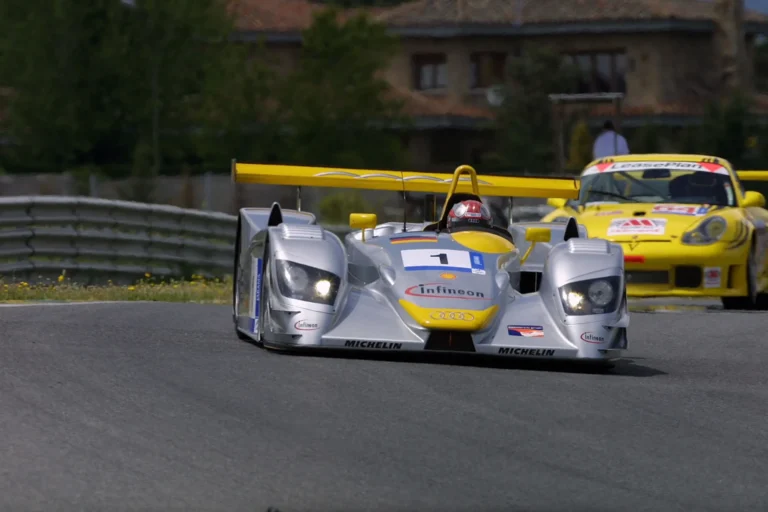
As the new millennium dawned, Audi set its sights on the ultimate test of endurance: the 24 Hours of Le Mans. What followed was a dynasty of unprecedented, crushing dominance. Between 2000 and 2014, Audi won Le Mans 13 times. The open-cockpit R8 LMP became the gold standard of the early 2000s. But the true technological flex arrived in 2006 with the R10 TDI. Audi brought a diesel to a prototype race. The V12 twin-turbo diesel produced so much torque that it required bespoke gearboxes, and it was so eerily quiet that drivers like Tom Kristensen and Allan McNish reported hearing the wind noise and the tire scrub over the engine. It was a clinical, highly efficient destruction of the opposition. Never satisfied, Audi then introduced the R18 e-tron quattro, becoming the first manufacturer to win Le Mans with a hybrid powertrain.
This relentless pursuit of track supremacy heavily infected Audi’s road cars. In 1994, Audi partnered with Porsche to create the RS2 Avant. By taking a sensible family estate, fitting Porsche brakes and suspension, and tuning the 5-cylinder engine to 315 horsepower, they essentially invented the ultra-fast wagon segment—a niche Audi still dominates today with the ballistic RS6. In 2006, they proved they could build a mid-engine supercar to rival Ferrari and Porsche with the R8, a stunning machine that paired everyday usability with a glorious, howling naturally aspirated V8 (and later, a Lamborghini-derived V10).
To drive an Audi RS model or a classic Quattro is to feel the reassuring, heavy hand of German engineering holding you to the pavement. There is no flamboyant tail-sliding or unpredictable snap-oversteer; there is only devastating, point-to-point cross-country pace, regardless of whether the road is dry, wet, or covered in snow. Audi represents the triumph of intellect over emotion in car design, yet paradoxically, cars like the Sport Quattro and the R8 possess immense, undeniable soul. They are the quiet giants of Ingolstadt, the engineers who looked at the limits of traction and aerodynamics, calmly took out their slide rules, and rewrote the rulebook of global motorsport.
Type
Foundation Year
Country
Founder/s
Headquarters

Type
Foundation Year
Country
Founder/s
Headquarters
About this brand
In the grand, tempestuous theatre of automotive history, certain manufacturers are defined by passion, others by luxury, and a select few by sheer, unyielding logic. Audi belongs unequivocally to the latter, yet it is a logic that produces a deeply visceral, spine-tingling kind of magic. To understand the four rings of Ingolstadt is to understand a brand that treats physics not as a limitation, but as a puzzle waiting to be solved. “Vorsprung durch Technik”—Advancement through Technology—is not merely an advertising slogan; it is a rigid, Germanic dogma that has propelled Audi to the absolute pinnacle of motorsport in virtually every discipline it has ever touched. It is a story of rear-engined pre-war monsters, of a five-cylinder turbocharged symphony echoing through the alpine forests, and of near-silent diesel prototypes crushing the spirit of their rivals in the dead of night at La Sarthe.
The origins of the marque are rooted in a spectacular display of ego and linguistic cleverness. In 1909, the brilliant engineer August Horch was forced out of the company that bore his own name. Prevented by trademark law from using “Horch” (the German imperative for “listen”) for his new venture, a colleague’s son suggested the Latin translation: Audi. The famous four interlocking rings came later, in 1932, symbolizing the merger of four independent Saxon car companies—Audi, DKW, Horch, and Wanderer—into the Auto Union consortium. During the 1930s, funded by the German state, Auto Union engaged in a titanic, terrifying technological war against Mercedes-Benz. The Auto Union “Silver Arrows”, designed by Ferdinand Porsche, were mid-engined leviathans powered by supercharged V16 engines. They were notoriously difficult to drive, featuring narrow tires, immense torque, and a pendulum-like weight distribution. It took the supernatural reflexes of drivers like Bernd Rosemeyer and Tazio Nuvolari to tame the Type C and Type D on the lethal, tree-lined circuits of Europe. These cars were decades ahead of their time, laying the conceptual groundwork for the modern Formula 1 car.
The aftermath of the Second World War left Auto Union’s factories in Zwickau trapped behind the Iron Curtain. The company was resurrected in Ingolstadt, West Germany, but spent the 1950s and 60s surviving on modest, two-stroke DKW economy cars. When Volkswagen acquired the struggling brand in the mid-1960s, Audi was strictly forbidden from developing new models; they were simply to assemble VW Beetles. But the spark of rebellion lived in a chief engineer named Ludwig Kraus. In total secrecy, hiding blueprints from VW executives, Kraus developed the Audi 100. When finally revealed, the car was so undeniably brilliant that VW relented. Kraus didn’t just save the Audi name from extinction; he reignited its engineering soul.
However, the modern mythos of Audi was forged by a different mastermind: Ferdinand Piëch. The grandson of Ferdinand Porsche, Piëch was a ruthless, brilliant engineer with a singular obsession with technological superiority. In the late 1970s, Audi engineers testing the VW Iltis military vehicle in the snow realized its rudimentary four-wheel-drive system allowed it to run rings around far more powerful, two-wheel-drive sports cars. Piëch green-lit a project to adapt this system for a high-performance grand tourer. At the 1980 Geneva Motor Show, the world was introduced to the Audi Ur-Quattro. It was a paradigm shift.
When Audi took the Quattro to the World Rally Championship, they didn’t just compete; they altered the fundamental laws of the sport. Until then, four-wheel drive was considered too heavy and complex for racing. The Quattro, with its turbocharged five-cylinder engine and immense mechanical grip, rendered two-wheel-drive rallying obsolete overnight. The sound of that inline-five—a guttural, off-beat warble punctuated by the violent chirps and stutters of the turbo wastegate—became the definitive soundtrack of Group B rallying. In the hands of legends like Hannu Mikkola, Stig Blomqvist, and the icy, peerless Walter Röhrl, the Quattro conquered the world. It was also the machine that allowed Michèle Mouton to become the first (and only) woman to win WRC events, nearly securing the World Championship in 1982. When Group B was eventually outlawed for being too fast and too dangerous, Audi packed up the ultimate iteration, the winged Sport Quattro S1 E2, took it to Colorado, and watched Walter Röhrl smash the Pikes Peak International Hill Climb record.
Denied the dirt tracks of Europe, Audi looked across the Atlantic to prove that Quattro could dominate on the tarmac. In 1988, they entered the Trans-Am series with the massive Audi 200, winning the championship on their first attempt. The following year, they unleashed one of the most outrageous racing cars ever conceived: the Audi 90 IMSA GTO. It was a silhouette racer with a carbon-fiber widebody, a screaming 720-horsepower 2.2-litre five-cylinder engine, and exhaust pipes that exited out of the passenger side door, spitting massive flames. Driven by Hans-Joachim Stuck, it humiliated the massive American V8s on their home turf. They repeated the trick in the early 90s in the German DTM championship with the V8 Quattro, proving that grip and intelligent packaging would always overcome sheer displacement.
As the new millennium dawned, Audi set its sights on the ultimate test of endurance: the 24 Hours of Le Mans. What followed was a dynasty of unprecedented, crushing dominance. Between 2000 and 2014, Audi won Le Mans 13 times. The open-cockpit R8 LMP became the gold standard of the early 2000s. But the true technological flex arrived in 2006 with the R10 TDI. Audi brought a diesel to a prototype race. The V12 twin-turbo diesel produced so much torque that it required bespoke gearboxes, and it was so eerily quiet that drivers like Tom Kristensen and Allan McNish reported hearing the wind noise and the tire scrub over the engine. It was a clinical, highly efficient destruction of the opposition. Never satisfied, Audi then introduced the R18 e-tron quattro, becoming the first manufacturer to win Le Mans with a hybrid powertrain.
This relentless pursuit of track supremacy heavily infected Audi’s road cars. In 1994, Audi partnered with Porsche to create the RS2 Avant. By taking a sensible family estate, fitting Porsche brakes and suspension, and tuning the 5-cylinder engine to 315 horsepower, they essentially invented the ultra-fast wagon segment—a niche Audi still dominates today with the ballistic RS6. In 2006, they proved they could build a mid-engine supercar to rival Ferrari and Porsche with the R8, a stunning machine that paired everyday usability with a glorious, howling naturally aspirated V8 (and later, a Lamborghini-derived V10).
To drive an Audi RS model or a classic Quattro is to feel the reassuring, heavy hand of German engineering holding you to the pavement. There is no flamboyant tail-sliding or unpredictable snap-oversteer; there is only devastating, point-to-point cross-country pace, regardless of whether the road is dry, wet, or covered in snow. Audi represents the triumph of intellect over emotion in car design, yet paradoxically, cars like the Sport Quattro and the R8 possess immense, undeniable soul. They are the quiet giants of Ingolstadt, the engineers who looked at the limits of traction and aerodynamics, calmly took out their slide rules, and rewrote the rulebook of global motorsport.
Submodels
Latest Variants
Model Lines