
Austin
Type
Foundation Year
Founder/s
Country
Headquarters
Brand Overview
To wander through the history of the British motor industry without acknowledging the monolithic presence of Austin is like trying to understand the ocean without mentioning water. For the better part of the 20th century, the sprawling, smoke-belching Longbridge plant in Birmingham was the absolute epicenter of British automotive engineering. Today, the name Austin might unfairly conjure images of beige, 1970s commuter cars slowly rusting in damp suburban driveways, the tragic victims of the British Leyland malaise. But to view the marque through such a narrow, cynical lens is a disservice to one of the most profoundly influential manufacturers in the history of the automobile. Austin is the acorn from which the mighty oak of British motorsport grew. It is the brand that effectively democratized racing, that gave Colin Chapman his first canvas, that won the first-ever British Touring Car Championship, and that, through a stroke of packaging genius, completely rewrote the rulebook of global rallying.
The story begins in the Edwardian era with a brilliant, obstinate engineer named Herbert Austin. Having made his name running the Wolseley Tool and Motor Car Company, he struck out on his own in 1905. His early cars were grand, heavy, and exquisitely engineered, favored by Russian Grand Dukes and British aristocracy. But Herbert Austin’s true stroke of absolute, world-shifting genius arrived in 1922 with the Austin Seven. To call the Seven a mere car is an understatement; it was a cultural phenomenon. It was tiny, affordable, and mechanically brilliant. It featured a four-cylinder engine, four-wheel brakes, and a footprint barely larger than a dining table. It put the British working and middle classes on wheels, but more importantly for the enthusiast, it put them on the racetrack.
The Austin Seven single-handedly created grassroots motorsport. Stripped of its fenders and fitted with lightweight, fabric or aluminum bodies, the Seven became a formidable racing machine. At Brooklands, the supercharged Austin Seven racers, affectionately known as the ‘rubber ducks’ due to their peculiar shape, engaged in titanic, high-revving battles against the overhead-cam MGs. The 750 Motor Club was formed purely to race these magnificent little machines. But the Seven’s legacy stretches far beyond Longbridge. A young engineer named Colin Chapman built his very first Lotus based on an Austin Seven chassis. Bruce McLaren won his first hill climb in an Ulster Seven in New Zealand. BMW’s very first car, the Dixi, was an Austin Seven built under license. Nissan’s early cars were heavily “inspired” by it. The entire global motorsport ecosystem owes an unpayable debt to the humble ‘Baby Austin’.
Following the Second World War, Austin merged with its bitter rival, Morris, to form the British Motor Corporation (BMC), but the Austin badge retained its unique, robust character. While the pre-war era was defined by the Seven, the 1950s saw Austin conquer the booming touring car scene. In 1958, a young gentleman racer named Jack Sears took to the track in an Austin A105 Westminster. It was a large, heavy saloon, but Sears wrung its neck with such sideways, tire-smoking ferocity that he won the inaugural British Saloon Car Championship (the precursor to today’s BTCC).
This blue-collar, tin-top heroism was perfected with the Austin A40 Farina. Styled by the Italians but built in Birmingham, the A40 was a small, boxy, rear-wheel-drive hatchback that became the absolute darling of the touring car grid. To this day, at the Goodwood Revival’s St Mary’s Trophy, the sight of an Austin A40 sliding through Madgwick corner, its inside front wheel dangling six inches in the air, its pushrod A-Series engine screaming past 7,000 rpm, is one of the most joyous spectacles in historic racing. It proved that you did not need a massive V8 to entertain the crowds or win races; you just needed a well-sorted chassis, a brave driver, and an Austin badge.
Parallel to the tin-top success was the glorious, hairy-chested chapter of the ‘Big Healeys’. While Donald Healey provided the chassis and the styling, Austin provided the industrial muscle and the engines, resulting in the Austin-Healey 100 and the legendary 3000. These cars were the absolute antithesis of the delicate, small-capacity British sports cars. The Austin C-Series straight-six engine was a heavy, iron lump that produced a tidal wave of torque and a guttural, terrifying exhaust note. Under the direction of BMC Competitions boss Stuart Turner, the works Austin-Healey 3000s were painted in iconic Tartan Red over Old English White and unleashed on the rally stages of Europe. Driven by fearless pilots like Timo Mäkinen, Rauno Aaltonen, and the incredible Pat Moss (Stirling’s sister), the Big Healeys battered their way to victories in the grueling Liege-Rome-Liege and the Alpine Rally. They were brutal cars that demanded physical strength and immense courage, sliding on the gravel passes with their exhausts dragging on the rocks.
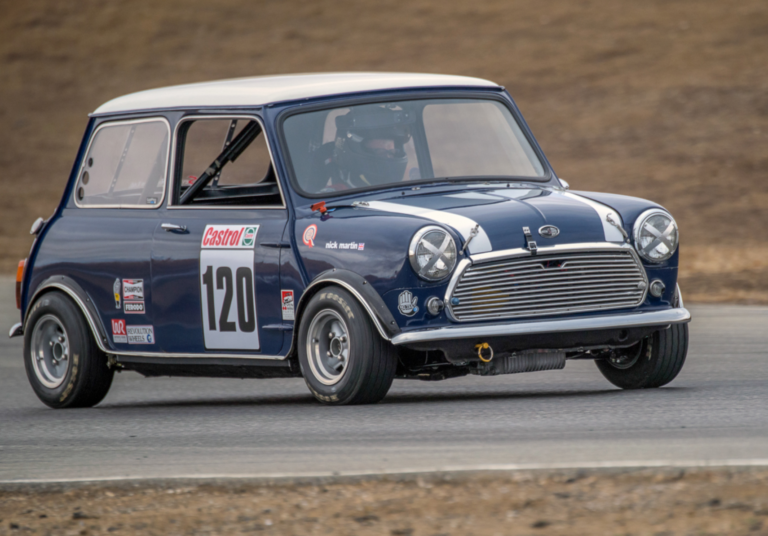
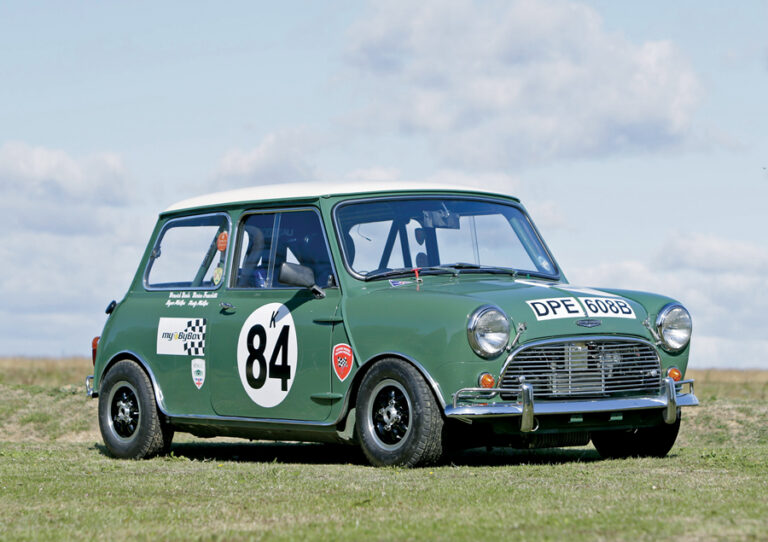
Yet, the ultimate technological triumph of the Austin nameplate arrived in 1959. Faced with a fuel crisis, BMC tasked the brilliant, eccentric engineer Alec Issigonis with designing a radically small car. The result was initially marketed as the Austin Se7en (and the Morris Mini-Minor). The Mini was a packaging miracle. Issigonis turned the A-Series engine sideways, mounted the gearbox in the sump, and pushed the tiny ten-inch wheels to the absolute extremities of the chassis. It maximized interior space, but inadvertently, it created the best-handling front-wheel-drive car the world had ever seen. When John Cooper convinced BMC to let him tune it, the Austin Mini Cooper was born. It became a giant-killer, dancing around massive American V8s on the circuits and dominating the Monte Carlo Rally. The Mini proved that agility and grip could conquer brute horsepower, forever changing the trajectory of automotive engineering.
Even when building larger, supposedly mundane family cars, Austin could not suppress its rallying DNA. The Austin 1800, nicknamed the ‘Landcrab’ due to its wide stance and incredibly stiff hydrolastic suspension, looked like a bloated toad. But that stiffness made it practically indestructible. In the late 1960s, BMC entered the Landcrabs into the marathon rallies—events like the London to Sydney Marathon. While the sports cars broke their suspensions in the deserts of the Middle East and the Australian outback, the big, ugly Austins just kept plowing forward, demonstrating a legendary, stubborn reliability.
The final chapters of the Austin story are tinged with the profound tragedy of British Leyland. The 1970s and 80s were marked by crippling strikes, compromised designs, and chronic underfunding. Cars like the Austin Allegro and Maestro, while possessing clever engineering features, were victims of a collapsing corporate structure. The badge that had once represented the absolute vanguard of British engineering was slowly suffocated, eventually being retired in the late 1980s.
However, to remember Austin for its final days is a grave mistake. The true enthusiast remembers the smell of hot castor oil blowing back from a supercharged Austin Seven at Brooklands. They remember the thunderous, spitting overrun of a Works Austin-Healey 3000 echoing through a snowy Alpine pass in the dead of night. They remember the giant-killing stance of a tiny Austin Mini Cooper S on the Col de Turini, and the heroic three-wheeling antics of an A40 at Goodwood. Austin was the working-class hero of the British motor industry, a brand that built cars for the masses but infused them with an indelible, tenacious spirit that conquered the motorsport world. It is the very foundation of the British racing legend.
Type
Foundation Year
Country
Founder/s
Headquarters
Type
Foundation Year
Country
Founder/s
Headquarters
About this brand
To wander through the history of the British motor industry without acknowledging the monolithic presence of Austin is like trying to understand the ocean without mentioning water. For the better part of the 20th century, the sprawling, smoke-belching Longbridge plant in Birmingham was the absolute epicenter of British automotive engineering. Today, the name Austin might unfairly conjure images of beige, 1970s commuter cars slowly rusting in damp suburban driveways, the tragic victims of the British Leyland malaise. But to view the marque through such a narrow, cynical lens is a disservice to one of the most profoundly influential manufacturers in the history of the automobile. Austin is the acorn from which the mighty oak of British motorsport grew. It is the brand that effectively democratized racing, that gave Colin Chapman his first canvas, that won the first-ever British Touring Car Championship, and that, through a stroke of packaging genius, completely rewrote the rulebook of global rallying.
The story begins in the Edwardian era with a brilliant, obstinate engineer named Herbert Austin. Having made his name running the Wolseley Tool and Motor Car Company, he struck out on his own in 1905. His early cars were grand, heavy, and exquisitely engineered, favored by Russian Grand Dukes and British aristocracy. But Herbert Austin’s true stroke of absolute, world-shifting genius arrived in 1922 with the Austin Seven. To call the Seven a mere car is an understatement; it was a cultural phenomenon. It was tiny, affordable, and mechanically brilliant. It featured a four-cylinder engine, four-wheel brakes, and a footprint barely larger than a dining table. It put the British working and middle classes on wheels, but more importantly for the enthusiast, it put them on the racetrack.
The Austin Seven single-handedly created grassroots motorsport. Stripped of its fenders and fitted with lightweight, fabric or aluminum bodies, the Seven became a formidable racing machine. At Brooklands, the supercharged Austin Seven racers, affectionately known as the ‘rubber ducks’ due to their peculiar shape, engaged in titanic, high-revving battles against the overhead-cam MGs. The 750 Motor Club was formed purely to race these magnificent little machines. But the Seven’s legacy stretches far beyond Longbridge. A young engineer named Colin Chapman built his very first Lotus based on an Austin Seven chassis. Bruce McLaren won his first hill climb in an Ulster Seven in New Zealand. BMW’s very first car, the Dixi, was an Austin Seven built under license. Nissan’s early cars were heavily “inspired” by it. The entire global motorsport ecosystem owes an unpayable debt to the humble ‘Baby Austin’.
Following the Second World War, Austin merged with its bitter rival, Morris, to form the British Motor Corporation (BMC), but the Austin badge retained its unique, robust character. While the pre-war era was defined by the Seven, the 1950s saw Austin conquer the booming touring car scene. In 1958, a young gentleman racer named Jack Sears took to the track in an Austin A105 Westminster. It was a large, heavy saloon, but Sears wrung its neck with such sideways, tire-smoking ferocity that he won the inaugural British Saloon Car Championship (the precursor to today’s BTCC).
This blue-collar, tin-top heroism was perfected with the Austin A40 Farina. Styled by the Italians but built in Birmingham, the A40 was a small, boxy, rear-wheel-drive hatchback that became the absolute darling of the touring car grid. To this day, at the Goodwood Revival’s St Mary’s Trophy, the sight of an Austin A40 sliding through Madgwick corner, its inside front wheel dangling six inches in the air, its pushrod A-Series engine screaming past 7,000 rpm, is one of the most joyous spectacles in historic racing. It proved that you did not need a massive V8 to entertain the crowds or win races; you just needed a well-sorted chassis, a brave driver, and an Austin badge.
Parallel to the tin-top success was the glorious, hairy-chested chapter of the ‘Big Healeys’. While Donald Healey provided the chassis and the styling, Austin provided the industrial muscle and the engines, resulting in the Austin-Healey 100 and the legendary 3000. These cars were the absolute antithesis of the delicate, small-capacity British sports cars. The Austin C-Series straight-six engine was a heavy, iron lump that produced a tidal wave of torque and a guttural, terrifying exhaust note. Under the direction of BMC Competitions boss Stuart Turner, the works Austin-Healey 3000s were painted in iconic Tartan Red over Old English White and unleashed on the rally stages of Europe. Driven by fearless pilots like Timo Mäkinen, Rauno Aaltonen, and the incredible Pat Moss (Stirling’s sister), the Big Healeys battered their way to victories in the grueling Liege-Rome-Liege and the Alpine Rally. They were brutal cars that demanded physical strength and immense courage, sliding on the gravel passes with their exhausts dragging on the rocks.
Yet, the ultimate technological triumph of the Austin nameplate arrived in 1959. Faced with a fuel crisis, BMC tasked the brilliant, eccentric engineer Alec Issigonis with designing a radically small car. The result was initially marketed as the Austin Se7en (and the Morris Mini-Minor). The Mini was a packaging miracle. Issigonis turned the A-Series engine sideways, mounted the gearbox in the sump, and pushed the tiny ten-inch wheels to the absolute extremities of the chassis. It maximized interior space, but inadvertently, it created the best-handling front-wheel-drive car the world had ever seen. When John Cooper convinced BMC to let him tune it, the Austin Mini Cooper was born. It became a giant-killer, dancing around massive American V8s on the circuits and dominating the Monte Carlo Rally. The Mini proved that agility and grip could conquer brute horsepower, forever changing the trajectory of automotive engineering.
Even when building larger, supposedly mundane family cars, Austin could not suppress its rallying DNA. The Austin 1800, nicknamed the ‘Landcrab’ due to its wide stance and incredibly stiff hydrolastic suspension, looked like a bloated toad. But that stiffness made it practically indestructible. In the late 1960s, BMC entered the Landcrabs into the marathon rallies—events like the London to Sydney Marathon. While the sports cars broke their suspensions in the deserts of the Middle East and the Australian outback, the big, ugly Austins just kept plowing forward, demonstrating a legendary, stubborn reliability.
The final chapters of the Austin story are tinged with the profound tragedy of British Leyland. The 1970s and 80s were marked by crippling strikes, compromised designs, and chronic underfunding. Cars like the Austin Allegro and Maestro, while possessing clever engineering features, were victims of a collapsing corporate structure. The badge that had once represented the absolute vanguard of British engineering was slowly suffocated, eventually being retired in the late 1980s.
However, to remember Austin for its final days is a grave mistake. The true enthusiast remembers the smell of hot castor oil blowing back from a supercharged Austin Seven at Brooklands. They remember the thunderous, spitting overrun of a Works Austin-Healey 3000 echoing through a snowy Alpine pass in the dead of night. They remember the giant-killing stance of a tiny Austin Mini Cooper S on the Col de Turini, and the heroic three-wheeling antics of an A40 at Goodwood. Austin was the working-class hero of the British motor industry, a brand that built cars for the masses but infused them with an indelible, tenacious spirit that conquered the motorsport world. It is the very foundation of the British racing legend.
Submodels
Latest Variants

Model Lines