
Mercedes-Benz
Type
Foundation Year
Founder/s
Country
Headquarters
Brand Overview
In the beginning, there was nothing. No roads, no gas stations, no speed limits, and no concept of personal mechanical mobility. Then, in 1886, a German engineer named Karl Benz applied for a patent for a “vehicle powered by a gas engine”. In that singular moment, the world shrank. While other manufacturers can claim to have refined the automobile, or democratized it, or made it faster, only one can claim to have invented it. Mercedes-Benz is not merely a car company; it is the genesis point. It is the North Star of the automotive industry, a monolith of engineering that has stood for nearly 140 years as the definitive answer to the question of how to move a human being from point A to point B with the maximum amount of dignity, speed, and safety. The three-pointed star is more than a logo; it is a promise of Teutonic perfection, a symbol that has adorned the dictators’ limousines, the Pope’s transport, the taxicabs of the world, and the most dominant racing cars ever to turn a wheel.
The history of the brand is a tale of two halves—Benz and Daimler—uniting to form a colossus. But the soul of the company was forged not in the boardroom, but on the dusty, dangerous roads of the early 20th century. While the “Patent-Motorwagen” was the spark, it was Bertha Benz, Karl’s wife, who provided the fire. By taking the fragile three-wheeler on the first long-distance journey (without telling her husband) to visit her mother, fixing fuel lines with her hairpin and brakes with leather from a shoemaker, she proved the car was a machine for the world.
However, the “Benz” part of the name implies reliability; the “Mercedes” part implies speed. Named after the daughter of Emil Jellinek, an Austrian diplomat and racer who demanded faster cars from Daimler, the name “Mercedes” was born in competition. And competition is where the legend of the “Silver Arrows” was written. In 1934, at the Nürburgring, the new Mercedes W25 race cars were found to be 1 kilogram over the 750kg weight limit. The team manager, the legendary Alfred Neubauer, supposedly ordered the mechanics to scrape off the white lead-based paint, exposing the raw aluminium skin. They passed inspection, they won the race, and the Silberpfeil legend was born.
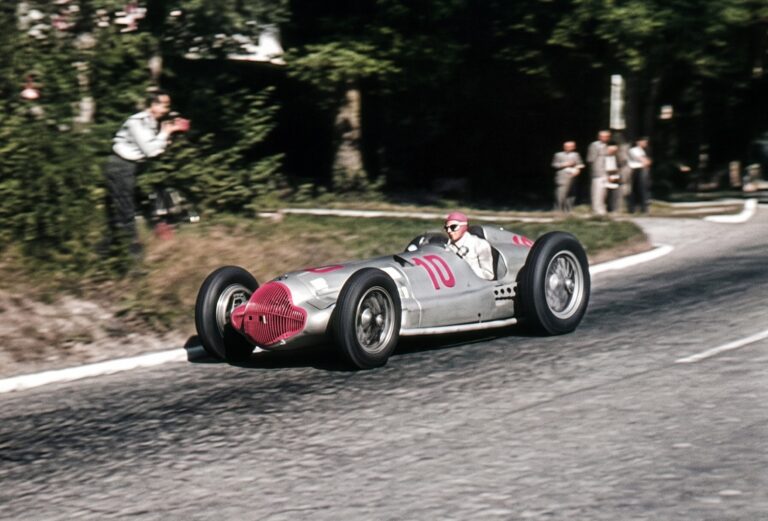
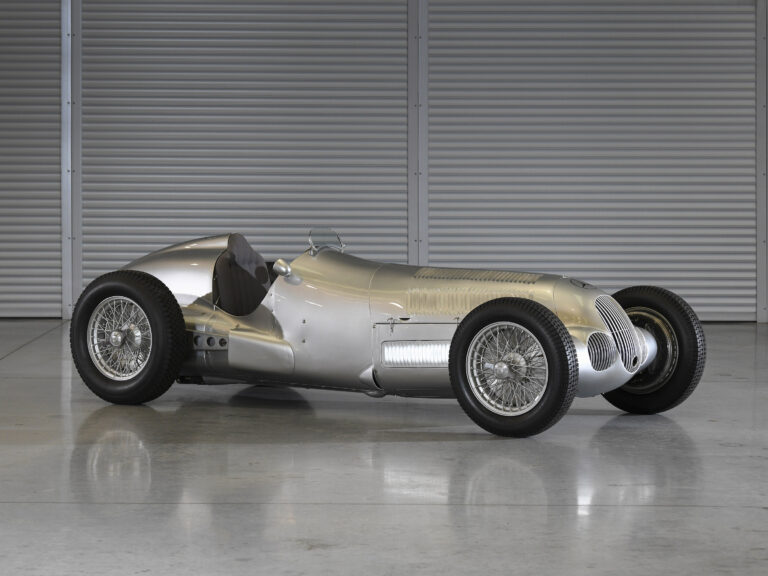
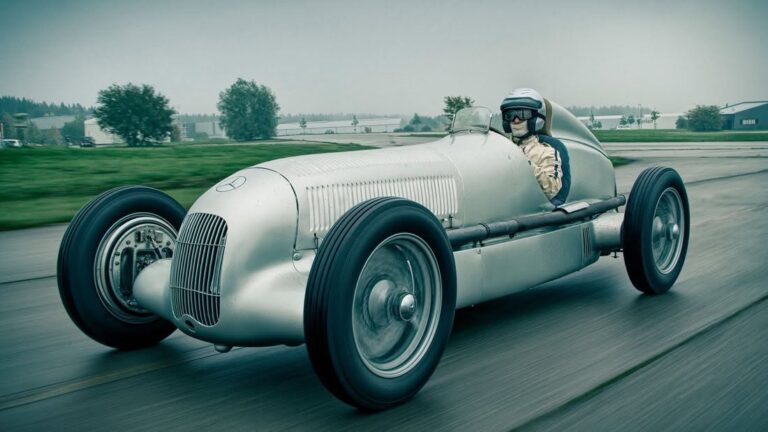
The 1930s were an era of technological terror. Funded by the German state, Mercedes-Benz and Auto Union built machines that defied physics. The W125 of 1937 produced nearly 600 horsepower—a figure that wouldn’t be matched in Formula 1 until the turbo era of the 1980s. Drivers like Rudolf Caracciola wrestled these monsters around the AVUS banking and the Nürburgring at speeds that seem suicidal today. This was engineering as a weapon, a demonstration of industrial might that was both awe-inspiring and terrifying.
World War II left the company in ruins, but the phoenix that rose from the ashes in the 1950s was arguably the most beautiful object ever engineered. The 300 SL “Gullwing”. Born from the W194 racing car, it was the first true supercar. With its tubular spaceframe chassis (which necessitated the high sills and thus the upward-opening doors) and direct fuel injection (a world first), it was lightyears ahead of anything from Italy or Britain. It was an alien spacecraft parked on the streets of 1954.
This era of elegance coincided with the most devastating display of racing dominance in history. In 1955, Mercedes hired the greatest driver in the world, Juan Manuel Fangio, and paired him with the greatest British talent, Stirling Moss. The car was the W196 (for F1) and the 300 SLR (for sports cars). They won everything. Moss’s victory at the 1955 Mille Miglia in the 300 SLR #722—averaging nearly 100 mph for 1,000 miles on public roads—is widely considered the greatest single drive in the history of motorsport. But 1955 also brought the darkness. At Le Mans, Pierre Levegh’s 300 SLR launched into the crowd, killing the driver and over 80 spectators. It remains the worst disaster in racing history. A shaken Mercedes-Benz withdrew from motorsport at the end of the season, not to return as a full factory team for decades.
The withdrawal led to a shift in focus. If they couldn’t race, they would build the best road cars in the world. The 1960s, 70s, and 80s were the era of “over-engineering”. The Mercedes “Grosser” 600 was a limousine so complex it used a high-pressure hydraulic system to operate everything from the windows to the trunk lid. It became the default transport for heads of state, dictators, and rock stars. The W123 and W124 E-Class sedans were built like bank vaults, cars designed to last a million miles. The door closure of a 1980s Mercedes—a solid, low-frequency thunk—became the industry benchmark for quality. This was the era of “The Best or Nothing”, where cost was secondary to engineering integrity.
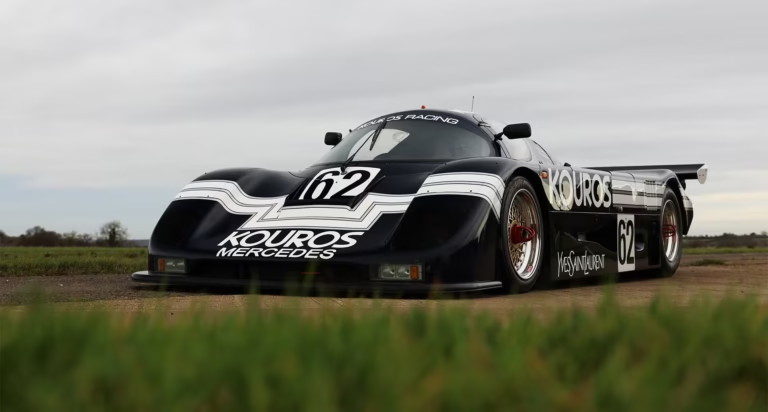
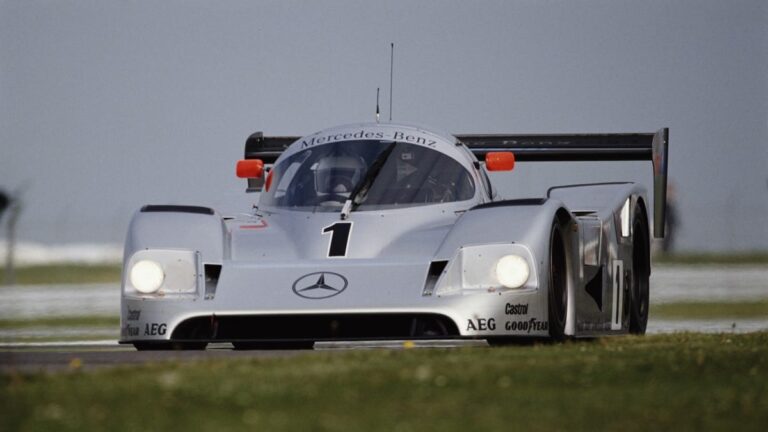
But the racer’s heart was merely dormant, not dead. In the late 80s, Mercedes partnered with Sauber to return to sports cars, culminating in the C9 winning Le Mans in 1989. On the touring car front, the brand engaged in a fierce war with BMW. The weapon was the 190E 2.3, tuned by Cosworth. To prove its durability, Mercedes took the car to the Nardò Ring and drove it flat-out for 50,000 kilometres, breaking world records. This car evolved into the wild, winged 190E 2.3 Evolution II, a DTM icon that fought door-to-door with the BMW M3.
This performance renaissance was aided by a small tuning shop in Affalterbach: AMG. Initially independent, Hans Werner Aufrecht and Erhard Melcher took staid Mercedes sedans and turned them into tyre-shredding monsters. The “Red Pig”—a massive 300 SEL 6.8 that finished second at the 24 Hours of Spa in 1971—put them on the map. The “Hammer”—a W124 E-Class with a massive V8—made them legends. In 1999, Mercedes fully acquired AMG, turning the sensible Stuttgart brand into a purveyor of smoky burnouts and V8 thunder.
The modern era of Mercedes-Benz is defined by its return to the summit of Formula 1. After a tentative return as an engine supplier (winning with McLaren) and a brief stint owning the Brawn GP team, the factory Mercedes-AMG Petronas team unleashed the most dominant dynasty the sport has ever seen. In the hybrid turbo era (2014 onwards), the Silver Arrows, led by Lewis Hamilton and Toto Wolff, won eight consecutive Constructors’ Championships. The W11 of 2020 is likely the fastest, most complex racing car ever built.
Today, the three-pointed star sits atop a vast empire. It encompasses the silent luxury of the electric EQS, the rugged utility of the G-Wagen (a military vehicle that became a fashion icon), and the hyper-performance of the AMG ONE, a car that puts a literal F1 engine on the road. Mercedes-Benz is a brand that manages to be everything to everyone, yet loses nothing in the process. It is the oldest car company, yet often the most advanced. It is the safe choice, and the fast choice. It is, quite simply, the standard by which all others are measured.
Type
Foundation Year
Country
Founder/s
Headquarters

Type
Foundation Year
Country
Founder/s
Headquarters
About this brand
In the beginning, there was nothing. No roads, no gas stations, no speed limits, and no concept of personal mechanical mobility. Then, in 1886, a German engineer named Karl Benz applied for a patent for a “vehicle powered by a gas engine”. In that singular moment, the world shrank. While other manufacturers can claim to have refined the automobile, or democratized it, or made it faster, only one can claim to have invented it. Mercedes-Benz is not merely a car company; it is the genesis point. It is the North Star of the automotive industry, a monolith of engineering that has stood for nearly 140 years as the definitive answer to the question of how to move a human being from point A to point B with the maximum amount of dignity, speed, and safety. The three-pointed star is more than a logo; it is a promise of Teutonic perfection, a symbol that has adorned the dictators’ limousines, the Pope’s transport, the taxicabs of the world, and the most dominant racing cars ever to turn a wheel.
The history of the brand is a tale of two halves—Benz and Daimler—uniting to form a colossus. But the soul of the company was forged not in the boardroom, but on the dusty, dangerous roads of the early 20th century. While the “Patent-Motorwagen” was the spark, it was Bertha Benz, Karl’s wife, who provided the fire. By taking the fragile three-wheeler on the first long-distance journey (without telling her husband) to visit her mother, fixing fuel lines with her hairpin and brakes with leather from a shoemaker, she proved the car was a machine for the world.
However, the “Benz” part of the name implies reliability; the “Mercedes” part implies speed. Named after the daughter of Emil Jellinek, an Austrian diplomat and racer who demanded faster cars from Daimler, the name “Mercedes” was born in competition. And competition is where the legend of the “Silver Arrows” was written. In 1934, at the Nürburgring, the new Mercedes W25 race cars were found to be 1 kilogram over the 750kg weight limit. The team manager, the legendary Alfred Neubauer, supposedly ordered the mechanics to scrape off the white lead-based paint, exposing the raw aluminium skin. They passed inspection, they won the race, and the Silberpfeil legend was born.
The 1930s were an era of technological terror. Funded by the German state, Mercedes-Benz and Auto Union built machines that defied physics. The W125 of 1937 produced nearly 600 horsepower—a figure that wouldn’t be matched in Formula 1 until the turbo era of the 1980s. Drivers like Rudolf Caracciola wrestled these monsters around the AVUS banking and the Nürburgring at speeds that seem suicidal today. This was engineering as a weapon, a demonstration of industrial might that was both awe-inspiring and terrifying.
World War II left the company in ruins, but the phoenix that rose from the ashes in the 1950s was arguably the most beautiful object ever engineered. The 300 SL “Gullwing”. Born from the W194 racing car, it was the first true supercar. With its tubular spaceframe chassis (which necessitated the high sills and thus the upward-opening doors) and direct fuel injection (a world first), it was lightyears ahead of anything from Italy or Britain. It was an alien spacecraft parked on the streets of 1954.
This era of elegance coincided with the most devastating display of racing dominance in history. In 1955, Mercedes hired the greatest driver in the world, Juan Manuel Fangio, and paired him with the greatest British talent, Stirling Moss. The car was the W196 (for F1) and the 300 SLR (for sports cars). They won everything. Moss’s victory at the 1955 Mille Miglia in the 300 SLR #722—averaging nearly 100 mph for 1,000 miles on public roads—is widely considered the greatest single drive in the history of motorsport. But 1955 also brought the darkness. At Le Mans, Pierre Levegh’s 300 SLR launched into the crowd, killing the driver and over 80 spectators. It remains the worst disaster in racing history. A shaken Mercedes-Benz withdrew from motorsport at the end of the season, not to return as a full factory team for decades.
The withdrawal led to a shift in focus. If they couldn’t race, they would build the best road cars in the world. The 1960s, 70s, and 80s were the era of “over-engineering”. The Mercedes “Grosser” 600 was a limousine so complex it used a high-pressure hydraulic system to operate everything from the windows to the trunk lid. It became the default transport for heads of state, dictators, and rock stars. The W123 and W124 E-Class sedans were built like bank vaults, cars designed to last a million miles. The door closure of a 1980s Mercedes—a solid, low-frequency thunk—became the industry benchmark for quality. This was the era of “The Best or Nothing”, where cost was secondary to engineering integrity.
But the racer’s heart was merely dormant, not dead. In the late 80s, Mercedes partnered with Sauber to return to sports cars, culminating in the C9 winning Le Mans in 1989. On the touring car front, the brand engaged in a fierce war with BMW. The weapon was the 190E 2.3, tuned by Cosworth. To prove its durability, Mercedes took the car to the Nardò Ring and drove it flat-out for 50,000 kilometres, breaking world records. This car evolved into the wild, winged 190E 2.3 Evolution II, a DTM icon that fought door-to-door with the BMW M3.
This performance renaissance was aided by a small tuning shop in Affalterbach: AMG. Initially independent, Hans Werner Aufrecht and Erhard Melcher took staid Mercedes sedans and turned them into tyre-shredding monsters. The “Red Pig”—a massive 300 SEL 6.8 that finished second at the 24 Hours of Spa in 1971—put them on the map. The “Hammer”—a W124 E-Class with a massive V8—made them legends. In 1999, Mercedes fully acquired AMG, turning the sensible Stuttgart brand into a purveyor of smoky burnouts and V8 thunder.
The modern era of Mercedes-Benz is defined by its return to the summit of Formula 1. After a tentative return as an engine supplier (winning with McLaren) and a brief stint owning the Brawn GP team, the factory Mercedes-AMG Petronas team unleashed the most dominant dynasty the sport has ever seen. In the hybrid turbo era (2014 onwards), the Silver Arrows, led by Lewis Hamilton and Toto Wolff, won eight consecutive Constructors’ Championships. The W11 of 2020 is likely the fastest, most complex racing car ever built.
Today, the three-pointed star sits atop a vast empire. It encompasses the silent luxury of the electric EQS, the rugged utility of the G-Wagen (a military vehicle that became a fashion icon), and the hyper-performance of the AMG ONE, a car that puts a literal F1 engine on the road. Mercedes-Benz is a brand that manages to be everything to everyone, yet loses nothing in the process. It is the oldest car company, yet often the most advanced. It is the safe choice, and the fast choice. It is, quite simply, the standard by which all others are measured.
Submodels
Latest Variants

Model Lines