

Ferrari 458 Italia GT2




Brand
Produced from
Portal
Model line
Predecessor
Sucessor
About this submodel
The year 2011 signaled a changing of the guard in the high-stakes world of Grand Touring endurance racing. The Ferrari F430 GT2, a machine that had claimed class victories at Le Mans and Sebring with near-monotonous regularity, was finally put out to pasture. Its successor had gargantuan shoes to fill. The road-going 458 Italia had already stunned the world with its technological wizardry, but transforming a digital, dual-clutch supercar into an analog, endurance-racing gladiator was a task fraught with peril. The result was the 2011 Ferrari 458 Italia GT2 (later known simply as the 458 GTE), a car that would go on to become one of the most successful GT racers in the history of the Prancing Horse. Developed in Padua by Michelotto Automobili—Ferrari’s long-standing partner for non-F1 racing activities—the 458 GT2 arrived at a time when the ACO GTE class was becoming a manufacturer bloodbath, pitting Maranello directly against the factory might of Corvette Racing, the precision of Porsche’s 911 RSRs, and the thunderous Aston Martin Vantages.
Technically, the 458 GT2 was a study in regulation-imposed irony. While the road car boasted 562 bhp, the ACO regulations for the GTE class mandated the use of air restrictors on the intake to balance performance across the grid. Consequently, the race car produced roughly 465 to 470 bhp—nearly 100 horsepower less than the showroom model. However, to judge the GT2 by peak horsepower is to misunderstand the discipline of endurance racing. The 4.5-liter F136 V8 was completely remapped to deliver a flat, muscular torque curve, allowing drivers to haul out of corners with relentless consistency. The fragile, high-tech dual-clutch transmission of the road car was discarded, replaced by a bulletproof Hewland six-speed sequential gearbox with straight-cut gears, capable of withstanding 24 hours of abuse.
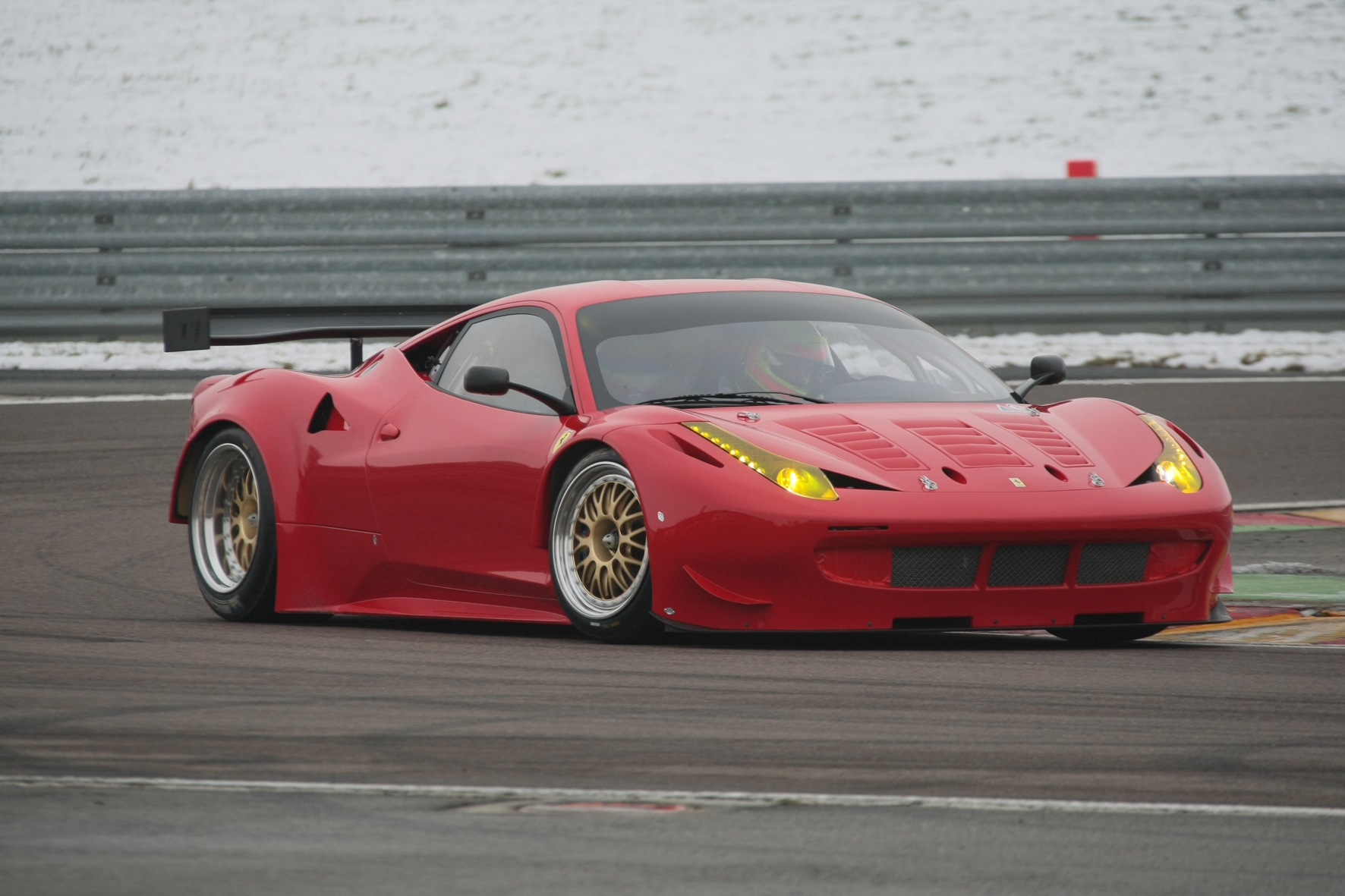
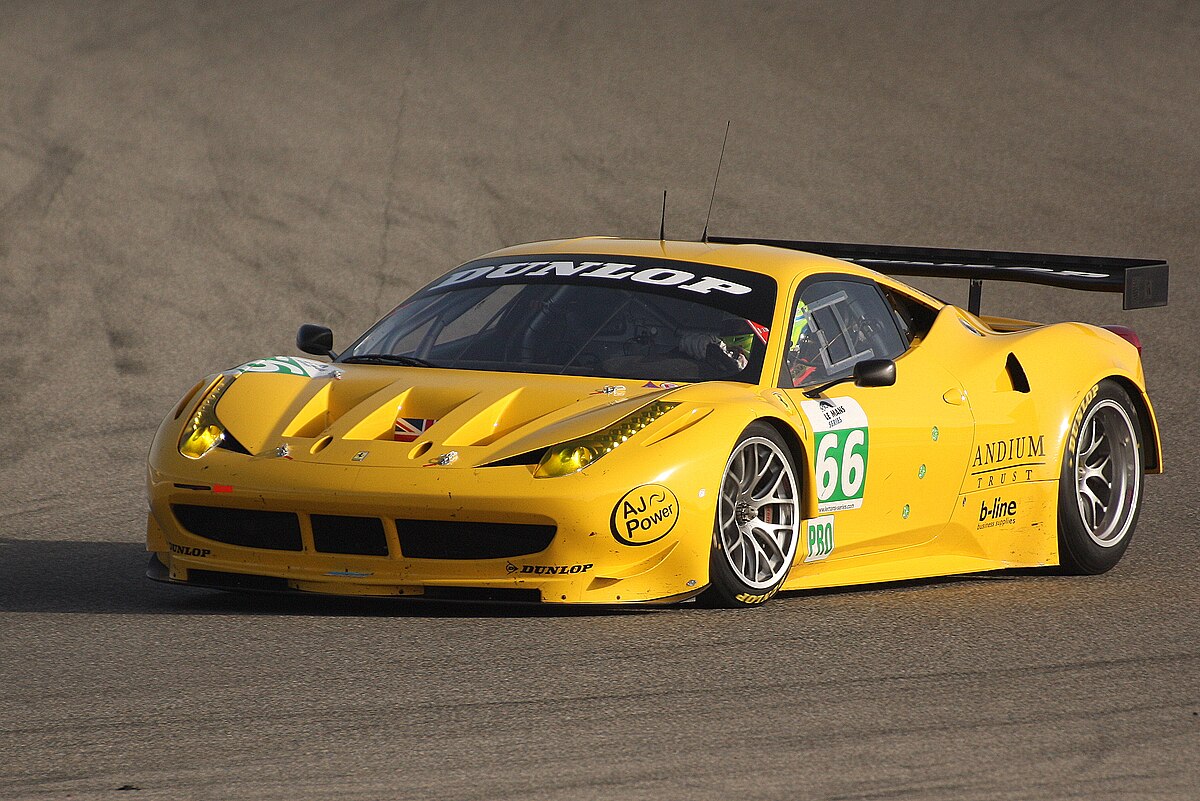
The chassis underwent a similarly ruthless transformation. The road car’s rubber bushings and adaptive magnetorheological dampers were swapped for rigid rose joints and multi-way adjustable racing dampers. This removed all compliance, transmitting every ripple of the tarmac directly to the driver’s spine but ensuring absolute geometric precision under high-G loads. Aerodynamically, the GT2 was a function-over-form evolution of Pininfarina’s design. A massive, adjustable rear wing, a deep front splitter, and a sprawling rear diffuser worked in concert with a flat floor to generate levels of downforce that would crush a standard suspension. The tracks were widened, necessitating bulging, vented fenders that gave the car a menacing, hunkered-down stance, far more aggressive than the narrower GT3 variant. Inside, the leather and carpets were gutted, replaced by a jungle of roll cage tubing, a carbon fiber bucket seat, and a dashboard that was a festival of Motec data logging and toggle switches.
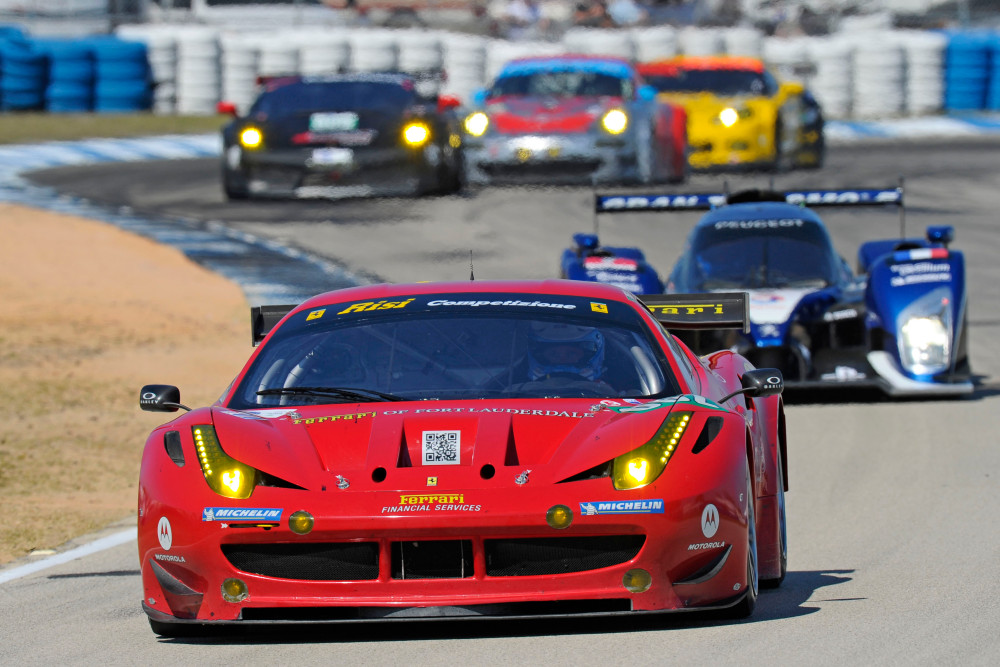
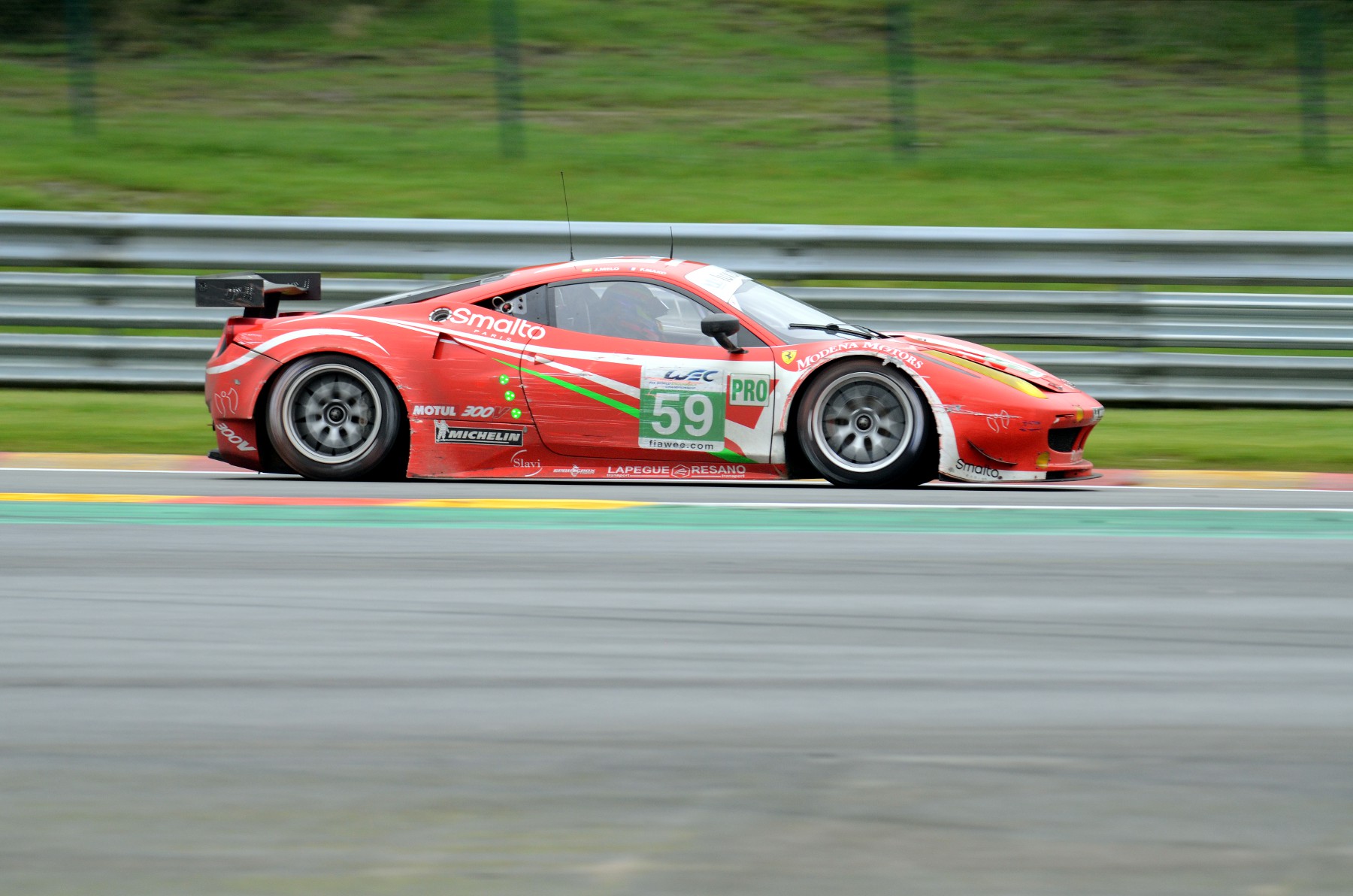
The impact of the 458 GT2 on the World Endurance Championship (WEC) and the European Le Mans Series was immediate and crushing. While it faced teething issues in its debut races against the established BMW M3 GT2s and Corvettes, once the reliability was sorted, it became a metronome of speed. Its crowning glory was its relationship with AF Corse and the virtuoso driver Gianmaria “Gimmi” Bruni. The combination of the 458 GT2, Bruni, and the Italian team became the gold standard of GT racing. The car claimed back-to-back GTE Pro class victories at the 24 Hours of Le Mans in 2012 and 2014. In the 2012 race, the #51 car driven by Bruni, Giancarlo Fisichella, and Toni Vilander didn’t just win; they broke the hearts of the Corvette and Aston Martin teams with a display of faultless reliability and pace.
The 458 GT2’s success wasn’t limited to the professional ranks. Its manageable handling balance—less rear-engined twitchiness than a Porsche, more precision than a Corvette—made it the weapon of choice for GTE Am drivers as well, racking up class wins at Le Mans in 2015 and 2016. It secured multiple WEC Manufacturers’ Cups for Ferrari, effectively painting the podiums of the world red for half a decade. Its rivalry with the Corvette C6.R and later the C7.R defines the modern golden era of GT racing, a transatlantic dogfight played out on the tarmac of La Sarthe, Sebring, and Spa.
The legacy of the Ferrari 458 Italia GT2 is secure as the final emperor of the naturally aspirated era. When it was eventually replaced by the turbocharged 488 GTE in 2016, the sport gained speed but lost soul. The 458 GT2 was the last of the screamers, a car that filled the woods of Le Mans with a piercing, flat-plane V8 wail that was distinct from the turbo-muffled whoosh of its successors. It proved that Ferrari could take its mid-engine berlinetta, strip away the digital aids, and build a mechanical warrior capable of conquering the world’s toughest races. In the pantheon of motorsport, it sits shoulder-to-shoulder with the 250 GTO and the F40 LM, not as a priceless collectible (though it is becoming one), but as a working-class hero that clocked in, did the job, and brought the silverware home to Maranello.
Brand
Produced from
Portal
Model line
Predecessor
Sucessor
Brand
Produced from
Portal
Model line
Model generation
Predecessor
Sucessor
About this submodel
The year 2011 signaled a changing of the guard in the high-stakes world of Grand Touring endurance racing. The Ferrari F430 GT2, a machine that had claimed class victories at Le Mans and Sebring with near-monotonous regularity, was finally put out to pasture. Its successor had gargantuan shoes to fill. The road-going 458 Italia had already stunned the world with its technological wizardry, but transforming a digital, dual-clutch supercar into an analog, endurance-racing gladiator was a task fraught with peril. The result was the 2011 Ferrari 458 Italia GT2 (later known simply as the 458 GTE), a car that would go on to become one of the most successful GT racers in the history of the Prancing Horse. Developed in Padua by Michelotto Automobili—Ferrari’s long-standing partner for non-F1 racing activities—the 458 GT2 arrived at a time when the ACO GTE class was becoming a manufacturer bloodbath, pitting Maranello directly against the factory might of Corvette Racing, the precision of Porsche’s 911 RSRs, and the thunderous Aston Martin Vantages.
Technically, the 458 GT2 was a study in regulation-imposed irony. While the road car boasted 562 bhp, the ACO regulations for the GTE class mandated the use of air restrictors on the intake to balance performance across the grid. Consequently, the race car produced roughly 465 to 470 bhp—nearly 100 horsepower less than the showroom model. However, to judge the GT2 by peak horsepower is to misunderstand the discipline of endurance racing. The 4.5-liter F136 V8 was completely remapped to deliver a flat, muscular torque curve, allowing drivers to haul out of corners with relentless consistency. The fragile, high-tech dual-clutch transmission of the road car was discarded, replaced by a bulletproof Hewland six-speed sequential gearbox with straight-cut gears, capable of withstanding 24 hours of abuse.
The chassis underwent a similarly ruthless transformation. The road car’s rubber bushings and adaptive magnetorheological dampers were swapped for rigid rose joints and multi-way adjustable racing dampers. This removed all compliance, transmitting every ripple of the tarmac directly to the driver’s spine but ensuring absolute geometric precision under high-G loads. Aerodynamically, the GT2 was a function-over-form evolution of Pininfarina’s design. A massive, adjustable rear wing, a deep front splitter, and a sprawling rear diffuser worked in concert with a flat floor to generate levels of downforce that would crush a standard suspension. The tracks were widened, necessitating bulging, vented fenders that gave the car a menacing, hunkered-down stance, far more aggressive than the narrower GT3 variant. Inside, the leather and carpets were gutted, replaced by a jungle of roll cage tubing, a carbon fiber bucket seat, and a dashboard that was a festival of Motec data logging and toggle switches.
The impact of the 458 GT2 on the World Endurance Championship (WEC) and the European Le Mans Series was immediate and crushing. While it faced teething issues in its debut races against the established BMW M3 GT2s and Corvettes, once the reliability was sorted, it became a metronome of speed. Its crowning glory was its relationship with AF Corse and the virtuoso driver Gianmaria “Gimmi” Bruni. The combination of the 458 GT2, Bruni, and the Italian team became the gold standard of GT racing. The car claimed back-to-back GTE Pro class victories at the 24 Hours of Le Mans in 2012 and 2014. In the 2012 race, the #51 car driven by Bruni, Giancarlo Fisichella, and Toni Vilander didn’t just win; they broke the hearts of the Corvette and Aston Martin teams with a display of faultless reliability and pace.
The 458 GT2’s success wasn’t limited to the professional ranks. Its manageable handling balance—less rear-engined twitchiness than a Porsche, more precision than a Corvette—made it the weapon of choice for GTE Am drivers as well, racking up class wins at Le Mans in 2015 and 2016. It secured multiple WEC Manufacturers’ Cups for Ferrari, effectively painting the podiums of the world red for half a decade. Its rivalry with the Corvette C6.R and later the C7.R defines the modern golden era of GT racing, a transatlantic dogfight played out on the tarmac of La Sarthe, Sebring, and Spa.
The legacy of the Ferrari 458 Italia GT2 is secure as the final emperor of the naturally aspirated era. When it was eventually replaced by the turbocharged 488 GTE in 2016, the sport gained speed but lost soul. The 458 GT2 was the last of the screamers, a car that filled the woods of Le Mans with a piercing, flat-plane V8 wail that was distinct from the turbo-muffled whoosh of its successors. It proved that Ferrari could take its mid-engine berlinetta, strip away the digital aids, and build a mechanical warrior capable of conquering the world’s toughest races. In the pantheon of motorsport, it sits shoulder-to-shoulder with the 250 GTO and the F40 LM, not as a priceless collectible (though it is becoming one), but as a working-class hero that clocked in, did the job, and brought the silverware home to Maranello.
Tech Specs
Discover the technical specifications
Tech Specs