
Panoz
Type
Foundation Year
Founder/s
Country
Headquarters
Brand Overview
In the wind tunnel-honed, computer-optimized world of modern motorsport, there exists a rigid orthodoxy. Race cars, particularly sports prototypes, are supposed to look a certain way. They are supposed to be mid-engined wedges, clinical exercises in aerodynamic efficiency designed by PhDs in sterile laboratories. But occasionally, a disruptor arrives who refuses to read the rulebook. In the late 1990s, that disruptor came from the unlikely hills of Braselton, Georgia. It was a brand fueled by pharmaceutical money, Irish whiskey, and a stubborn refusal to follow the herd. It was Panoz. To the casual observer, Panoz is a footnote, a quirky American boutique manufacturer. But to those who stood trackside at Le Mans or Sebring at the turn of the millennium, Panoz is a religion. It represents the thunderous, ground-shaking roar of a Ford V8, the terrifying silhouette of the “Batmobile”, and the indomitable spirit of its founder, Don Panoz.
The story of Panoz is essentially the story of a father and son with very different dreams converging to create something spectacular. Dan Panoz, the son, wanted to build cars. In 1989, he acquired the rights to the chassis of the defunct Irish manufacturer TMC Costin. He wanted to build a pure, lightweight American roadster. Don Panoz, the father, was a pharmaceutical tycoon who held the patent for the nicotine patch. He had the capital and, as it turned out, a dormant but explosive passion for competition. When Dan built the Panoz Roadster—later the AIV (Aluminum Intensive Vehicle)—it was a quirky, cycle-fendered throwback with a Mustang V8. It was fast and fun, but it was a cottage industry product. It was Don who looked at the car, looked at the race track, and decided that if they were going to build cars, they were going to beat the world.
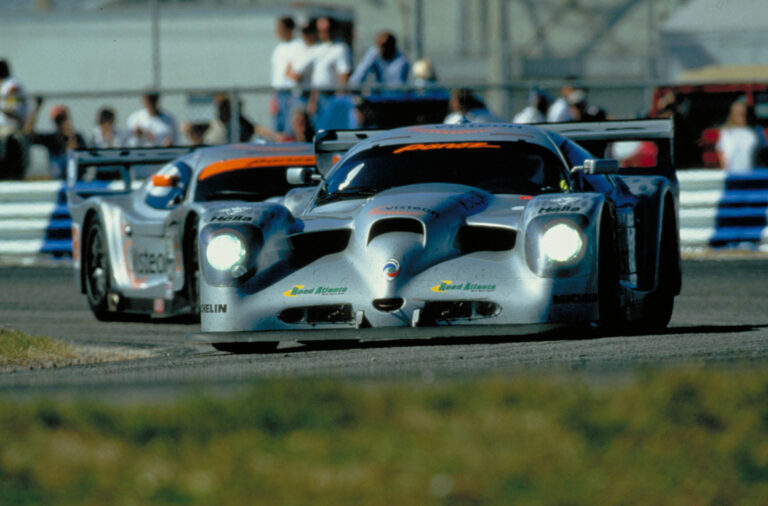
Don Panoz did not know that you weren’t supposed to put the engine in the front of a Le Mans prototype. Or perhaps he knew, and he simply didn’t care. In 1997, aiming for the FIA GT Championship and the 24 Hours of Le Mans, Panoz commissioned Reynard to build the Esperante GTR-1. In an era dominated by the mid-engined Porsche 911 GT1 and Mercedes CLK GTR, the GTR-1 was a shock to the system. It had a snout like an anteater, a cockpit set so far back the driver was practically sitting over the rear axle, and a massive 6.0-litre Ford-Roush V8 under the sprawling bonnet. It looked like the Batmobile. It was brash, it was visually arresting, and it made a noise that sounded like the earth splitting open.
The logic—and there was logic—was that a front-mid-engine layout made the car easier to service and more stable. The experts laughed. Then, the car started winning. In the US, it became a force. But the true cult status arrived when Panoz chopped the roof off. The LMP-1 Roadster S, introduced in 1999, is arguably the most beloved sports prototype of the modern era. While Audi was debuting the clinical, silent R8, Panoz fielded this open-cockpit, front-engine hot rod. It was the “Spirit of America”. The sight of David Brabham or Jan Magnussen wrestling the “Sparky” (as the chassis was nicknamed due to the titanium skid plates showering the following cars in sparks) through the Porsche Curves is one of the definitive images of endurance racing.
The Panoz LMP-1 didn’t just look cool; it was a giant killer. It won the 12 Hours of Sebring. It won at the Nürburgring. It won the Petit Le Mans. In 2000, Panoz defeated the factory Audi R8s and BMW V12 LMRs to win the American Le Mans Series (ALMS) Manufacturers’ Championship. It was a victory for the garagista, for the old-school philosophy of brute force and mechanical grip. It proved that a small team from Georgia could out-muscle the biggest corporate budgets in Germany.
But Don Panoz’s contribution to motoring went far beyond his own cars. He was the saviour of American sports car racing. In the late 90s, US racing was a fractured mess. Don bought Road Atlanta, upgraded it to world-class standards, and created a new race: the Petit Le Mans. He then founded the American Le Mans Series (ALMS), adopting the ACO rules and bringing the magic of Le Mans to tracks like Laguna Seca and Mosport. Without Don Panoz, the modern golden era of IMSA simply would not exist. He was the benevolent dictator who ensured that fans in America could see the best prototypes and GT cars in the world.
On the road, the company produced the Esperante, a refined, aluminium-bodied convertible that competed with the Jaguar XK and Porsche 911. It was rare, exclusive, and hand-built. But true to form, its finest hour came on the track. In 2006, a factory-backed Panoz Esperante GTLM entered the GT2 class at the 12 Hours of Sebring and the 24 Hours of Le Mans. Against the might of the factory Porsche and Ferrari teams, the humble Esperante took the class victory at Le Mans. It was a stunning upset, proving that the company wasn’t just a prototype specialist, but a capable GT constructor as well.
Don Panoz never stopped innovating, even when the ideas seemed insane. In 2012, he partnered with Ben Bowlby to back the DeltaWing. This dart-shaped, “half-weight, half-power” experiment ran at Le Mans as the “Garage 56” entry. It looked like a fighter jet without wings. It steered with tiny front tires. It defied every convention of vehicle dynamics. While it ultimately failed to finish due to a collision, it proved that Panoz was still the home of the radical idea. This spirit continued with the GT-EV, an electric experimental car, and the constant push for alternative fuels.
Panoz also touched the world of open-wheel racing. The Panoz DP01 chassis, built for the final season of the Champ Car World Series in 2007, is widely regarded by drivers as one of the best open-wheel cars ever made. It was fast, safe, and produced great racing. Even though the series merged with IndyCar and the car was retired prematurely, it remains a testament to the engineering capabilities of the Élan Motorsport Technologies group (a Panoz subsidiary).
Don Panoz passed away in 2018, and with him, the automotive world lost one of its last true characters. He was a man who smoked cigarettes on the pit wall while promoting nicotine patches, a man who bought race tracks because he wanted a place to race his cars, and a man who believed that an American V8 belonged at the front of the grid—literally.
Today, the Panoz factory is quieter. The roar of the GTR-1 no longer shakes the Georgia pines on a daily basis. But the legacy is indelible. Panoz proved that you could be different and still win. They proved that character counts for as much as wind tunnel data. Every time a Corvette or a Mustang thunders down the Mulsanne straight, they are driving on pavement paved by the audacious spirit of Don Panoz and his magnificent, front-engined monsters.
Type
Foundation Year
Country
Founder/s
Headquarters

Type
Foundation Year
Country
Founder/s
Headquarters
About this brand
In the wind tunnel-honed, computer-optimized world of modern motorsport, there exists a rigid orthodoxy. Race cars, particularly sports prototypes, are supposed to look a certain way. They are supposed to be mid-engined wedges, clinical exercises in aerodynamic efficiency designed by PhDs in sterile laboratories. But occasionally, a disruptor arrives who refuses to read the rulebook. In the late 1990s, that disruptor came from the unlikely hills of Braselton, Georgia. It was a brand fueled by pharmaceutical money, Irish whiskey, and a stubborn refusal to follow the herd. It was Panoz. To the casual observer, Panoz is a footnote, a quirky American boutique manufacturer. But to those who stood trackside at Le Mans or Sebring at the turn of the millennium, Panoz is a religion. It represents the thunderous, ground-shaking roar of a Ford V8, the terrifying silhouette of the “Batmobile”, and the indomitable spirit of its founder, Don Panoz.
The story of Panoz is essentially the story of a father and son with very different dreams converging to create something spectacular. Dan Panoz, the son, wanted to build cars. In 1989, he acquired the rights to the chassis of the defunct Irish manufacturer TMC Costin. He wanted to build a pure, lightweight American roadster. Don Panoz, the father, was a pharmaceutical tycoon who held the patent for the nicotine patch. He had the capital and, as it turned out, a dormant but explosive passion for competition. When Dan built the Panoz Roadster—later the AIV (Aluminum Intensive Vehicle)—it was a quirky, cycle-fendered throwback with a Mustang V8. It was fast and fun, but it was a cottage industry product. It was Don who looked at the car, looked at the race track, and decided that if they were going to build cars, they were going to beat the world.
Don Panoz did not know that you weren’t supposed to put the engine in the front of a Le Mans prototype. Or perhaps he knew, and he simply didn’t care. In 1997, aiming for the FIA GT Championship and the 24 Hours of Le Mans, Panoz commissioned Reynard to build the Esperante GTR-1. In an era dominated by the mid-engined Porsche 911 GT1 and Mercedes CLK GTR, the GTR-1 was a shock to the system. It had a snout like an anteater, a cockpit set so far back the driver was practically sitting over the rear axle, and a massive 6.0-litre Ford-Roush V8 under the sprawling bonnet. It looked like the Batmobile. It was brash, it was visually arresting, and it made a noise that sounded like the earth splitting open.
The logic—and there was logic—was that a front-mid-engine layout made the car easier to service and more stable. The experts laughed. Then, the car started winning. In the US, it became a force. But the true cult status arrived when Panoz chopped the roof off. The LMP-1 Roadster S, introduced in 1999, is arguably the most beloved sports prototype of the modern era. While Audi was debuting the clinical, silent R8, Panoz fielded this open-cockpit, front-engine hot rod. It was the “Spirit of America”. The sight of David Brabham or Jan Magnussen wrestling the “Sparky” (as the chassis was nicknamed due to the titanium skid plates showering the following cars in sparks) through the Porsche Curves is one of the definitive images of endurance racing.
The Panoz LMP-1 didn’t just look cool; it was a giant killer. It won the 12 Hours of Sebring. It won at the Nürburgring. It won the Petit Le Mans. In 2000, Panoz defeated the factory Audi R8s and BMW V12 LMRs to win the American Le Mans Series (ALMS) Manufacturers’ Championship. It was a victory for the garagista, for the old-school philosophy of brute force and mechanical grip. It proved that a small team from Georgia could out-muscle the biggest corporate budgets in Germany.
But Don Panoz’s contribution to motoring went far beyond his own cars. He was the saviour of American sports car racing. In the late 90s, US racing was a fractured mess. Don bought Road Atlanta, upgraded it to world-class standards, and created a new race: the Petit Le Mans. He then founded the American Le Mans Series (ALMS), adopting the ACO rules and bringing the magic of Le Mans to tracks like Laguna Seca and Mosport. Without Don Panoz, the modern golden era of IMSA simply would not exist. He was the benevolent dictator who ensured that fans in America could see the best prototypes and GT cars in the world.
On the road, the company produced the Esperante, a refined, aluminium-bodied convertible that competed with the Jaguar XK and Porsche 911. It was rare, exclusive, and hand-built. But true to form, its finest hour came on the track. In 2006, a factory-backed Panoz Esperante GTLM entered the GT2 class at the 12 Hours of Sebring and the 24 Hours of Le Mans. Against the might of the factory Porsche and Ferrari teams, the humble Esperante took the class victory at Le Mans. It was a stunning upset, proving that the company wasn’t just a prototype specialist, but a capable GT constructor as well.
Don Panoz never stopped innovating, even when the ideas seemed insane. In 2012, he partnered with Ben Bowlby to back the DeltaWing. This dart-shaped, “half-weight, half-power” experiment ran at Le Mans as the “Garage 56” entry. It looked like a fighter jet without wings. It steered with tiny front tires. It defied every convention of vehicle dynamics. While it ultimately failed to finish due to a collision, it proved that Panoz was still the home of the radical idea. This spirit continued with the GT-EV, an electric experimental car, and the constant push for alternative fuels.
Panoz also touched the world of open-wheel racing. The Panoz DP01 chassis, built for the final season of the Champ Car World Series in 2007, is widely regarded by drivers as one of the best open-wheel cars ever made. It was fast, safe, and produced great racing. Even though the series merged with IndyCar and the car was retired prematurely, it remains a testament to the engineering capabilities of the Élan Motorsport Technologies group (a Panoz subsidiary).
Don Panoz passed away in 2018, and with him, the automotive world lost one of its last true characters. He was a man who smoked cigarettes on the pit wall while promoting nicotine patches, a man who bought race tracks because he wanted a place to race his cars, and a man who believed that an American V8 belonged at the front of the grid—literally.
Today, the Panoz factory is quieter. The roar of the GTR-1 no longer shakes the Georgia pines on a daily basis. But the legacy is indelible. Panoz proved that you could be different and still win. They proved that character counts for as much as wind tunnel data. Every time a Corvette or a Mustang thunders down the Mulsanne straight, they are driving on pavement paved by the audacious spirit of Don Panoz and his magnificent, front-engined monsters.
Submodels
Latest Variants

Model Lines