
Sunbeam
Type
Foundation Year
Founder/s
Country
Headquarters
Brand Overview
In the misty, cobblestoned narrative of the British motor industry, there are names that evoke reliability, names that evoke luxury, and names that evoke failure. But the name Sunbeam evokes something far more visceral: glory. To the uninitiated, the badge might conjure images of a petite, finned roadster driven by Grace Kelly in a Hitchcock film, or perhaps a V8-powered hot rod cobbled together in the swinging sixties. But to look at Sunbeam through such a narrow lens is to ignore one of the most technologically ambitious, fearless, and aristocratic engineering firms ever to emerge from the “Black Country”. There was a time, before the badge engineering of the Rootes Group diluted the wine, when Sunbeam was not just a car maker; it was the “Supreme Car”, a marque that stood shoulder-to-shoulder with Bugatti and Bentley, breaking land speed records on Florida beaches and conquering the Grand Prix circuits of France. The story of Sunbeam is a tragedy of British greatness—a trajectory that soared to the very sun, only to burn its wings and fade into obscurity, leaving behind a legacy of speed that few can match.
The story begins in Wolverhampton, at a factory aptly named “Sunbeamland”. Founded by John Marston in the late 19th century, the company initially produced bicycles of such exquisite quality—finished in deep, lustrous Japanning black with gold leaf pin-striping—that they were considered the Rolls-Royce of two wheels. Marston was a Victorian perfectionist, a man who abhorred shoddiness. But the true architect of Sunbeam’s automotive immortality was not Marston, but a flamboyant Breton engineer named Louis Coatalen. Joining the company in 1909, Coatalen was the spiritual opposite of the conservative Marston. He was a racer, a bon vivant, and a man obsessed with the internal combustion engine. He steered Sunbeam away from sedate tourers and toward the race track.
Coatalen understood that racing improved the breed, and more importantly, it sold cars. Under his direction, Sunbeam became the first British manufacturer to truly grasp the importance of the Grand Prix. While Bentley was wrestling heavy trucks around Le Mans, Sunbeam was building delicate, high-revving, twin-cam machines to fight Fiat and Peugeot. The zenith of this ambition came on July 2, 1923, at the French Grand Prix in Tours. Henry Segrave, piloting a Sunbeam driven by a fiery six-cylinder engine, took the checkered flag. It was a seismic moment: the first time a British car had ever won a Grand Prix. It would take decades for Vanwall and Cooper to repeat the feat. That victory cemented Sunbeam as engineering royalty.
But Coatalen’s ambition could not be contained by a mere race circuit. He looked to the horizon and saw the Land Speed Record. The 1920s were the era of the aero-engine monsters, and Sunbeam was the undisputed king. They built the 350hp Sunbeam, famously named “Blue Bird” by Malcolm Campbell, which broke the record at Pendine Sands. But they went further. In 1927, they unveiled the Sunbeam 1000hp, nicknamed “The Slug”. It was a streamlined red leviathan powered by two V12 Matabele aircraft engines—one mounted in front of the driver, one behind. It was the first car in history to break the 200 mph barrier, driven by Henry Segrave at Daytona Beach. For a brief, shining moment, the fastest car in the world was built in Wolverhampton.
However, engineering brilliance does not always equate to financial stability. The conglomerate Sunbeam-Talbot-Darracq (STD Motors) collapsed in 1935, a victim of the Great Depression and Coatalen’s reckless spending on racing. The marque was rescued by the Rootes brothers, Billy and Reggie. Under the Rootes Group, the bespoke, hand-built engineering of the Coatalen era vanished, replaced by mass-production rationality. Purists wept, but the Rootes era brought a different kind of success. The Sunbeam-Talbot 90 was a rally weapon, a rugged saloon that, in the hands of a young Stirling Moss, earned a Coupe des Alpes (Gold Cup) in the Alpine Rally. It proved that while the Grand Prix DNA was gone, the sporting spirit survived.
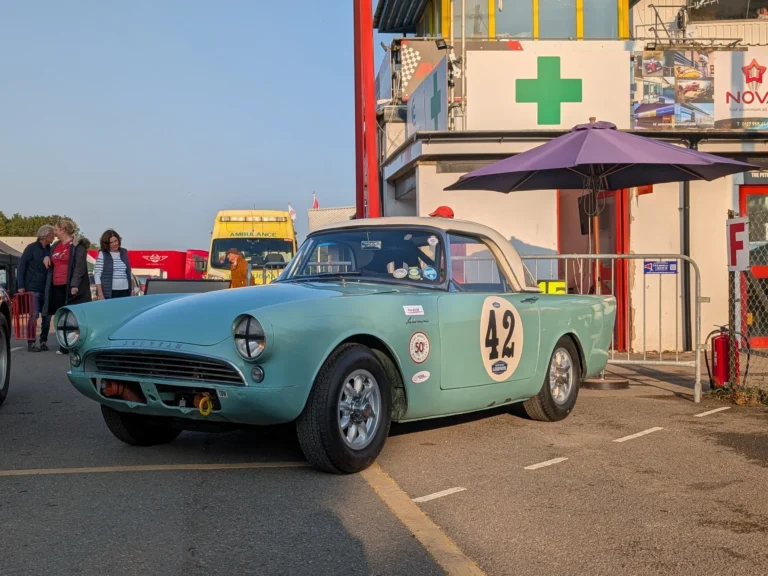
This spirit flourished in the 1950s with the Sunbeam Alpine. It was a glamorous two-seater, built for the export market, capitalizing on the American obsession with British roadsters. It wasn’t particularly fast, but it was stylish, finding fame on the silver screen in To Catch a Thief and as the first car driven by James Bond on screen (in Dr. No). But by the 1960s, the Alpine’s four-cylinder engine was being embarrassed by Triumphs and MGs. Sunbeam needed a hammer.
The solution came from the same man who had solved a similar problem for AC Cars: Carroll Shelby. The Rootes Group hired the Texan to work his magic. Shelby looked at the Alpine’s engine bay, realized a Ford V8 would just about fit, and the Sunbeam Tiger was born. The Tiger was a “poor man’s Cobra”. It had the same 260 (and later 289) cubic inch Ford V8, the same rack-and-pinion steering, and the same ability to shred rear tires. It was a crude, hot-rodding exercise—to change the rear spark plugs, you often had to cut a hole in the firewall or drop the engine—but it was magnificent. It transformed a hairdresser’s car into a muscle car. It remains one of the most undervalued classics of the era, a car with genuine Shelby DNA for a fraction of the price of a Cobra.
The final chapter of Sunbeam is a strange, jagged coda involving Chrysler, who bought the Rootes Group in the late 60s. Chrysler, in their infinite wisdom, killed the Tiger because they couldn’t have a car powered by a Ford engine in their lineup, yet they had no V8 of their own that would fit. The brand languished until a final, unexpected flash of brilliance in the late 70s. Desperate to compete in the “hot hatch” market, the company (now known as Talbot) commissioned Lotus to build an engine for their small Sunbeam hatchback.
The result was the Talbot Sunbeam Lotus. It was an ugly, boxy, rear-wheel-drive hatchback fitted with a 2.2-litre Lotus engine. It was a homologation special, a rally car for the road. In 1981, against the might of the Audi Quattro and the Ford Escort RS, the Sunbeam Lotus won the World Rally Championship for Manufacturers. It was a stunning achievement, a final rage against the dying of the light. Henri Toivonen piloting the Sunbeam Lotus to victory at the RAC Rally is one of the definitive images of pre-Group B rallying.
Sadly, it wasn’t enough. The Sunbeam name was quietly retired in 1981, a casualty of Peugeot’s takeover of Chrysler Europe. The factory at Linwood in Scotland was closed, and the Wolverhampton legacy was finally laid to rest.
Today, Sunbeam occupies a curious space in the collector market. The pre-war cars are revered as masterpieces of the vintage era, standing alongside Bentleys at events like the Goodwood Revival. The Tigers are sought after by those who want American V8 torque with British style. But the connective tissue—the sheer audacity of a company that went from making Japanned bicycles to building the fastest machine on earth—is often lost. Sunbeam was the brand of the pioneer. It was the car of Henry Segrave risking his life on the sands of Daytona. It was the car of Louis Coatalen betting the company’s fortune on a Grand Prix win. It was a brand that never quite knew its place, and because of that, it reached heights that no other British manufacturer, before or since, has ever managed to duplicate in quite the same way.
Type
Foundation Year
Country
Founder/s
Headquarters

Type
Foundation Year
Country
Founder/s
Headquarters
About this brand
In the misty, cobblestoned narrative of the British motor industry, there are names that evoke reliability, names that evoke luxury, and names that evoke failure. But the name Sunbeam evokes something far more visceral: glory. To the uninitiated, the badge might conjure images of a petite, finned roadster driven by Grace Kelly in a Hitchcock film, or perhaps a V8-powered hot rod cobbled together in the swinging sixties. But to look at Sunbeam through such a narrow lens is to ignore one of the most technologically ambitious, fearless, and aristocratic engineering firms ever to emerge from the “Black Country”. There was a time, before the badge engineering of the Rootes Group diluted the wine, when Sunbeam was not just a car maker; it was the “Supreme Car”, a marque that stood shoulder-to-shoulder with Bugatti and Bentley, breaking land speed records on Florida beaches and conquering the Grand Prix circuits of France. The story of Sunbeam is a tragedy of British greatness—a trajectory that soared to the very sun, only to burn its wings and fade into obscurity, leaving behind a legacy of speed that few can match.
The story begins in Wolverhampton, at a factory aptly named “Sunbeamland”. Founded by John Marston in the late 19th century, the company initially produced bicycles of such exquisite quality—finished in deep, lustrous Japanning black with gold leaf pin-striping—that they were considered the Rolls-Royce of two wheels. Marston was a Victorian perfectionist, a man who abhorred shoddiness. But the true architect of Sunbeam’s automotive immortality was not Marston, but a flamboyant Breton engineer named Louis Coatalen. Joining the company in 1909, Coatalen was the spiritual opposite of the conservative Marston. He was a racer, a bon vivant, and a man obsessed with the internal combustion engine. He steered Sunbeam away from sedate tourers and toward the race track.
Coatalen understood that racing improved the breed, and more importantly, it sold cars. Under his direction, Sunbeam became the first British manufacturer to truly grasp the importance of the Grand Prix. While Bentley was wrestling heavy trucks around Le Mans, Sunbeam was building delicate, high-revving, twin-cam machines to fight Fiat and Peugeot. The zenith of this ambition came on July 2, 1923, at the French Grand Prix in Tours. Henry Segrave, piloting a Sunbeam driven by a fiery six-cylinder engine, took the checkered flag. It was a seismic moment: the first time a British car had ever won a Grand Prix. It would take decades for Vanwall and Cooper to repeat the feat. That victory cemented Sunbeam as engineering royalty.
But Coatalen’s ambition could not be contained by a mere race circuit. He looked to the horizon and saw the Land Speed Record. The 1920s were the era of the aero-engine monsters, and Sunbeam was the undisputed king. They built the 350hp Sunbeam, famously named “Blue Bird” by Malcolm Campbell, which broke the record at Pendine Sands. But they went further. In 1927, they unveiled the Sunbeam 1000hp, nicknamed “The Slug”. It was a streamlined red leviathan powered by two V12 Matabele aircraft engines—one mounted in front of the driver, one behind. It was the first car in history to break the 200 mph barrier, driven by Henry Segrave at Daytona Beach. For a brief, shining moment, the fastest car in the world was built in Wolverhampton.
However, engineering brilliance does not always equate to financial stability. The conglomerate Sunbeam-Talbot-Darracq (STD Motors) collapsed in 1935, a victim of the Great Depression and Coatalen’s reckless spending on racing. The marque was rescued by the Rootes brothers, Billy and Reggie. Under the Rootes Group, the bespoke, hand-built engineering of the Coatalen era vanished, replaced by mass-production rationality. Purists wept, but the Rootes era brought a different kind of success. The Sunbeam-Talbot 90 was a rally weapon, a rugged saloon that, in the hands of a young Stirling Moss, earned a Coupe des Alpes (Gold Cup) in the Alpine Rally. It proved that while the Grand Prix DNA was gone, the sporting spirit survived.
This spirit flourished in the 1950s with the Sunbeam Alpine. It was a glamorous two-seater, built for the export market, capitalizing on the American obsession with British roadsters. It wasn’t particularly fast, but it was stylish, finding fame on the silver screen in To Catch a Thief and as the first car driven by James Bond on screen (in Dr. No). But by the 1960s, the Alpine’s four-cylinder engine was being embarrassed by Triumphs and MGs. Sunbeam needed a hammer.
The solution came from the same man who had solved a similar problem for AC Cars: Carroll Shelby. The Rootes Group hired the Texan to work his magic. Shelby looked at the Alpine’s engine bay, realized a Ford V8 would just about fit, and the Sunbeam Tiger was born. The Tiger was a “poor man’s Cobra”. It had the same 260 (and later 289) cubic inch Ford V8, the same rack-and-pinion steering, and the same ability to shred rear tires. It was a crude, hot-rodding exercise—to change the rear spark plugs, you often had to cut a hole in the firewall or drop the engine—but it was magnificent. It transformed a hairdresser’s car into a muscle car. It remains one of the most undervalued classics of the era, a car with genuine Shelby DNA for a fraction of the price of a Cobra.
The final chapter of Sunbeam is a strange, jagged coda involving Chrysler, who bought the Rootes Group in the late 60s. Chrysler, in their infinite wisdom, killed the Tiger because they couldn’t have a car powered by a Ford engine in their lineup, yet they had no V8 of their own that would fit. The brand languished until a final, unexpected flash of brilliance in the late 70s. Desperate to compete in the “hot hatch” market, the company (now known as Talbot) commissioned Lotus to build an engine for their small Sunbeam hatchback.
The result was the Talbot Sunbeam Lotus. It was an ugly, boxy, rear-wheel-drive hatchback fitted with a 2.2-litre Lotus engine. It was a homologation special, a rally car for the road. In 1981, against the might of the Audi Quattro and the Ford Escort RS, the Sunbeam Lotus won the World Rally Championship for Manufacturers. It was a stunning achievement, a final rage against the dying of the light. Henri Toivonen piloting the Sunbeam Lotus to victory at the RAC Rally is one of the definitive images of pre-Group B rallying.
Sadly, it wasn’t enough. The Sunbeam name was quietly retired in 1981, a casualty of Peugeot’s takeover of Chrysler Europe. The factory at Linwood in Scotland was closed, and the Wolverhampton legacy was finally laid to rest.
Today, Sunbeam occupies a curious space in the collector market. The pre-war cars are revered as masterpieces of the vintage era, standing alongside Bentleys at events like the Goodwood Revival. The Tigers are sought after by those who want American V8 torque with British style. But the connective tissue—the sheer audacity of a company that went from making Japanned bicycles to building the fastest machine on earth—is often lost. Sunbeam was the brand of the pioneer. It was the car of Henry Segrave risking his life on the sands of Daytona. It was the car of Louis Coatalen betting the company’s fortune on a Grand Prix win. It was a brand that never quite knew its place, and because of that, it reached heights that no other British manufacturer, before or since, has ever managed to duplicate in quite the same way.
Submodels
Latest Variants
Model Lines