
Bugatti
Type
Foundation Year
Founder/s
Country
Headquarters
Brand Overview
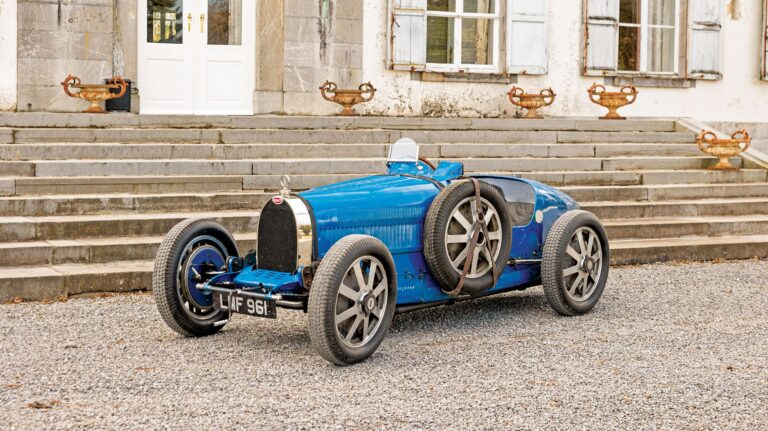
At the 1924 French Grand Prix at Lyon, the new Bugatti Type 35 arrived with exquisite alloy wheels and ended the day humbled by tyre trouble; within two years it had made humiliation look like prophecy. Few racing cars have ever sounded so civilised while crushing opposition so completely. Its straight-eight sang with a hard, metallic treble, a polished snarl from a 2.0-litre (122 cu in) engine that cared less for brute displacement than for balance, lightness and the divine arithmetic of reduced mass. It was a little blue rapier, not a cudgel, and it announced the governing principle of Ettore Bugatti’s world: speed must also be beautiful.
Ettore Arco Isidoro Bugatti, born in Milan in 1881, came from a family in which art was not decoration but bloodline. His father, Carlo, designed furniture and jewellery; his brother Rembrandt sculpted animals with a muscular tenderness that later gave the Royale its elephant mascot. Ettore carried that sensibility into metal. After early work with Prinetti & Stucchi, De Dietrich and Mathis, he established Automobiles Ettore Bugatti in 1909 at Molsheim, then in German Alsace and later returned to France. Molsheim was never merely a factory. It was a court, a studio, a stable and a laboratory, presided over by a patron who would rather offend convention than build an ugly motor car.
The early Type 13, later celebrated as the Brescia, proved that small could be savage. In 1920 at Le Mans, in the Grand Prix de la Sarthe, its compact 1.5-litre (92 cu in) four-cylinder engine and low weight embarrassed larger rivals, teaching Europe a lesson that would echo through every serious racing paddock: kilograms were enemies. By 1923 Bugatti was experimenting with the blunt, slab-sided Type 32, quickly nicknamed the “Tank”, a strange aerodynamic wager that finished third in the French Grand Prix at an average of 114 km/h (71 mph). It looked eccentric, almost wilfully odd, yet beneath the visual shock lay a modern truth. Air mattered. Shape mattered. The wind was no longer background scenery; it was an adversary.
Then came the Type 35, the purest Bugatti argument. Its wheelbase of roughly 2400 mm (94.5 in), narrow body and hollow front axle gave it wiry agility; its aluminium bodywork sat like stretched silk over a steel ladder frame. The early cars weighed about 650 kg (1433 lbs) to 750 kg (1653 lbs), depending on version, and the best supercharged variants reached more than 200 km/h (124 mph). Yet numbers alone miss the miracle. The steering was light but alive, the chassis truthful, the brakes cable-operated and demanding, the engine keen to spin. Private owners could buy one, drive it on the road, race it at the weekend and, if they possessed courage and mechanical sympathy, trouble the works entries. Bugatti had democratised the Grand Prix car, though only for those wealthy enough to join the sect.
Its record became almost absurd. The Type 35 family won the 1926 Grand Prix World Championship and dominated the Targa Florio five years running from 1925 to 1929, carving through Sicilian mountains where dust, stone walls and fatigue punished anything clumsy. Bugatti victories accumulated at grands prix, hill climbs and road races until the total passed into legend, counted in the thousands. The French racing blue livery became less a colour than a warning. Around hairpins the cars seemed to pivot on instinct; on straights they held a line with aristocratic calm, exhaust notes ricocheting from village walls like gunfire played on a violin.
Bugatti’s genius, however, was never confined to racing. Ettore also built monuments to extravagance. The Type 41 Royale, produced from 1926 to 1933, measured roughly 6.4 metres (21 ft) long and used a colossal 12.7-litre (775 cu in) straight-eight engine. It was intended for monarchs and magnates, yet history played one of its colder jokes: the Great Depression arrived and kings proved less numerous as customers than ambition required. Only six Royales were built, vast and serene machines whose bonnets seemed to run towards the horizon. They did not bark; they advanced, their engines murmuring with locomotive dignity, every sweep of coachwork declaring that excess could be disciplined into form.
The 1930s belonged increasingly to Jean Bugatti, Ettore’s gifted son, whose eye softened the marque without weakening it. The Type 57 was his masterpiece, a family of touring and sporting cars that included the Atalante and the mythical Type 57SC Atlantic. The Atlantic’s riveted dorsal seam, required by its electron-alloy conception and retained as visual drama, gave the car the menace of a predatory fish and the poise of couture. Beneath the bonnet sat a 3.3-litre (201 cu in) straight-eight, and in supercharged form the 57SC could approach 200 km/h (124 mph). It was not merely fast; it looked as if it had escaped from a future that had understood elegance better than our own.
Jean also sharpened Bugatti’s endurance reputation. In 1937, Jean-Pierre Wimille and Robert Benoist won the 24 Hours of Le Mans in a Type 57G ’Tank’, covering 3287 km (2043 miles). In 1939, Wimille returned with Pierre Veyron and won again, the streamlined body cutting the Mulsanne air with uncanny efficiency. But that same year Jean died while testing a Type 57 near Molsheim. He was only 30. The tragedy struck the company like a cracked crankcase. War followed, the factory was disrupted, and Ettore, already ageing and wounded by grief and occupation, died in 1947. The old Bugatti, the Bugatti of hand-filed components and imperious blue racers, never truly recovered.
There were afterlives. Romano Artioli revived the name in Italy in the late 1980s, creating the EB110 at Campogalliano. Its quad-turbocharged 3.5-litre (214 cu in) V12, carbon-fibre structure and four-wheel drive made it one of the defining supercars of the early 1990s, capable of around 342 km/h (213 mph) in Super Sport form. The venture collapsed, but it proved the badge could still demand extremes. Volkswagen then acquired the marque and returned it spiritually to Molsheim, where the Veyron 16.4 rewrote the upper limit of the road car. Its 8.0-litre (488 cu in) quad-turbocharged W16 produced 1001 PS and exceeded 400 km/h (249 mph), making absurdity repeatable, warrantied and upholstered.
The Chiron carried that obsession into a denser, more violent register: 8.0 litres (488 cu in), four turbochargers, immense heat, immense grip, immense theatre. At full attack it is less a car than a controlled weather event, the W16 compressing the horizon while the bodywork manages pressure, cooling and poise with ruthless intelligence. Later came the W16 Mistral and Bolide, end-of-era machines that treated the engine as both weapon and relic. Now, under Bugatti Rimac, the Tourbillon opens a V16 chapter, promising continuity through transformation rather than nostalgia. Bugatti has always been most authentic when it risks absurdity in pursuit of grace.
That is the thread from Type 13 to Tourbillon: not luxury alone, not speed alone, but the refusal to separate engineering from sculpture. A Bugatti grille is a signature, a horseshoe doorway into a philosophy. The best of them feel alive before they move; once moving, they reveal why Ettore’s severity mattered. Weight, proportion, metallurgy, sound, touch, the arc of a wing, the feel of a gearlever, the exact curve of a windscreen: for Molsheim these were not separate departments. They were one language. Bugatti’s history is full of arrogance, brilliance, miscalculation and grief, yet its finest cars still possess a quality rivals seldom touch. They make performance feel ceremonial.
Type
Foundation Year
Country
Founder/s
Headquarters

Type
Foundation Year
Country
Founder/s
Headquarters
About this brand
At the 1924 French Grand Prix at Lyon, the new Bugatti Type 35 arrived with exquisite alloy wheels and ended the day humbled by tyre trouble; within two years it had made humiliation look like prophecy. Few racing cars have ever sounded so civilised while crushing opposition so completely. Its straight-eight sang with a hard, metallic treble, a polished snarl from a 2.0-litre (122 cu in) engine that cared less for brute displacement than for balance, lightness and the divine arithmetic of reduced mass. It was a little blue rapier, not a cudgel, and it announced the governing principle of Ettore Bugatti’s world: speed must also be beautiful.
Ettore Arco Isidoro Bugatti, born in Milan in 1881, came from a family in which art was not decoration but bloodline. His father, Carlo, designed furniture and jewellery; his brother Rembrandt sculpted animals with a muscular tenderness that later gave the Royale its elephant mascot. Ettore carried that sensibility into metal. After early work with Prinetti & Stucchi, De Dietrich and Mathis, he established Automobiles Ettore Bugatti in 1909 at Molsheim, then in German Alsace and later returned to France. Molsheim was never merely a factory. It was a court, a studio, a stable and a laboratory, presided over by a patron who would rather offend convention than build an ugly motor car.
The early Type 13, later celebrated as the Brescia, proved that small could be savage. In 1920 at Le Mans, in the Grand Prix de la Sarthe, its compact 1.5-litre (92 cu in) four-cylinder engine and low weight embarrassed larger rivals, teaching Europe a lesson that would echo through every serious racing paddock: kilograms were enemies. By 1923 Bugatti was experimenting with the blunt, slab-sided Type 32, quickly nicknamed the “Tank”, a strange aerodynamic wager that finished third in the French Grand Prix at an average of 114 km/h (71 mph). It looked eccentric, almost wilfully odd, yet beneath the visual shock lay a modern truth. Air mattered. Shape mattered. The wind was no longer background scenery; it was an adversary.
Then came the Type 35, the purest Bugatti argument. Its wheelbase of roughly 2400 mm (94.5 in), narrow body and hollow front axle gave it wiry agility; its aluminium bodywork sat like stretched silk over a steel ladder frame. The early cars weighed about 650 kg (1433 lbs) to 750 kg (1653 lbs), depending on version, and the best supercharged variants reached more than 200 km/h (124 mph). Yet numbers alone miss the miracle. The steering was light but alive, the chassis truthful, the brakes cable-operated and demanding, the engine keen to spin. Private owners could buy one, drive it on the road, race it at the weekend and, if they possessed courage and mechanical sympathy, trouble the works entries. Bugatti had democratised the Grand Prix car, though only for those wealthy enough to join the sect.
Its record became almost absurd. The Type 35 family won the 1926 Grand Prix World Championship and dominated the Targa Florio five years running from 1925 to 1929, carving through Sicilian mountains where dust, stone walls and fatigue punished anything clumsy. Bugatti victories accumulated at grands prix, hill climbs and road races until the total passed into legend, counted in the thousands. The French racing blue livery became less a colour than a warning. Around hairpins the cars seemed to pivot on instinct; on straights they held a line with aristocratic calm, exhaust notes ricocheting from village walls like gunfire played on a violin.
Bugatti’s genius, however, was never confined to racing. Ettore also built monuments to extravagance. The Type 41 Royale, produced from 1926 to 1933, measured roughly 6.4 metres (21 ft) long and used a colossal 12.7-litre (775 cu in) straight-eight engine. It was intended for monarchs and magnates, yet history played one of its colder jokes: the Great Depression arrived and kings proved less numerous as customers than ambition required. Only six Royales were built, vast and serene machines whose bonnets seemed to run towards the horizon. They did not bark; they advanced, their engines murmuring with locomotive dignity, every sweep of coachwork declaring that excess could be disciplined into form.
The 1930s belonged increasingly to Jean Bugatti, Ettore’s gifted son, whose eye softened the marque without weakening it. The Type 57 was his masterpiece, a family of touring and sporting cars that included the Atalante and the mythical Type 57SC Atlantic. The Atlantic’s riveted dorsal seam, required by its electron-alloy conception and retained as visual drama, gave the car the menace of a predatory fish and the poise of couture. Beneath the bonnet sat a 3.3-litre (201 cu in) straight-eight, and in supercharged form the 57SC could approach 200 km/h (124 mph). It was not merely fast; it looked as if it had escaped from a future that had understood elegance better than our own.
Jean also sharpened Bugatti’s endurance reputation. In 1937, Jean-Pierre Wimille and Robert Benoist won the 24 Hours of Le Mans in a Type 57G ’Tank’, covering 3287 km (2043 miles). In 1939, Wimille returned with Pierre Veyron and won again, the streamlined body cutting the Mulsanne air with uncanny efficiency. But that same year Jean died while testing a Type 57 near Molsheim. He was only 30. The tragedy struck the company like a cracked crankcase. War followed, the factory was disrupted, and Ettore, already ageing and wounded by grief and occupation, died in 1947. The old Bugatti, the Bugatti of hand-filed components and imperious blue racers, never truly recovered.
There were afterlives. Romano Artioli revived the name in Italy in the late 1980s, creating the EB110 at Campogalliano. Its quad-turbocharged 3.5-litre (214 cu in) V12, carbon-fibre structure and four-wheel drive made it one of the defining supercars of the early 1990s, capable of around 342 km/h (213 mph) in Super Sport form. The venture collapsed, but it proved the badge could still demand extremes. Volkswagen then acquired the marque and returned it spiritually to Molsheim, where the Veyron 16.4 rewrote the upper limit of the road car. Its 8.0-litre (488 cu in) quad-turbocharged W16 produced 1001 PS and exceeded 400 km/h (249 mph), making absurdity repeatable, warrantied and upholstered.
The Chiron carried that obsession into a denser, more violent register: 8.0 litres (488 cu in), four turbochargers, immense heat, immense grip, immense theatre. At full attack it is less a car than a controlled weather event, the W16 compressing the horizon while the bodywork manages pressure, cooling and poise with ruthless intelligence. Later came the W16 Mistral and Bolide, end-of-era machines that treated the engine as both weapon and relic. Now, under Bugatti Rimac, the Tourbillon opens a V16 chapter, promising continuity through transformation rather than nostalgia. Bugatti has always been most authentic when it risks absurdity in pursuit of grace.
That is the thread from Type 13 to Tourbillon: not luxury alone, not speed alone, but the refusal to separate engineering from sculpture. A Bugatti grille is a signature, a horseshoe doorway into a philosophy. The best of them feel alive before they move; once moving, they reveal why Ettore’s severity mattered. Weight, proportion, metallurgy, sound, touch, the arc of a wing, the feel of a gearlever, the exact curve of a windscreen: for Molsheim these were not separate departments. They were one language. Bugatti’s history is full of arrogance, brilliance, miscalculation and grief, yet its finest cars still possess a quality rivals seldom touch. They make performance feel ceremonial.
Submodels
Latest Variants

Model Lines