Allard
Type
Foundation Year
Founder/s
Country
Headquarters
Brand Overview
The deafening, ungodly bellow of a 5.4-litre (331 cu in) Cadillac V8 tearing through the damp French night in 1950 is a sound etched permanently into motorsport folklore. Sydney Allard and Tom Cole, wrestling a rudimentary British roadster with a gearbox jammed in top gear for ten excruciating hours, somehow bludgeoned their way to a miraculous third place overall at the 24 Hours of Le Mans. This heroic, brutal drive perfectly encapsulated the ethos of Allard. The brand did not exist to coddle its occupants with polished walnut or supple leather; it was forged to deliver sheer, terrifying acceleration. The fundamental DNA was simple but devastating: construct an immensely robust, rudimentary chassis, clad it in a lightweight aluminium body, and stuff the engine bay with a torque-rich American V8 from Ford, Cadillac, or Chrysler.
This uncompromising philosophy was born in the freezing mud of British Trials competition. Long before the company was formally established, Sydney Allard, a fiercely competitive driver and gifted mechanic, built bespoke specials designed to claw through rutted hillsides and flooded bogs. In the 1930s, he salvaged Ford flathead V8 engines and chassis components, ingeniously grafting them to sleek Bugatti tail sections rescued from local scrapyards. These unstoppable “Allard Specials” dominated the pre-war mud-plugging scene, proving practically invincible in the dirt and laying the technological foundation for the ferocious road cars that would soon follow.
Following the Second World War, the Allard Motor Company was officially founded in 1946 in Clapham, London. In a devastated Britain crippled by severe steel shortages, Sydney shrewdly capitalised on an abundance of surplus Ford parts. The factory released its first true production models: the competition-focused J1, the nimble two-seater K1, the four-seater L-Type, and the slightly more refined M-Type drophead. These early cars shared a bizarre engineering quirk in their Ballamy divided-axle independent front suspension. This rudimentary setup resulted in a grotesque positive camber under heavy cornering—making the front tyres look as though they were folding completely beneath the bonnet—but it offered phenomenal compliance and grip on the terribly scarred and uneven roads of post-war Europe.
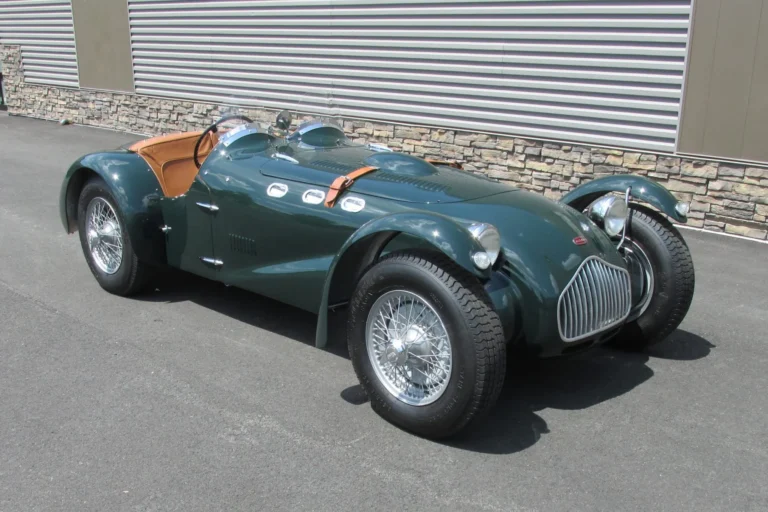
The dawn of the 1950s brought Allard’s absolute zenith with the introduction of the mythical J2 and its eventual evolution, the J2X. Realising the domestic British market was impoverished, Allard aimed these stripped-out roadsters squarely at America. The cars were shipped across the Atlantic entirely devoid of engines, allowing power-hungry buyers to install gigantic overhead-valve V8s locally. Tipping the scales at a mere 940 kg (2072 lbs), a J2 possessed a savage power-to-weight ratio, capable of sprinting from 0-96 km/h (0-60 mph) in roughly six seconds. The handling was notorious, demanding immense physical strength and courage to keep the rear wheels from constantly overtaking the front. Yet, this sheer brute force attracted the era’s finest motoring minds. A young Carroll Shelby launched his racing career in 1953 by wrestling a Cadillac-powered J2 to multiple victories in the SCCA, an experience that heavily influenced his later creation of the Shelby Cobra. Similarly, the brilliant engineer Zora Arkus-Duntov—the future father of the Corvette—raced an Allard at Le Mans and applied his learnings to American sports cars, notably developing the famous Ardun overhead-valve conversion for the Ford flatheads used in many Allards. The crowning achievement of this golden era occurred in 1952, when Sydney Allard navigated a massive, closed Allard P1 saloon, powered by a 4.4-litre (267 cu in) Ford V8, through treacherous Alpine blizzards to win the Monte Carlo Rally outright. Starting his journey from Glasgow, he bested Stirling Moss to become the only man in history to win the legendary rally driving a car bearing his own name.
However, the mechanical landscape was shifting rapidly. By 1953, the crude formula of placing a massive engine in a simple chassis was losing ground to European sophistication. Manufacturers like Jaguar introduced the monocoque C-Type and D-Type, featuring aerodynamic mastery and revolutionary disc brakes. Allard’s subsequent offerings—the Palm Beach roadster, the wider K3, and the vast Safari Estate—lacked the technological polish of their rivals and struggled heavily in the showrooms. Then, attempting to provide a cheap alternative to motorcycles in a period of severe post-war austerity, Sydney committed a fatal commercial error: the 1954 Allard Clipper. An abhorrent three-wheeled microcar clad in colour-impregnated fibreglass and powered by a pathetic 346 cc (21.1 cu in) Villiers two-stroke motorcycle engine, it was the absolute antithesis of the Allard spirit. Plagued by extreme overheating and snapped driveshafts, it was a colossal disaster of design and reliability, with only roughly 20 units ever produced.
The Clipper debacle haemorrhaged vital funds, and without the immense capital required to develop modern, lightweight chassis architectures or establish mass-production facilities, the company withered. By the late 1950s, unable to compete with the refined, disc-braked sports cars from Aston Martin and Jaguar available at similar price points, the Allard Motor Company was forced into obsolescence and bankruptcy, officially ceasing series automobile production.
Yet, Sydney’s obsession with absolute acceleration refused to die. In the brand’s afterlife, the workshop survived by modifying Ford Anglias and fitting Shorrock superchargers. Fascinated by the raw violence of American straight-line racing, Sydney built the first official European dragster in 1961. The Allard Chrysler Dragster, propelled by a 5.8-litre (354 cu in) supercharged Chrysler Hemi, shattered British records and introduced the sport of drag racing to Europe through a series of legendary festivals, cementing Sydney’s legacy before his death in 1966.
While the original company perished decades ago, the thunder of its V8s endures in an ultra-exclusive niche of continuation cars. In North America, Allard Motor Works constructs the J2X Mk II, a superbly engineered, street-legal modern replica. Concurrently, the Allard bloodline remains active; Sydney’s son Alan and grandson Lloyd retrieved the original factory blueprints to hand-build a strictly limited run of exact continuation models of the 1953 JR sports racer in the UK. Through them, the deafening, brutal spirit of Clapham’s greatest hot-rodder lives on, still smoking tyres and rattling windows at historic events like Goodwood.
Type
Foundation Year
Country
Founder/s
Headquarters
Type
Foundation Year
Country
Founder/s
Headquarters
About this brand
The deafening, ungodly bellow of a 5.4-litre (331 cu in) Cadillac V8 tearing through the damp French night in 1950 is a sound etched permanently into motorsport folklore. Sydney Allard and Tom Cole, wrestling a rudimentary British roadster with a gearbox jammed in top gear for ten excruciating hours, somehow bludgeoned their way to a miraculous third place overall at the 24 Hours of Le Mans. This heroic, brutal drive perfectly encapsulated the ethos of Allard. The brand did not exist to coddle its occupants with polished walnut or supple leather; it was forged to deliver sheer, terrifying acceleration. The fundamental DNA was simple but devastating: construct an immensely robust, rudimentary chassis, clad it in a lightweight aluminium body, and stuff the engine bay with a torque-rich American V8 from Ford, Cadillac, or Chrysler.
This uncompromising philosophy was born in the freezing mud of British Trials competition. Long before the company was formally established, Sydney Allard, a fiercely competitive driver and gifted mechanic, built bespoke specials designed to claw through rutted hillsides and flooded bogs. In the 1930s, he salvaged Ford flathead V8 engines and chassis components, ingeniously grafting them to sleek Bugatti tail sections rescued from local scrapyards. These unstoppable “Allard Specials” dominated the pre-war mud-plugging scene, proving practically invincible in the dirt and laying the technological foundation for the ferocious road cars that would soon follow.
Following the Second World War, the Allard Motor Company was officially founded in 1946 in Clapham, London. In a devastated Britain crippled by severe steel shortages, Sydney shrewdly capitalised on an abundance of surplus Ford parts. The factory released its first true production models: the competition-focused J1, the nimble two-seater K1, the four-seater L-Type, and the slightly more refined M-Type drophead. These early cars shared a bizarre engineering quirk in their Ballamy divided-axle independent front suspension. This rudimentary setup resulted in a grotesque positive camber under heavy cornering—making the front tyres look as though they were folding completely beneath the bonnet—but it offered phenomenal compliance and grip on the terribly scarred and uneven roads of post-war Europe.
The dawn of the 1950s brought Allard’s absolute zenith with the introduction of the mythical J2 and its eventual evolution, the J2X. Realising the domestic British market was impoverished, Allard aimed these stripped-out roadsters squarely at America. The cars were shipped across the Atlantic entirely devoid of engines, allowing power-hungry buyers to install gigantic overhead-valve V8s locally. Tipping the scales at a mere 940 kg (2072 lbs), a J2 possessed a savage power-to-weight ratio, capable of sprinting from 0-96 km/h (0-60 mph) in roughly six seconds. The handling was notorious, demanding immense physical strength and courage to keep the rear wheels from constantly overtaking the front. Yet, this sheer brute force attracted the era’s finest motoring minds. A young Carroll Shelby launched his racing career in 1953 by wrestling a Cadillac-powered J2 to multiple victories in the SCCA, an experience that heavily influenced his later creation of the Shelby Cobra. Similarly, the brilliant engineer Zora Arkus-Duntov—the future father of the Corvette—raced an Allard at Le Mans and applied his learnings to American sports cars, notably developing the famous Ardun overhead-valve conversion for the Ford flatheads used in many Allards. The crowning achievement of this golden era occurred in 1952, when Sydney Allard navigated a massive, closed Allard P1 saloon, powered by a 4.4-litre (267 cu in) Ford V8, through treacherous Alpine blizzards to win the Monte Carlo Rally outright. Starting his journey from Glasgow, he bested Stirling Moss to become the only man in history to win the legendary rally driving a car bearing his own name.
However, the mechanical landscape was shifting rapidly. By 1953, the crude formula of placing a massive engine in a simple chassis was losing ground to European sophistication. Manufacturers like Jaguar introduced the monocoque C-Type and D-Type, featuring aerodynamic mastery and revolutionary disc brakes. Allard’s subsequent offerings—the Palm Beach roadster, the wider K3, and the vast Safari Estate—lacked the technological polish of their rivals and struggled heavily in the showrooms. Then, attempting to provide a cheap alternative to motorcycles in a period of severe post-war austerity, Sydney committed a fatal commercial error: the 1954 Allard Clipper. An abhorrent three-wheeled microcar clad in colour-impregnated fibreglass and powered by a pathetic 346 cc (21.1 cu in) Villiers two-stroke motorcycle engine, it was the absolute antithesis of the Allard spirit. Plagued by extreme overheating and snapped driveshafts, it was a colossal disaster of design and reliability, with only roughly 20 units ever produced.
The Clipper debacle haemorrhaged vital funds, and without the immense capital required to develop modern, lightweight chassis architectures or establish mass-production facilities, the company withered. By the late 1950s, unable to compete with the refined, disc-braked sports cars from Aston Martin and Jaguar available at similar price points, the Allard Motor Company was forced into obsolescence and bankruptcy, officially ceasing series automobile production.
Yet, Sydney’s obsession with absolute acceleration refused to die. In the brand’s afterlife, the workshop survived by modifying Ford Anglias and fitting Shorrock superchargers. Fascinated by the raw violence of American straight-line racing, Sydney built the first official European dragster in 1961. The Allard Chrysler Dragster, propelled by a 5.8-litre (354 cu in) supercharged Chrysler Hemi, shattered British records and introduced the sport of drag racing to Europe through a series of legendary festivals, cementing Sydney’s legacy before his death in 1966.
While the original company perished decades ago, the thunder of its V8s endures in an ultra-exclusive niche of continuation cars. In North America, Allard Motor Works constructs the J2X Mk II, a superbly engineered, street-legal modern replica. Concurrently, the Allard bloodline remains active; Sydney’s son Alan and grandson Lloyd retrieved the original factory blueprints to hand-build a strictly limited run of exact continuation models of the 1953 JR sports racer in the UK. Through them, the deafening, brutal spirit of Clapham’s greatest hot-rodder lives on, still smoking tyres and rattling windows at historic events like Goodwood.
Submodels
Latest Variants
Model Lines