
Delahaye
Type
Foundation Year
Founder/s
Country
Headquarters
Brand Overview
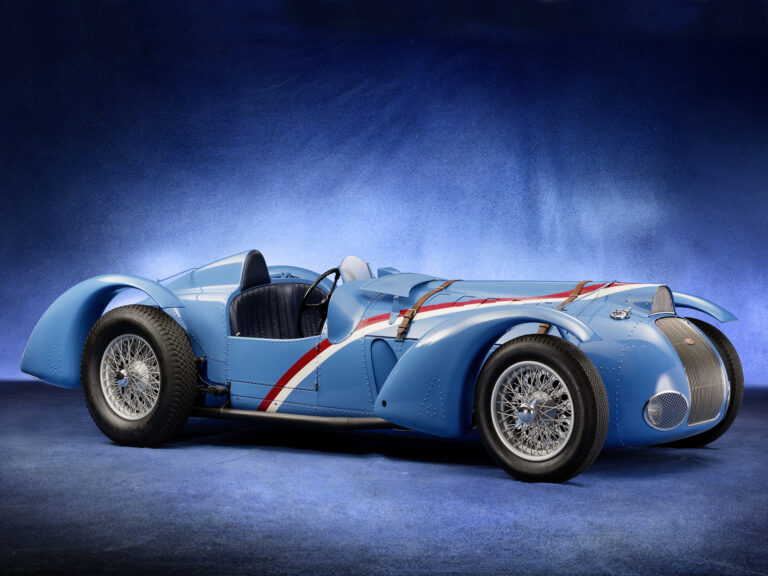
At Le Mans in 1938, a privately entered Delahaye 135 CS limped and thundered through the night with a recalcitrant gearbox, yet still carried Eugène Chaboud and Jean Trémoulet to victory. It was a perfectly French triumph: improvised, elegant, stubborn, and faintly operatic. The car was not a blunt instrument but a long-bonneted blade, its straight-six singing through the darkness with that metallic, chesty timbre peculiar to a large unsupercharged pre-war engine, a noise somewhere between a hunting horn and a lathe under heavy load.
Delahaye’s story began far from concours lawns. Émile Delahaye, born in Tours in 1843, was an engineer of the old industrial school: machines first, romance afterwards. By 1894 he was experimenting with motor cars at Tours, and the early Delahayes were robust, practical devices with rear-mounted engines, belt and chain drive, and the air of workshop pragmatism. Émile himself used competition as advertising, entering the Paris–Marseille–Paris road race in 1896. Those primitive events were less sport than ordeal, where dust, stones, tyres and anatomy all suffered equally, but they established the name among France’s pioneers.
In 1898 the company moved production to Paris after Delahaye joined forces with Léon Desmarais and Georges Morane. Émile retired in 1901 and died in 1905, yet the marque retained his engineering sobriety. Under Charles Weiffenbach, known as “Monsieur Charles”, Delahaye built lorries, buses, fire engines and dependable cars. That breadth mattered. The firm’s later aristocratic machinery was rooted not in fragile salon theatrics but in commercial stamina: engines that could pull a load, brakes that had to work, chassis members that knew the weight of duty before the weight of a coachbuilt dream.
The transformation came in the 1930s, when France, though politically anxious and economically strained, still understood speed as theatre. Delahaye established a competition department in 1932, acquired Delage in 1935, and found its defining instrument in the Type 135. Introduced in 1935 and designed by Jean François, the 135 used a six-cylinder engine of 3.2 litres (195 cu in), later enlarged to 3.6 litres (217 cu in) in the 135M and faster 135 MS forms. It had independent front suspension by transverse leaf spring, a live rear axle, cable-operated Bendix brakes, and a four-speed manual gearbox or Cotal electromagnetic preselector. None of this was revolutionary in isolation; together, it gave the car balance, toughness and a remarkable appetite for hard roads.
That appetite produced the “Coupe des Alpes” nickname after success in the Alpine rallies, where Delahayes clawed over passes with the bonnet lifting slightly on crests and the rear axle skittering under power on broken surfaces. A bare 135 chassis could weigh roughly 935 kg (2061 lbs), depending on form, and even the road cars had a lean athleticism beneath their couture clothing. With triple carburettors and the larger engine, the strongest 135 MS variants have been credited with up to around 160 bhp; more important was the manner of delivery, a muscular surge rather than a shriek, pulling from the diaphragm and hardening into a grand mechanical bellow.
Then the coachbuilders arrived and turned competent metallurgy into moving sculpture. Figoni et Falaschi, Saoutchik, Chapron, Pourtout, Franay, Letourneur et Marchand and others treated the Delahaye chassis as a stage. The best bodies did not merely cover mechanical parts; they dramatized them. Wings flowed like wet silk. Chrome flashed like jewellery under gaslight. Windscreens sat low and rakish, boots tapered, bonnets stretched ahead with predatory calm. Figoni’s enveloping wings and two-tone paint schemes could make a 135 look as if it had been blown smooth in a wind tunnel, though the true force at work was Parisian bravura.
Yet Delahaye was never just a boulevard apparition. In 1936, its competition cars took second and third in the Mille Miglia, proving that French elegance could survive Italian punishment. At Le Mans two years later, the blue 135 CS of Chaboud and Trémoulet inherited the lead after Raymond Sommer and Clemente Biondetti’s Alfa Romeo was undone by tyre failure on the Hunaudières. The Delahaye had its own misery, reportedly running for hour after hour in top gear, but it endured. Another 135 CS finished second with Yves Giraud-Cabantous and Gaston Serraud, while a third Delahaye came fourth. Only 15 of 42 starters reached the flag; Delahaye reached it with composure.
The V12 Type 145 added a fiercer chapter. Built to confront the state-subsidised might of Auto Union and Mercedes-Benz under the 4.5-litre (275 cu in) unsupercharged Grand Prix formula, it carried a 4.5-litre (275 cu in) twelve-cylinder engine and the compact menace of a prizefighter in evening dress. René Dreyfus’s victory in the 1938 Pau Grand Prix, achieved against Rudolf Caracciola’s Mercedes-Benz, became one of those bright pre-war moments that later seemed almost mythical. It was not a campaign of Germanic industrial scale, but a flash of French precision, courage and useful defiance.
War broke the spell. Occupation scattered resources, hid cars, starved factories and changed taste. After 1945, Delahaye returned with the 135, then the grander Type 175, 178 and 180 series, and finally the Type 235 of 1951. The cars were still handsome, still exquisitely furnished, still capable of making a connoisseur pause before opening the door. But France’s fiscal climate punished large engines, export markets were difficult, and unit construction, mass production and modern suspensions were rewriting the rules. A coachbuilt Delahaye, with its separate chassis and hand-beaten aluminium panels, belonged to an older rhythm of craftsmanship.
In 1954 Hotchkiss absorbed Delahaye, and car production ended. Delage, already under Delahaye control since the mid-1930s, vanished with it. The closing was not merely commercial housekeeping; it marked the end of one of France’s great pre-war idioms, where a customer selected a chassis like a patron selecting marble, then asked a coachbuilder to carve desire into metal. What remains is unusually potent. A Delahaye can be admired as sculpture, but that is only half the point. The best of them still suggest heat from the exhaust, oil on the mechanic’s cuff, leather warmed by sun, and a straight-six clearing its throat before another mountain road.
Type
Foundation Year
Country
Founder/s
Headquarters

Type
Foundation Year
Country
Founder/s
Headquarters
About this brand
At Le Mans in 1938, a privately entered Delahaye 135 CS limped and thundered through the night with a recalcitrant gearbox, yet still carried Eugène Chaboud and Jean Trémoulet to victory. It was a perfectly French triumph: improvised, elegant, stubborn, and faintly operatic. The car was not a blunt instrument but a long-bonneted blade, its straight-six singing through the darkness with that metallic, chesty timbre peculiar to a large unsupercharged pre-war engine, a noise somewhere between a hunting horn and a lathe under heavy load.
Delahaye’s story began far from concours lawns. Émile Delahaye, born in Tours in 1843, was an engineer of the old industrial school: machines first, romance afterwards. By 1894 he was experimenting with motor cars at Tours, and the early Delahayes were robust, practical devices with rear-mounted engines, belt and chain drive, and the air of workshop pragmatism. Émile himself used competition as advertising, entering the Paris–Marseille–Paris road race in 1896. Those primitive events were less sport than ordeal, where dust, stones, tyres and anatomy all suffered equally, but they established the name among France’s pioneers.
In 1898 the company moved production to Paris after Delahaye joined forces with Léon Desmarais and Georges Morane. Émile retired in 1901 and died in 1905, yet the marque retained his engineering sobriety. Under Charles Weiffenbach, known as “Monsieur Charles”, Delahaye built lorries, buses, fire engines and dependable cars. That breadth mattered. The firm’s later aristocratic machinery was rooted not in fragile salon theatrics but in commercial stamina: engines that could pull a load, brakes that had to work, chassis members that knew the weight of duty before the weight of a coachbuilt dream.
The transformation came in the 1930s, when France, though politically anxious and economically strained, still understood speed as theatre. Delahaye established a competition department in 1932, acquired Delage in 1935, and found its defining instrument in the Type 135. Introduced in 1935 and designed by Jean François, the 135 used a six-cylinder engine of 3.2 litres (195 cu in), later enlarged to 3.6 litres (217 cu in) in the 135M and faster 135 MS forms. It had independent front suspension by transverse leaf spring, a live rear axle, cable-operated Bendix brakes, and a four-speed manual gearbox or Cotal electromagnetic preselector. None of this was revolutionary in isolation; together, it gave the car balance, toughness and a remarkable appetite for hard roads.
That appetite produced the “Coupe des Alpes” nickname after success in the Alpine rallies, where Delahayes clawed over passes with the bonnet lifting slightly on crests and the rear axle skittering under power on broken surfaces. A bare 135 chassis could weigh roughly 935 kg (2061 lbs), depending on form, and even the road cars had a lean athleticism beneath their couture clothing. With triple carburettors and the larger engine, the strongest 135 MS variants have been credited with up to around 160 bhp; more important was the manner of delivery, a muscular surge rather than a shriek, pulling from the diaphragm and hardening into a grand mechanical bellow.
Then the coachbuilders arrived and turned competent metallurgy into moving sculpture. Figoni et Falaschi, Saoutchik, Chapron, Pourtout, Franay, Letourneur et Marchand and others treated the Delahaye chassis as a stage. The best bodies did not merely cover mechanical parts; they dramatized them. Wings flowed like wet silk. Chrome flashed like jewellery under gaslight. Windscreens sat low and rakish, boots tapered, bonnets stretched ahead with predatory calm. Figoni’s enveloping wings and two-tone paint schemes could make a 135 look as if it had been blown smooth in a wind tunnel, though the true force at work was Parisian bravura.
Yet Delahaye was never just a boulevard apparition. In 1936, its competition cars took second and third in the Mille Miglia, proving that French elegance could survive Italian punishment. At Le Mans two years later, the blue 135 CS of Chaboud and Trémoulet inherited the lead after Raymond Sommer and Clemente Biondetti’s Alfa Romeo was undone by tyre failure on the Hunaudières. The Delahaye had its own misery, reportedly running for hour after hour in top gear, but it endured. Another 135 CS finished second with Yves Giraud-Cabantous and Gaston Serraud, while a third Delahaye came fourth. Only 15 of 42 starters reached the flag; Delahaye reached it with composure.
The V12 Type 145 added a fiercer chapter. Built to confront the state-subsidised might of Auto Union and Mercedes-Benz under the 4.5-litre (275 cu in) unsupercharged Grand Prix formula, it carried a 4.5-litre (275 cu in) twelve-cylinder engine and the compact menace of a prizefighter in evening dress. René Dreyfus’s victory in the 1938 Pau Grand Prix, achieved against Rudolf Caracciola’s Mercedes-Benz, became one of those bright pre-war moments that later seemed almost mythical. It was not a campaign of Germanic industrial scale, but a flash of French precision, courage and useful defiance.
War broke the spell. Occupation scattered resources, hid cars, starved factories and changed taste. After 1945, Delahaye returned with the 135, then the grander Type 175, 178 and 180 series, and finally the Type 235 of 1951. The cars were still handsome, still exquisitely furnished, still capable of making a connoisseur pause before opening the door. But France’s fiscal climate punished large engines, export markets were difficult, and unit construction, mass production and modern suspensions were rewriting the rules. A coachbuilt Delahaye, with its separate chassis and hand-beaten aluminium panels, belonged to an older rhythm of craftsmanship.
In 1954 Hotchkiss absorbed Delahaye, and car production ended. Delage, already under Delahaye control since the mid-1930s, vanished with it. The closing was not merely commercial housekeeping; it marked the end of one of France’s great pre-war idioms, where a customer selected a chassis like a patron selecting marble, then asked a coachbuilder to carve desire into metal. What remains is unusually potent. A Delahaye can be admired as sculpture, but that is only half the point. The best of them still suggest heat from the exhaust, oil on the mechanic’s cuff, leather warmed by sun, and a straight-six clearing its throat before another mountain road.
Submodels
Latest Variants

Model Lines