
Tojeiro
Type
Foundation Year
Founder/s
Country
Headquarters
Brand Overview
In the misty, tea-stained annals of British motorsport history, there are names that scream from the headlines—Chapman, Cooper, Lyons—and then there are the names that are whispered with a reverent nod by those who truly know. John Tojeiro is one of those names. He is the quiet architect behind one of the most significant bloodlines in automotive history, a man whose engineering DNA is embedded in the chassis of the most famous American muscle car ever built, yet who remains a spectral figure to the general public. To speak of Tojeiro is to speak of the quintessential “Garagista” spirit, a time when a brilliant mind, a welding torch, and a draughty shed in Cambridgeshire could produce a machine capable of shaming the industrial giants of Europe. John Tojeiro was not a mass manufacturer; he was a bespoke tailor of speed, an innovator whose ideas were often stolen, borrowed, or bought for a pittance, only to go on to achieve global immortality under a different badge.
Born in Portugal to a Portuguese father and an English mother, but raised in England, “Toj”, as he was affectionately known, possessed an intuitive understanding of vehicle dynamics that bypassed academic rigidity. After the Second World War, the British racing scene was a hive of activity, fueled by surplus aircraft parts and a desperate need for adrenaline. While Colin Chapman was obsessing over structural triangulation and lightness at Lotus, Tojeiro took a slightly different path. He looked at the exotic Italian machinery of the time—the Touring-bodied Ferraris and the early Cisitalias—and saw the future. He saw the beauty of the “Superleggera” principle, but he also saw a way to simplify it for the British club racer. His signature became the twin-tube ladder chassis. It sounds simple today, almost agricultural, but in the early 1950s, it was a revelation. Two large-diameter steel tubes running the length of the car, connected by cross-members, with independent suspension hanging off each end. It was light, it was stiff, and crucially, it was compliant enough to handle the rough, airfield-based circuits of post-war Britain.
The car that would secure his legacy—and arguably change the course of automotive history—was the Tojeiro-Bristol built for a dashing London dealer and racer named Cliff Davis. Registered LOY 500, this car was a masterpiece of proportion and performance. It looked like a Ferrari 166 MM Barchetta that had spent some time in an English finishing school. It was powered by the tall, sophisticated Bristol straight-six engine. In 1953, Davis took this car to the track and started winning everything in sight. The car was so dominant, and so beautiful, that it caught the eye of the Hurlock brothers, the owners of AC Cars.
AC was a venerable company that was stuck in a rut, producing staid, underpowered tourers. They needed a sports car. They saw the Tojeiro-Bristol, saw the trophies it was winning, and made Tojeiro an offer. They would buy the design rights to his chassis and body shape for a royalty of £5 per car (capped at a modest total). Tojeiro, always the engineer and rarely the businessman, agreed. AC put the car into production as the AC Ace. A decade later, a failed chicken farmer from Texas named Carroll Shelby would look at that same Ace chassis, realize it could take a Ford V8, and create the Shelby Cobra. Every single Cobra, from the early 260s to the monstrous 427s, owes its skeletal structure to the twin-tube design sketched by John Tojeiro in a shed in the early 50s. Without Toj, there is no Snake.
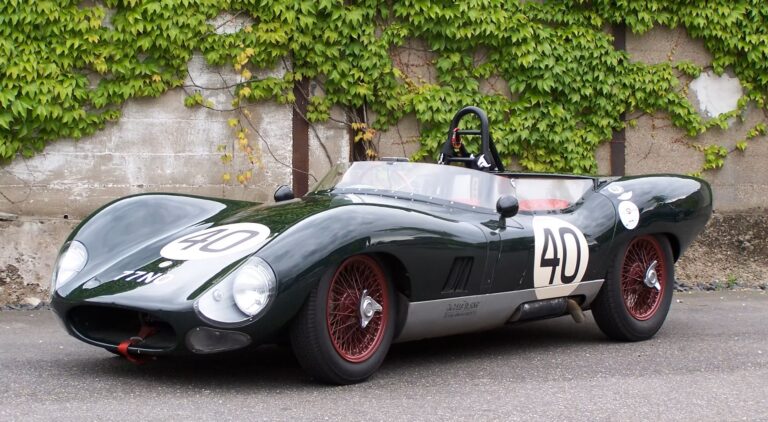
But to define Tojeiro solely by the AC Ace is to ignore his most spectacular creations: the Ecurie Ecosse years. David Murray, the patron of the legendary Scottish racing team Ecurie Ecosse, famously painted his Jaguar D-Types in Flag Metallic Blue. But when the D-Types began to lose their competitive edge against the lighter sports racers, Murray turned to Tojeiro. He commissioned a series of Tojeiro-Jaguars. These were brutish, magnificent machines. Tojeiro built a specialized spaceframe chassis and clothed it in a body that was somehow both more aggressive and more voluptuous than the D-Type.
The 1956/57 Tojeiro-Jaguars were formidable. They utilized the 3.4-litre and later 3.8-litre XK engines, but because Tojeiro wasn’t constrained by Jaguar’s production lines, he could push the engineering boundaries. He utilized a De Dion rear axle setup when Jaguar was still using live axles on their road cars. These cars were fast—terrifyingly so. They were driven by the cream of the crop, including Jackie Stewart’s brother, Jimmy Stewart, and Le Mans winner Ron Flockhart. However, they were also tinged with the danger of the era. The crash of a Tojeiro-Jaguar at the Nürburgring 1000km, which effectively ended the career of driver Jack Fairman, highlighted the fragility of these hand-built prototypes when pushed to the absolute limit on the world’s toughest tracks.
Tojeiro never stopped innovating. As the 1950s bled into the 60s, the writing was on the wall for front-engined sports racers. Cooper had revolutionized Formula 1 with the engine in the back, and the sports car world was following suit. Tojeiro responded with a series of mid-engined coupes that were years ahead of their time. The Tojeiro-Climax and later the Tojeiro-Ford coupes built for Ecurie Ecosse were striking. With their truncated Kamm-tails and low rooflines, they bore a startling resemblance to the Lola Mk6 and the Ford GT40 that would appear years later. Once again, Tojeiro had seen the future shape of the automobile before the major manufacturers had even sharpened their pencils.
One of the most fascinating “what-ifs” of the Tojeiro story involves these mid-engined coupes. The 1962 Tojeiro EE (Ecurie Ecosse) was powered by a 2.5-litre Coventry Climax engine. It ran at Le Mans, showcasing potential but suffering from the perennial privateer curse of under-development and lack of funds. Had Tojeiro possessed the backing of a Ford or a Ferrari, his mid-engined concepts might be spoken of in the same breath as the Ford GT40 today. Instead, they remain cult classics, beloved by historians who recognize the brilliance in their layout.
John Tojeiro eventually drifted away from the automotive limelight as the industry became more corporate and the “garagista” era faded. He turned his engineering talents to other fields, including marine architecture, designing race boats. He died in 2005, a man who never amassed a fortune from his creations but who lived to see his “child”, the AC Ace chassis, become the most collectible American car in history via the Shelby connection.
There is a purity to a Tojeiro that is hard to find in other marques. A Ferrari is about the engine; a Lotus is about the suspension; a Tojeiro is about the line. Whether it is the physical line of the twin-tube chassis—simple, strong, effective—or the aesthetic line of the bodywork, which influenced the quintessential British sports car shape for a generation. Driving a Tojeiro today, particularly a Bristol or Jaguar-powered sports racer, is a visceral experience. You are sitting inside a piece of history that feels surprisingly modern in its balance. The steering is light, the turn-in is crisp (thanks to that independent suspension), and the car communicates with you through the thin metal of the seat. It doesn’t fight the road; it flows with it.
Tojeiro represents the last of the romantic age of engineering, where a single man’s vision could create a world-beater. He was the bridge between the pre-war ladder frames and the modern monocoques. He was the man who gave AC its Ace, Shelby his Cobra, and Ecurie Ecosse its most beautiful contenders. In the great tapestry of motorsport, John Tojeiro is not the loudest thread, but he is the one that holds the entire picture together.
Type
Foundation Year
Country
Founder/s
Headquarters
Type
Foundation Year
Country
Founder/s
Headquarters
About this brand
In the misty, tea-stained annals of British motorsport history, there are names that scream from the headlines—Chapman, Cooper, Lyons—and then there are the names that are whispered with a reverent nod by those who truly know. John Tojeiro is one of those names. He is the quiet architect behind one of the most significant bloodlines in automotive history, a man whose engineering DNA is embedded in the chassis of the most famous American muscle car ever built, yet who remains a spectral figure to the general public. To speak of Tojeiro is to speak of the quintessential “Garagista” spirit, a time when a brilliant mind, a welding torch, and a draughty shed in Cambridgeshire could produce a machine capable of shaming the industrial giants of Europe. John Tojeiro was not a mass manufacturer; he was a bespoke tailor of speed, an innovator whose ideas were often stolen, borrowed, or bought for a pittance, only to go on to achieve global immortality under a different badge.
Born in Portugal to a Portuguese father and an English mother, but raised in England, “Toj”, as he was affectionately known, possessed an intuitive understanding of vehicle dynamics that bypassed academic rigidity. After the Second World War, the British racing scene was a hive of activity, fueled by surplus aircraft parts and a desperate need for adrenaline. While Colin Chapman was obsessing over structural triangulation and lightness at Lotus, Tojeiro took a slightly different path. He looked at the exotic Italian machinery of the time—the Touring-bodied Ferraris and the early Cisitalias—and saw the future. He saw the beauty of the “Superleggera” principle, but he also saw a way to simplify it for the British club racer. His signature became the twin-tube ladder chassis. It sounds simple today, almost agricultural, but in the early 1950s, it was a revelation. Two large-diameter steel tubes running the length of the car, connected by cross-members, with independent suspension hanging off each end. It was light, it was stiff, and crucially, it was compliant enough to handle the rough, airfield-based circuits of post-war Britain.
The car that would secure his legacy—and arguably change the course of automotive history—was the Tojeiro-Bristol built for a dashing London dealer and racer named Cliff Davis. Registered LOY 500, this car was a masterpiece of proportion and performance. It looked like a Ferrari 166 MM Barchetta that had spent some time in an English finishing school. It was powered by the tall, sophisticated Bristol straight-six engine. In 1953, Davis took this car to the track and started winning everything in sight. The car was so dominant, and so beautiful, that it caught the eye of the Hurlock brothers, the owners of AC Cars.
AC was a venerable company that was stuck in a rut, producing staid, underpowered tourers. They needed a sports car. They saw the Tojeiro-Bristol, saw the trophies it was winning, and made Tojeiro an offer. They would buy the design rights to his chassis and body shape for a royalty of £5 per car (capped at a modest total). Tojeiro, always the engineer and rarely the businessman, agreed. AC put the car into production as the AC Ace. A decade later, a failed chicken farmer from Texas named Carroll Shelby would look at that same Ace chassis, realize it could take a Ford V8, and create the Shelby Cobra. Every single Cobra, from the early 260s to the monstrous 427s, owes its skeletal structure to the twin-tube design sketched by John Tojeiro in a shed in the early 50s. Without Toj, there is no Snake.
But to define Tojeiro solely by the AC Ace is to ignore his most spectacular creations: the Ecurie Ecosse years. David Murray, the patron of the legendary Scottish racing team Ecurie Ecosse, famously painted his Jaguar D-Types in Flag Metallic Blue. But when the D-Types began to lose their competitive edge against the lighter sports racers, Murray turned to Tojeiro. He commissioned a series of Tojeiro-Jaguars. These were brutish, magnificent machines. Tojeiro built a specialized spaceframe chassis and clothed it in a body that was somehow both more aggressive and more voluptuous than the D-Type.
The 1956/57 Tojeiro-Jaguars were formidable. They utilized the 3.4-litre and later 3.8-litre XK engines, but because Tojeiro wasn’t constrained by Jaguar’s production lines, he could push the engineering boundaries. He utilized a De Dion rear axle setup when Jaguar was still using live axles on their road cars. These cars were fast—terrifyingly so. They were driven by the cream of the crop, including Jackie Stewart’s brother, Jimmy Stewart, and Le Mans winner Ron Flockhart. However, they were also tinged with the danger of the era. The crash of a Tojeiro-Jaguar at the Nürburgring 1000km, which effectively ended the career of driver Jack Fairman, highlighted the fragility of these hand-built prototypes when pushed to the absolute limit on the world’s toughest tracks.
Tojeiro never stopped innovating. As the 1950s bled into the 60s, the writing was on the wall for front-engined sports racers. Cooper had revolutionized Formula 1 with the engine in the back, and the sports car world was following suit. Tojeiro responded with a series of mid-engined coupes that were years ahead of their time. The Tojeiro-Climax and later the Tojeiro-Ford coupes built for Ecurie Ecosse were striking. With their truncated Kamm-tails and low rooflines, they bore a startling resemblance to the Lola Mk6 and the Ford GT40 that would appear years later. Once again, Tojeiro had seen the future shape of the automobile before the major manufacturers had even sharpened their pencils.
One of the most fascinating “what-ifs” of the Tojeiro story involves these mid-engined coupes. The 1962 Tojeiro EE (Ecurie Ecosse) was powered by a 2.5-litre Coventry Climax engine. It ran at Le Mans, showcasing potential but suffering from the perennial privateer curse of under-development and lack of funds. Had Tojeiro possessed the backing of a Ford or a Ferrari, his mid-engined concepts might be spoken of in the same breath as the Ford GT40 today. Instead, they remain cult classics, beloved by historians who recognize the brilliance in their layout.
John Tojeiro eventually drifted away from the automotive limelight as the industry became more corporate and the “garagista” era faded. He turned his engineering talents to other fields, including marine architecture, designing race boats. He died in 2005, a man who never amassed a fortune from his creations but who lived to see his “child”, the AC Ace chassis, become the most collectible American car in history via the Shelby connection.
There is a purity to a Tojeiro that is hard to find in other marques. A Ferrari is about the engine; a Lotus is about the suspension; a Tojeiro is about the line. Whether it is the physical line of the twin-tube chassis—simple, strong, effective—or the aesthetic line of the bodywork, which influenced the quintessential British sports car shape for a generation. Driving a Tojeiro today, particularly a Bristol or Jaguar-powered sports racer, is a visceral experience. You are sitting inside a piece of history that feels surprisingly modern in its balance. The steering is light, the turn-in is crisp (thanks to that independent suspension), and the car communicates with you through the thin metal of the seat. It doesn’t fight the road; it flows with it.
Tojeiro represents the last of the romantic age of engineering, where a single man’s vision could create a world-beater. He was the bridge between the pre-war ladder frames and the modern monocoques. He was the man who gave AC its Ace, Shelby his Cobra, and Ecurie Ecosse its most beautiful contenders. In the great tapestry of motorsport, John Tojeiro is not the loudest thread, but he is the one that holds the entire picture together.
Submodels
Latest Variants
Model Lines