
Alfa Romeo Giulia 2000 GT Veloce
Brand
Produced from
Portal
Vehicle category
Model line
Model generation
Predecessor
Successor
Submodel Overview
By the time the calendar flipped into the 1970s, the automotive landscape was maturing. The raw, frantic energy of the Swinging Sixties was giving way to a decade that demanded greater refinement, effortless high-speed cruising, and grand touring luxury. Alfa Romeo’s legendary 105-series coupe, originally penned as a masterpiece of proportion by a young Giorgetto Giugiaro at Bertone, had already been evolving. It had grown from the rev-happy 1300 and 1600 models into the muscular 1750 GTV. However, to keep pace with an increasingly competitive market dominated by the fuel-injected precision of the BMW 2002 Tii, the brutal torque of the Ford Capri 3000 GT, and the emerging threat of the six-cylinder Datsun 240Z, Milan needed to deploy the ultimate, most perfected iteration of its classic chassis. Introduced in 1971 at Gardone Riviera, the Alfa Romeo Giulia 2000 GT Veloce (universally known as the 2000 GTV) was the final, triumphant crescendo of the traditional front-engine, rear-drive Bertone coupe lineage. It was a vehicle that traded the nervous, frenetic edge of its smaller-displacement siblings for the long-legged, muscular stride of a true continental grand tourer.
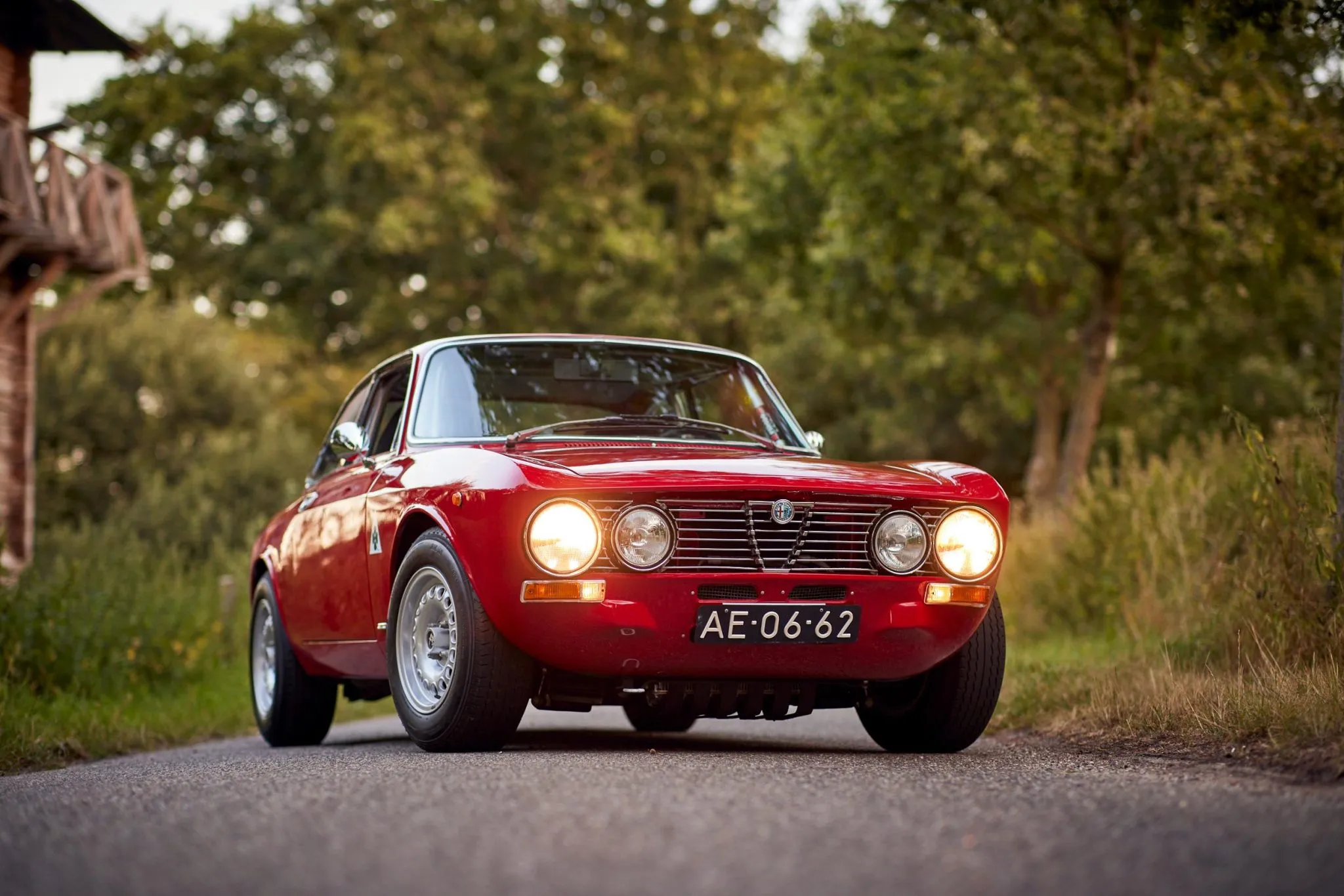
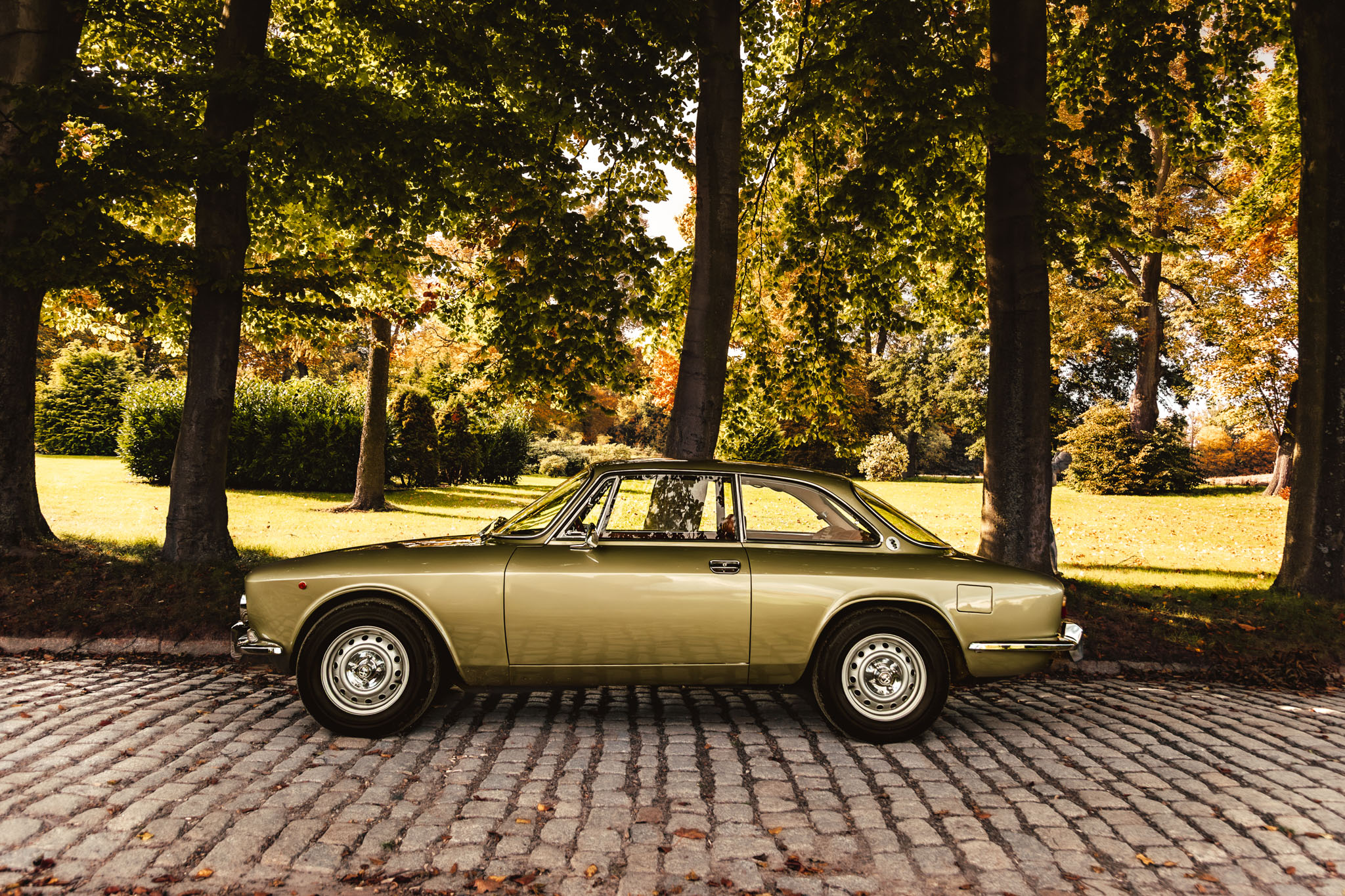
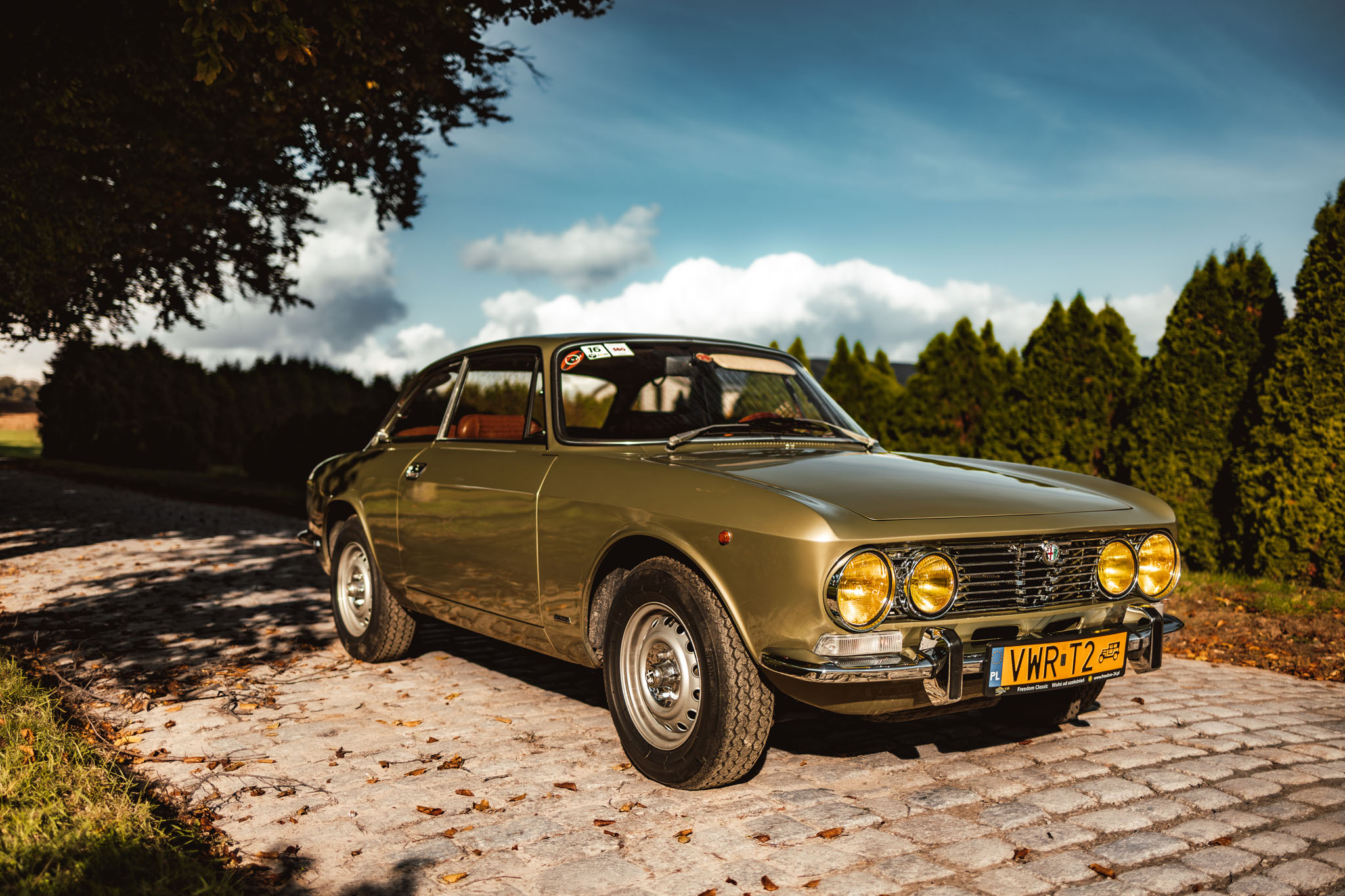
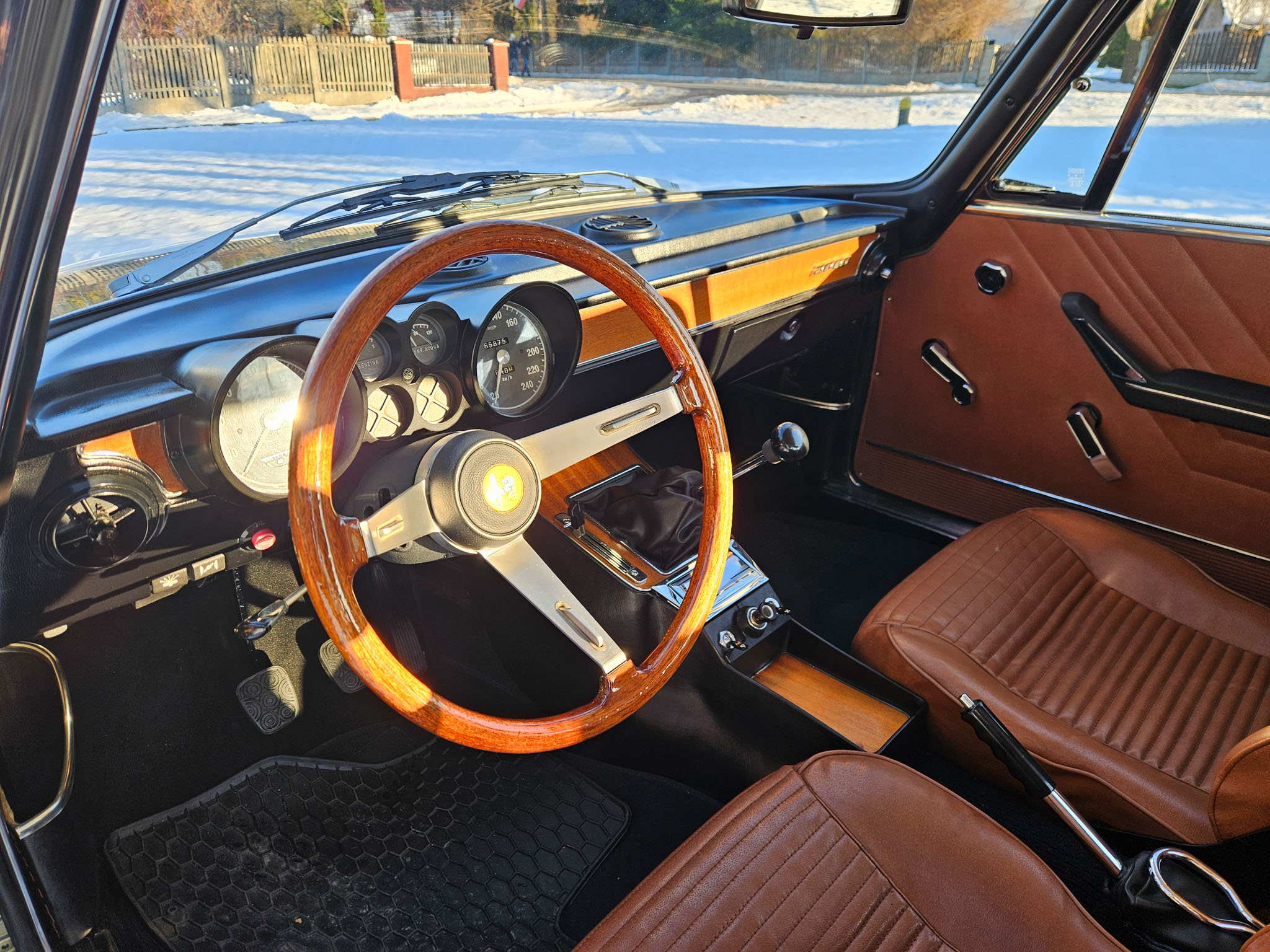
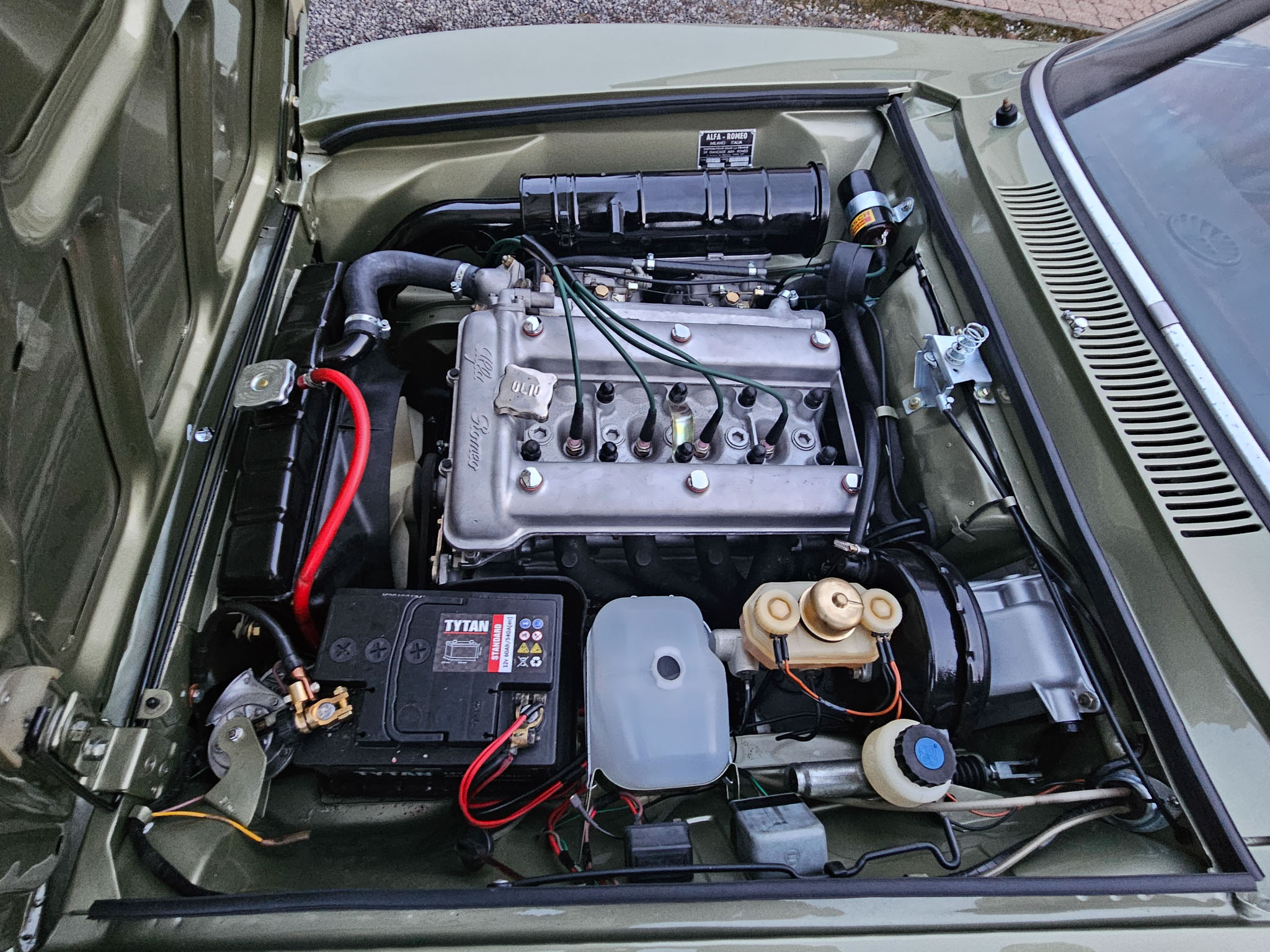
To analyze the anatomy of the 2000 GTV is to witness a masterpiece subtly updated for a new decade. Visually, Giugiaro’s timeless silhouette remained intact, but Alfa Romeo applied a series of purposeful cosmetic updates. The front fascia was widened by a new, imposing grille featuring eight horizontal chrome bars, bisected by the traditional Alfa heart shield. The rear was treated to larger, more modern taillight clusters that incorporated reversing lights, while the C-pillars were adorned with intricate enamel badges featuring the Visconti serpent of Milan. But the true magic, as always with an Alfa Romeo, resided beneath the forward-hinged bonnet. The legendary Bialbero (twin-cam) inline-four engine was bored and stroked to its absolute zenith: 1962cc. Breathing through twin side-draft carburettors—typically Weber, Dell’Orto, or Solex for the European market, while US models received the complex SPICA mechanical fuel injection—this alloy jewel produced a robust 132 brake horsepower. More importantly, it delivered a thick, accessible wave of mid-range torque. To harness this newfound muscle, Alfa Romeo made a critical mechanical addition: a limited-slip differential (LSD) became standard equipment. Paired with the universally praised five-speed manual gearbox, four-wheel disc brakes, and the familiar independent front and live-axle rear suspension, the 2000 GTV possessed a chassis balance that was utterly telepathic. Inside, the cabin received a comprehensive redesign. The beautiful, deeply cowled twin dials of the 1750 were replaced by a single, comprehensive instrument binnacle behind a deeply dished wooden steering wheel, while the seats were redesigned to offer genuine, long-distance grand touring comfort.
On the street, the 2000 GTV was a massive commercial triumph. With over 37,000 units produced between 1971 and 1976, it became the best-selling variant of the larger-displacement 105-series coupes. It was the quintessential gentleman’s express, a car capable of carving through alpine passes with poise before effortlessly devouring hundreds of miles of the Autostrada. It cultivated a reputation as the thinking man’s sports coupe, chosen by those who appreciated engineering soul over mere horsepower figures. In the realm of motorsport, while the brutally flared 1750-based GTAm naturally grabbed the headlines in the European Touring Car Championship, the 2000 GTV became an incredibly formidable weapon in the hands of privateers. Homologated for Group 1 and Group 2 racing, the 2-litre coupe was an absolute terror in domestic saloon car championships across Europe and Australia. Its inherent reliability, standard limited-slip differential, and torque-rich powerband allowed private entrants to consistently embarrass factory-backed efforts in the two-liter class, dancing on the edge of adhesion with the inside front wheel famously hovering just above the tarmac.
The legacy of the 1971 Alfa Romeo Giulia 2000 GT Veloce is one of absolute, uncompromised perfection. It represents the ultimate evolutionary peak of one of the most successful and beloved sports car architectures in automotive history. When it was finally retired in 1976 to make way for the radically different, wedge-shaped Alfetta GTV—which utilized a transaxle layout to achieve perfect weight distribution—the classic era of the Bertone Alfa Romeo was officially closed. Today, the 2000 GTV is widely regarded as the most usable, dynamically complete, and driver-friendly iteration of the entire 105-series family. It occupies a sovereign place in the pantheon of grand touring cars. It is an immortal testament to an era when Italian passion, brilliant engineering, and timeless design converged to create the definitive, everyday sports coupe.
Brand
Produced from
Portal
Vehicle category
Model line
Model generation
Predecessor
Sucessor
Brand
Produced from
Portal
Vehicle category
Model line
Model generation
Predecessor
Sucessor
Submodel Overview
By the time the calendar flipped into the 1970s, the automotive landscape was maturing. The raw, frantic energy of the Swinging Sixties was giving way to a decade that demanded greater refinement, effortless high-speed cruising, and grand touring luxury. Alfa Romeo’s legendary 105-series coupe, originally penned as a masterpiece of proportion by a young Giorgetto Giugiaro at Bertone, had already been evolving. It had grown from the rev-happy 1300 and 1600 models into the muscular 1750 GTV. However, to keep pace with an increasingly competitive market dominated by the fuel-injected precision of the BMW 2002 Tii, the brutal torque of the Ford Capri 3000 GT, and the emerging threat of the six-cylinder Datsun 240Z, Milan needed to deploy the ultimate, most perfected iteration of its classic chassis. Introduced in 1971 at Gardone Riviera, the Alfa Romeo Giulia 2000 GT Veloce (universally known as the 2000 GTV) was the final, triumphant crescendo of the traditional front-engine, rear-drive Bertone coupe lineage. It was a vehicle that traded the nervous, frenetic edge of its smaller-displacement siblings for the long-legged, muscular stride of a true continental grand tourer.
To analyze the anatomy of the 2000 GTV is to witness a masterpiece subtly updated for a new decade. Visually, Giugiaro’s timeless silhouette remained intact, but Alfa Romeo applied a series of purposeful cosmetic updates. The front fascia was widened by a new, imposing grille featuring eight horizontal chrome bars, bisected by the traditional Alfa heart shield. The rear was treated to larger, more modern taillight clusters that incorporated reversing lights, while the C-pillars were adorned with intricate enamel badges featuring the Visconti serpent of Milan. But the true magic, as always with an Alfa Romeo, resided beneath the forward-hinged bonnet. The legendary Bialbero (twin-cam) inline-four engine was bored and stroked to its absolute zenith: 1962cc. Breathing through twin side-draft carburettors—typically Weber, Dell’Orto, or Solex for the European market, while US models received the complex SPICA mechanical fuel injection—this alloy jewel produced a robust 132 brake horsepower. More importantly, it delivered a thick, accessible wave of mid-range torque. To harness this newfound muscle, Alfa Romeo made a critical mechanical addition: a limited-slip differential (LSD) became standard equipment. Paired with the universally praised five-speed manual gearbox, four-wheel disc brakes, and the familiar independent front and live-axle rear suspension, the 2000 GTV possessed a chassis balance that was utterly telepathic. Inside, the cabin received a comprehensive redesign. The beautiful, deeply cowled twin dials of the 1750 were replaced by a single, comprehensive instrument binnacle behind a deeply dished wooden steering wheel, while the seats were redesigned to offer genuine, long-distance grand touring comfort.
On the street, the 2000 GTV was a massive commercial triumph. With over 37,000 units produced between 1971 and 1976, it became the best-selling variant of the larger-displacement 105-series coupes. It was the quintessential gentleman’s express, a car capable of carving through alpine passes with poise before effortlessly devouring hundreds of miles of the Autostrada. It cultivated a reputation as the thinking man’s sports coupe, chosen by those who appreciated engineering soul over mere horsepower figures. In the realm of motorsport, while the brutally flared 1750-based GTAm naturally grabbed the headlines in the European Touring Car Championship, the 2000 GTV became an incredibly formidable weapon in the hands of privateers. Homologated for Group 1 and Group 2 racing, the 2-litre coupe was an absolute terror in domestic saloon car championships across Europe and Australia. Its inherent reliability, standard limited-slip differential, and torque-rich powerband allowed private entrants to consistently embarrass factory-backed efforts in the two-liter class, dancing on the edge of adhesion with the inside front wheel famously hovering just above the tarmac.
The legacy of the 1971 Alfa Romeo Giulia 2000 GT Veloce is one of absolute, uncompromised perfection. It represents the ultimate evolutionary peak of one of the most successful and beloved sports car architectures in automotive history. When it was finally retired in 1976 to make way for the radically different, wedge-shaped Alfetta GTV—which utilized a transaxle layout to achieve perfect weight distribution—the classic era of the Bertone Alfa Romeo was officially closed. Today, the 2000 GTV is widely regarded as the most usable, dynamically complete, and driver-friendly iteration of the entire 105-series family. It occupies a sovereign place in the pantheon of grand touring cars. It is an immortal testament to an era when Italian passion, brilliant engineering, and timeless design converged to create the definitive, everyday sports coupe.
Tech Specs
Technical Specifications
Tech Specs
Technical Specifications
Engine
01
03
Internal combustion engine
Configuration
Alfa Romeo Twin Cam, Inline-4
Location
Front, longitudinally mounted
Construction
Aluminium alloy block and head
Displacement (cc)
1,962 cc
Displacement (cu in)
119.7 cu in
Compression
9.0:1
Bore x Stroke
84.0 mm x 88.5 mm
Valvetrain
2 valves per cylinder, DOHC
Fuel feed
2 x Weber 40 DCOE (or Dell'Orto / Solex) carburetors
Lubrication
Wet sump
Aspiration
Naturally aspirated
Output
Power (hp)
130 hp
Power (kW)
97 kW
Max power at
5,500 RPM
Torque (Nm)
182 Nm
Torque (ft lbs)
134 ft lbs
Max torque at
3,000 RPM
Drivetrain
02
03
Chassis
Type
Monocoque unibody
Material
Steel
Body
Material
Steel
Transmission
Gearbox
Alfa Romeo, 5-speed manual
Drive
Rear Wheel Drive (Limited Slip Differential standard)
Suspension
Front
Independent, double wishbones, coil springs, telescopic dampers, anti-roll bar
Rear
Live axle, trailing arms, upper reaction trunnion (T-bar), coil springs, telescopic dampers, anti-roll bar
Steering
Type
Recirculating ball
Brakes
Front
Solid discs Ø272 mm, 2-piston calipers
Rear
Solid discs Ø267 mm, 2-piston calipers
Wheels
Front
5.5" x 14" (Campagnolo 'Turbina' alloy)
Rear
5.5" x 14" (Campagnolo 'Turbina' alloy)
Tires
Front
165 HR 14
Rear
165 HR 14
Dimensions and performance
03
03
Dimensions
Length (mm)
4,089 mm
Length (in)
161.0 in
Width (mm)
1,575 mm
Width (in)
62.0 in
Height (mm)
1,315 mm
Height (in)
51.8 in
Wheelbase (mm)
2,350 mm
Wheelbase (in)
92.5 in
Weight (kg)
1,040 kg
Weight (lbs)
2,293 lbs
Performance
Power to weight
~0.12 hp/kg
Top speed (km/h)
195 km/h
Top speed (mph)
121 mph
0-100 km/h (0-60 mph)
~8.9 s