
The sheer scale of the challenge defies modern logic, existing now only as a glorious, terrifying ghost of a bygone era. To compete in the Mille Miglia was to subject oneself to total sensory assault. It was the visual exhaustion of steering heavy machinery into the blinding light of dawn, the absolute terror of keeping the throttle pinned through impossibly narrow mediaeval towns, and the acrid, unmistakable smell of carbonised brakes descending steep mountain passes. It was the deafening roar of unsilenced exhausts ricocheting off terracotta walls and echoing through the remote valleys of the Apennines. This was no meticulously manicured, closed circuit. The Mille Miglia was waged on ordinary public roads, a volatile mixture of shattered tarmac and loose, blinding dirt, stretching in a punishing figure-eight loop of roughly 1600 km (1000 miles) from the provincial calm of Brescia down to the monumental sprawl of Rome, and back again.
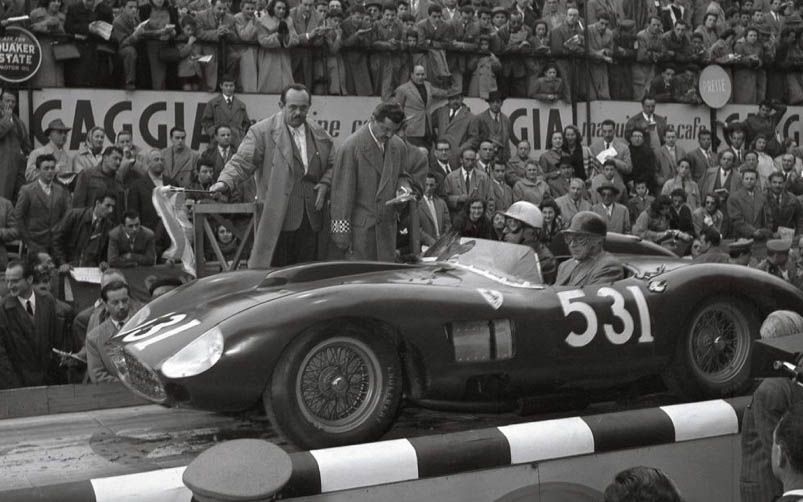
Unlike traditional grid formations, competitors were dispatched one by one at single-minute intervals. While the earliest pre-war editions used standard sequential digits, from 1949 onwards a car’s painted racing number denoted its exact starting time—car 531 leaving at 5:31 in the morning, for instance—adding an unrelenting psychological pressure to outrun the clock.
The race was born in 1927 from deeply wounded civic pride. When Brescia lost the prestigious Italian Grand Prix to the newly built autodrome at Monza, four young aristocrats and motoring zealots—Aymo Maggi, Franco Mazzotti, Renzo Castagneto, and Giovanni Canestrini—devised an act of spectacular, reckless rebellion. They envisioned an unbroken run down the spine of the country to prove that normal production cars could conquer the nation’s rugged infrastructure at sustained high speeds. The inaugural race was won by Ferdinando Minoia and Giuseppe Morandi, appropriately piloting an OM 665 built in Brescia itself, averaging a highly respectable 77 km/h (48 mph) and igniting a national obsession.
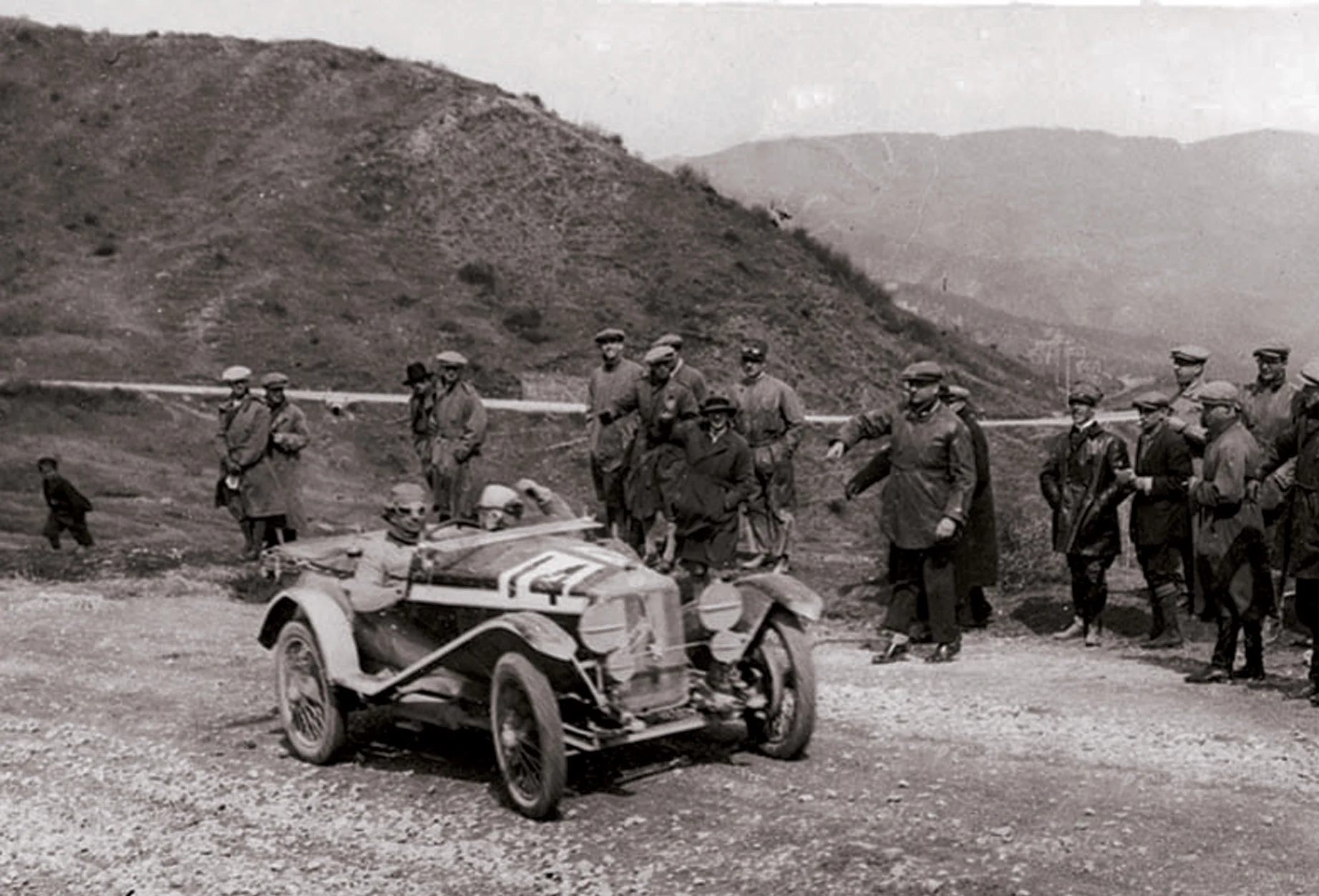
As machinery rapidly evolved and terminal speeds climbed, so did the extreme peril and the sheer, ruthless cunning of the drivers. The 1930 edition immortalised the fierce rivalry between Alfa Romeo teammates Tazio Nuvolari and Achille Varzi. Chasing Varzi toward the finish, Nuvolari executed a masterstroke of predatory racing that has since become one of the most heavily dramatised myths in Italian motorsport history. Catching Varzi in the early morning dawn near Lake Garda, Nuvolari took advantage of the ambient twilight and deliberately switched off his headlights. He did not drive blind in total darkness, as the romanticised paddock lore often suggests, but merely extinguished his lamps so that Varzi would not spot the glare of approaching headlights in his mirrors. Varzi, believing he was comfortably ahead, was caught entirely unawares as Nuvolari flicked his lamps back on and surged past near the finish line. It is a moment that perfectly distils the wild spirit and the calculated madness of the event.
Throughout the 1930s, Alfa Romeo forged an iron grip on the race, taking victory after victory. Yet, the inherent danger of racing heavy, powerful machinery through heavily populated areas inevitably extracted a dark toll. In 1938, a horrific crash in Bologna claimed the lives of ten spectators, tragically including several children. Benito Mussolini’s fascist government reacted swiftly, prohibiting motor racing in urban centres and temporarily killing the open-road format. To circumvent the strict prohibition, the 1940 event was mutated into the “Grand Prix of Brescia”, held on a closed triangular route between Brescia, Cremona, and Mantua. While BMW took the outright victory with its slippery 328, the event was historically momentous for a different reason: it saw the debut of the Auto Avio Costruzioni 815. This was the very first independent creation of Enzo Ferrari, though legal disputes with his former employers at Alfa Romeo prevented him from affixing his own name to the bonnet.
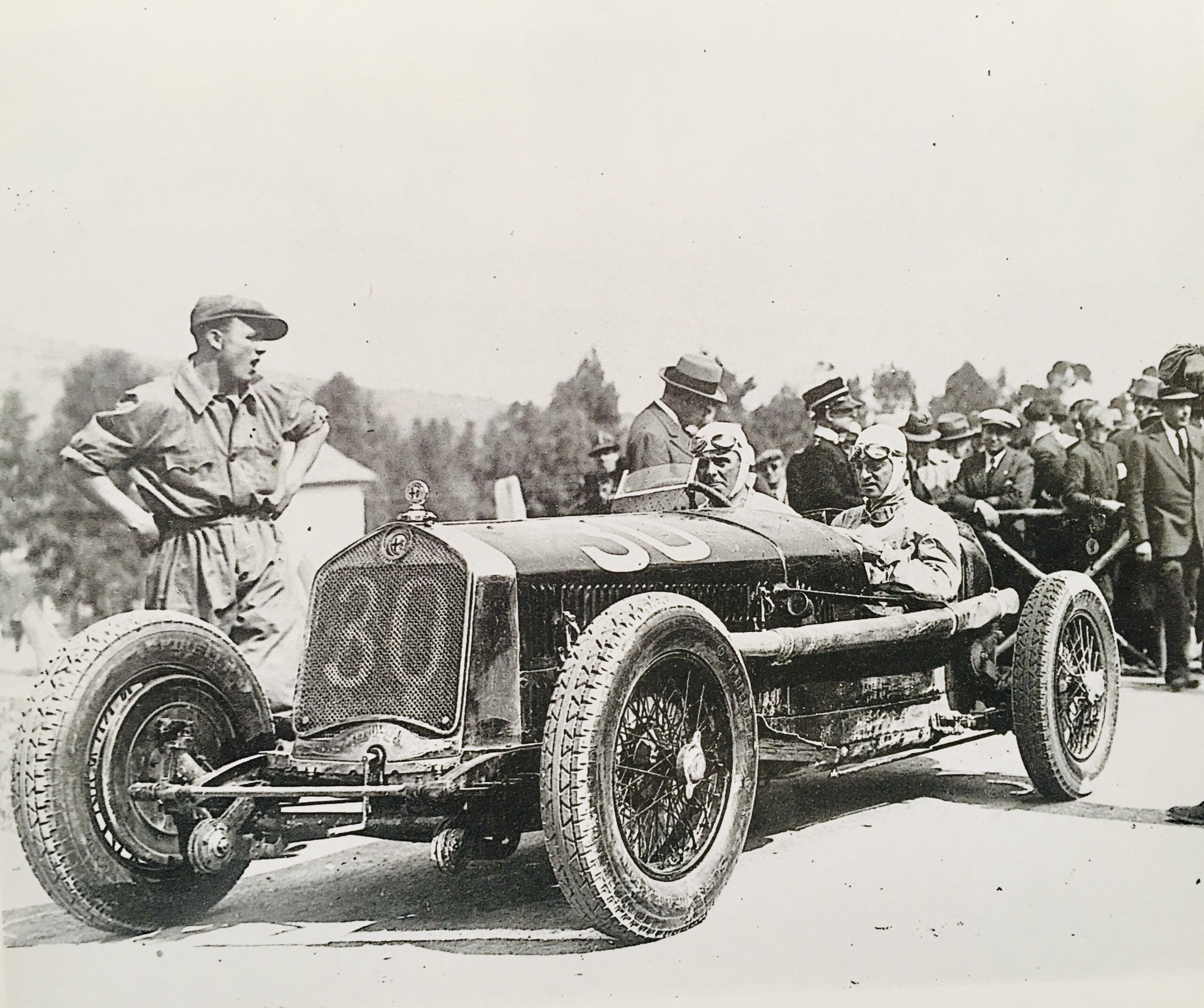
Following the devastation of the Second World War, Italy was physically and economically shattered. The resurrection of the Mille Miglia in 1947 served as a potent symbol of national recovery, reconstruction, and mechanical pride. It was during this post-war renaissance that Ferrari truly built its mythos, taming the treacherous Italian roads. Masters of the route emerged, such as Clemente Biondetti, who set an enduring record for victories. It also attracted the eccentrics of the golden age, epitomised by the wealthy young gentleman driver Giannino Marzotto. Finding standard canvas racing overalls dreadfully uncomfortable, Marzotto famously drove his Ferrari to outright victory in 1950 whilst wearing a bespoke double-breasted brown suit and a matching tie.
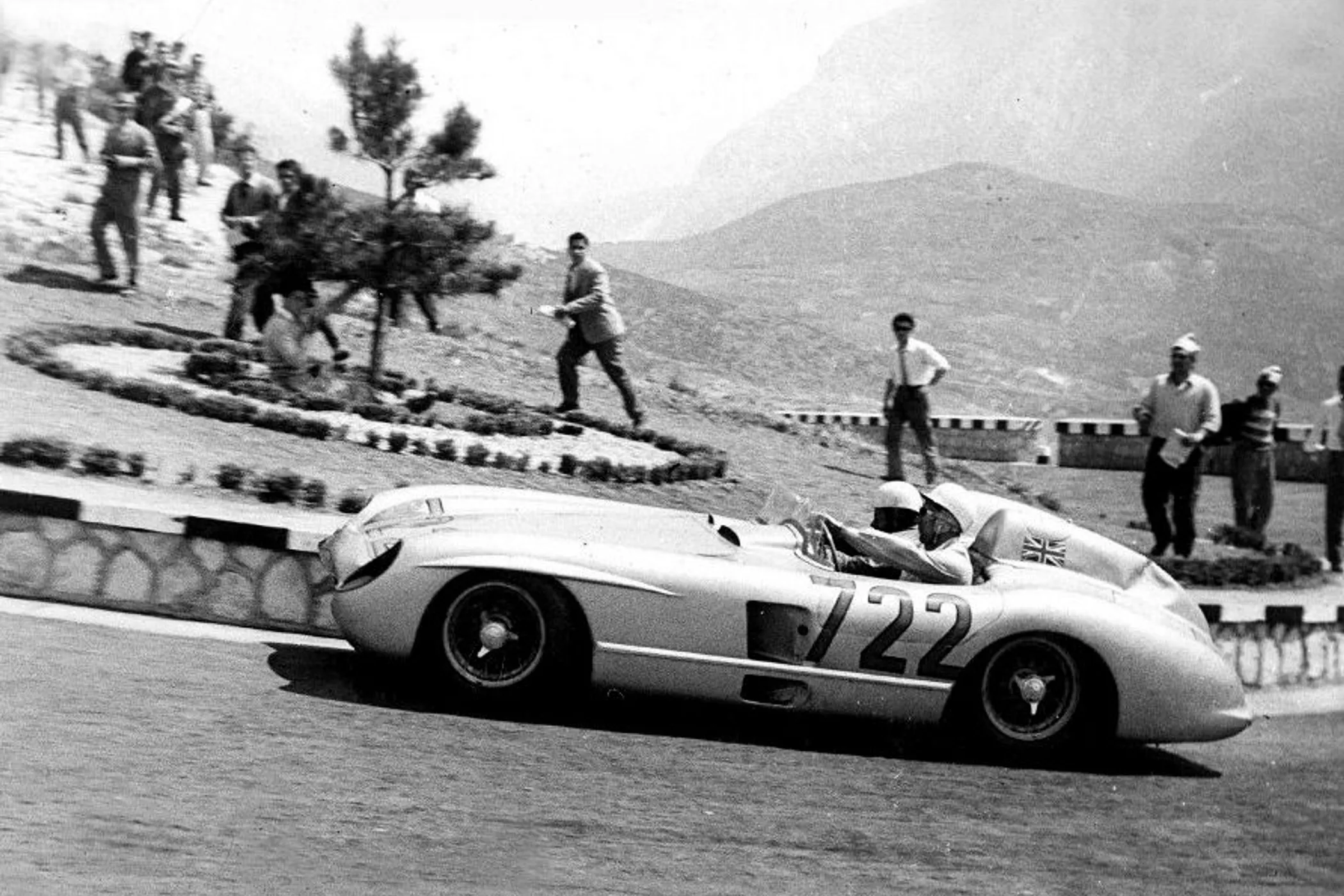
Foreign mastery arrived in 1955 with a performance that remains the absolute pinnacle of open-road racing. The British prodigy Stirling Moss, gripping the steering wheel of a silver Mercedes-Benz 300 SLR, obliterated the course in 10 hours, 7 minutes, and 48 seconds. He averaged a staggering 157 km/h (98 mph) across public highways. This supernatural feat was made possible by his co-driver, the bearded motorsport journalist Denis Jenkinson, who had devised a pioneering pace-note system. Jenkinson fed a continuous roll of paper notes through a bespoke aluminium box, using hand signals to communicate blind crests and treacherous corners to Moss above the howling din of the straight-eight engine. It was the conceptual precursor to modern rally pacenotes, flawlessly executed at terrifying velocity.
The intoxicating romance of the Mille Miglia, however, masked a grim reality that shattered entirely during the spring of 1957. The aristocratic Spanish driver Alfonso de Portago, a dashing star of the Scuderia Ferrari, was tearing toward the finish at speeds exceeding 250 km/h (155 mph) when a front tyre on his mighty 4.0-litre (4023 cc) Ferrari 335 S violently exploded near the village of Guidizzolo. The heavy machine vaulted a ditch and carved into the dense crowd lining the grass verges. Portago, his American co-driver Edmund Nelson, and nine spectators—five of them young children—were killed instantly. The national trauma was absolute and immediate. The Italian government banned competitive racing on public roads forever, bringing the era of city-to-city speed races to a violent halt. Enzo Ferrari was dragged through the courts, facing a highly publicised and agonising trial for manslaughter, though he was ultimately acquitted years later when experts suggested the blowout was caused by a reflective “cat’s eye” road marker. The Mille Miglia, in its glorious, blood-stained original form, was dead.
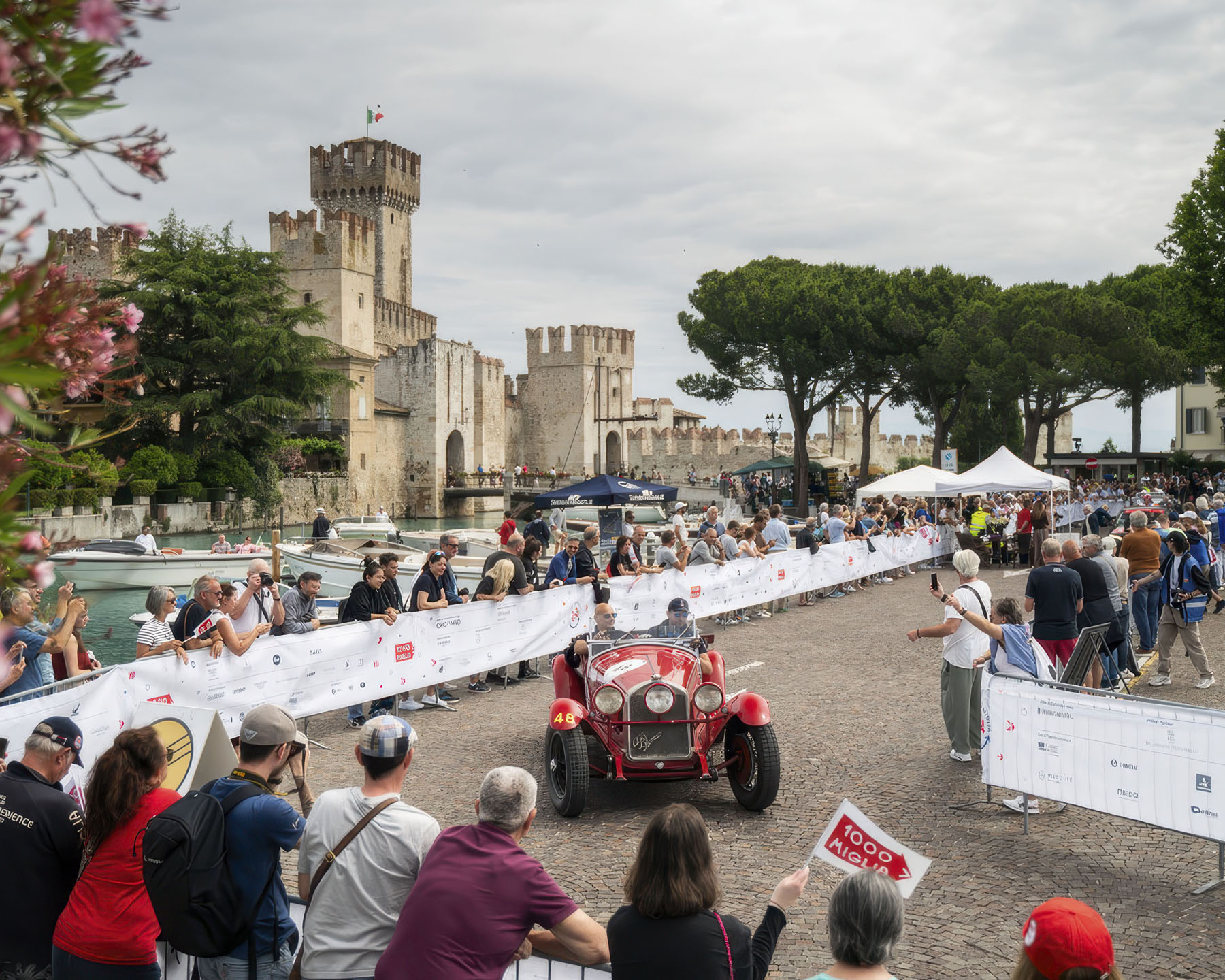
Yet, the asphalt remembers, and so does the automotive world. Since 1977, the ghosts of Brescia have been appeased by the rebirth of the event as the Mille Miglia Storica. Stripped of its lethal, unregulated speed, it is now an exclusive regularity rally for classic vehicles. Eligibility is strictly confined to models of cars that either competed or were officially registered for the original events between 1927 and 1957. Today, it functions as a staggeringly elite rolling museum, where convoys of multi-million-pound automotive royalty retrace the same scenic mountain passes and ancient cobbled squares. It lacks the mortal peril of the old days, but as the metallic rasp of vintage carburettors and exhausts echoes through the Italian countryside once more, the immortal aura of the red arrow survives intact.
The sheer scale of the challenge defies modern logic, existing now only as a glorious, terrifying ghost of a bygone era. To compete in the Mille Miglia was to subject oneself to total sensory assault. It was the visual exhaustion of steering heavy machinery into the blinding light of dawn, the absolute terror of keeping the throttle pinned through impossibly narrow mediaeval towns, and the acrid, unmistakable smell of carbonised brakes descending steep mountain passes. It was the deafening roar of unsilenced exhausts ricocheting off terracotta walls and echoing through the remote valleys of the Apennines. This was no meticulously manicured, closed circuit. The Mille Miglia was waged on ordinary public roads, a volatile mixture of shattered tarmac and loose, blinding dirt, stretching in a punishing figure-eight loop of roughly 1600 km (1000 miles) from the provincial calm of Brescia down to the monumental sprawl of Rome, and back again.
Unlike traditional grid formations, competitors were dispatched one by one at single-minute intervals. While the earliest pre-war editions used standard sequential digits, from 1949 onwards a car’s painted racing number denoted its exact starting time—car 531 leaving at 5:31 in the morning, for instance—adding an unrelenting psychological pressure to outrun the clock.
The race was born in 1927 from deeply wounded civic pride. When Brescia lost the prestigious Italian Grand Prix to the newly built autodrome at Monza, four young aristocrats and motoring zealots—Aymo Maggi, Franco Mazzotti, Renzo Castagneto, and Giovanni Canestrini—devised an act of spectacular, reckless rebellion. They envisioned an unbroken run down the spine of the country to prove that normal production cars could conquer the nation’s rugged infrastructure at sustained high speeds. The inaugural race was won by Ferdinando Minoia and Giuseppe Morandi, appropriately piloting an OM 665 built in Brescia itself, averaging a highly respectable 77 km/h (48 mph) and igniting a national obsession.
As machinery rapidly evolved and terminal speeds climbed, so did the extreme peril and the sheer, ruthless cunning of the drivers. The 1930 edition immortalised the fierce rivalry between Alfa Romeo teammates Tazio Nuvolari and Achille Varzi. Chasing Varzi toward the finish, Nuvolari executed a masterstroke of predatory racing that has since become one of the most heavily dramatised myths in Italian motorsport history. Catching Varzi in the early morning dawn near Lake Garda, Nuvolari took advantage of the ambient twilight and deliberately switched off his headlights. He did not drive blind in total darkness, as the romanticised paddock lore often suggests, but merely extinguished his lamps so that Varzi would not spot the glare of approaching headlights in his mirrors. Varzi, believing he was comfortably ahead, was caught entirely unawares as Nuvolari flicked his lamps back on and surged past near the finish line. It is a moment that perfectly distils the wild spirit and the calculated madness of the event.
Throughout the 1930s, Alfa Romeo forged an iron grip on the race, taking victory after victory. Yet, the inherent danger of racing heavy, powerful machinery through heavily populated areas inevitably extracted a dark toll. In 1938, a horrific crash in Bologna claimed the lives of ten spectators, tragically including several children. Benito Mussolini’s fascist government reacted swiftly, prohibiting motor racing in urban centres and temporarily killing the open-road format. To circumvent the strict prohibition, the 1940 event was mutated into the “Grand Prix of Brescia”, held on a closed triangular route between Brescia, Cremona, and Mantua. While BMW took the outright victory with its slippery 328, the event was historically momentous for a different reason: it saw the debut of the Auto Avio Costruzioni 815. This was the very first independent creation of Enzo Ferrari, though legal disputes with his former employers at Alfa Romeo prevented him from affixing his own name to the bonnet.
Following the devastation of the Second World War, Italy was physically and economically shattered. The resurrection of the Mille Miglia in 1947 served as a potent symbol of national recovery, reconstruction, and mechanical pride. It was during this post-war renaissance that Ferrari truly built its mythos, taming the treacherous Italian roads. Masters of the route emerged, such as Clemente Biondetti, who set an enduring record for victories. It also attracted the eccentrics of the golden age, epitomised by the wealthy young gentleman driver Giannino Marzotto. Finding standard canvas racing overalls dreadfully uncomfortable, Marzotto famously drove his Ferrari to outright victory in 1950 whilst wearing a bespoke double-breasted brown suit and a matching tie.
Foreign mastery arrived in 1955 with a performance that remains the absolute pinnacle of open-road racing. The British prodigy Stirling Moss, gripping the steering wheel of a silver Mercedes-Benz 300 SLR, obliterated the course in 10 hours, 7 minutes, and 48 seconds. He averaged a staggering 157 km/h (98 mph) across public highways. This supernatural feat was made possible by his co-driver, the bearded motorsport journalist Denis Jenkinson, who had devised a pioneering pace-note system. Jenkinson fed a continuous roll of paper notes through a bespoke aluminium box, using hand signals to communicate blind crests and treacherous corners to Moss above the howling din of the straight-eight engine. It was the conceptual precursor to modern rally pacenotes, flawlessly executed at terrifying velocity.
The intoxicating romance of the Mille Miglia, however, masked a grim reality that shattered entirely during the spring of 1957. The aristocratic Spanish driver Alfonso de Portago, a dashing star of the Scuderia Ferrari, was tearing toward the finish at speeds exceeding 250 km/h (155 mph) when a front tyre on his mighty 4.0-litre (4023 cc) Ferrari 335 S violently exploded near the village of Guidizzolo. The heavy machine vaulted a ditch and carved into the dense crowd lining the grass verges. Portago, his American co-driver Edmund Nelson, and nine spectators—five of them young children—were killed instantly. The national trauma was absolute and immediate. The Italian government banned competitive racing on public roads forever, bringing the era of city-to-city speed races to a violent halt. Enzo Ferrari was dragged through the courts, facing a highly publicised and agonising trial for manslaughter, though he was ultimately acquitted years later when experts suggested the blowout was caused by a reflective “cat’s eye” road marker. The Mille Miglia, in its glorious, blood-stained original form, was dead.
Yet, the asphalt remembers, and so does the automotive world. Since 1977, the ghosts of Brescia have been appeased by the rebirth of the event as the Mille Miglia Storica. Stripped of its lethal, unregulated speed, it is now an exclusive regularity rally for classic vehicles. Eligibility is strictly confined to models of cars that either competed or were officially registered for the original events between 1927 and 1957. Today, it functions as a staggeringly elite rolling museum, where convoys of multi-million-pound automotive royalty retrace the same scenic mountain passes and ancient cobbled squares. It lacks the mortal peril of the old days, but as the metallic rasp of vintage carburettors and exhausts echoes through the Italian countryside once more, the immortal aura of the red arrow survives intact.