Austin-Healey 100S (Sebring) Roadster


Brand
Produced from
Portal
Vehicle category
Model line
Model generation
Predecessor
Sucessor
About this submodel
The Austin-Healey 100 (BN1) was a sensation. It was a beautiful, brawny, and affordable 100-mph sports car that took America by storm. But to its creator, the pragmatic and competition-hardened Donald Healey, it was merely a starting point. The BN1 was a fine road car and a decent club racer, but Healey dreamed of winning at the highest levels—Sebring, Le Mans, the Mille Miglia. To do that, the standard 100 was simply too heavy, its gearbox too compromised, and its drum brakes a terrifying liability. Healey needed a scalpel, not a sledgehammer. He needed a purpose-built weapon. The result was a car that shared its beautiful silhouette with the production model but was, in its soul, a pure-bred racing machine. It was the 1954 Austin-Healey 100S.
The “S” in its name was a direct, confident nod to its primary target: the brutal 12 Hours of Sebring. This was not a trim package; it was a complete, ground-up re-engineering of the car, focused on the three core principles of racing: add lightness, add power, and add brakes. Only 50 production cars were built (plus a handful of works prototypes), created specifically to homologate the car for international competition. It was aimed directly at the other small-bore, lightweight giants in the 2.0-3.0-litre class: the jewel-like Porsche 550 Spyder, the fast-and-fragile OSCA MT4s, and the potent Frazer Nash Le Mans Replicas. The 100S was Donald Healey’s aluminium-bodied answer, and it was a masterpiece.
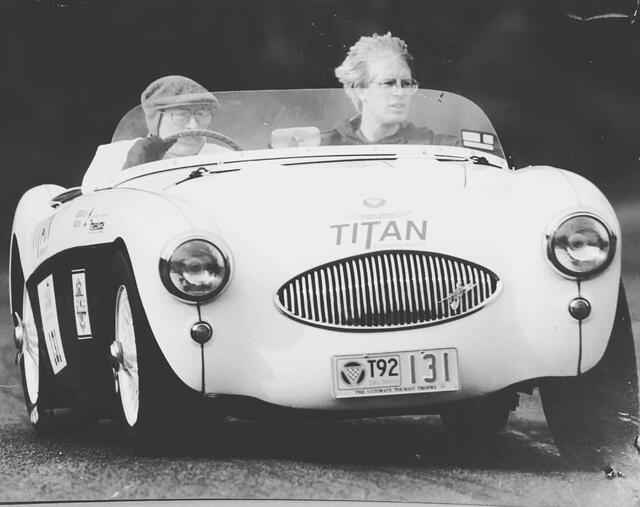
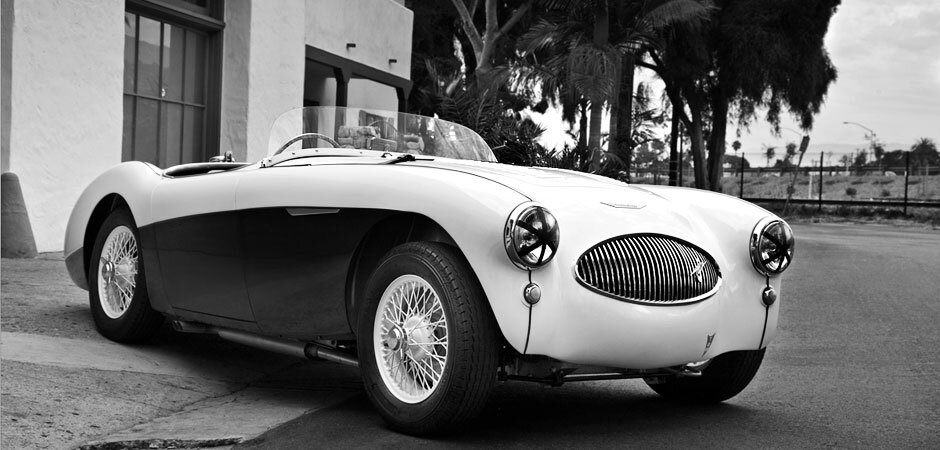
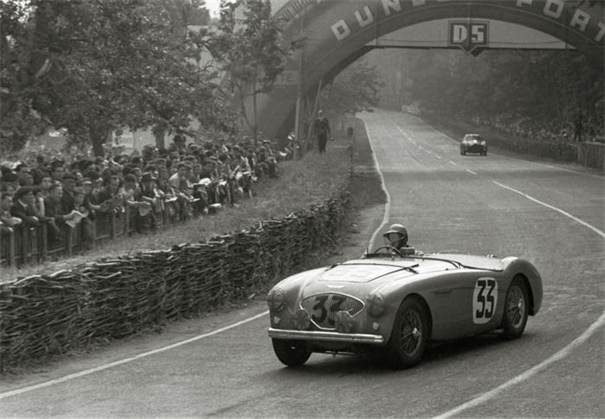
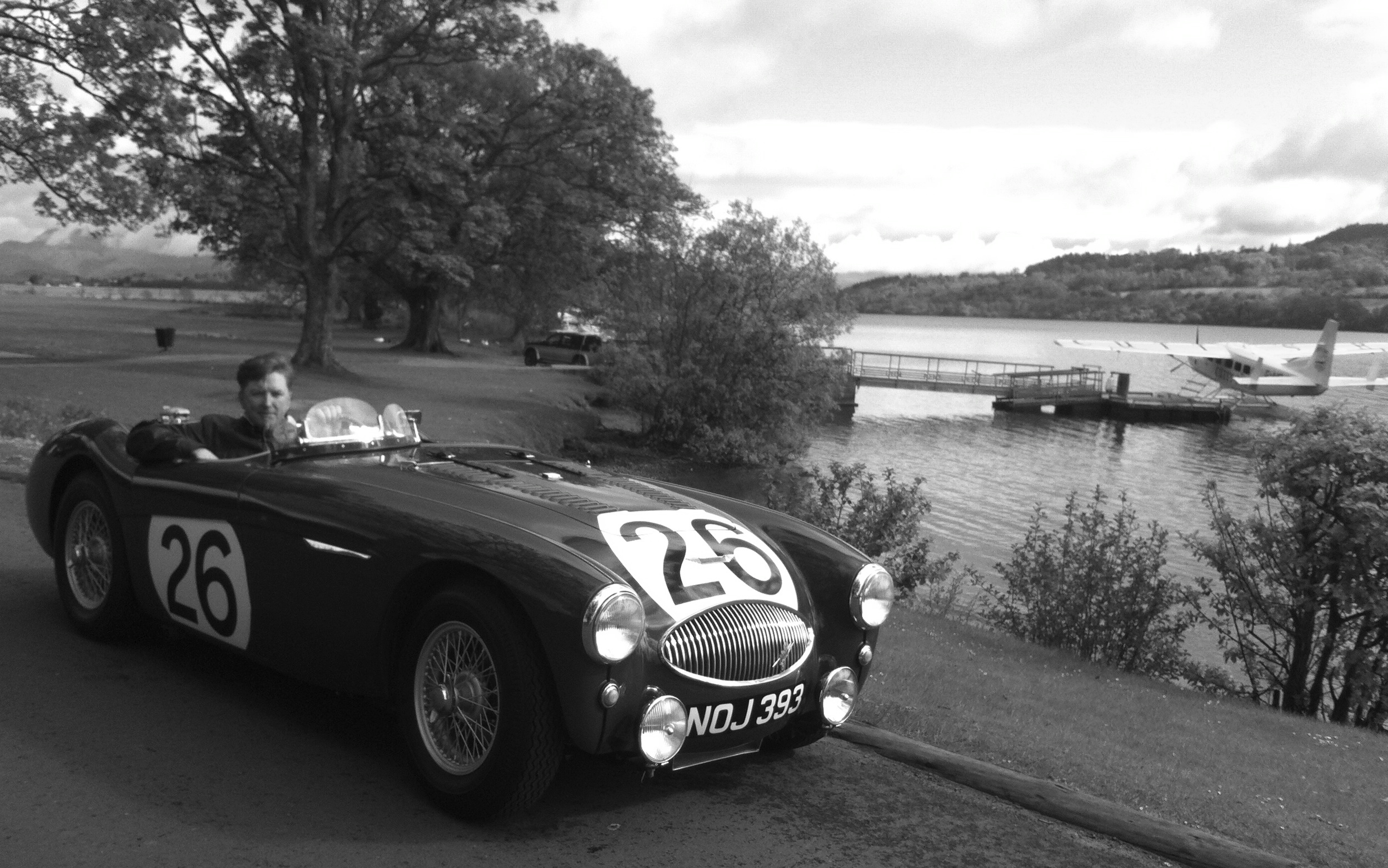
The transformation began with the body. The standard car’s steel shell was discarded, and the specialists at Jensen, who were already building the production bodies, were tasked with recreating Gerry Coker’s design in 100% aluminium. The result was a stunning, lightweight shell that shed over 90kg (200lbs) from the car’s total weight. The 100S was instantly identifiable. The heavy chrome bumpers were deleted, replaced by simple, minimalist over-riders or, in many cases, nothing at all. The signature fold-flat windscreen was gone, replaced by a tiny, wrap-around perspex aero screen that offered only a token gesture against the wind. The grille was a smaller, oval-shaped opening, designed to improve aerodynamics and cooling. A louvered bonnet, leather retaining strap, and a large, quick-access fuel filler on the rear deck completed the purposeful, aggressive look. This was no roadster; it was a pure racing spyder.
If the body was a work of art, the engine was a work of focused engineering. The robust 2,660cc Austin four-cylinder was handed over to the wizards at the Weslake research company. They designed a brand-new, high-performance aluminium cylinder head with larger valves and a higher compression ratio. This was paired with a nitrided crankshaft, special pistons, and a more aggressive camshaft. In place of the standard car’s modest carburettors, the 100S inhaled deeply through two massive, 1.75-inch SU H6 units. The result was a reliable 132 hp at 4,700 rpm, a colossal 40% jump in power over the BN1’s 90 hp. This was mated to the new, conventional 4-speed gearbox from the BN2 (the 3-speed was gone), but with closer, competition-oriented ratios.
The 100S’s greatest innovation, however, was its brakes. Donald Healey knew that power was useless without control. The drum brakes on the BN1 were barely adequate for the road and faded into oblivion on the track. The 100S made a monumental leap: it was one of the very first production sports cars in the world to be fitted with four-wheel disc brakes. These were state-of-the-art Dunlop units, the same technology Jaguar had used to conquer Le Mans with the C-Type. This single feature gave the 100S an incredible competitive advantage, allowing drivers to brake later, harder, and more consistently than their drum-braked rivals, a crucial edge in a 12-hour endurance race. The interior was, as expected, pure function. The luxurious seats were replaced with lightweight metal buckets, the carpets were gone, and the dash was a simple, crackle-finish panel dominated by a large tachometer.
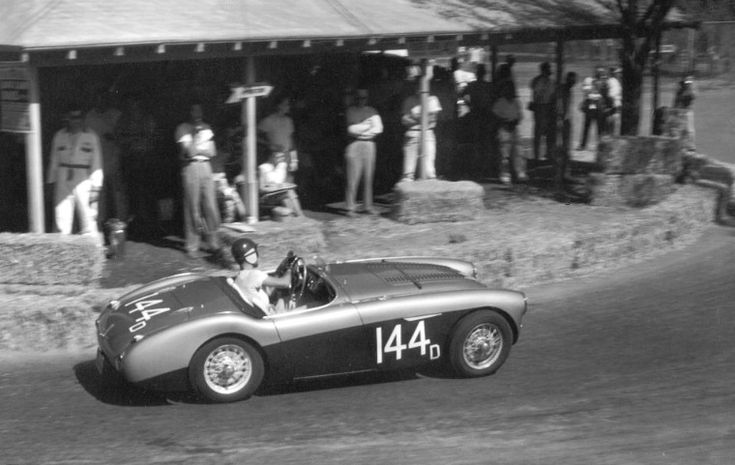
The 100S’s history is defined by its greatest triumph and its darkest day. Its raison d’être was fulfilled in spectacular fashion at the 1955 12 Hours of Sebring. A “Works” 100S, driven by Stirling Moss and Lance Macklin, was entered, but it was the privateer entries that stole the show. A car entered by American gentleman driver Briggs Cunningham and driven by Bill Lloyd and George Huntoon, ran a flawless race. It outlasted, out-braked, and out-manoeuvred its exotic European rivals to score a sensational 1st in class and 6th overall. Just behind them was another 100S, securing a dominant 1-2 class finish. The “S” had conquered Sebring.
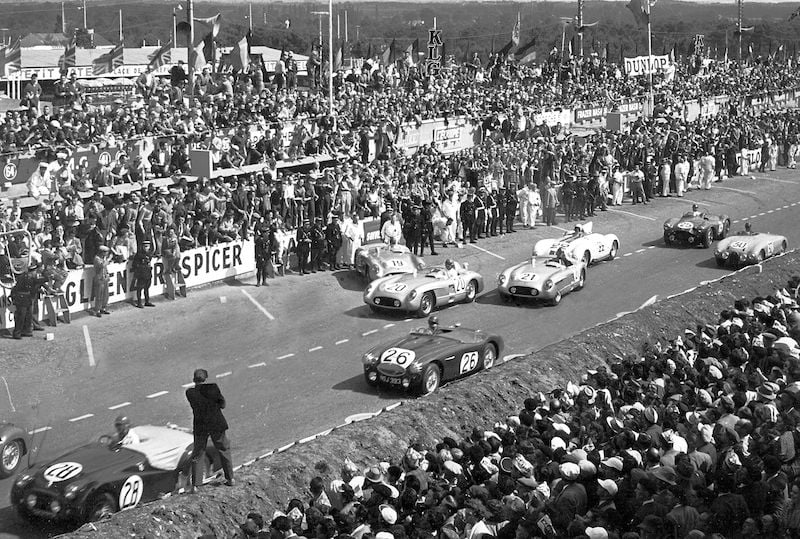
Just three months later, the 100S was at the centre of motorsport’s greatest tragedy: the 1955 Le Mans disaster. The “Works” 100S, driven by Lance Macklin, was a key car in the horrifying chain of events. When Mike Hawthorn’s Jaguar D-Type braked abruptly to pit, Macklin swerved to avoid him. This action took him directly into the path of Pierre Levegh’s Mercedes-Benz 300 SLR, which was approaching at over 150 mph. The Mercedes was launched into the crowd, killing Levegh and over 80 spectators. While Macklin survived, the 100S was forever, and tragically, entwined with that awful day.
Despite this dark chapter, the 100S was a resounding success. The 50 production cars were snapped up by the top privateer racers of the day, including Carroll Shelby, who raced one extensively in America. It was the ultimate four-cylinder Healey, a car that bridged the gap between club-level sports cars and full-blown “Works” prototypes. It was the last, purest, and most potent expression of the 100/4 before the heavier, smoother, six-cylinder 100/6 arrived in 1956. Today, the 100S is a “blue-chip” collector’s car, the undisputed holy grail for any Healey enthusiast, a mythical, hand-built aluminium warrior from a golden, and dangerous, era of racing.
Brand
Produced from
Portal
Vehicle category
Model line
Model generation
Predecessor
Sucessor
Brand
Produced from
Portal
Vehicle category
Model line
Model generation
Predecessor
Sucessor
About this submodel
The Austin-Healey 100 (BN1) was a sensation. It was a beautiful, brawny, and affordable 100-mph sports car that took America by storm. But to its creator, the pragmatic and competition-hardened Donald Healey, it was merely a starting point. The BN1 was a fine road car and a decent club racer, but Healey dreamed of winning at the highest levels—Sebring, Le Mans, the Mille Miglia. To do that, the standard 100 was simply too heavy, its gearbox too compromised, and its drum brakes a terrifying liability. Healey needed a scalpel, not a sledgehammer. He needed a purpose-built weapon. The result was a car that shared its beautiful silhouette with the production model but was, in its soul, a pure-bred racing machine. It was the 1954 Austin-Healey 100S.
The “S” in its name was a direct, confident nod to its primary target: the brutal 12 Hours of Sebring. This was not a trim package; it was a complete, ground-up re-engineering of the car, focused on the three core principles of racing: add lightness, add power, and add brakes. Only 50 production cars were built (plus a handful of works prototypes), created specifically to homologate the car for international competition. It was aimed directly at the other small-bore, lightweight giants in the 2.0-3.0-litre class: the jewel-like Porsche 550 Spyder, the fast-and-fragile OSCA MT4s, and the potent Frazer Nash Le Mans Replicas. The 100S was Donald Healey’s aluminium-bodied answer, and it was a masterpiece.
The transformation began with the body. The standard car’s steel shell was discarded, and the specialists at Jensen, who were already building the production bodies, were tasked with recreating Gerry Coker’s design in 100% aluminium. The result was a stunning, lightweight shell that shed over 90kg (200lbs) from the car’s total weight. The 100S was instantly identifiable. The heavy chrome bumpers were deleted, replaced by simple, minimalist over-riders or, in many cases, nothing at all. The signature fold-flat windscreen was gone, replaced by a tiny, wrap-around perspex aero screen that offered only a token gesture against the wind. The grille was a smaller, oval-shaped opening, designed to improve aerodynamics and cooling. A louvered bonnet, leather retaining strap, and a large, quick-access fuel filler on the rear deck completed the purposeful, aggressive look. This was no roadster; it was a pure racing spyder.
If the body was a work of art, the engine was a work of focused engineering. The robust 2,660cc Austin four-cylinder was handed over to the wizards at the Weslake research company. They designed a brand-new, high-performance aluminium cylinder head with larger valves and a higher compression ratio. This was paired with a nitrided crankshaft, special pistons, and a more aggressive camshaft. In place of the standard car’s modest carburettors, the 100S inhaled deeply through two massive, 1.75-inch SU H6 units. The result was a reliable 132 hp at 4,700 rpm, a colossal 40% jump in power over the BN1’s 90 hp. This was mated to the new, conventional 4-speed gearbox from the BN2 (the 3-speed was gone), but with closer, competition-oriented ratios.
The 100S’s greatest innovation, however, was its brakes. Donald Healey knew that power was useless without control. The drum brakes on the BN1 were barely adequate for the road and faded into oblivion on the track. The 100S made a monumental leap: it was one of the very first production sports cars in the world to be fitted with four-wheel disc brakes. These were state-of-the-art Dunlop units, the same technology Jaguar had used to conquer Le Mans with the C-Type. This single feature gave the 100S an incredible competitive advantage, allowing drivers to brake later, harder, and more consistently than their drum-braked rivals, a crucial edge in a 12-hour endurance race. The interior was, as expected, pure function. The luxurious seats were replaced with lightweight metal buckets, the carpets were gone, and the dash was a simple, crackle-finish panel dominated by a large tachometer.
The 100S’s history is defined by its greatest triumph and its darkest day. Its raison d’être was fulfilled in spectacular fashion at the 1955 12 Hours of Sebring. A “Works” 100S, driven by Stirling Moss and Lance Macklin, was entered, but it was the privateer entries that stole the show. A car entered by American gentleman driver Briggs Cunningham and driven by Bill Lloyd and George Huntoon, ran a flawless race. It outlasted, out-braked, and out-manoeuvred its exotic European rivals to score a sensational 1st in class and 6th overall. Just behind them was another 100S, securing a dominant 1-2 class finish. The “S” had conquered Sebring.
Just three months later, the 100S was at the centre of motorsport’s greatest tragedy: the 1955 Le Mans disaster. The “Works” 100S, driven by Lance Macklin, was a key car in the horrifying chain of events. When Mike Hawthorn’s Jaguar D-Type braked abruptly to pit, Macklin swerved to avoid him. This action took him directly into the path of Pierre Levegh’s Mercedes-Benz 300 SLR, which was approaching at over 150 mph. The Mercedes was launched into the crowd, killing Levegh and over 80 spectators. While Macklin survived, the 100S was forever, and tragically, entwined with that awful day.
Despite this dark chapter, the 100S was a resounding success. The 50 production cars were snapped up by the top privateer racers of the day, including Carroll Shelby, who raced one extensively in America. It was the ultimate four-cylinder Healey, a car that bridged the gap between club-level sports cars and full-blown “Works” prototypes. It was the last, purest, and most potent expression of the 100/4 before the heavier, smoother, six-cylinder 100/6 arrived in 1956. Today, the 100S is a “blue-chip” collector’s car, the undisputed holy grail for any Healey enthusiast, a mythical, hand-built aluminium warrior from a golden, and dangerous, era of racing.
Tech Specs
Discover the technical specifications
Tech Specs
Discover the technical specifications
Engine
01
03
Internal combustion engine
Configuration
Inline-4
Location
Front, longitudinally mounted
Construction
Cast-iron block and aluminium alloy head
Displacement (cc)
2,660 cc
Displacement (cu in)
162.3 cu in
Compression
8.3:1
Bore x Stroke
87.3 mm x 111.1 mm
Valvetrain
2 valves per cylinder, OHV
Fuel feed
2 SU H6 Carburettors
Lubrication
Wet sump
Aspiration
Naturally aspirated
Output
Power (hp)
132 hp
Power (kW)
98 kW
Max power at
4,700 RPM
Torque (Nm)
228 Nm
Torque (ft lbs)
168 ft lbs
Max torque at
2,500 RPM
Drivetrain
02
03
Chassis
Type
Ladder frame
Material
Steel
Body
Material
Aluminium panels
Transmission
Gearbox
4-speed manual
Drive
Rear Wheel Drive
Suspension
Front
Double wishbones, coil springs over shock absorbers
Rear
Live axle, semi-elliptic leaf springs, shock absorbers
Steering
Type
Cam-and-peg
Brakes
Front
Discs Ø292 mm
Rear
Discs Ø292 mm
Wheels
Front
-
Rear
-
Tires
Front
-
Rear
-
Dimensions and performance
03
03
Dimensions
Lenght (mm)
3,759 mm
Lenght (in)
148 in
Width (mm)
1,537 mm
Width (in)
60.5 in
Height (mm)
1,067 mm
Height (in)
42 in
Wheelbase (mm)
2,290 mm
Wheelbase (in)
90.2 in
Weight (kg)
850 kg
Weight (lbs)
1,874 lbs
Performance
Power to weight
0.16 hp/kg
Top speed (km/h)
190 km/h
Top speed (mph)
118 mph
0-100 km/h (0-60 mph)
7.6 s
Submodels
Other variants of this model
Submodels