Ford Mustang 289 Group 2
Brand
Produced from
Portal
Vehicle category
Model line
Model generation
Predecessor
Sucessor
About this submodel
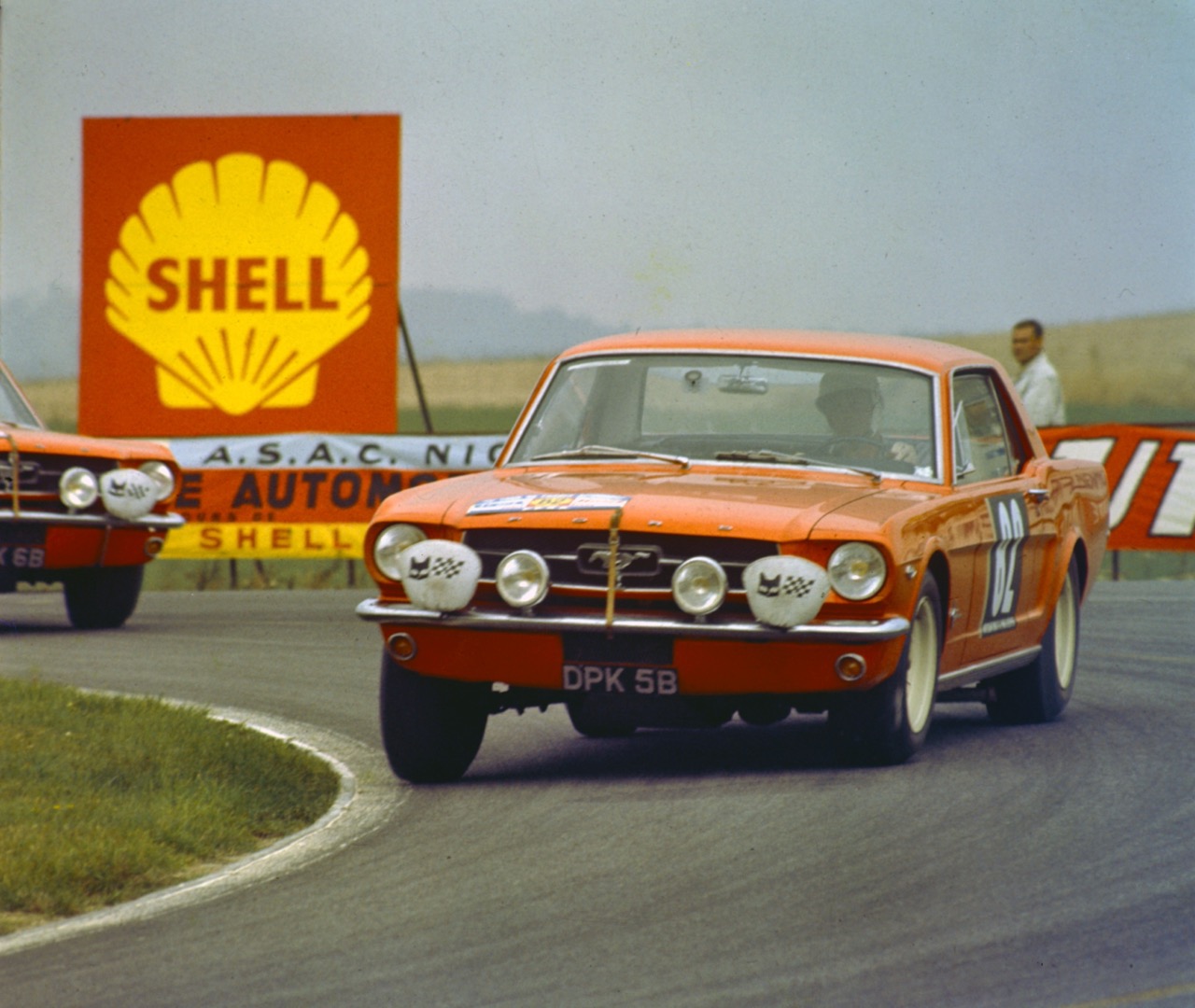
While the Shelby GT350R was busy rewriting the rulebook of American amateur road racing in the SCCA, a different, arguably more sophisticated strain of the Mustang virus was infecting the race tracks of Europe. By 1966, the landscape of the British Saloon Car Championship (BSCC) and the European Touring Car Championship (ETCC) was shifting. The era of the lumbering, softly-sprung Jaguar Mk2 was fading, and the gigantic 7.0-litre Ford Galaxie 500s—while spectacular—were simply too large for the tighter, technical circuits of the continent. Ford of Europe, emboldened by the success of the Lotus Cortina, sought a weapon that combined American horsepower with European chassis dynamics to dominate the premier “over 2.0-litre” class. They found their answer not in a Shelby catalog, but in the workshops of Byfleet, Surrey, run by the legendary Alan Mann. The 1966 Ford Mustang 289 Group 2 was the result: a homologated touring car that took the pony car silhouette and infused it with the precision of a scalpel, creating a machine that would brutalize the European opposition with a level of professionalism previously unseen in saloon racing.
Technically, the Group 2 Mustang was a fascinating divergence from its American GT350 cousin. While Shelby’s R-Model was a fiberglass-clad sports car built for “Production” racing, the FIA Group 2 regulations mandated the retention of the steel bodywork, full glass windows, and the standard interior silhouette, including the rear seat. This meant the Alan Mann Racing (AMR) Mustangs were heavier than the Shelbys, but they were masterpieces of suspension engineering. The unibody shells were seam-welded for rigidity, a necessity to handle the forces generated by the stiffened suspension. AMR discarded the vagueness of the stock setup, installing stiffer, lowered coil springs, re-valved Koni shock absorbers, and substantial anti-roll bars. The live rear axle, the Mustang’s Achilles’ heel, was tamed with panhard rods and traction bars that prevented lateral movement and axle tramp, allowing the car to be driven with a surprising degree of finesse rather than just point-and-shoot aggression.
Under the steel hood lay the “Hi-Po” 289 cubic inch (4.7-litre) V8, but it was far from stock. Blueprinted and balanced, these engines breathed through quadruple Weber 48 IDA carburetors, a setup that provided instantaneous throttle response and a distinct, guttural induction roar that drowned out the buzzing Lotus Cortinas. Producing approximately 360 to 380 bhp, the engine was mated to a close-ratio BorgWarner T-10 four-speed gearbox. Braking was handled by massive Kelsey-Hayes ventilated discs at the front and large drums (or homologated discs in later iterations) at the rear, necessary to haul the 1,200 kg beast down from speeds approaching 150 mph. Visually, the cars were understated compared to the striped Shelbys; usually painted in the iconic Red and Gold livery of Alan Mann Racing or the white of the Broadspeed team, they rolled on 15-inch Minilite magnesium wheels, their fenders gently flared to cover the Dunlop Racing tires.
The impact of the 1966 Group 2 Mustang on European motorsport was nothing short of a hegemony. In the 1966 BSCC season, the Alan Mann Mustangs, piloted primarily by the aristocratic and immensely talented Sir John Whitmore, were unstoppable. Whitmore won the class in virtually every race he entered, securing the British Saloon Car Championship title with emphatic ease. The sight of the Red and Gold Mustang lifting its inside front wheel at Paddock Hill Bend, drifting perfectly while chasing down nimble Minis and lapping Jaguars, became one of the defining images of 1960s British motorsport. It wasn’t just a British phenomenon; in the ETCC, the Mustangs fought a fierce war against the Alfa Romeo GTAs and BMWs. While the smaller engines of the Alfas often gave them the handicap advantage for the overall title, on track, the Mustang was the undisputed King of the Road, taking overall victories at circuits as diverse as Zolder and Snetterton.
The Group 2 Mustang’s career was intense but essentially limited to the 1966 and 1967 seasons in factory capacity. By 1968, the regulations shifted to Group 5, and Ford’s focus moved to the new Escort Twin Cam, which offered better marketing synergy for the European market. However, the Mustang had done its job. It had banished the Jaguar Mk2 to history and proven that an American V8 could be made to handle on twisty European tarmac. It paved the way for the later domination of the Chevrolet Camaro Z/28 and the Ford Boss 302 in the late 60s and early 70s saloon series.
Today, the 1966 Ford Mustang 289 Group 2 holds a revered place in the pantheon of touring cars. It represents the pinnacle of the “Trans-Atlantic” racing relationship, where American muscle was refined by British engineering. Unlike the Shelby GT350, which is celebrated as an American sports car, the Group 2 Mustang is celebrated as a European touring car legend, a brute in a tailored suit that taught the old guard a lesson in professionalism and pace. To see one today at the Goodwood Revival, battling wheel-to-wheel with a Ford Falcon Sprint or a Lotus Cortina, is to witness the glorious, thunderous zenith of the pre-aerodynamic era.
Brand
Produced from
Portal
Vehicle category
Model line
Model generation
Predecessor
Sucessor
Brand
Produced from
Portal
Vehicle category
Model line
Model generation
Predecessor
Sucessor
About this submodel
While the Shelby GT350R was busy rewriting the rulebook of American amateur road racing in the SCCA, a different, arguably more sophisticated strain of the Mustang virus was infecting the race tracks of Europe. By 1966, the landscape of the British Saloon Car Championship (BSCC) and the European Touring Car Championship (ETCC) was shifting. The era of the lumbering, softly-sprung Jaguar Mk2 was fading, and the gigantic 7.0-litre Ford Galaxie 500s—while spectacular—were simply too large for the tighter, technical circuits of the continent. Ford of Europe, emboldened by the success of the Lotus Cortina, sought a weapon that combined American horsepower with European chassis dynamics to dominate the premier “over 2.0-litre” class. They found their answer not in a Shelby catalog, but in the workshops of Byfleet, Surrey, run by the legendary Alan Mann. The 1966 Ford Mustang 289 Group 2 was the result: a homologated touring car that took the pony car silhouette and infused it with the precision of a scalpel, creating a machine that would brutalize the European opposition with a level of professionalism previously unseen in saloon racing.
Technically, the Group 2 Mustang was a fascinating divergence from its American GT350 cousin. While Shelby’s R-Model was a fiberglass-clad sports car built for “Production” racing, the FIA Group 2 regulations mandated the retention of the steel bodywork, full glass windows, and the standard interior silhouette, including the rear seat. This meant the Alan Mann Racing (AMR) Mustangs were heavier than the Shelbys, but they were masterpieces of suspension engineering. The unibody shells were seam-welded for rigidity, a necessity to handle the forces generated by the stiffened suspension. AMR discarded the vagueness of the stock setup, installing stiffer, lowered coil springs, re-valved Koni shock absorbers, and substantial anti-roll bars. The live rear axle, the Mustang’s Achilles’ heel, was tamed with panhard rods and traction bars that prevented lateral movement and axle tramp, allowing the car to be driven with a surprising degree of finesse rather than just point-and-shoot aggression.
Under the steel hood lay the “Hi-Po” 289 cubic inch (4.7-litre) V8, but it was far from stock. Blueprinted and balanced, these engines breathed through quadruple Weber 48 IDA carburetors, a setup that provided instantaneous throttle response and a distinct, guttural induction roar that drowned out the buzzing Lotus Cortinas. Producing approximately 360 to 380 bhp, the engine was mated to a close-ratio BorgWarner T-10 four-speed gearbox. Braking was handled by massive Kelsey-Hayes ventilated discs at the front and large drums (or homologated discs in later iterations) at the rear, necessary to haul the 1,200 kg beast down from speeds approaching 150 mph. Visually, the cars were understated compared to the striped Shelbys; usually painted in the iconic Red and Gold livery of Alan Mann Racing or the white of the Broadspeed team, they rolled on 15-inch Minilite magnesium wheels, their fenders gently flared to cover the Dunlop Racing tires.
The impact of the 1966 Group 2 Mustang on European motorsport was nothing short of a hegemony. In the 1966 BSCC season, the Alan Mann Mustangs, piloted primarily by the aristocratic and immensely talented Sir John Whitmore, were unstoppable. Whitmore won the class in virtually every race he entered, securing the British Saloon Car Championship title with emphatic ease. The sight of the Red and Gold Mustang lifting its inside front wheel at Paddock Hill Bend, drifting perfectly while chasing down nimble Minis and lapping Jaguars, became one of the defining images of 1960s British motorsport. It wasn’t just a British phenomenon; in the ETCC, the Mustangs fought a fierce war against the Alfa Romeo GTAs and BMWs. While the smaller engines of the Alfas often gave them the handicap advantage for the overall title, on track, the Mustang was the undisputed King of the Road, taking overall victories at circuits as diverse as Zolder and Snetterton.
The Group 2 Mustang’s career was intense but essentially limited to the 1966 and 1967 seasons in factory capacity. By 1968, the regulations shifted to Group 5, and Ford’s focus moved to the new Escort Twin Cam, which offered better marketing synergy for the European market. However, the Mustang had done its job. It had banished the Jaguar Mk2 to history and proven that an American V8 could be made to handle on twisty European tarmac. It paved the way for the later domination of the Chevrolet Camaro Z/28 and the Ford Boss 302 in the late 60s and early 70s saloon series.
Today, the 1966 Ford Mustang 289 Group 2 holds a revered place in the pantheon of touring cars. It represents the pinnacle of the “Trans-Atlantic” racing relationship, where American muscle was refined by British engineering. Unlike the Shelby GT350, which is celebrated as an American sports car, the Group 2 Mustang is celebrated as a European touring car legend, a brute in a tailored suit that taught the old guard a lesson in professionalism and pace. To see one today at the Goodwood Revival, battling wheel-to-wheel with a Ford Falcon Sprint or a Lotus Cortina, is to witness the glorious, thunderous zenith of the pre-aerodynamic era.
Tech Specs
Discover the technical specifications
Tech Specs
Discover the technical specifications
Engine
01
03
Internal combustion engine
Configuration
Ford Windsor 289 "HiPo" Race Spec, V8 - 90º
Location
Front, longitudinally mounted
Construction
Cast iron block and heads
Displacement (cc)
4,727 cc
Displacement (cu in)
288.5 cu in
Compression
11.5:1
Bore x Stroke
101.6 mm x 72.9 mm
Valvetrain
2 valves per cylinder, OHV
Fuel feed
4 x Weber 48 IDA carburetors
Lubrication
Wet sump
Aspiration
Naturally aspirated
Output
Power (hp)
350 hp
Power (kW)
261 kW
Max power at
7,200 RPM
Torque (Nm)
440 Nm
Torque (ft lbs)
324.5 ft lbs
Max torque at
5,000 RPM
Drivetrain
02
03
Chassis
Type
Unibody reinforced
Material
Steel
Body
Material
Steel
Transmission
Gearbox
Ford Toploader, 4-speed manual
Drive
Rear Wheel Drive (Limited Slip Differential)
Suspension
Front
Independent, stiffer coil springs, Koni dampers, thicker anti-roll bar, "Shelby drop" on upper arms
Rear
Live axle, semi-elliptic leaf springs, Koni dampers, traction bars
Steering
Type
Recirculating ball
Brakes
Front
Ventilated discs Ø287 mm, 4-piston calipers (Kelsey-Hayes)
Rear
Drums Ø254 mm (Large competition drums)
Wheels
Front
7" x 15" or 8" x 15"
Rear
7" x 15" or 8" x 15"
Tires
Front
5.50-15 / 6.00-15
Rear
5.50-15 / 6.00-15
Dimensions and performance
03
03
Dimensions
Lenght (mm)
4,613 mm
Lenght (in)
181.6 in
Width (mm)
1,732 mm
Width (in)
68.2 in
Height (mm)
1,290 mm
Height (in)
50.8 in
Wheelbase (mm)
2,743 mm
Wheelbase (in)
108.0 in
Weight (kg)
~1,180 kg
Weight (lbs)
~2,600 lbs
Performance
Power to weight
~0.29 hp/kg
Top speed (km/h)
~245 km/h
Top speed (mph)
~152 mph
0-100 km/h (0-60 mph)
~5.4 s
Submodels
Other variants of this model
Submodels