Chevron B36 Mazda 10A R2
Brand
Produced from
Portal
Vehicle category
Model line
Predecessor
Sucessor
About this submodel
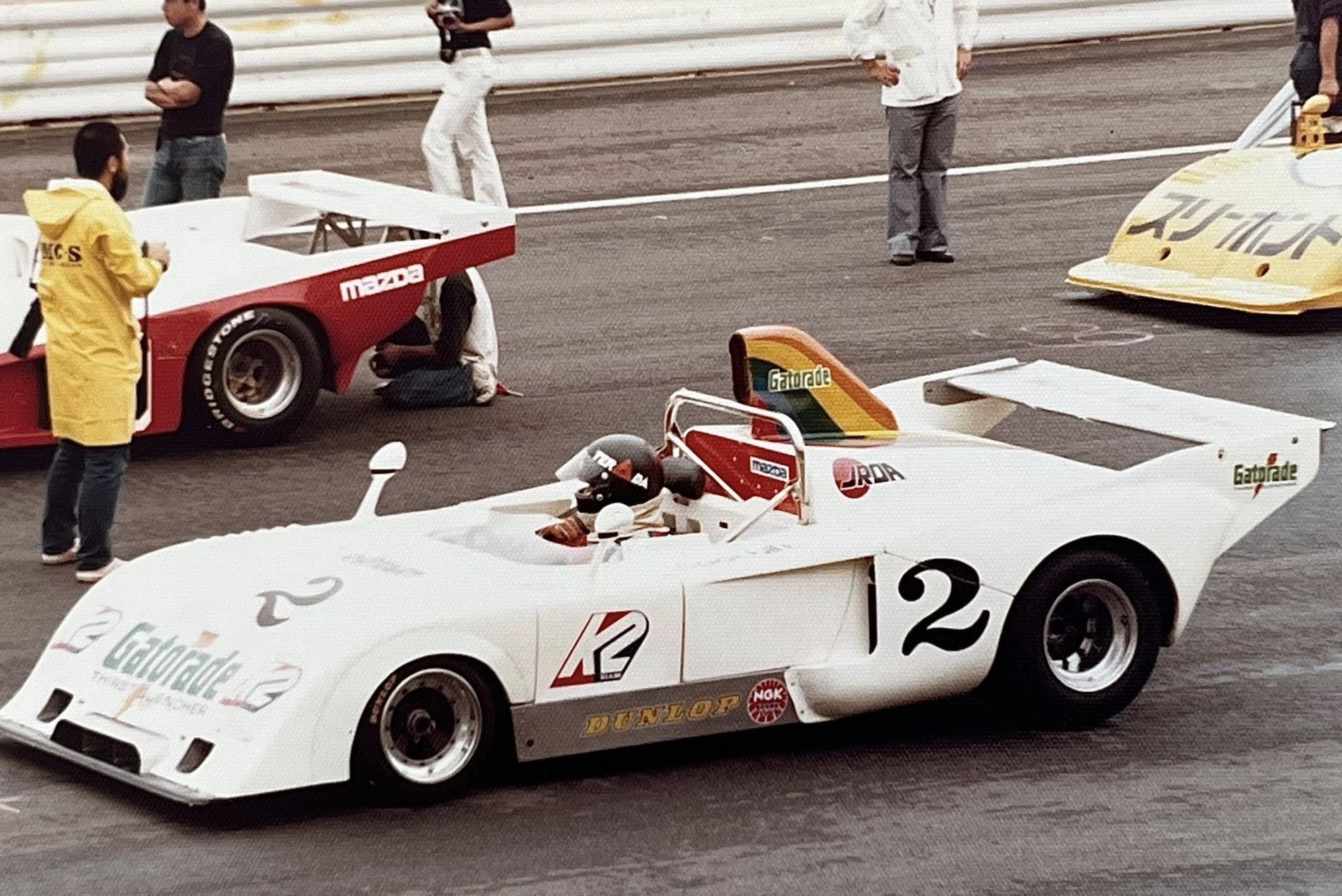
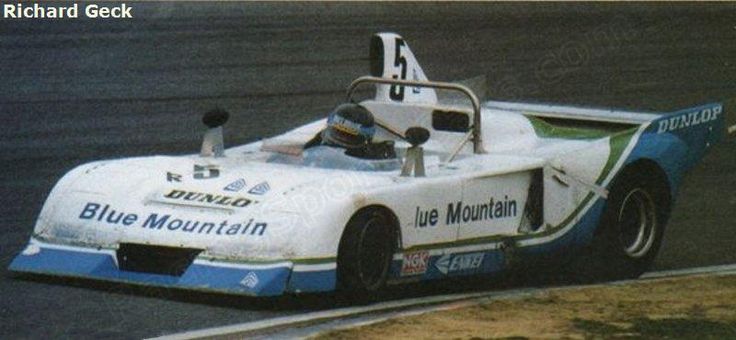
In the mid-1970s, the world of sports prototype racing was defined by a rigid orthodoxy. The grid of the European 2-Litre Championship was a sea of reciprocating pistons, a rhythmic thrum of Ford Cosworth BDGs and BMW M12s. But thousands of miles away, on the high-speed circuit of Fuji Speedway in Japan, a different kind of revolution was screaming at 10,000 rpm. The 1976 Chevron B36 Mazda was not just a race car; it was a cultural phenomenon, a machine that bridged the gap between the disciplined engineering of Derek Bennett’s Bolton workshop and the wild, silhouette-racer aesthetic of the Japanese Grand Champion (GC) series. While the B36 was designed as a precision instrument for European twisty bits, in Japan, it was transformed into a fire-breathing, rotary-powered monster that became the poster child for a golden age of Japanese motorsport.
The context for this car is unique. The Fuji Grand Champion series was a “run what you brung” environment for 2.0-litre prototypes, but it evolved into something far more spectacular. The Japanese teams, led by heroes like Yojiro Terada and Kazuyoshi Hoshino, realized that the standard European bodywork was insufficient for the massive straights of Fuji. They began to modify the cars, but the heart of the beast was the Mazda rotary. The B36 chassis was the perfect recipient. Bennett’s aluminium monocoque was incredibly stiff and light, a vast improvement over the earlier steel-framed cars. Into this British tub, teams like Mazdaspeed and privateers dropped the Mazda 10A R2 (and later the 12A and 13B). This was a twin-rotor Wankel engine, displacing a geometric 982cc but rated as a 2.0-litre equivalent.
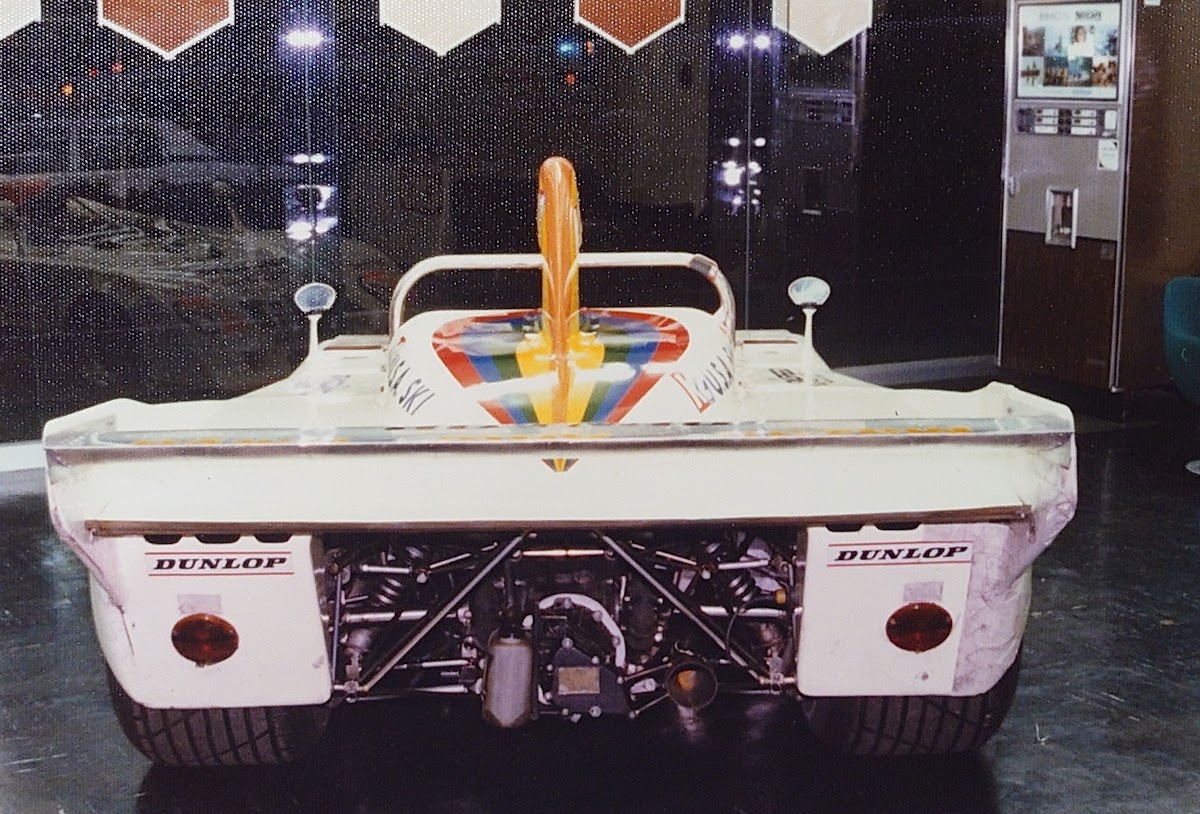
Technically, the B36 Mazda was a fascinating hybrid. The engine was a marvel of compact density. Small enough to be lifted by a single mechanic, it sat incredibly low in the chassis, lowering the centre of gravity even further than the Cosworth-powered cars. In race trim, with peripheral ports and a massive Weber carburetor, the 10A produced around 200-230 bhp. While it lacked the torque of the BMW M12, it possessed a linear, turbine-like power delivery that didn’t stop pulling until the tachometer hit five digits. The sound was apocalyptic—a high-frequency, buzzing shriek that could shatter eardrums.
But the visual transformation was even more radical. To cope with the high speeds of Fuji, the B36 bodywork was often discarded or heavily modified. Japanese constructors fitted “Long-Tail” cowls, massive rear wings that extended feet behind the car, and enclosed wheel arches. These “GC Special” bodies turned the svelte Chevron into a land-speed record car, capable of frightening velocities on the main straight. The B36 chassis handled this aerodynamic load with aplomb, its suspension geometry proving adaptable enough to manage the downforce levels that far exceeded its original design parameters.
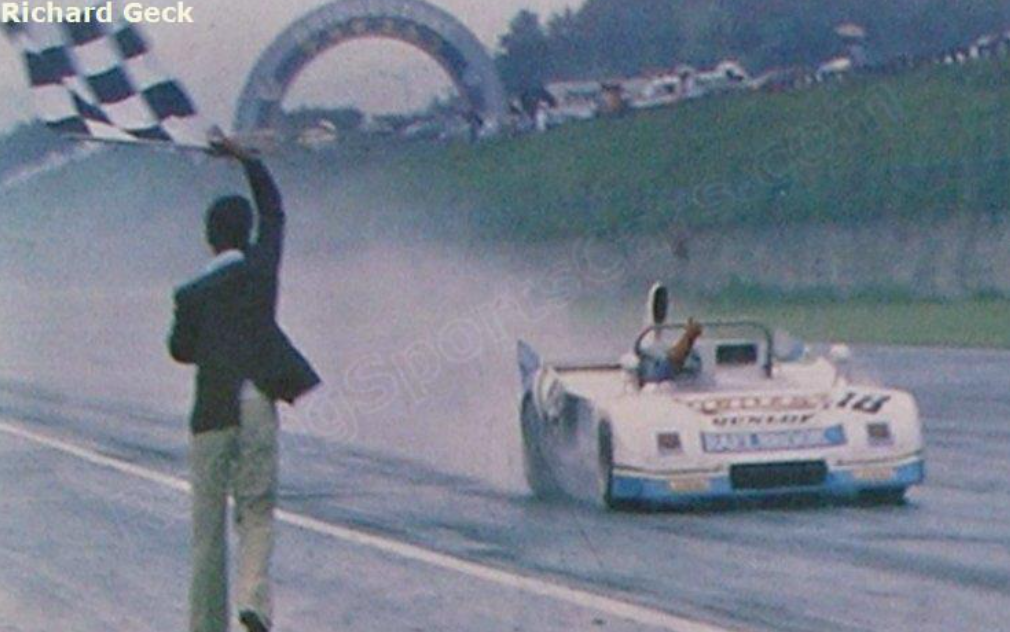
The impact of the Chevron B36 Mazda in Japan was immense. It was a fan favorite, not just for its speed, but for the spectacle. The rotary engines were notorious for dumping unburnt fuel into the hot exhaust, resulting in massive, metre-long flames spitting from the tailpipes on every downshift. It was a visceral experience. Drivers like Terada used these cars to challenge the dominant BMW-powered March and Lola. While the BMW engines had the raw horsepower advantage, the reliability of the Mazda rotary (once the apex seal issues were sorted) made it a formidable endurance weapon. The B36 Mazda also made appearances in Europe, most notably at Le Mans, where the light weight of the rotary package and the reliability of the Chevron chassis made for a compelling entry in the smaller classes, keeping the “rotary dream” alive long before the 787B’s historic win.
The legacy of the Chevron B36 Mazda 10A R2 is one of cross-cultural brilliance. It proved that Derek Bennett’s chassis design was robust enough to handle an engine concept he likely never envisioned it carrying. It stands as the spiritual ancestor to the Group C Mazdas, a machine that taught Japanese engineers the value of a stiff monocoque chassis while teaching European aerodynamicists the value of high-speed stability. Today, these cars are some of the most spectacular sights in historic racing, a flame-spitting reminder of a time when the British chassis industry and the Japanese rotary revolution met on the racetrack and created something louder, wilder, and faster than the sum of their parts.
Brand
Produced from
Portal
Vehicle category
Model line
Predecessor
Sucessor
Brand
Produced from
Portal
Vehicle category
Model line
Model generation
Predecessor
Sucessor
About this submodel
In the mid-1970s, the world of sports prototype racing was defined by a rigid orthodoxy. The grid of the European 2-Litre Championship was a sea of reciprocating pistons, a rhythmic thrum of Ford Cosworth BDGs and BMW M12s. But thousands of miles away, on the high-speed circuit of Fuji Speedway in Japan, a different kind of revolution was screaming at 10,000 rpm. The 1976 Chevron B36 Mazda was not just a race car; it was a cultural phenomenon, a machine that bridged the gap between the disciplined engineering of Derek Bennett’s Bolton workshop and the wild, silhouette-racer aesthetic of the Japanese Grand Champion (GC) series. While the B36 was designed as a precision instrument for European twisty bits, in Japan, it was transformed into a fire-breathing, rotary-powered monster that became the poster child for a golden age of Japanese motorsport.
The context for this car is unique. The Fuji Grand Champion series was a “run what you brung” environment for 2.0-litre prototypes, but it evolved into something far more spectacular. The Japanese teams, led by heroes like Yojiro Terada and Kazuyoshi Hoshino, realized that the standard European bodywork was insufficient for the massive straights of Fuji. They began to modify the cars, but the heart of the beast was the Mazda rotary. The B36 chassis was the perfect recipient. Bennett’s aluminium monocoque was incredibly stiff and light, a vast improvement over the earlier steel-framed cars. Into this British tub, teams like Mazdaspeed and privateers dropped the Mazda 10A R2 (and later the 12A and 13B). This was a twin-rotor Wankel engine, displacing a geometric 982cc but rated as a 2.0-litre equivalent.
Technically, the B36 Mazda was a fascinating hybrid. The engine was a marvel of compact density. Small enough to be lifted by a single mechanic, it sat incredibly low in the chassis, lowering the centre of gravity even further than the Cosworth-powered cars. In race trim, with peripheral ports and a massive Weber carburetor, the 10A produced around 200-230 bhp. While it lacked the torque of the BMW M12, it possessed a linear, turbine-like power delivery that didn’t stop pulling until the tachometer hit five digits. The sound was apocalyptic—a high-frequency, buzzing shriek that could shatter eardrums.
But the visual transformation was even more radical. To cope with the high speeds of Fuji, the B36 bodywork was often discarded or heavily modified. Japanese constructors fitted “Long-Tail” cowls, massive rear wings that extended feet behind the car, and enclosed wheel arches. These “GC Special” bodies turned the svelte Chevron into a land-speed record car, capable of frightening velocities on the main straight. The B36 chassis handled this aerodynamic load with aplomb, its suspension geometry proving adaptable enough to manage the downforce levels that far exceeded its original design parameters.
The impact of the Chevron B36 Mazda in Japan was immense. It was a fan favorite, not just for its speed, but for the spectacle. The rotary engines were notorious for dumping unburnt fuel into the hot exhaust, resulting in massive, metre-long flames spitting from the tailpipes on every downshift. It was a visceral experience. Drivers like Terada used these cars to challenge the dominant BMW-powered March and Lola. While the BMW engines had the raw horsepower advantage, the reliability of the Mazda rotary (once the apex seal issues were sorted) made it a formidable endurance weapon. The B36 Mazda also made appearances in Europe, most notably at Le Mans, where the light weight of the rotary package and the reliability of the Chevron chassis made for a compelling entry in the smaller classes, keeping the “rotary dream” alive long before the 787B’s historic win.
The legacy of the Chevron B36 Mazda 10A R2 is one of cross-cultural brilliance. It proved that Derek Bennett’s chassis design was robust enough to handle an engine concept he likely never envisioned it carrying. It stands as the spiritual ancestor to the Group C Mazdas, a machine that taught Japanese engineers the value of a stiff monocoque chassis while teaching European aerodynamicists the value of high-speed stability. Today, these cars are some of the most spectacular sights in historic racing, a flame-spitting reminder of a time when the British chassis industry and the Japanese rotary revolution met on the racetrack and created something louder, wilder, and faster than the sum of their parts.
Tech Specs
Discover the technical specifications
Tech Specs
Discover the technical specifications
Engine
01
03
Internal combustion engine
Configuration
Mazda 10A R2, 2 Rotor Wankel
Location
Mid, longitudinally mounted
Construction
Sand-cast aluminium plated with chrome rotor housing, cast iron rotorsc
Displacement (cc)
982 cc
Displacement (cu in)
59.9 cu in
Compression
-
Bore x Stroke
-
Valvetrain
-
Fuel feed
Zenith-Stromberg 4 barrel carburetor
Lubrication
Dry sump
Aspiration
Naturally aspirated
Output
Power (hp)
200 hp
Power (kW)
149 kW
Max power at
-
Torque (Nm)
-
Torque (ft lbs)
-
Max torque at
-
Drivetrain
02
03
Chassis
Type
Monocoque with front and rear subframes
Material
Aluminium
Body
Material
Fibreglass
Transmission
Gearbox
5-speed manual
Drive
Rear Wheel Drive
Suspension
Front
Double wishbones, coil springs over dampers, anti-roll bar
Rear
Single top links, twin lower links, twin trailing arms, coil springs over dampers, anti-roll bar
Steering
Type
Rack and pinion
Brakes
Front
Ventilated discs
Rear
Ventilated discs
Wheels
Front
-
Rear
-
Tires
Front
-
Rear
-
Dimensions and performance
03
03
Dimensions
Lenght (mm)
-
Lenght (in)
-
Width (mm)
-
Width (in)
-
Height (mm)
-
Height (in)
-
Wheelbase (mm)
2,400 mm
Wheelbase (in)
94.5 in
Weight (kg)
-
Weight (lbs)
-
Performance
Power to weight
-
Top speed (km/h)
-
Top speed (mph)
-
0-100 km/h (0-60 mph)
-
Submodels
Other variants of this model
Submodels