Chevrolet Corvette C6 Z06.R GT3

Brand
Produced from
Portal
Vehicle category
Model line
Model generation
Predecessor
Sucessor
About this submodel
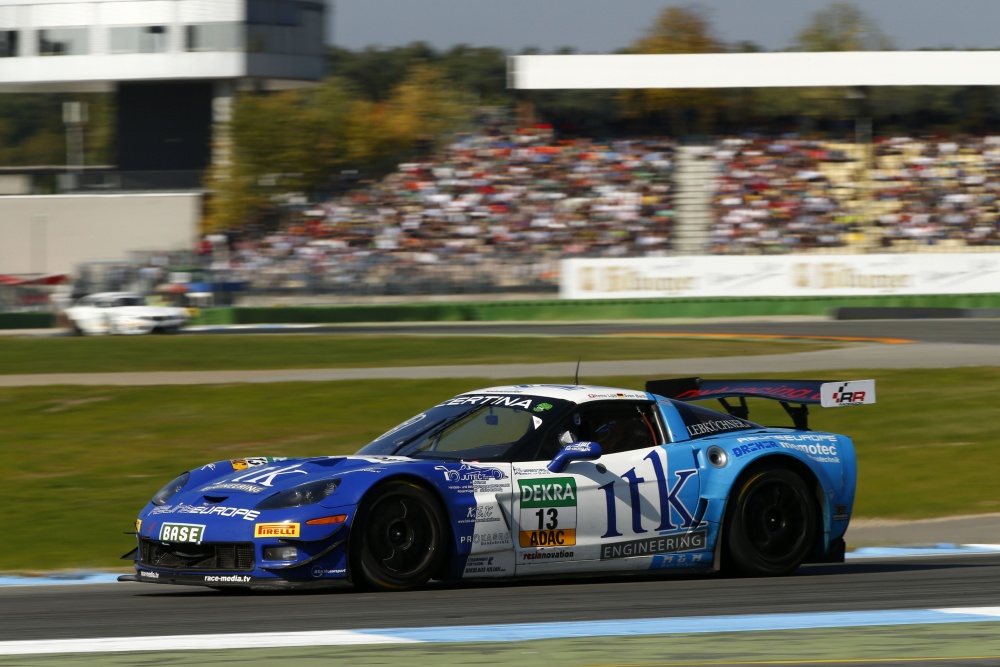
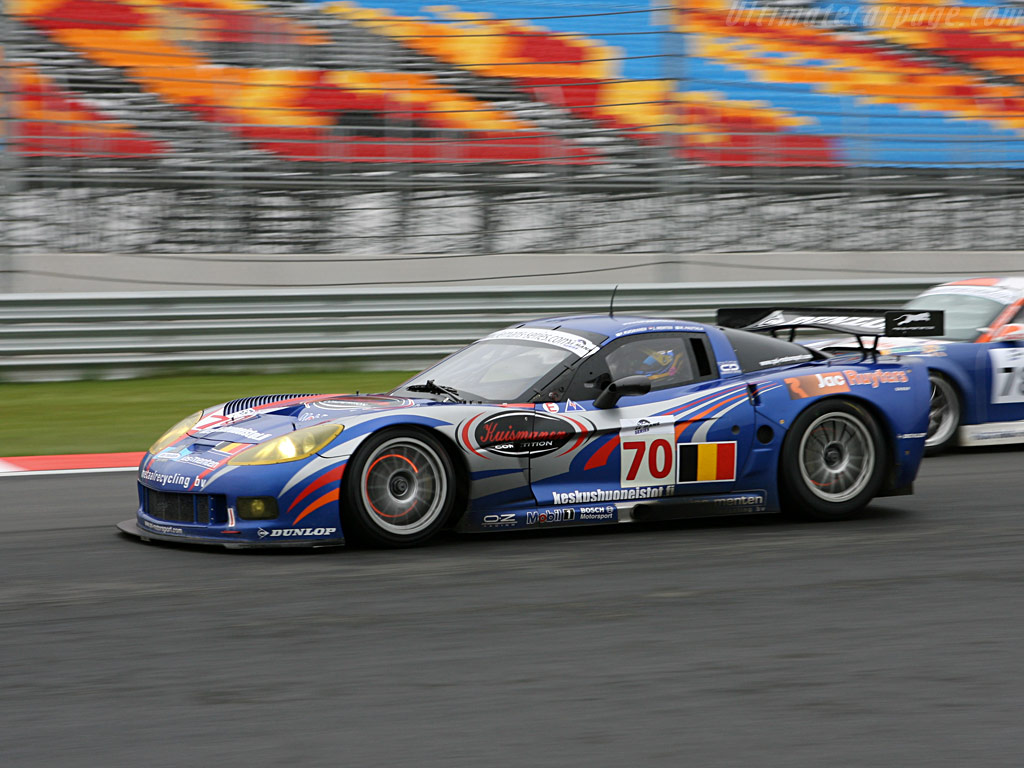
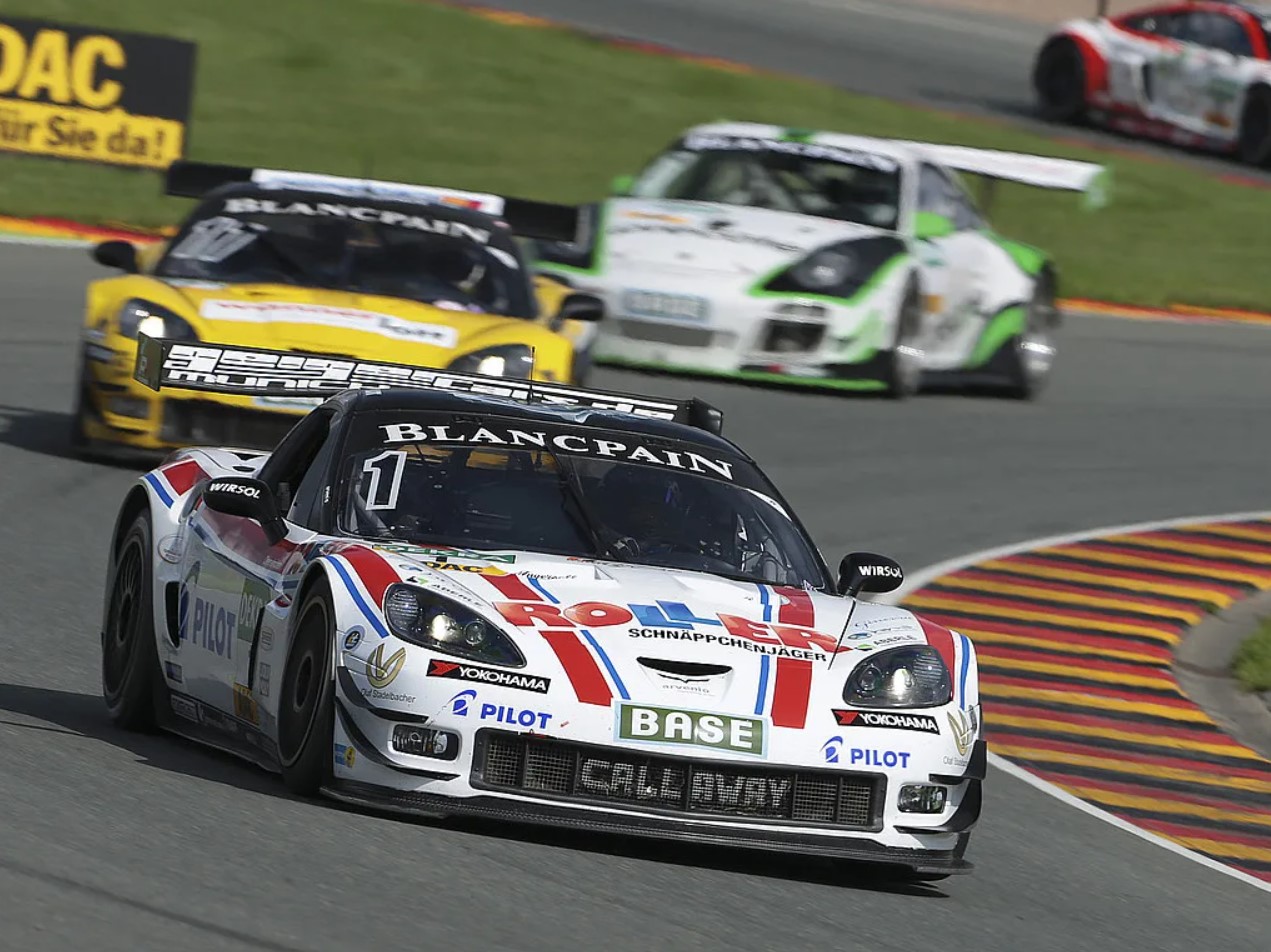
The year 2006 marked a seismic shift in the landscape of grand touring motorsport. While the headlines were dominated by the factory-backed titans in the GT1 and GT2 categories—where Pratt & Miller’s yellow C6.Rs were waging a transatlantic war against Aston Martin and Ferrari—a quieter, populist revolution was brewing in the paddock. Stéphane Ratel, the architect of modern GT racing, had envisioned a new category: GT3. This was to be the domain of the gentleman driver and the privateer team, a class where the cars were closely linked to their road-going counterparts, balanced by performance rather than endless spending. General Motors, entirely focused on their Le Mans program, had no interest in building a customer car for this fledgling European series. However, in the small German town of Leingarten, Callaway Competition saw an opportunity. They looked at the newly released, aluminum-framed C6 Z06 street car and saw not just a grand tourer, but the raw materials for a world-beater. The result was the Chevrolet Corvette C6 Z06.R GT3, a car that would become the most successful Corvette in European sprint racing history.
To understand the Z06.R, one must understand its provenance. Unlike the C6.R GTE/GT1, which was a purpose-built tube-frame prototype that merely resembled a Corvette, the Z06.R was fundamentally a production car turned up to eleven. Callaway Competition, led by Ernst Wöhr and Giovanni Ciccone, had been tuning Corvettes since the 1980s and had successfully campaigned the C4 and C12 in previous eras. They received GM’s blessing—but not their money—to homologate the C6 Z06 for the FIA GT3 championship. The starting point was the production hydroformed aluminum chassis, a technological marvel that offered immense rigidity but presented a nightmare for race engineers accustomed to welding steel cages. Callaway developed a unique method to bond and bolt a steel safety cell into the aluminum structure, creating a chassis that was both compliant and incredibly stiff.
The heart of the beast was, inevitably, the engine. The road-going Z06’s LS7 is widely regarded as one of the greatest internal combustion engines ever made, and in the Z06.R, it was unleashed. Displacing a massive 7.0 litres (427 cubic inches), this dry-sump Small Block V8 was a naturally aspirated sledgehammer. While the regulations often required air restrictors to balance performance against smaller-engined rivals like the Porsche 911 GT3 Cup or the Ferrari F430, the Corvette’s torque curve was a force of nature. Producing between 500 and 530 horsepower depending on the “Balance of Performance” (BoP), it drove the rear wheels through a longitudinally mounted Hewland six-speed sequential transaxle. The sound was distinct—a deep, guttural, earth-shaking rumble that contrasted sharply with the high-pitched wail of the Italian and German competition. It was the sound of American thunder rolling through the Eifel mountains.
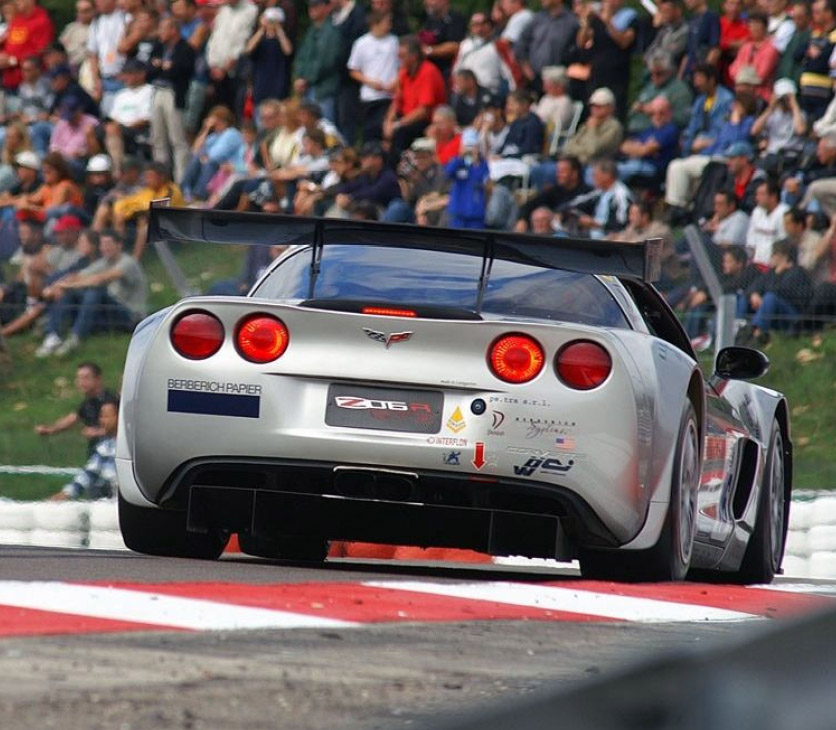
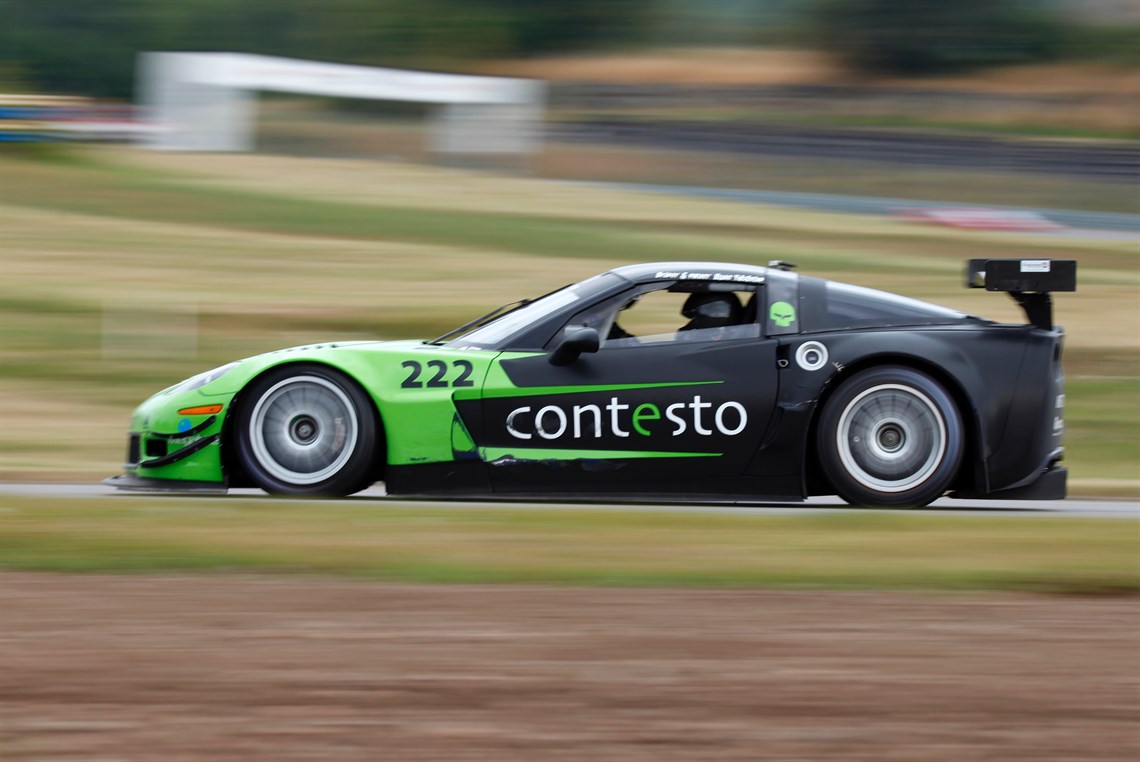
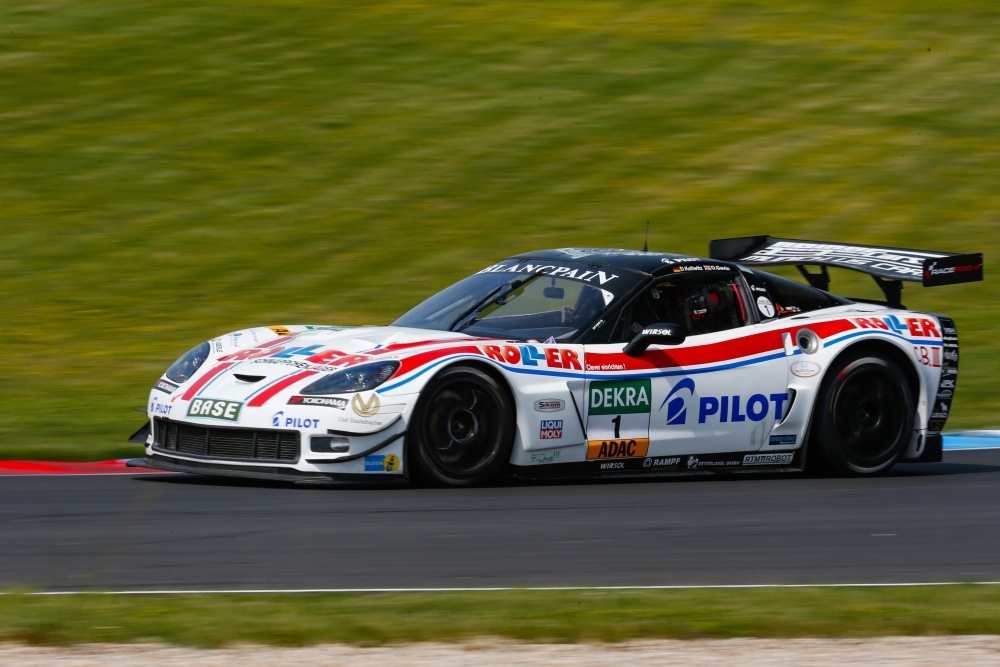
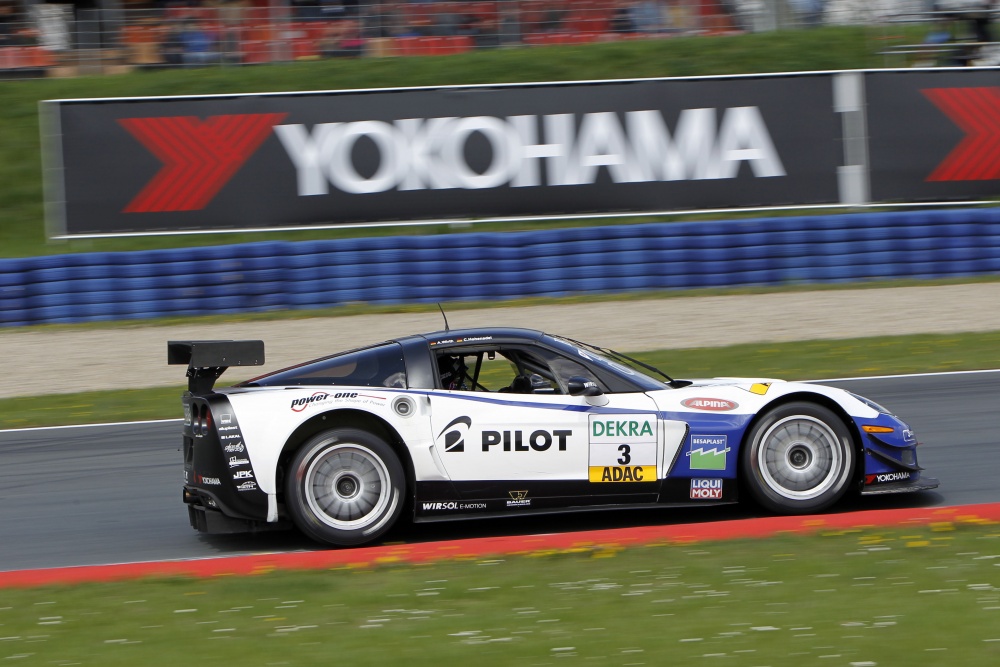
Visually, the Z06.R was an exercise in functional aggression. It retained the wide-body stance of the production Z06 but added a comprehensive, yet cost-effective, aerodynamic package. A large carbon-fibre splitter scraped the tarmac at the front, while a massive, adjustable rear wing provided the downforce necessary to keep the lightweight rear end planted at speed. The cooling was heavily revised, with the hood sporting deep vents to extract heat from the massive V8 and reduce front-end lift. Inside, the luxury of the road car was stripped away, replaced by a spartan workspace dominated by a digital dash, a carbon bucket seat, and the comforting lever of the sequential shifter. Despite the modifications, the DNA of the street car was palpable; this was a racer that proved just how capable the C6 Z06 platform truly was.
The impact of the Z06.R GT3 was immediate and devastating. In the inaugural years of the FIA GT3 European Championship, the Callaway-built Corvettes were the cars to beat. They possessed a unique combination of mechanical grip, user-friendly torque, and braking stability that made them accessible to amateur drivers while being lethally fast in the hands of pros. In 2007, the team of Martini Callaway Racing dominated the FIA GT3 Team Championship, with drivers Luca Pirri and Jürgen von Gartzen showcasing the car’s prowess. But the car’s true dynasty was forged in the ADAC GT Masters, the German national series that became the premier GT3 battleground. The Z06.R became the winningest car in the series’ history for a long period, taking the Team Championship in 2009 and the Drivers’ Championship in 2013 with Daniel Keilwitz and Diego Alessi.
The car attracted legends. Klaus Ludwig, the multiple Le Mans and DTM champion, came out of retirement to race the Z06.R, praising its handling and power delivery. It wasn’t just a blunt instrument; it was a precision tool that happened to be shaped like a hammer. Throughout its lifespan, the Z06.R fought against three generations of Porsche 911s, the Audi R8 LMS, the Mercedes SLS AMG, and the McLaren MP4-12C. While the mid-engine rivals eventually brought superior aerodynamics and electronics, the front-engine Corvette remained competitive through constant evolution by Callaway, proving the inherent brilliance of the original design.
The legacy of the C6 Z06.R GT3 is profound. It established Callaway Competition as the de facto factory team for Corvette in the GT3 category, a relationship that continued into the C7 generation. It proved that the Corvette could compete on the tight, technical circuits of Europe against the best engineering Germany and Italy could offer, without the bottomless budget of a factory program. It bridged the gap between the showroom floor and the podium in a way the GT1 cars never could. For the privateer racer, it offered a reliable, cost-effective, and devastatingly fast entry into the world of GT racing. The Z06.R GT3 was the car that truly democratized the Corvette’s racing success, taking the “Win on Sunday, Sell on Monday” ethos and applying it to the hardest racing series on the continent. It remains a fan favourite, a roaring, sliding, 7.0-litre testament to the golden age of naturally aspirated GT racing.
Brand
Produced from
Portal
Vehicle category
Model line
Model generation
Predecessor
Sucessor
Brand
Produced from
Portal
Vehicle category
Model line
Model generation
Predecessor
Sucessor
About this submodel
The year 2006 marked a seismic shift in the landscape of grand touring motorsport. While the headlines were dominated by the factory-backed titans in the GT1 and GT2 categories—where Pratt & Miller’s yellow C6.Rs were waging a transatlantic war against Aston Martin and Ferrari—a quieter, populist revolution was brewing in the paddock. Stéphane Ratel, the architect of modern GT racing, had envisioned a new category: GT3. This was to be the domain of the gentleman driver and the privateer team, a class where the cars were closely linked to their road-going counterparts, balanced by performance rather than endless spending. General Motors, entirely focused on their Le Mans program, had no interest in building a customer car for this fledgling European series. However, in the small German town of Leingarten, Callaway Competition saw an opportunity. They looked at the newly released, aluminum-framed C6 Z06 street car and saw not just a grand tourer, but the raw materials for a world-beater. The result was the Chevrolet Corvette C6 Z06.R GT3, a car that would become the most successful Corvette in European sprint racing history.
To understand the Z06.R, one must understand its provenance. Unlike the C6.R GTE/GT1, which was a purpose-built tube-frame prototype that merely resembled a Corvette, the Z06.R was fundamentally a production car turned up to eleven. Callaway Competition, led by Ernst Wöhr and Giovanni Ciccone, had been tuning Corvettes since the 1980s and had successfully campaigned the C4 and C12 in previous eras. They received GM’s blessing—but not their money—to homologate the C6 Z06 for the FIA GT3 championship. The starting point was the production hydroformed aluminum chassis, a technological marvel that offered immense rigidity but presented a nightmare for race engineers accustomed to welding steel cages. Callaway developed a unique method to bond and bolt a steel safety cell into the aluminum structure, creating a chassis that was both compliant and incredibly stiff.
The heart of the beast was, inevitably, the engine. The road-going Z06’s LS7 is widely regarded as one of the greatest internal combustion engines ever made, and in the Z06.R, it was unleashed. Displacing a massive 7.0 litres (427 cubic inches), this dry-sump Small Block V8 was a naturally aspirated sledgehammer. While the regulations often required air restrictors to balance performance against smaller-engined rivals like the Porsche 911 GT3 Cup or the Ferrari F430, the Corvette’s torque curve was a force of nature. Producing between 500 and 530 horsepower depending on the “Balance of Performance” (BoP), it drove the rear wheels through a longitudinally mounted Hewland six-speed sequential transaxle. The sound was distinct—a deep, guttural, earth-shaking rumble that contrasted sharply with the high-pitched wail of the Italian and German competition. It was the sound of American thunder rolling through the Eifel mountains.
Visually, the Z06.R was an exercise in functional aggression. It retained the wide-body stance of the production Z06 but added a comprehensive, yet cost-effective, aerodynamic package. A large carbon-fibre splitter scraped the tarmac at the front, while a massive, adjustable rear wing provided the downforce necessary to keep the lightweight rear end planted at speed. The cooling was heavily revised, with the hood sporting deep vents to extract heat from the massive V8 and reduce front-end lift. Inside, the luxury of the road car was stripped away, replaced by a spartan workspace dominated by a digital dash, a carbon bucket seat, and the comforting lever of the sequential shifter. Despite the modifications, the DNA of the street car was palpable; this was a racer that proved just how capable the C6 Z06 platform truly was.
The impact of the Z06.R GT3 was immediate and devastating. In the inaugural years of the FIA GT3 European Championship, the Callaway-built Corvettes were the cars to beat. They possessed a unique combination of mechanical grip, user-friendly torque, and braking stability that made them accessible to amateur drivers while being lethally fast in the hands of pros. In 2007, the team of Martini Callaway Racing dominated the FIA GT3 Team Championship, with drivers Luca Pirri and Jürgen von Gartzen showcasing the car’s prowess. But the car’s true dynasty was forged in the ADAC GT Masters, the German national series that became the premier GT3 battleground. The Z06.R became the winningest car in the series’ history for a long period, taking the Team Championship in 2009 and the Drivers’ Championship in 2013 with Daniel Keilwitz and Diego Alessi.
The car attracted legends. Klaus Ludwig, the multiple Le Mans and DTM champion, came out of retirement to race the Z06.R, praising its handling and power delivery. It wasn’t just a blunt instrument; it was a precision tool that happened to be shaped like a hammer. Throughout its lifespan, the Z06.R fought against three generations of Porsche 911s, the Audi R8 LMS, the Mercedes SLS AMG, and the McLaren MP4-12C. While the mid-engine rivals eventually brought superior aerodynamics and electronics, the front-engine Corvette remained competitive through constant evolution by Callaway, proving the inherent brilliance of the original design.
The legacy of the C6 Z06.R GT3 is profound. It established Callaway Competition as the de facto factory team for Corvette in the GT3 category, a relationship that continued into the C7 generation. It proved that the Corvette could compete on the tight, technical circuits of Europe against the best engineering Germany and Italy could offer, without the bottomless budget of a factory program. It bridged the gap between the showroom floor and the podium in a way the GT1 cars never could. For the privateer racer, it offered a reliable, cost-effective, and devastatingly fast entry into the world of GT racing. The Z06.R GT3 was the car that truly democratized the Corvette’s racing success, taking the “Win on Sunday, Sell on Monday” ethos and applying it to the hardest racing series on the continent. It remains a fan favourite, a roaring, sliding, 7.0-litre testament to the golden age of naturally aspirated GT racing.
Tech Specs
Discover the technical specifications
Tech Specs
Discover the technical specifications
Engine
01
03
Internal combustion engine
Configuration
Chevrolet Callaway LS7 GT3, V8 - 90º
Location
Front, longitudinally mounted
Construction
Cast aluminium block and head
Displacement (cc)
7,011 cc
Displacement (cu in)
427.8 cu in
Compression
~11.0:1
Bore x Stroke
104.8 mm x 101.6 mm
Valvetrain
2 valves per cylinder, OHV
Fuel feed
Fuel Injection
Lubrication
Dry sump
Aspiration
Naturally aspirated
Output
Power (hp)
532 hp
Power (kW)
397 kW
Max power at
6,400 RPM
Torque (Nm)
650 Nm
Torque (ft lbs)
479 ft lbs
Max torque at
5,200 RPM
Drivetrain
02
03
Chassis
Type
Monocoque unibody
Material
Aluminium
Body
Material
Carbon composite and fibreglass panels
Transmission
Gearbox
Hewland, 6-speed sequential
Drive
Rear Wheel Drive
Suspension
Front
Double wishbones, coil springs over Moton adjustable dampers, anti-roll bar (Replaces stock leaf spring)
Rear
Double wishbones, coil springs over Moton adjustable dampers, anti-roll bar (Replaces stock leaf spring)
Steering
Type
Rack and pinion, power assisted
Brakes
Front
Alcon ventilated steel discs Ø370 mm, 6-piston calipers
Rear
Alcon ventilated steel discs Ø335 mm, 4-piston calipers
Wheels
Front
12" x 18" (Forged Magnesium/Aluminium)
Rear
32" x 18" (Forged Magnesium/Aluminium)
Tires
Front
30/65-18
Rear
31/71-18
Dimensions and performance
03
03
Dimensions
Lenght (mm)
4,570 mm
Lenght (in)
179.9 in
Width (mm)
1,998 mm
Width (in)
78.7 in
Height (mm)
1,190 mm
Height (in)
46.9 in
Wheelbase (mm)
2,686 mm
Wheelbase (in)
105.7 in
Weight (kg)
1,272 kg
Weight (lbs)
2,804 lbs
Performance
Power to weight
~0.43 hp/kg
Top speed (km/h)
~320 km/h
Top speed (mph)
~199 mph
0-100 km/h (0-60 mph)
3.9 s
Submodels
Other variants of this model
Submodels