Austin-Healey 100 (100/4) BN1 Roadster
Brand
Produced from
Portal
Vehicle category
Model line
Model generation
Predecessor
Sucessor
About this submodel
It is, perhaps, the greatest creation myth in British automotive history. The setting: London’s Earls Court Motor Show, 1952. The air is thick with post-war optimism, and a generation starved of glamour is flocking to see the future. Tucked away on a small stand is a stunning, impossibly low, and perfectly proportioned sports car, the work of one man, Donald Healey. A successful rally driver, engineer, and tinkerer, Healey had built his prototype, the “Healey Hundred,” on a shoestring budget. Its chassis was a simple ladder frame, and its engine was a massive, torque-laden 2.6-litre four-cylinder, unceremoniously lifted from the Austin A90 Atlantic saloon. Healey’s genius was in seeing the magic in those mundane parts. He hoped to sell a few dozen. What happened next is folklore. Leonard Lord, the indomitable, all-powerful managing director of the Austin Motor Company, saw the car. He was so captivated, so struck by its potential, that he walked onto the stand, struck a deal with a stunned Donald Healey, and by the show’s end, the car had a new name: the Austin-Healey 100. This first, purest model, the BN1, was not just a new car; it was the birth of a legend.
The BN1 was an instant sensation, a machine that perfectly captured the spirit of the age. It was not a finicky, high-strung thoroughbred; it was a “hairy-chested” brute. Its target was the booming American market, and its rivals were clear. The ageing MG TD was a relic of a pre-war world. The new, scrappy Triumph TR2 was its direct domestic rival, offering similar 100-mph performance at a lower price. And then there was the car the Healey’s stunning lines emulated: the Jaguar XK120, a more sophisticated, complex (DOHC), and expensive machine. The Austin-Healey 100 hit the absolute sweet spot. It had the exotic, jaw-dropping looks of the Jaguar but with the robust, simple-to-fix mechanicals of an Austin. It was the perfect car for a generation of new enthusiasts who wanted to race in SCCA events on Sunday and drive to work on Monday.
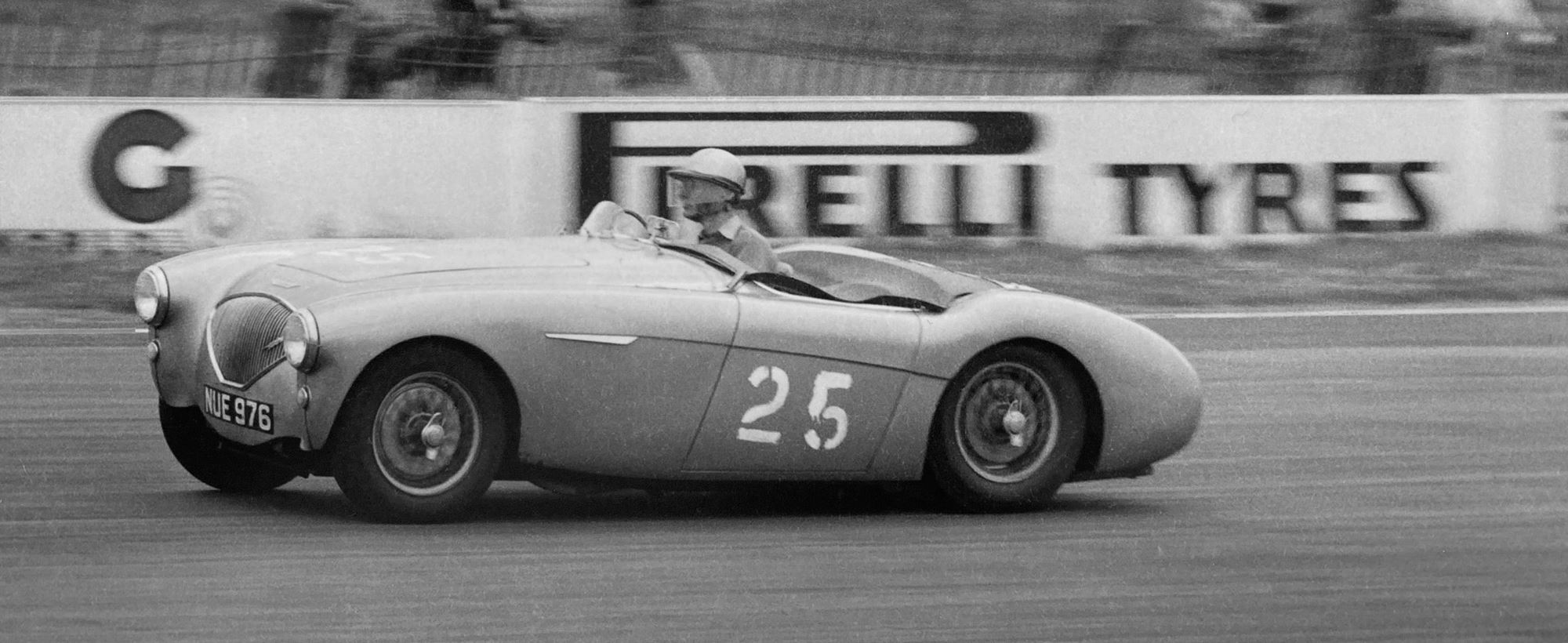
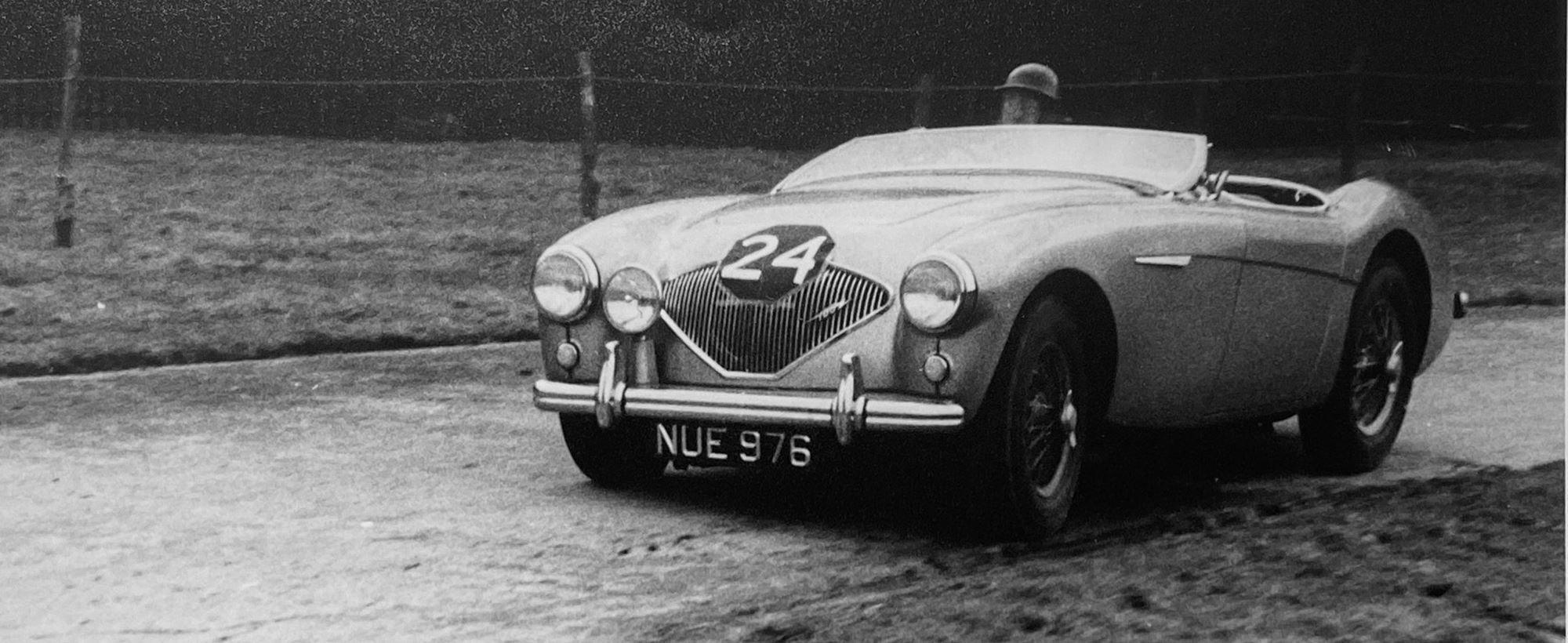
The design, penned by Gerry Coker, was the car’s first masterstroke. It was elemental. Long, low, and uncluttered, its lines flowed from the single-piece clamshell bonnet to the gently sloping rear deck. There were no external door handles, just a simple cord on the inside. The cockpit was purposeful, with a low-cut body that made the driver feel part of the scenery. But its defining feature, the one that screamed “pure sports car,” was the windscreen. It was designed not just to be lowered, but to fold perfectly flat, transforming the car from a dashing roadster into a minimalist, fly-screened racer. It was a statement of intent, a direct link to the windswept cockpits of Brooklands and Le Mans.
Under the skin, the BN1 was a masterpiece of clever pragmatism. The engine was the 2,660cc Austin four-cylinder. With a single SU carburettor, it produced a modest 90 hp, but that was not the point. The point was its colossal 144 lb-ft of torque. This was a car you didn’t rev so much as ride the wave of low-down grunt. It was this torque, combined with its 940kg weight, that gave the car its “100” name, signifying its 100-mph capability. But the BN1’s most famous quirk was its gearbox, also lifted from the A90. It was a 3-speed manual, a bizarre choice for a sports car even in 1953. The saving grace was the standard-fitment Laycock de Normanville overdrive, which operated on both second and third gears, effectively giving the driver a 5-speed ‘box. This column-shifted, overdrive-flicking setup is the defining mechanical characteristic of the BN1, a charmingly clunky but effective solution. The chassis was a simple, stiff ladder frame. The steering was cam-and-peg, and the brakes were 11-inch Girling drums all around. It was not high-tech, but it was strong.
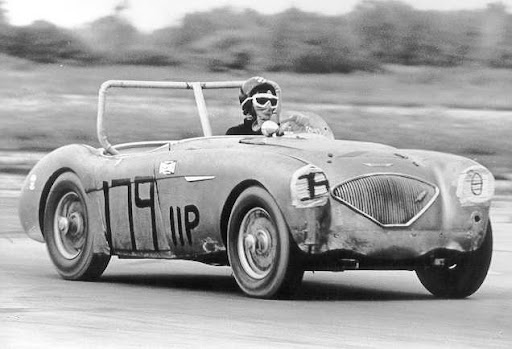
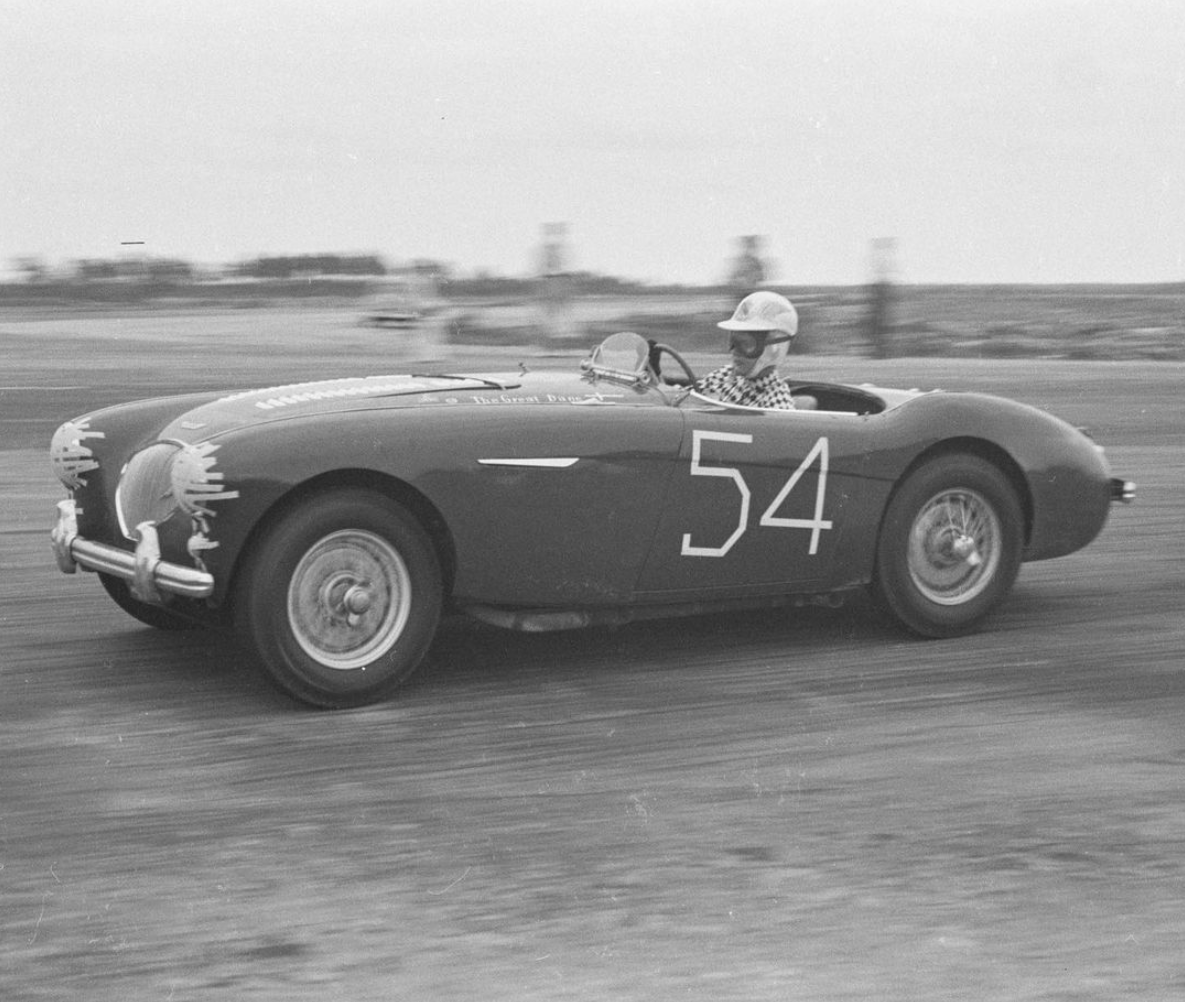
The impact of the BN1 was seismic. Over 10,000 were built and sold between 1953 and 1955, with the vast majority exported to the United States. It became the definitive British sports car for a generation of Americans, a symbol of freedom and style. It also became an instant hero in the burgeoning SCCA club racing scene. The BN1 was light, tough, and its torquey engine was perfect for the short, fast circuits of America. But Donald Healey was a racer at heart. To prove the car’s mettle, two special lightweight, tuned “Works” cars were prepared for the 1953 24 Hours of Le Mans. Against a field of far more exotic machinery, the two cars ran like clockwork, finishing 12th and 14th overall. It was a stunning display of reliability and performance, cementing the car’s sporting credentials from day one. Privateers and Works cars alike became fixtures at Sebring, the Mille Miglia, and countless other events.
The BN1 was a short-lived, brilliant flash. By 1955, it was replaced by the BN2. The BN2 was an evolution, not a revolution. It looked almost identical, but it featured the all-important, conventional 4-speed manual gearbox (still with overdrive), finally giving drivers the control they craved. This new model also served as the platform for the more focused 100M and the all-conquering, all-aluminium 100S. But the BN1’s legacy was already secure. It was the originator. It was the car born from that mythical handshake on the floor of Earls Court. It established the Austin-Healey brand, funded its future, and set the template for the entire “Big Healey” dynasty that would follow. It was the purest, rawest, and most elemental of the line, a perfect storm of design, brawn, and romance.
Brand
Produced from
Portal
Vehicle category
Model line
Model generation
Predecessor
Sucessor
Brand
Produced from
Portal
Vehicle category
Model line
Model generation
Predecessor
Sucessor
About this submodel
It is, perhaps, the greatest creation myth in British automotive history. The setting: London’s Earls Court Motor Show, 1952. The air is thick with post-war optimism, and a generation starved of glamour is flocking to see the future. Tucked away on a small stand is a stunning, impossibly low, and perfectly proportioned sports car, the work of one man, Donald Healey. A successful rally driver, engineer, and tinkerer, Healey had built his prototype, the “Healey Hundred,” on a shoestring budget. Its chassis was a simple ladder frame, and its engine was a massive, torque-laden 2.6-litre four-cylinder, unceremoniously lifted from the Austin A90 Atlantic saloon. Healey’s genius was in seeing the magic in those mundane parts. He hoped to sell a few dozen. What happened next is folklore. Leonard Lord, the indomitable, all-powerful managing director of the Austin Motor Company, saw the car. He was so captivated, so struck by its potential, that he walked onto the stand, struck a deal with a stunned Donald Healey, and by the show’s end, the car had a new name: the Austin-Healey 100. This first, purest model, the BN1, was not just a new car; it was the birth of a legend.
The BN1 was an instant sensation, a machine that perfectly captured the spirit of the age. It was not a finicky, high-strung thoroughbred; it was a “hairy-chested” brute. Its target was the booming American market, and its rivals were clear. The ageing MG TD was a relic of a pre-war world. The new, scrappy Triumph TR2 was its direct domestic rival, offering similar 100-mph performance at a lower price. And then there was the car the Healey’s stunning lines emulated: the Jaguar XK120, a more sophisticated, complex (DOHC), and expensive machine. The Austin-Healey 100 hit the absolute sweet spot. It had the exotic, jaw-dropping looks of the Jaguar but with the robust, simple-to-fix mechanicals of an Austin. It was the perfect car for a generation of new enthusiasts who wanted to race in SCCA events on Sunday and drive to work on Monday.
The design, penned by Gerry Coker, was the car’s first masterstroke. It was elemental. Long, low, and uncluttered, its lines flowed from the single-piece clamshell bonnet to the gently sloping rear deck. There were no external door handles, just a simple cord on the inside. The cockpit was purposeful, with a low-cut body that made the driver feel part of the scenery. But its defining feature, the one that screamed “pure sports car,” was the windscreen. It was designed not just to be lowered, but to fold perfectly flat, transforming the car from a dashing roadster into a minimalist, fly-screened racer. It was a statement of intent, a direct link to the windswept cockpits of Brooklands and Le Mans.
Under the skin, the BN1 was a masterpiece of clever pragmatism. The engine was the 2,660cc Austin four-cylinder. With a single SU carburettor, it produced a modest 90 hp, but that was not the point. The point was its colossal 144 lb-ft of torque. This was a car you didn’t rev so much as ride the wave of low-down grunt. It was this torque, combined with its 940kg weight, that gave the car its “100” name, signifying its 100-mph capability. But the BN1’s most famous quirk was its gearbox, also lifted from the A90. It was a 3-speed manual, a bizarre choice for a sports car even in 1953. The saving grace was the standard-fitment Laycock de Normanville overdrive, which operated on both second and third gears, effectively giving the driver a 5-speed ‘box. This column-shifted, overdrive-flicking setup is the defining mechanical characteristic of the BN1, a charmingly clunky but effective solution. The chassis was a simple, stiff ladder frame. The steering was cam-and-peg, and the brakes were 11-inch Girling drums all around. It was not high-tech, but it was strong.
The impact of the BN1 was seismic. Over 10,000 were built and sold between 1953 and 1955, with the vast majority exported to the United States. It became the definitive British sports car for a generation of Americans, a symbol of freedom and style. It also became an instant hero in the burgeoning SCCA club racing scene. The BN1 was light, tough, and its torquey engine was perfect for the short, fast circuits of America. But Donald Healey was a racer at heart. To prove the car’s mettle, two special lightweight, tuned “Works” cars were prepared for the 1953 24 Hours of Le Mans. Against a field of far more exotic machinery, the two cars ran like clockwork, finishing 12th and 14th overall. It was a stunning display of reliability and performance, cementing the car’s sporting credentials from day one. Privateers and Works cars alike became fixtures at Sebring, the Mille Miglia, and countless other events.
The BN1 was a short-lived, brilliant flash. By 1955, it was replaced by the BN2. The BN2 was an evolution, not a revolution. It looked almost identical, but it featured the all-important, conventional 4-speed manual gearbox (still with overdrive), finally giving drivers the control they craved. This new model also served as the platform for the more focused 100M and the all-conquering, all-aluminium 100S. But the BN1’s legacy was already secure. It was the originator. It was the car born from that mythical handshake on the floor of Earls Court. It established the Austin-Healey brand, funded its future, and set the template for the entire “Big Healey” dynasty that would follow. It was the purest, rawest, and most elemental of the line, a perfect storm of design, brawn, and romance.
Tech Specs
Discover the technical specifications
Tech Specs
Discover the technical specifications
Engine
01
03
Internal combustion engine
Configuration
Inline-4
Location
Front, longitudinally mounted
Construction
Cast-iron block and aluminium alloy head
Displacement (cc)
2,600 cc
Displacement (cu in)
158.6 cu in
Compression
7.5:1
Bore x Stroke
87.3 mm x 111.1 mm
Valvetrain
2 valves per cylinder, OHV
Fuel feed
2 SU H4 Carburettors
Lubrication
Wet sump
Aspiration
Naturally aspirated
Output
Power (hp)
90 hp
Power (kW)
144 kW
Max power at
2,000 RPM
Torque (Nm)
195 Nm
Torque (ft lbs)
144 ft lbs
Max torque at
2,000 RPM
Drivetrain
02
03
Chassis
Type
Ladder frame
Material
Steel
Body
Material
Aluminium panels
Transmission
Gearbox
3-speed manual
Drive
Rear Wheel Drive
Suspension
Front
Coil springs over shock absorbers
Rear
Rigid axle, semi-elliptic leaf springs, shock absorbers
Steering
Type
Cam and lever
Brakes
Front
Discs
Rear
Discs
Wheels
Front
-
Rear
-
Tires
Front
-
Rear
-
Dimensions and performance
03
03
Dimensions
Lenght (mm)
3,848 mm
Lenght (in)
151.5 in
Width (mm)
1,524 mm
Width (in)
60.0 in
Height (mm)
1,245 mm
Height (in)
49 in
Wheelbase (mm)
2,286 mm
Wheelbase (in)
90 in
Weight (kg)
909 kg
Weight (lbs)
2,005 lbs
Performance
Power to weight
0.09 hp/kg
Top speed (km/h)
165 km/h
Top speed (mph)
103 mph
0-100 km/h (0-60 mph)
10.5 s
Submodels
Other variants of this model
Submodels