
Germany is the undisputed cradle of the motorcar, the ancestral home of engineering titans such as Mercedes-Benz, Porsche, BMW, and Audi. For decades, the German Grand Prix was not merely a motor race; it was a matter of intense national pride, serving as the ultimate, high-speed shop window to broadcast Germanic technological supremacy to the globe. The event was intrinsically defined by its two historical, contrasting homes: the twisting, relentless topography of the Eifel mountains at the Nürburgring, and the dense, haunting forests of Baden-Württemberg at the Hockenheimring. Yet, today, this nation of fervent motorsport fanatics has been stripped of its home race, its legendary asphalt silenced by the ruthless, uncompromising economics of the modern era.
The story was born in blood and rain. In 1926, the inaugural Formula Libre event was staged in southwestern Berlin at the AVUS circuit, essentially a brutal dual-carriageway linked by perilous, stark hairpins. Under a torrential downpour, the rudimentary tarmac quickly dissolved into a lethal skating rink. The blinding spray and treacherous lack of grip claimed multiple lives when Adolf Rosenberger violently crashed his Mercedes into the wooden timekeepers’ hut. This gruesome tragedy delivered a stark revelation: Germany desperately needed a purpose-built, uncompromising racetrack capable of containing the escalating power of the automobile.
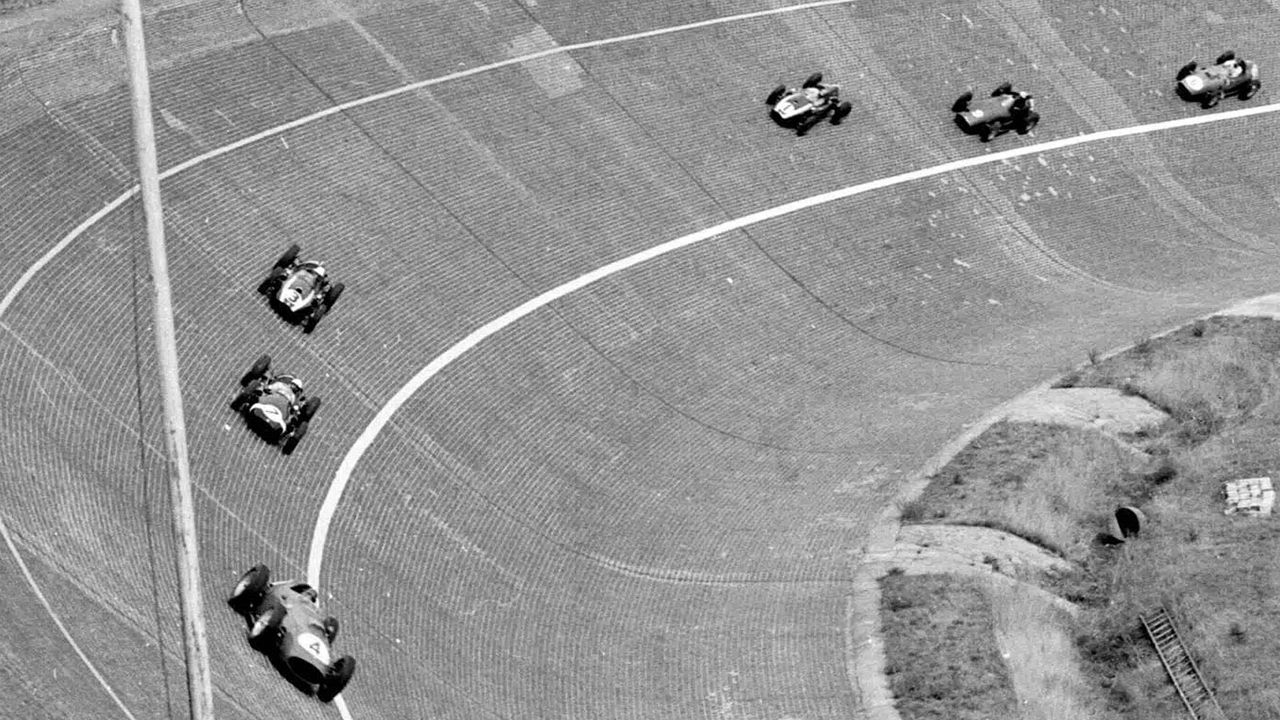
The colossal answer materialised in 1927 with the inauguration of the Nürburgring. However, the inaugural Grand Prix that year was not contested solely on the famed Nordschleife; it was fought on the Gesamtstrecke (Combined Circuit), a staggering 28.265 km (17.56 miles) layout that married the 22.8-kilometre (14.1-mile) northern loop with the 5.5 km (3.4 miles) Südschleife. It was not until 1931 that the event exclusively adopted the standalone Nordschleife.
Coiling menacingly around the medieval Nürburg castle, this leviathan boasted over 160 tortuous corners. It was an arena of pure sensory overload; drivers fought the sheer visual exhaustion of plunging into the Eifel valleys at dawn, where dappled sunlight pierced the ancient canopy and the deafening roar of twelve-cylinder engines echoed relentlessly across the mountains.
Rudolf Caracciola, widely celebrated as the “Regenmeister”, became the supreme local hero, manhandling supercharged Mercedes-Benz titans to conquer the undulating topography whilst battling the thunderous, mid-engined Auto Unions.
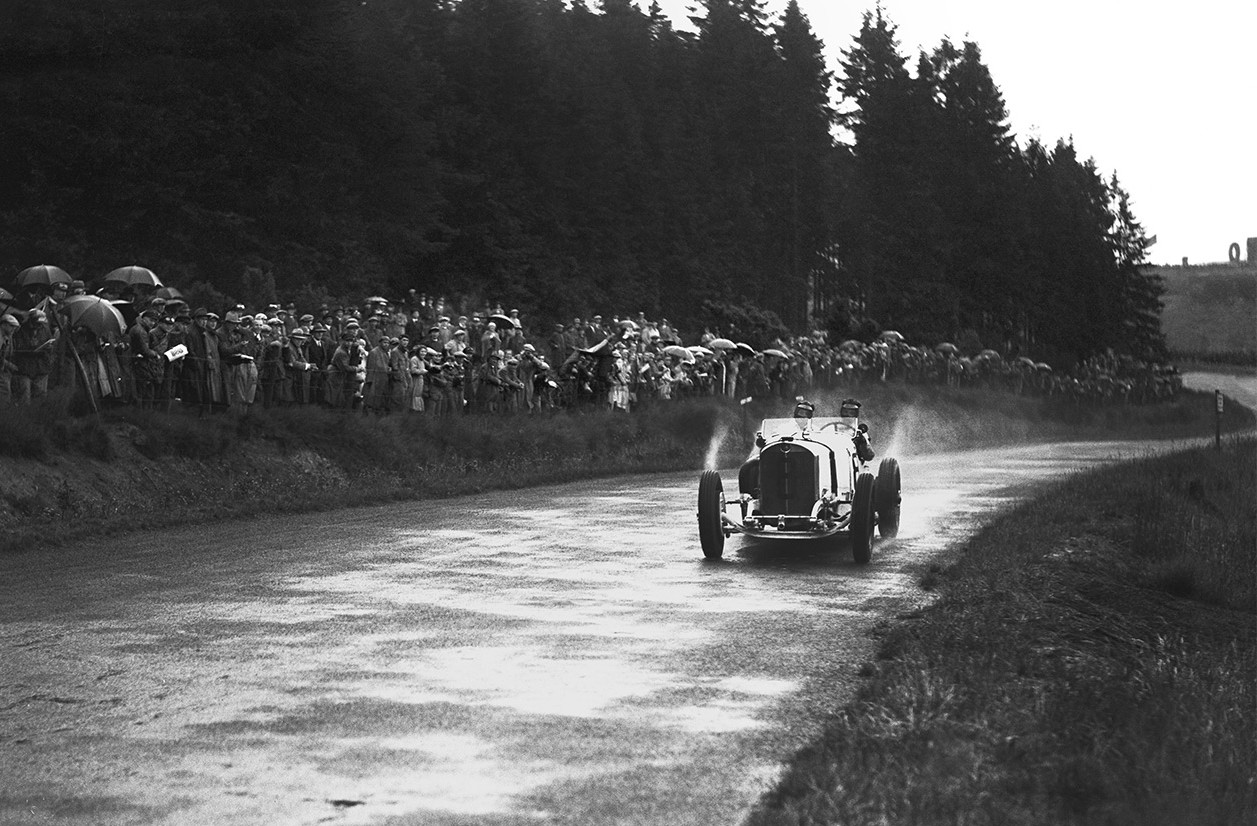
Yet, the pre-war era’s most astounding chapter belonged to an Italian interloper. In 1935, a crowd exceeding 300,000 spectators—flanked by the Nazi high command anticipating a glorious showcase of Aryan superiority—witnessed Tazio Nuvolari conjure an impossible miracle. Wrestling a desperately obsolete, vastly underpowered Alfa Romeo against a mighty armada of nine German machines, he drifted through the treacherous descents with supernatural car control to humiliate the home favourites. The shock was so profound that the flustered organisers possessed no recording of the Italian national anthem, forcing Nuvolari to allegedly supply his personal gramophone record for the tense podium ceremony. While this beloved paddock legend insists the Germans were caught entirely unprepared, it is highly likely that Nuvolari simply provided his own pristine copy of the Marcia Reale to ensure it was played instead of the fascist Giovinezza, adding a mythological gloss to an already superhuman feat.
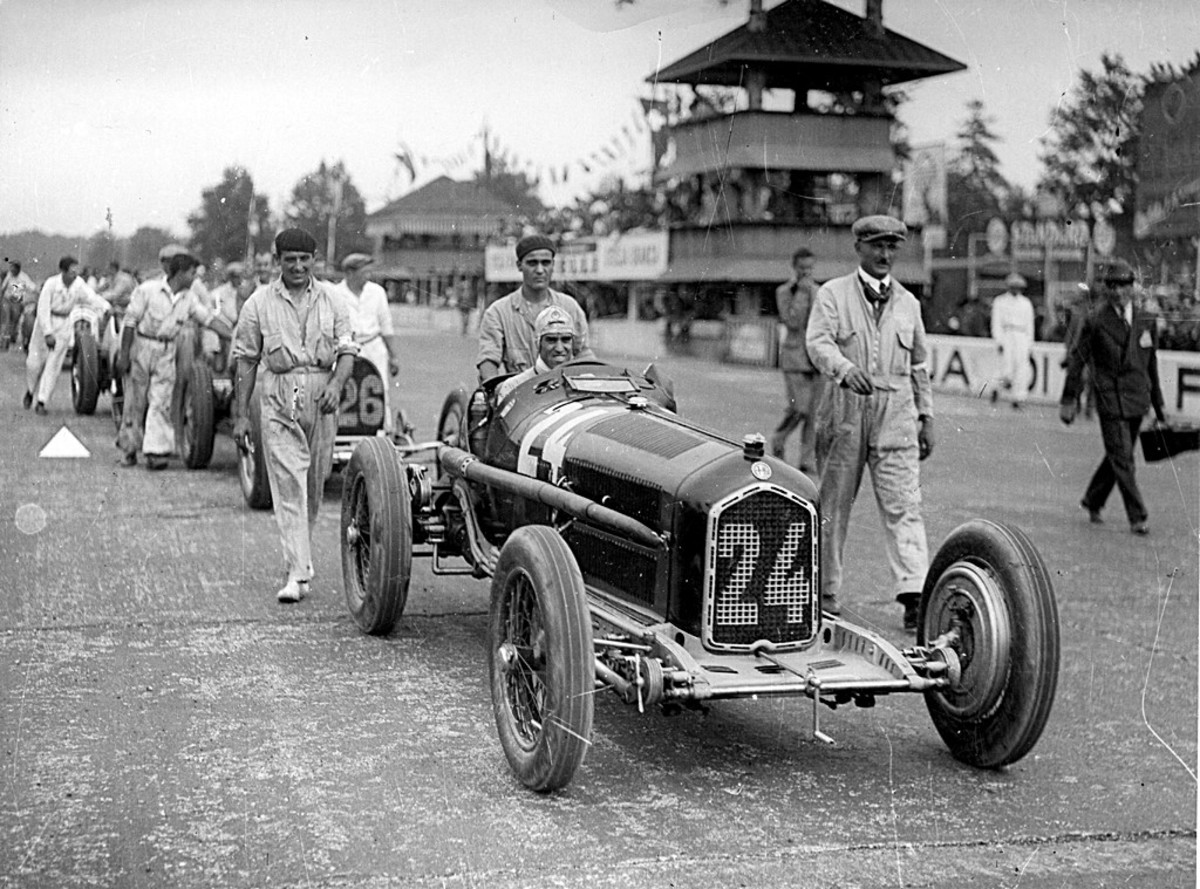
Following its seamless integration into the nascent Formula One World Championship, the event reached a crescendo of virtuosity in the 1950s. Juan Manuel Fangio delivered his absolute masterpiece upon the mountain in 1957. After a calamitous pit stop left him nearly a full minute adrift of the leading Ferraris, Fangio returned to the track in a state of transcendent fury. Driving his Maserati far beyond its perceived limits, the acrid scent of carbonised brakes hung heavy as he obliterated the lap record in nine of the subsequent ten laps, sensationally hunting down his rivals on the penultimate tour to secure his fifth world crown.
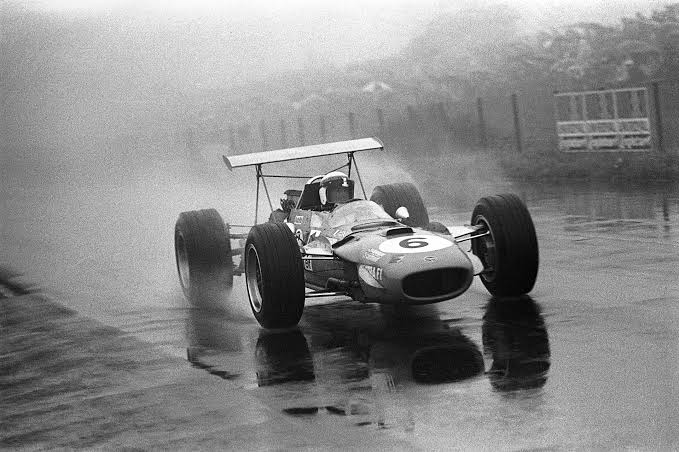
As the 1960s dawned, aerodynamic and mechanical leaps made the cars terrifyingly fast, rendering the mountain track a deadly anachronism. In 1968, Jackie Stewart achieved arguably the greatest victory in motorsport history; amidst an apocalyptic storm and impenetrable fog that reduced visibility to mere metres, he masterfully navigated the deluge to win by an astonishing four minutes. However, the raw terror of plunging blindly through the forests eventually broke the grid’s tolerance. Refusing to gamble their lives on an unmarshallable circuit, Stewart led a fiery driver boycott in 1970, forcing the Grand Prix to seek temporary refuge at the flatter, faster Hockenheimring.
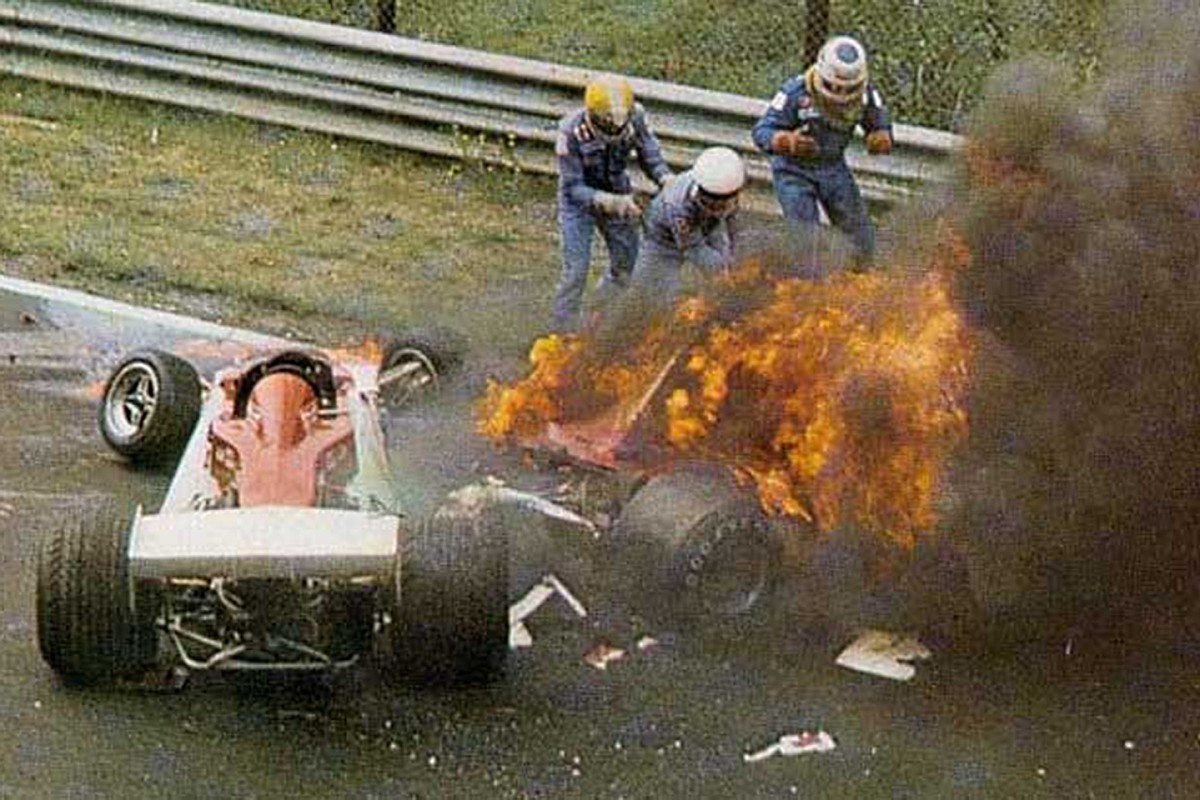
The Nordschleife enjoyed a brief, uneasy reinstatement, but its fate was violently sealed in 1976. Defending champion Niki Lauda violently lost control of his Ferrari at the extremely fast, unnamed left-hand kink just after Ex-Mühle, immediately preceding the much slower Bergwerk corner. The exact catalyst of the crash remains heavily debated; while Lauda and paddock experts strongly suspected a rear radius arm or magnesium upright failure, Ferrari’s internal investigation controversially cited driver error on a wet patch or kerb. Regardless of the definitive cause, his Ferrari careered into the earth banks and immediately erupted into a horrific fireball. With marshals stranded miles away on the sprawling circuit, fellow drivers bravely parked their machines and waded into the inferno to drag the burning Austrian from the wreckage. On that grim afternoon, the “Green Hell”, as Stewart had famously dubbed it, died forever as a modern Formula 1 venue.
The German Grand Prix subsequently entrenched itself at Hockenheim, a brutal, relentless rollercoaster of sheer acceleration tearing through the Baden-Württemberg woodlands. It was the ultimate, uncompromising proving ground for the terrifying 1000-PS (986-bhp) turbocharged engines of the 1980s, where colossal slipstreaming battles reached fever pitch. Tensions routinely boiled over; famously in 1982, championship leader Nelson Piquet was obtusely punted out of the race by the lapped Eliseo Salazar, prompting Piquet to leap from his shattered Brabham and launch a furious barrage of kicks and punches at the bewildered Chilean by the trackside.
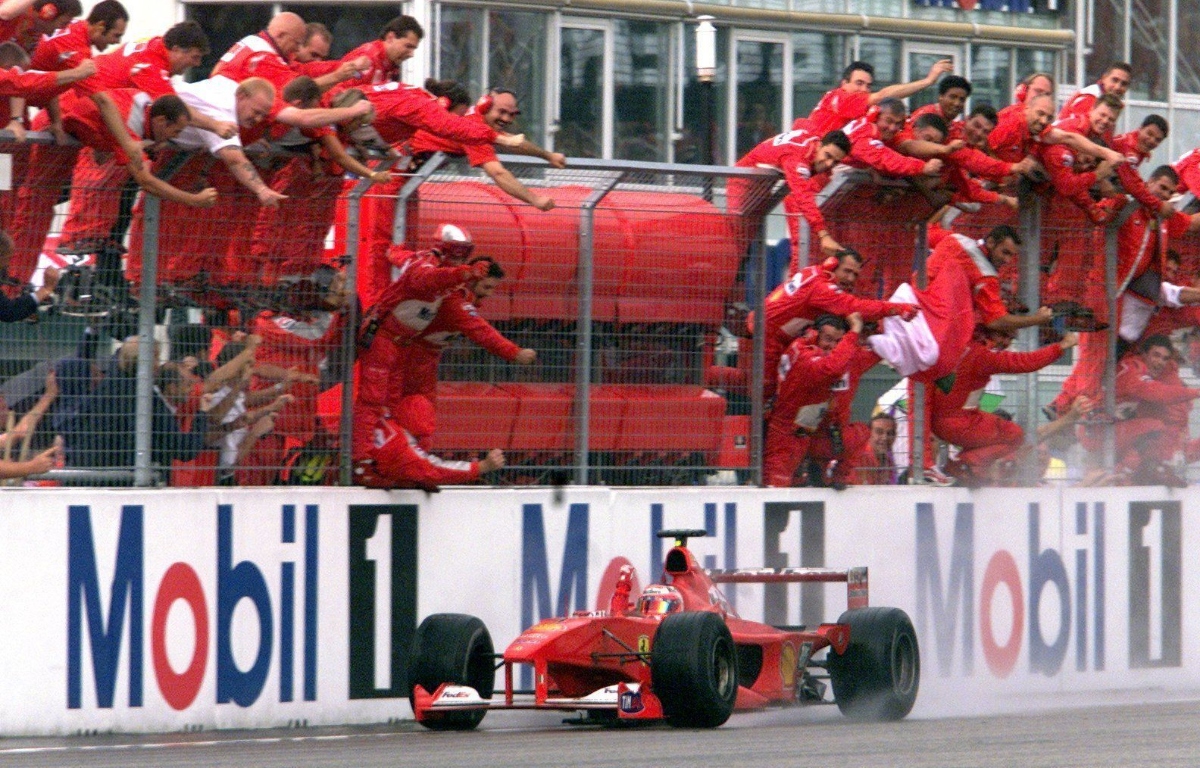
The 1990s and 2000s were wholly consumed by the messianic rise of Michael Schumacher, who single-handedly elevated Formula 1 to a national religion within Germany. The circuit’s stadium section, the Motodrom, became a visceral cauldron of fanaticism where over 100,000 spectators enveloped the grandstands in crimson smoke and a sea of Ferrari banners. This fanatical backdrop framed the chaotic 2000 edition, where Rubens Barrichello miraculously stormed from 18th on the grid to claim an emotional maiden victory in treacherous rain, a race bizarrely interrupted by a disgruntled former Mercedes-Benz employee who wandered across the live circuit wrapped in a plastic sheet in a perilous protest against his dismissal.
However, Hockenheim’s haunting, high-speed forest blasts were increasingly deemed too dangerous and commercially unviable for modern television broadcasts. In 2002, controversial architect Hermann Tilke took a chainsaw to the ancient pines, mutilating the classic layout into a sanitised, vastly shorter facility. Concurrently, the operators of the Nürburgring—having constructed a clinical, modern Grand Prix track adjacent to the old loop in 1984—clamoured for their share of the lucrative pie. To stave off the looming spectre of financial ruin, the two historically bitter rivals brokered an uneasy truce, agreeing to alternate hosting duties year by year. However, a bitter naming rights dispute between the rival automobile clubs—the AvD and the ADAC—resulted in the 2007 Nürburgring event being officially titled the ‘European Grand Prix’, leaving a gap in the German Grand Prix lineage for that year. The planned alternation under the proper national moniker successfully commenced in 2008 at Hockenheim.
Ultimately, this fragile compromise was annihilated by the shifting financial tectonic plates of modern motorsport. By 2014, deprived of the lavish state subsidies enjoyed by newly constructed circuits in the Middle East and Asia, neither the bankrupt Nürburgring nor the impoverished Hockenheim could summon the extortionate 20 million USD (£15.4 million) sanctioning fees initially demanded by Bernie Ecclestone, and subsequently by Liberty Media.
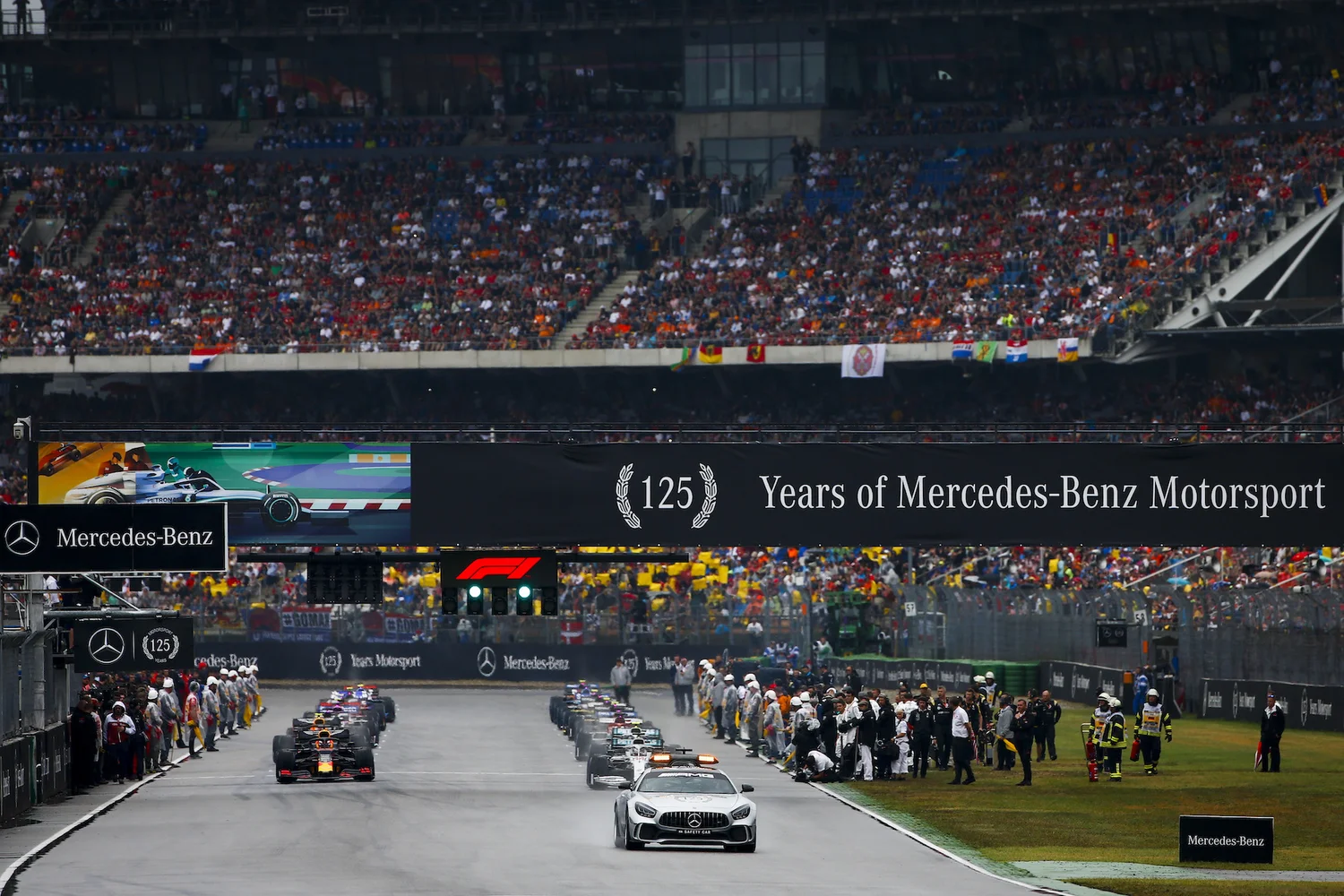
The race enjoyed one final, magnificent swan song at Hockenheim in 2019, exceptionally bankrolled by Mercedes-Benz to celebrate their 125th motorsport anniversary. It was an instant, chaotic classic: under torrential skies, Max Verstappen triumphed whilst the mighty Mercedes squad embarrassingly floundered, their drivers sliding into the barriers directly in front of their corporate board who were humiliatingly clad in vintage flat caps and braces. A solitary, pandemic-induced patch occurred at the Nürburgring in 2020, tellingly branded the Eifel Grand Prix rather than carrying the proud national moniker.
Today, the once-mighty German Grand Prix is a ghost, completely erased from the calendar; a poignant memory of an era where mechanical artistry and raw courage reigned supreme, now paved over by the unrelenting march of commerce.
Germany is the undisputed cradle of the motorcar, the ancestral home of engineering titans such as Mercedes-Benz, Porsche, BMW, and Audi. For decades, the German Grand Prix was not merely a motor race; it was a matter of intense national pride, serving as the ultimate, high-speed shop window to broadcast Germanic technological supremacy to the globe. The event was intrinsically defined by its two historical, contrasting homes: the twisting, relentless topography of the Eifel mountains at the Nürburgring, and the dense, haunting forests of Baden-Württemberg at the Hockenheimring. Yet, today, this nation of fervent motorsport fanatics has been stripped of its home race, its legendary asphalt silenced by the ruthless, uncompromising economics of the modern era.
The story was born in blood and rain. In 1926, the inaugural Formula Libre event was staged in southwestern Berlin at the AVUS circuit, essentially a brutal dual-carriageway linked by perilous, stark hairpins. Under a torrential downpour, the rudimentary tarmac quickly dissolved into a lethal skating rink. The blinding spray and treacherous lack of grip claimed multiple lives when Adolf Rosenberger violently crashed his Mercedes into the wooden timekeepers’ hut. This gruesome tragedy delivered a stark revelation: Germany desperately needed a purpose-built, uncompromising racetrack capable of containing the escalating power of the automobile.
The colossal answer materialised in 1927 with the inauguration of the Nürburgring. However, the inaugural Grand Prix that year was not contested solely on the famed Nordschleife; it was fought on the Gesamtstrecke (Combined Circuit), a staggering 28.265 km (17.56 miles) layout that married the 22.8-kilometre (14.1-mile) northern loop with the 5.5 km (3.4 miles) Südschleife. It was not until 1931 that the event exclusively adopted the standalone Nordschleife.
Coiling menacingly around the medieval Nürburg castle, this leviathan boasted over 160 tortuous corners. It was an arena of pure sensory overload; drivers fought the sheer visual exhaustion of plunging into the Eifel valleys at dawn, where dappled sunlight pierced the ancient canopy and the deafening roar of twelve-cylinder engines echoed relentlessly across the mountains.
Rudolf Caracciola, widely celebrated as the “Regenmeister”, became the supreme local hero, manhandling supercharged Mercedes-Benz titans to conquer the undulating topography whilst battling the thunderous, mid-engined Auto Unions.
Yet, the pre-war era’s most astounding chapter belonged to an Italian interloper. In 1935, a crowd exceeding 300,000 spectators—flanked by the Nazi high command anticipating a glorious showcase of Aryan superiority—witnessed Tazio Nuvolari conjure an impossible miracle. Wrestling a desperately obsolete, vastly underpowered Alfa Romeo against a mighty armada of nine German machines, he drifted through the treacherous descents with supernatural car control to humiliate the home favourites. The shock was so profound that the flustered organisers possessed no recording of the Italian national anthem, forcing Nuvolari to allegedly supply his personal gramophone record for the tense podium ceremony. While this beloved paddock legend insists the Germans were caught entirely unprepared, it is highly likely that Nuvolari simply provided his own pristine copy of the Marcia Reale to ensure it was played instead of the fascist Giovinezza, adding a mythological gloss to an already superhuman feat.
Following its seamless integration into the nascent Formula One World Championship, the event reached a crescendo of virtuosity in the 1950s. Juan Manuel Fangio delivered his absolute masterpiece upon the mountain in 1957. After a calamitous pit stop left him nearly a full minute adrift of the leading Ferraris, Fangio returned to the track in a state of transcendent fury. Driving his Maserati far beyond its perceived limits, the acrid scent of carbonised brakes hung heavy as he obliterated the lap record in nine of the subsequent ten laps, sensationally hunting down his rivals on the penultimate tour to secure his fifth world crown.
As the 1960s dawned, aerodynamic and mechanical leaps made the cars terrifyingly fast, rendering the mountain track a deadly anachronism. In 1968, Jackie Stewart achieved arguably the greatest victory in motorsport history; amidst an apocalyptic storm and impenetrable fog that reduced visibility to mere metres, he masterfully navigated the deluge to win by an astonishing four minutes. However, the raw terror of plunging blindly through the forests eventually broke the grid’s tolerance. Refusing to gamble their lives on an unmarshallable circuit, Stewart led a fiery driver boycott in 1970, forcing the Grand Prix to seek temporary refuge at the flatter, faster Hockenheimring.
The Nordschleife enjoyed a brief, uneasy reinstatement, but its fate was violently sealed in 1976. Defending champion Niki Lauda violently lost control of his Ferrari at the extremely fast, unnamed left-hand kink just after Ex-Mühle, immediately preceding the much slower Bergwerk corner. The exact catalyst of the crash remains heavily debated; while Lauda and paddock experts strongly suspected a rear radius arm or magnesium upright failure, Ferrari’s internal investigation controversially cited driver error on a wet patch or kerb. Regardless of the definitive cause, his Ferrari careered into the earth banks and immediately erupted into a horrific fireball. With marshals stranded miles away on the sprawling circuit, fellow drivers bravely parked their machines and waded into the inferno to drag the burning Austrian from the wreckage. On that grim afternoon, the “Green Hell”, as Stewart had famously dubbed it, died forever as a modern Formula 1 venue.
The German Grand Prix subsequently entrenched itself at Hockenheim, a brutal, relentless rollercoaster of sheer acceleration tearing through the Baden-Württemberg woodlands. It was the ultimate, uncompromising proving ground for the terrifying 1000-PS (986-bhp) turbocharged engines of the 1980s, where colossal slipstreaming battles reached fever pitch. Tensions routinely boiled over; famously in 1982, championship leader Nelson Piquet was obtusely punted out of the race by the lapped Eliseo Salazar, prompting Piquet to leap from his shattered Brabham and launch a furious barrage of kicks and punches at the bewildered Chilean by the trackside.
The 1990s and 2000s were wholly consumed by the messianic rise of Michael Schumacher, who single-handedly elevated Formula 1 to a national religion within Germany. The circuit’s stadium section, the Motodrom, became a visceral cauldron of fanaticism where over 100,000 spectators enveloped the grandstands in crimson smoke and a sea of Ferrari banners. This fanatical backdrop framed the chaotic 2000 edition, where Rubens Barrichello miraculously stormed from 18th on the grid to claim an emotional maiden victory in treacherous rain, a race bizarrely interrupted by a disgruntled former Mercedes-Benz employee who wandered across the live circuit wrapped in a plastic sheet in a perilous protest against his dismissal.
However, Hockenheim’s haunting, high-speed forest blasts were increasingly deemed too dangerous and commercially unviable for modern television broadcasts. In 2002, controversial architect Hermann Tilke took a chainsaw to the ancient pines, mutilating the classic layout into a sanitised, vastly shorter facility. Concurrently, the operators of the Nürburgring—having constructed a clinical, modern Grand Prix track adjacent to the old loop in 1984—clamoured for their share of the lucrative pie. To stave off the looming spectre of financial ruin, the two historically bitter rivals brokered an uneasy truce, agreeing to alternate hosting duties year by year. However, a bitter naming rights dispute between the rival automobile clubs—the AvD and the ADAC—resulted in the 2007 Nürburgring event being officially titled the ‘European Grand Prix’, leaving a gap in the German Grand Prix lineage for that year. The planned alternation under the proper national moniker successfully commenced in 2008 at Hockenheim.
Ultimately, this fragile compromise was annihilated by the shifting financial tectonic plates of modern motorsport. By 2014, deprived of the lavish state subsidies enjoyed by newly constructed circuits in the Middle East and Asia, neither the bankrupt Nürburgring nor the impoverished Hockenheim could summon the extortionate 20 million USD (£15.4 million) sanctioning fees initially demanded by Bernie Ecclestone, and subsequently by Liberty Media.
The race enjoyed one final, magnificent swan song at Hockenheim in 2019, exceptionally bankrolled by Mercedes-Benz to celebrate their 125th motorsport anniversary. It was an instant, chaotic classic: under torrential skies, Max Verstappen triumphed whilst the mighty Mercedes squad embarrassingly floundered, their drivers sliding into the barriers directly in front of their corporate board who were humiliatingly clad in vintage flat caps and braces. A solitary, pandemic-induced patch occurred at the Nürburgring in 2020, tellingly branded the Eifel Grand Prix rather than carrying the proud national moniker.
Today, the once-mighty German Grand Prix is a ghost, completely erased from the calendar; a poignant memory of an era where mechanical artistry and raw courage reigned supreme, now paved over by the unrelenting march of commerce.