
Auto Union
Type
Foundation Year
Founder/s
Country
Headquarters
Brand Overview
At 432.7 km/h (268.9 mph) on the Frankfurt–Darmstadt autobahn in January 1938, an Auto Union streamliner briefly made the public road feel smaller than human nerve. It was not merely fast; it was an aluminium missile with a racing engine where convention said no engine should be, astern of the driver and ahead of the rear axle, howling with supercharged violence. Bernd Rosemeyer, the young phenomenon who had made such machinery look almost obedient, would not survive that record attempt. The tragedy fixed Auto Union in legend: beautiful, brutal, technically audacious, and shadowed by the political darkness of its age.
Auto Union was born not from romance but from emergency. On 29 June 1932, amid the convulsions of the Depression, four Saxon manufacturers were bound together: Audi, DKW, Horch and Wanderer. The four interlocking rings were not decoration but a corporate survival pact, each ring preserving a marque with its own clientele and character. DKW brought clever, popular two-stroke engineering and motorcycles; Horch contributed aristocratic luxury; Audi carried August Horch’s earlier legacy; Wanderer supplied sober middle-class respectability. The headquarters moved through Saxony, with Chemnitz becoming central to the corporation, while the racing department found its furnace at the Horch works in Zwickau. From that pragmatic merger came one of the most radical Grand Prix programmes ever mounted.
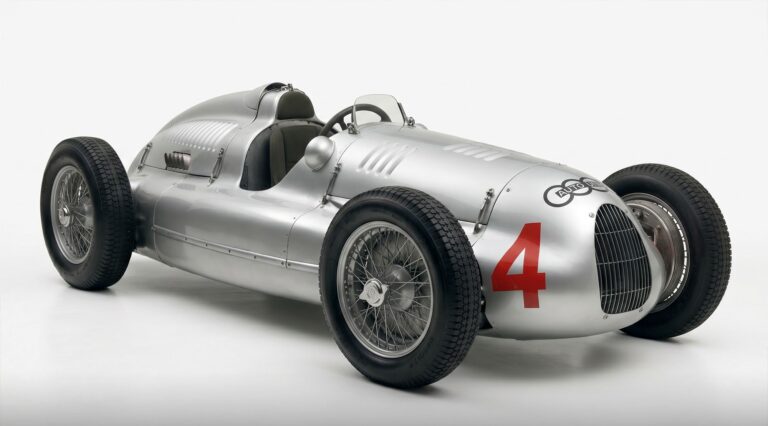
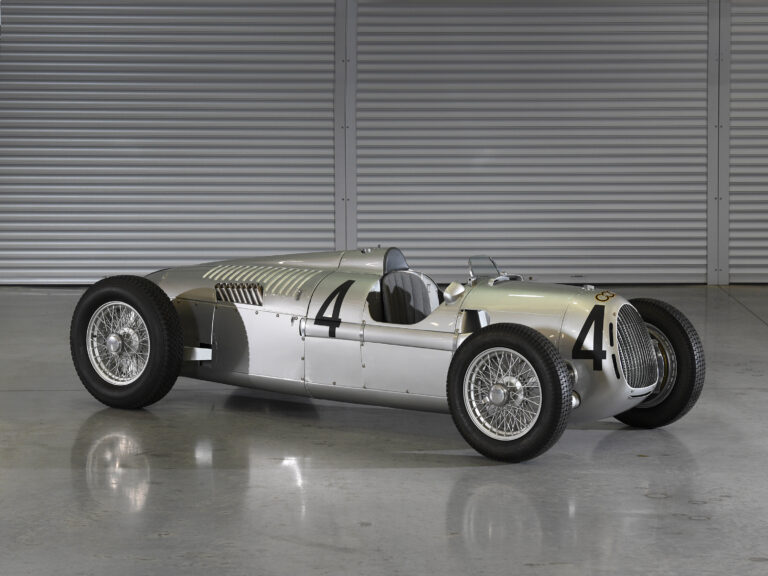
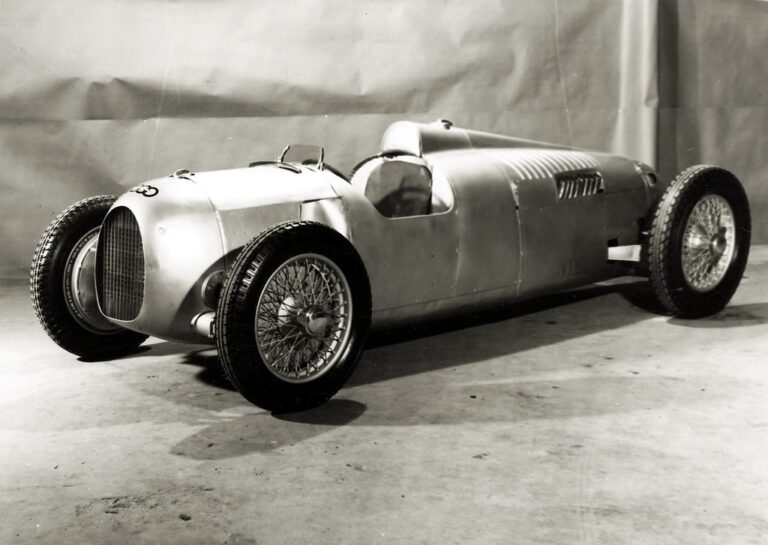
The catalyst was Ferdinand Porsche’s P-Wagen project, conceived for the 750 kg (1653 lbs) Grand Prix formula. Porsche, Karl Rabe and Josef Kales pursued an answer that seemed almost heretical in the early 1930s: put the engine behind the driver, lower the seating position, centralise the fuel load and attack weight distribution from first principles. Auto Union acquired the design in 1933, and by 1934 the Type A appeared like a provocation in silver. Its architecture prefigured the post-war revolution by decades. The driver sat forward, peering over a long bonnet that carried the radiator rather than the motor; behind his shoulders lay a supercharged V16, a restless mass of torque, heat and noise.
The early cars were not polite instruments. The Type A’s 4.4-litre (266 cu in) V16 grew through the Type B to the Type C’s 6.0-litre (366 cu in) monster, often quoted at approximately 520 bhp (388 kW). In an age of narrow tyres, drum brakes and road circuits lined with trees, it was an animal. The engine did not scream in the modern manner; it bellowed and tore, overlaid with the hard chatter of its supercharger and the metallic rasp of exhausts working under ferocious load. Its torque arrived like weather. Drivers could provoke wheelspin at more than 160 km/h (100 mph), and the rear-biased mass, swing-axle suspension and sudden power delivery gave the chassis a reputation for oversteer as dramatic as its speed.
Hans Stuck, already a hillclimb master, understood its appetite for gradient, throttle and bravery. Achille Varzi lent it Italian elegance. Tazio Nuvolari, late in the decade, would impose his own impossible will upon it. Yet the driver most fused with Auto Union was Rosemeyer, a former motorcycle racer whose sensitivity seemed to translate the car’s violence into rhythm. In 1936, with the Type C, he won the German Grand Prix at the Nürburgring, the Swiss Grand Prix at Bremgarten and the Italian Grand Prix at Monza, taking the AIACR European Championship.
The rivalry with Mercedes-Benz gave the period its mythic voltage. Both teams ran silver German cars, both received state support, and both pursued speed with resources and intensity few private manufacturers could match. Mercedes tended towards the more orthodox front-engined layout, honed with formidable discipline; Auto Union looked like the future arriving too early, all mass and menace compressed behind the cockpit. Against Alfa Romeo, Maserati and Bugatti, the German machines often seemed to belong to another category of physics. Yet politics cannot be polished from the bodywork. The Silver Arrows were exploited as propaganda by the Nazi regime, and any serious admiration for the engineering must acknowledge the uneasy machinery of power that stood behind it.
Auto Union also became a laboratory for aerodynamics. Paul Jaray’s streamlined thinking influenced record cars whose enveloping bodies made the Grand Prix machines appear almost naked by comparison. On AVUS, on mountain roads and on the autobahn, the company pursued speed records with obsessive courage. The designs could look uncannily pure: smooth tails, faired wheels, bodies drawn as if by airflow rather than styling department. But the same purity magnified risk. At extreme speed, crosswinds were not inconveniences but verdicts. Rosemeyer’s fatal crash turned triumph into mourning and froze the Auto Union streamliner in the mind as both masterpiece and warning.
Regulations changed for 1938, limiting supercharged Grand Prix engines to 3.0 litres (183 cu in). Auto Union’s Type D answered with a V12 rather than the great V16, and the chassis became more manageable, notably with de Dion rear suspension. It remained intensely fast, but the world around it was fraying. Nuvolari’s victory for Auto Union at Donington Park in 1938 gave Britain one of its most vivid pre-war spectacles: the little Mantuan wrestling the silver machine through parkland curves in front of astonished spectators. By 1939, racing had become a prelude to catastrophe. War scattered engineers, destroyed records, and left cars hidden, seized or lost.
After 1945, Auto Union’s story moved from Saxony to Bavaria. The company was re-established in Ingolstadt in 1949, living first through DKW two-strokes and cautious reconstruction rather than thunderous Grand Prix ambition. Volkswagen’s acquisition in the 1960s and the 1969 merger with NSU eventually led towards the modern Audi identity. The four rings survived because they were too strong a symbol to discard: not a nostalgic badge, but a condensed history of consolidation, invention and reinvention. When Audi later celebrated quattro traction, aluminium construction and endurance racing dominance, it was not simply inventing a technical personality; it was reawakening one.
Auto Union’s greatest cars were flawed in the way all epochal machines are flawed: they exceeded the world prepared for them. Their cockpits were cramped, their tyres overmatched, their brakes finite, their handling unforgiving. Yet their central idea was prophetic. The rear-mid-engined layout that defined Formula One from the late 1950s onwards had already thundered through the Eifel forests in the hands of Stuck and Rosemeyer. Their V16s did not merely push air aside; they announced a different grammar of racing design.
Type
Foundation Year
Country
Founder/s
Headquarters
Type
Foundation Year
Country
Founder/s
Headquarters
About this brand
At 432.7 km/h (268.9 mph) on the Frankfurt–Darmstadt autobahn in January 1938, an Auto Union streamliner briefly made the public road feel smaller than human nerve. It was not merely fast; it was an aluminium missile with a racing engine where convention said no engine should be, astern of the driver and ahead of the rear axle, howling with supercharged violence. Bernd Rosemeyer, the young phenomenon who had made such machinery look almost obedient, would not survive that record attempt. The tragedy fixed Auto Union in legend: beautiful, brutal, technically audacious, and shadowed by the political darkness of its age.
Auto Union was born not from romance but from emergency. On 29 June 1932, amid the convulsions of the Depression, four Saxon manufacturers were bound together: Audi, DKW, Horch and Wanderer. The four interlocking rings were not decoration but a corporate survival pact, each ring preserving a marque with its own clientele and character. DKW brought clever, popular two-stroke engineering and motorcycles; Horch contributed aristocratic luxury; Audi carried August Horch’s earlier legacy; Wanderer supplied sober middle-class respectability. The headquarters moved through Saxony, with Chemnitz becoming central to the corporation, while the racing department found its furnace at the Horch works in Zwickau. From that pragmatic merger came one of the most radical Grand Prix programmes ever mounted.
The catalyst was Ferdinand Porsche’s P-Wagen project, conceived for the 750 kg (1653 lbs) Grand Prix formula. Porsche, Karl Rabe and Josef Kales pursued an answer that seemed almost heretical in the early 1930s: put the engine behind the driver, lower the seating position, centralise the fuel load and attack weight distribution from first principles. Auto Union acquired the design in 1933, and by 1934 the Type A appeared like a provocation in silver. Its architecture prefigured the post-war revolution by decades. The driver sat forward, peering over a long bonnet that carried the radiator rather than the motor; behind his shoulders lay a supercharged V16, a restless mass of torque, heat and noise.
The early cars were not polite instruments. The Type A’s 4.4-litre (266 cu in) V16 grew through the Type B to the Type C’s 6.0-litre (366 cu in) monster, often quoted at approximately 520 bhp (388 kW). In an age of narrow tyres, drum brakes and road circuits lined with trees, it was an animal. The engine did not scream in the modern manner; it bellowed and tore, overlaid with the hard chatter of its supercharger and the metallic rasp of exhausts working under ferocious load. Its torque arrived like weather. Drivers could provoke wheelspin at more than 160 km/h (100 mph), and the rear-biased mass, swing-axle suspension and sudden power delivery gave the chassis a reputation for oversteer as dramatic as its speed.
Hans Stuck, already a hillclimb master, understood its appetite for gradient, throttle and bravery. Achille Varzi lent it Italian elegance. Tazio Nuvolari, late in the decade, would impose his own impossible will upon it. Yet the driver most fused with Auto Union was Rosemeyer, a former motorcycle racer whose sensitivity seemed to translate the car’s violence into rhythm. In 1936, with the Type C, he won the German Grand Prix at the Nürburgring, the Swiss Grand Prix at Bremgarten and the Italian Grand Prix at Monza, taking the AIACR European Championship.
The rivalry with Mercedes-Benz gave the period its mythic voltage. Both teams ran silver German cars, both received state support, and both pursued speed with resources and intensity few private manufacturers could match. Mercedes tended towards the more orthodox front-engined layout, honed with formidable discipline; Auto Union looked like the future arriving too early, all mass and menace compressed behind the cockpit. Against Alfa Romeo, Maserati and Bugatti, the German machines often seemed to belong to another category of physics. Yet politics cannot be polished from the bodywork. The Silver Arrows were exploited as propaganda by the Nazi regime, and any serious admiration for the engineering must acknowledge the uneasy machinery of power that stood behind it.
Auto Union also became a laboratory for aerodynamics. Paul Jaray’s streamlined thinking influenced record cars whose enveloping bodies made the Grand Prix machines appear almost naked by comparison. On AVUS, on mountain roads and on the autobahn, the company pursued speed records with obsessive courage. The designs could look uncannily pure: smooth tails, faired wheels, bodies drawn as if by airflow rather than styling department. But the same purity magnified risk. At extreme speed, crosswinds were not inconveniences but verdicts. Rosemeyer’s fatal crash turned triumph into mourning and froze the Auto Union streamliner in the mind as both masterpiece and warning.
Regulations changed for 1938, limiting supercharged Grand Prix engines to 3.0 litres (183 cu in). Auto Union’s Type D answered with a V12 rather than the great V16, and the chassis became more manageable, notably with de Dion rear suspension. It remained intensely fast, but the world around it was fraying. Nuvolari’s victory for Auto Union at Donington Park in 1938 gave Britain one of its most vivid pre-war spectacles: the little Mantuan wrestling the silver machine through parkland curves in front of astonished spectators. By 1939, racing had become a prelude to catastrophe. War scattered engineers, destroyed records, and left cars hidden, seized or lost.
After 1945, Auto Union’s story moved from Saxony to Bavaria. The company was re-established in Ingolstadt in 1949, living first through DKW two-strokes and cautious reconstruction rather than thunderous Grand Prix ambition. Volkswagen’s acquisition in the 1960s and the 1969 merger with NSU eventually led towards the modern Audi identity. The four rings survived because they were too strong a symbol to discard: not a nostalgic badge, but a condensed history of consolidation, invention and reinvention. When Audi later celebrated quattro traction, aluminium construction and endurance racing dominance, it was not simply inventing a technical personality; it was reawakening one.
Auto Union’s greatest cars were flawed in the way all epochal machines are flawed: they exceeded the world prepared for them. Their cockpits were cramped, their tyres overmatched, their brakes finite, their handling unforgiving. Yet their central idea was prophetic. The rear-mid-engined layout that defined Formula One from the late 1950s onwards had already thundered through the Eifel forests in the hands of Stuck and Rosemeyer. Their V16s did not merely push air aside; they announced a different grammar of racing design.
Submodels
Latest Variants

Model Lines