
Alfa Romeo 159A
Brand
Produced from
Portal
Vehicle category
Model line
Model generation
Predecessor
Successor
Submodel Overview
At 9,300 rpm, the supercharged straight-eight beneath the scarlet bonnet of the Alfa Romeo 159A did not merely roar; it emitted a metallic, ear-splitting shriek that tore through the pine forests of Bremgarten and the Ardennes while gulping methanol at a ruinous 160 litres per 100 kilometres (1.77 mpg). That mechanical fury was born not of arrogance, but of acute desperation. At the 1950 Formula One World Championship finale at Monza, Alberto Ascari had pushed Milan’s finest to the limit in the transitional, 4,101 cc (250.3 cu in) Ferrari 340 F1, before Aurelio Lampredi’s full 4,493 cc (274.2 cu in) Ferrari 375 F1 debuted at the non-championship Penya Rhin Grand Prix that October—a machine capable of running non-stop while the thirsty ‘Alfettas’ remained tethered to their pit stalls. Monza had also exposed the limits of the 350 bhp Alfa Romeo 158/50’s pre-war swing-axle rear suspension: when fitted with an experimental, nearly 400 bhp engine, Juan Manuel Fangio’s swing-axle chassis succumbed to violent camber changes and snap oversteer, whereas Giuseppe “Nino” Farina clinched the race and the inaugural World Championship driving a prototype 158 equipped with an experimental De Dion rear axle.
Deprived of state funds to build a clean-sheet successor over the winter of 1950–1951, technical director Orazio Satta Puliga and his right-hand man Giuseppe Busso standardised that De Dion layout across the existing 1938 chassis to create the early-season 159A specification. While overmatched supercharged rivals like the Maserati 4CLT/48 and Simca-Gordini T15 had been left behind by the horsepower war, the 4.5-litre (274.6 cu in), 260 bhp twin-ignition Talbot-Lago T26C-DA and T26C-GS lurked reliably in the background, and Britain’s complex BRM Type 15 V16 remained mired in teething troubles, leaving the 159A to square off directly against Maranello’s 380 bhp V12 juggernaut.
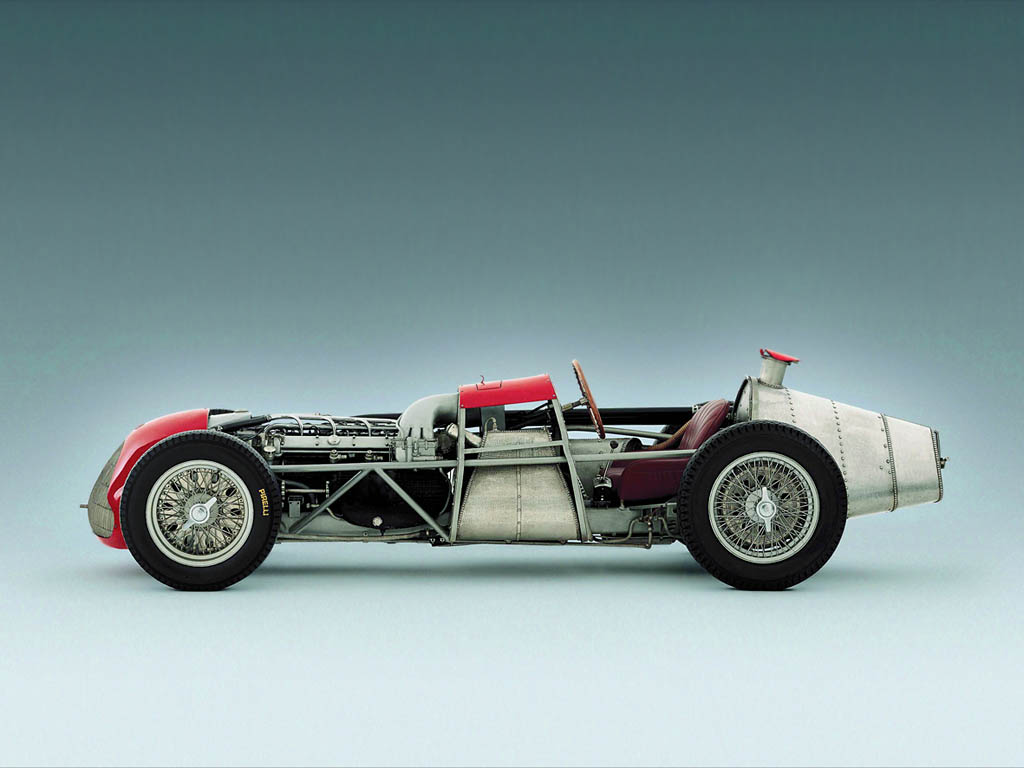
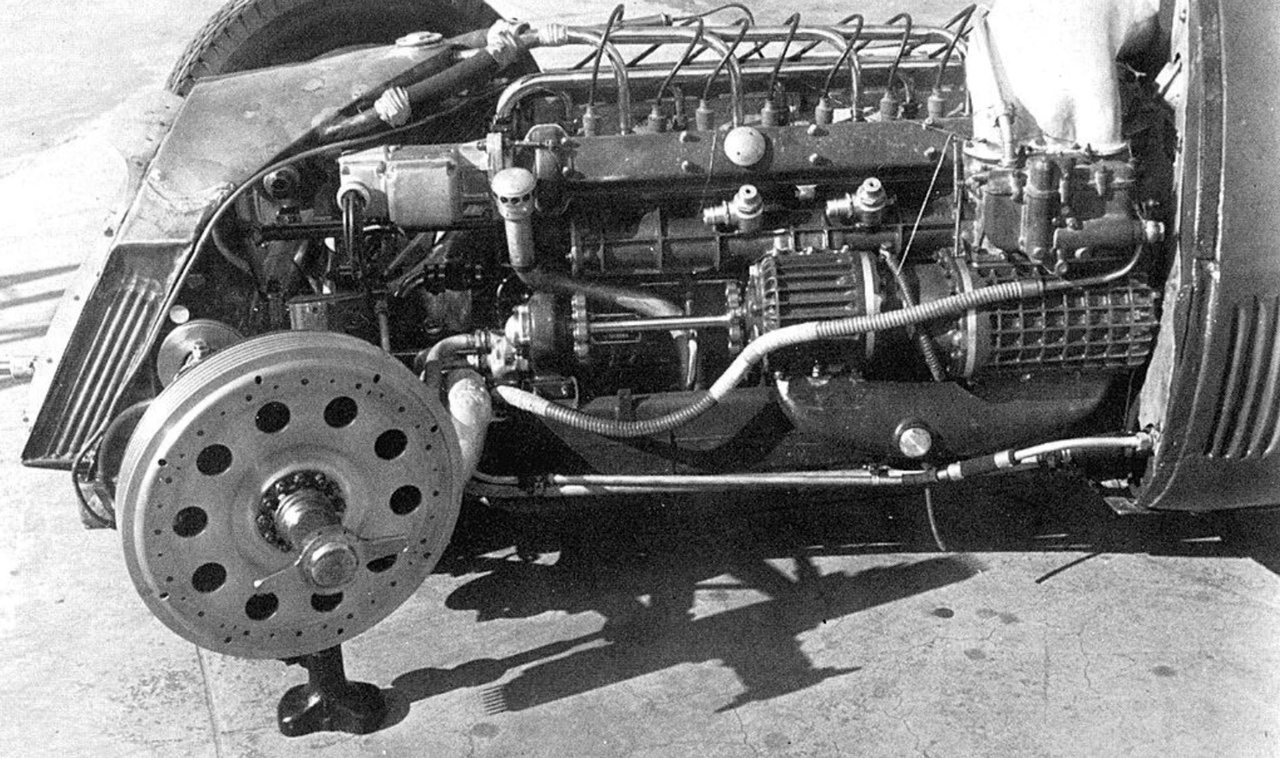
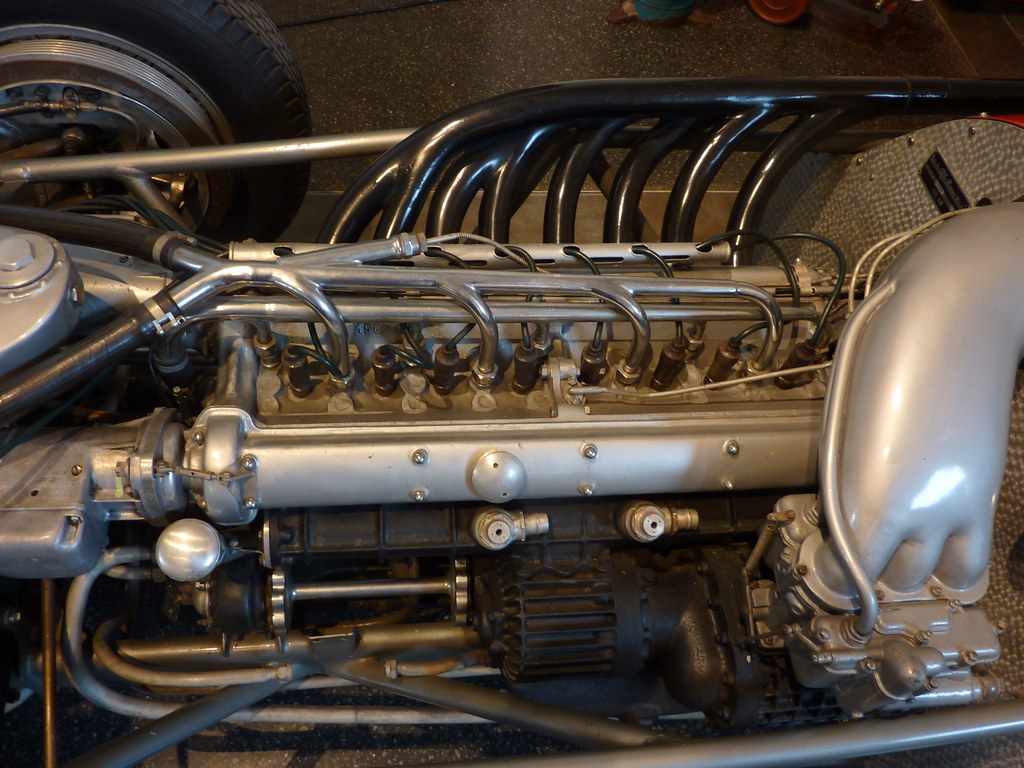
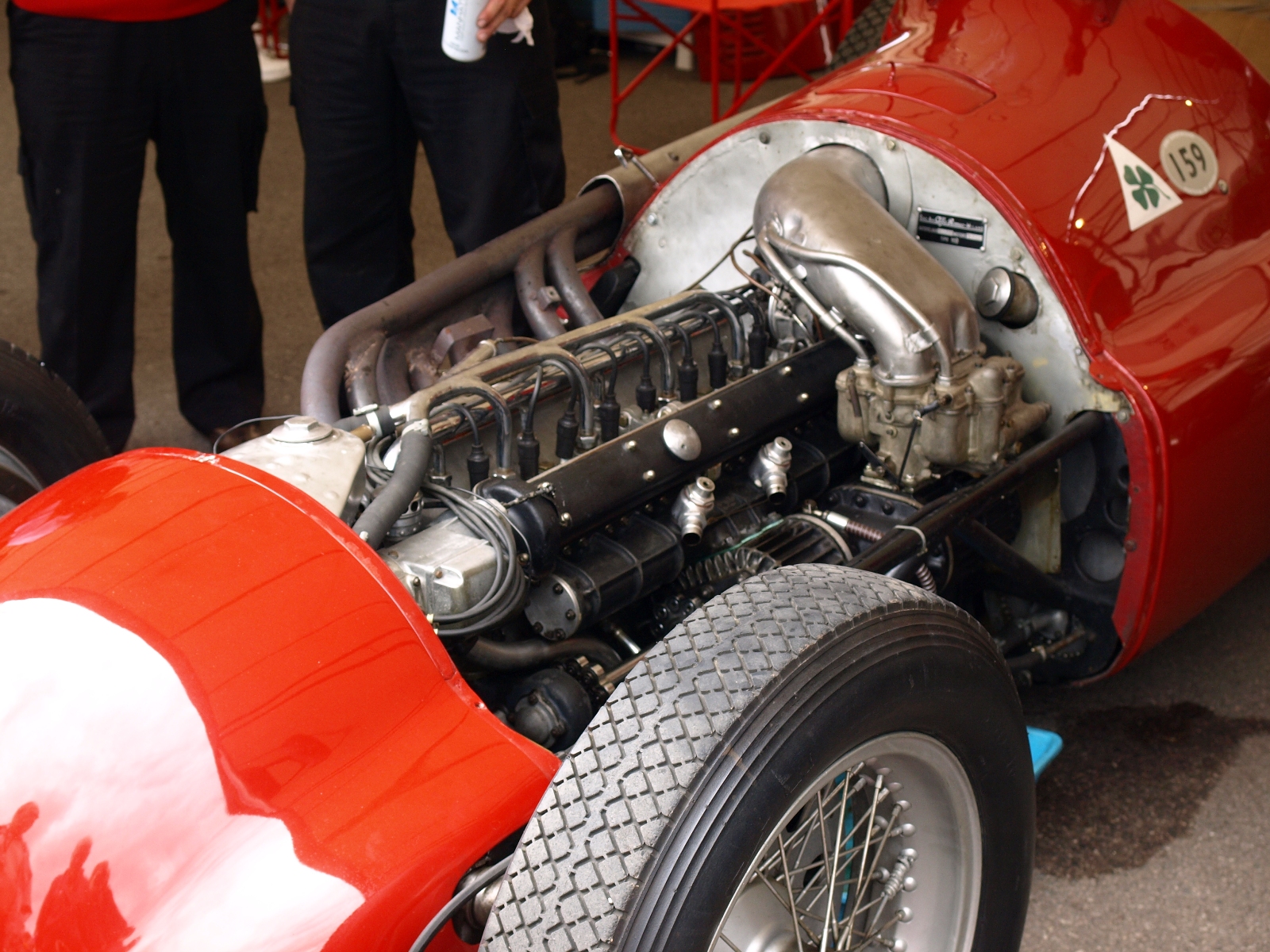
Extracting another 75 bhp from Gioacchino Colombo’s 13-year-old jewel required ferocious boost pressures. Displacing 1,479 cc (90.25 cu in) from a square-shouldered 58 mm by 70 mm (2.28 in by 2.76 in) bore and stroke, the straight-eight retained its one-piece elektron magnesium-alloy block, aluminium cylinder head, hemispherical combustion chambers, and gear-driven twin overhead camshafts. By fitting larger-capacity two-stage Roots superchargers, a new triple-choke Weber carburettor, and sodium-cooled exhaust valves, Busso pushed output to 425 bhp at 9,300 rpm, with chaotic over-rev peaks reaching 9,600 rpm. To tame this violence, the wayward swing axles were discarded in favour of the De Dion rear axle featuring a transverse tube passing behind the differential, located longitudinally by radius rods and laterally by a central vertical sliding block, and suspended via a transverse leaf spring paired with twin hydraulic and friction Houdaille and telescopic dampers. However, this newfound rear traction exposed alarming torsional flex in the carryover 1938 elliptical-section tubular steel ladder frame. Power reached the rear wheels via a four-speed transaxle whose exceptionally tall first gear forced drivers to slip the dry multi-plate clutch mercilessly off the line, while finned, 350 mm (13.8 in) duralumin drum brakes struggled to haul the car down from 300 km/h (186 mph).
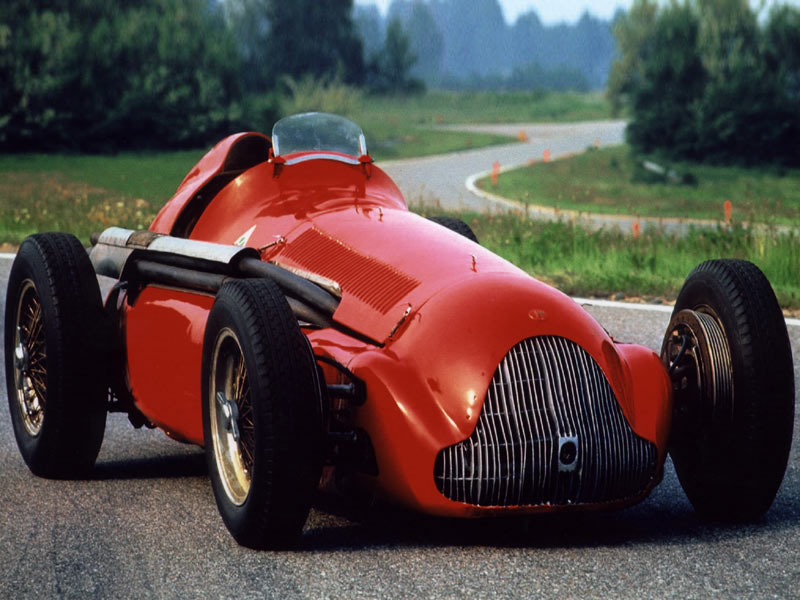
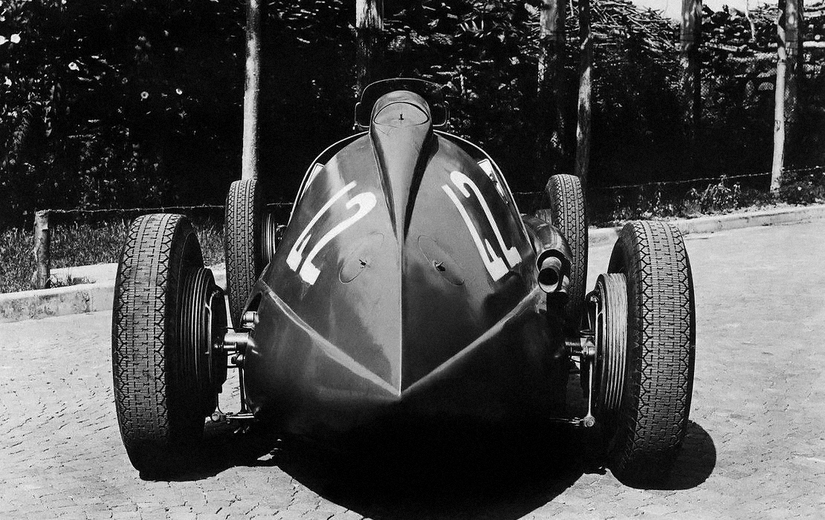
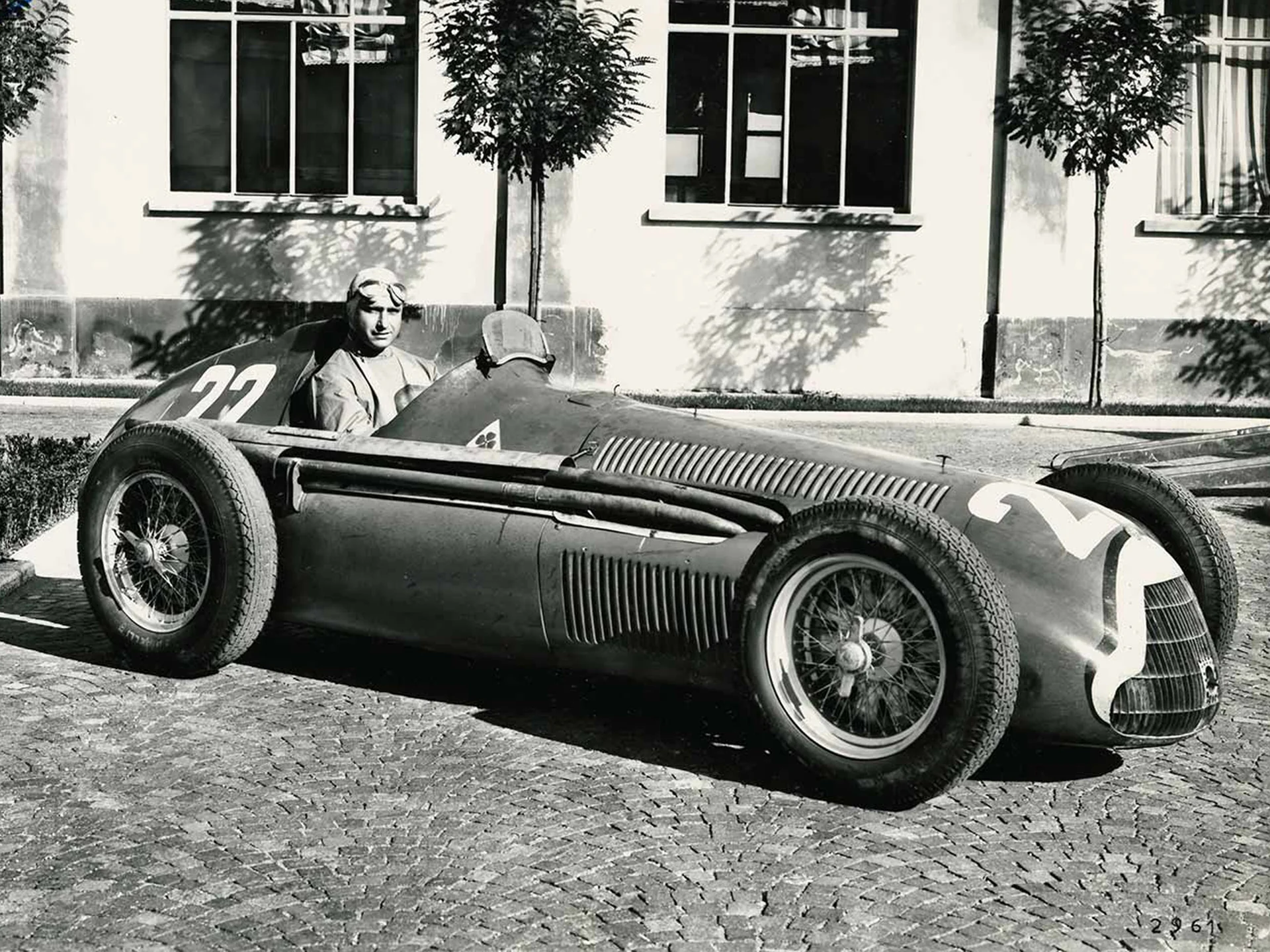
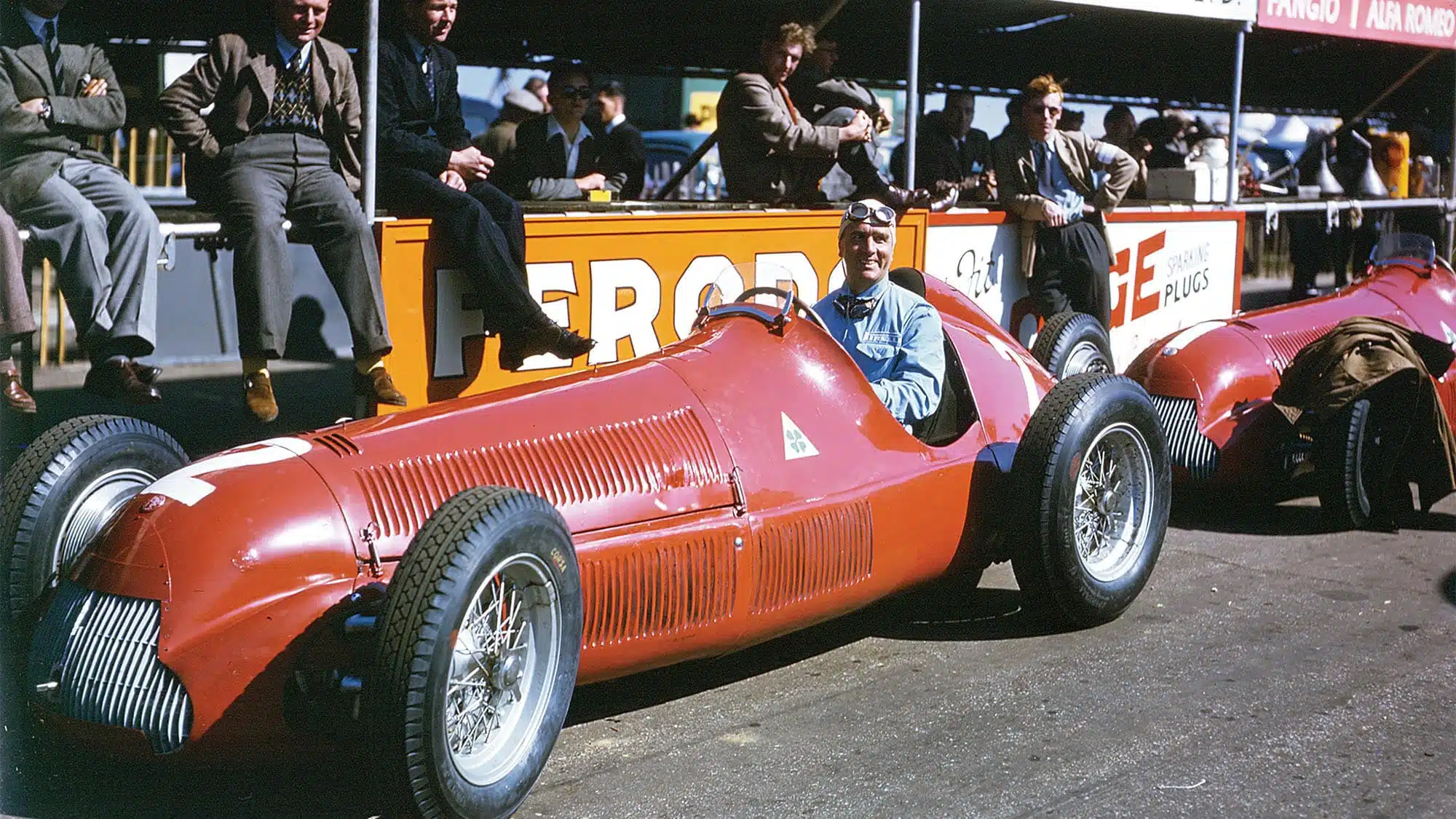
Externally, the 159A wore a lower, more bulbous tail to house the De Dion assembly and enlarged primary fuel tank, fresh side cooling louvres, and twin stacked exhaust pipes running along the left flank. Unlike the later 159B with its bulging cockpit-side pannier tanks, the 159A maintained clean flanks by pairing its tail tank with a cowl-mounted saddle tank straddling the driver’s legs for a total capacity of 170 to 225 litres (37.4 to 49.5 imperial gallons). Inside the cramped cockpit, dominated by a massive central Jaeger rev counter scaled to 10,000 rpm, drivers endured suffocating heat radiating off the exhausts and transmission tunnel.
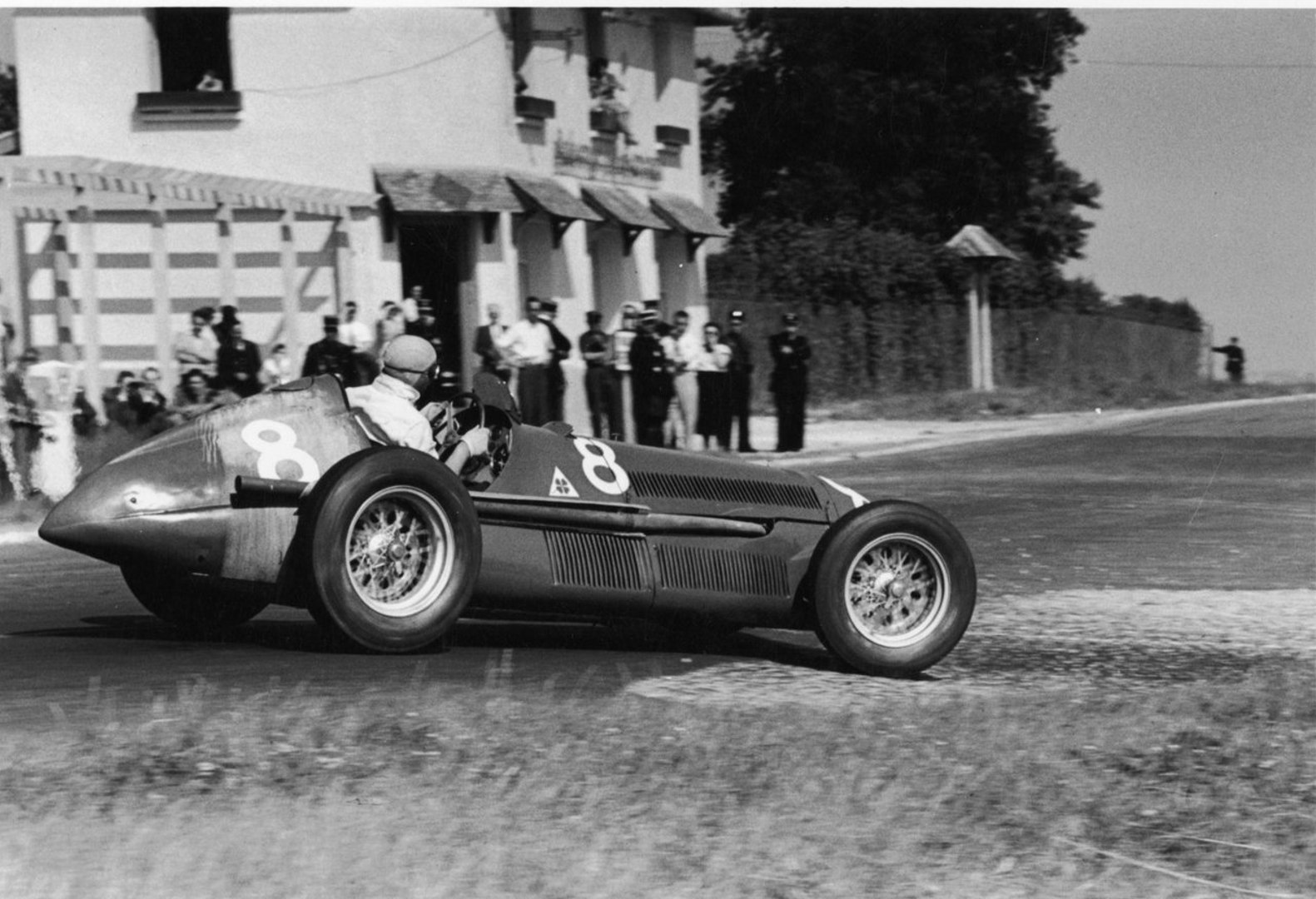
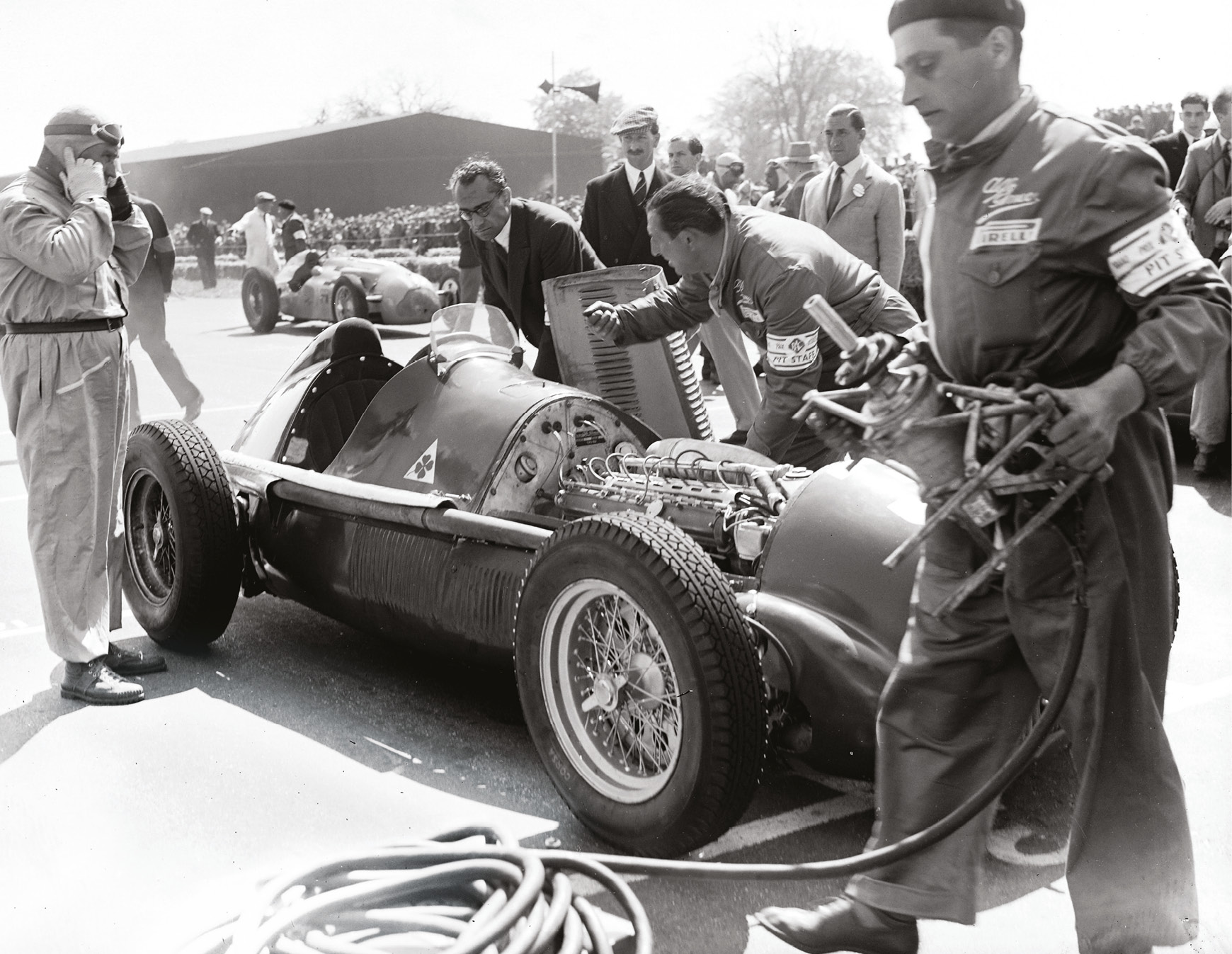
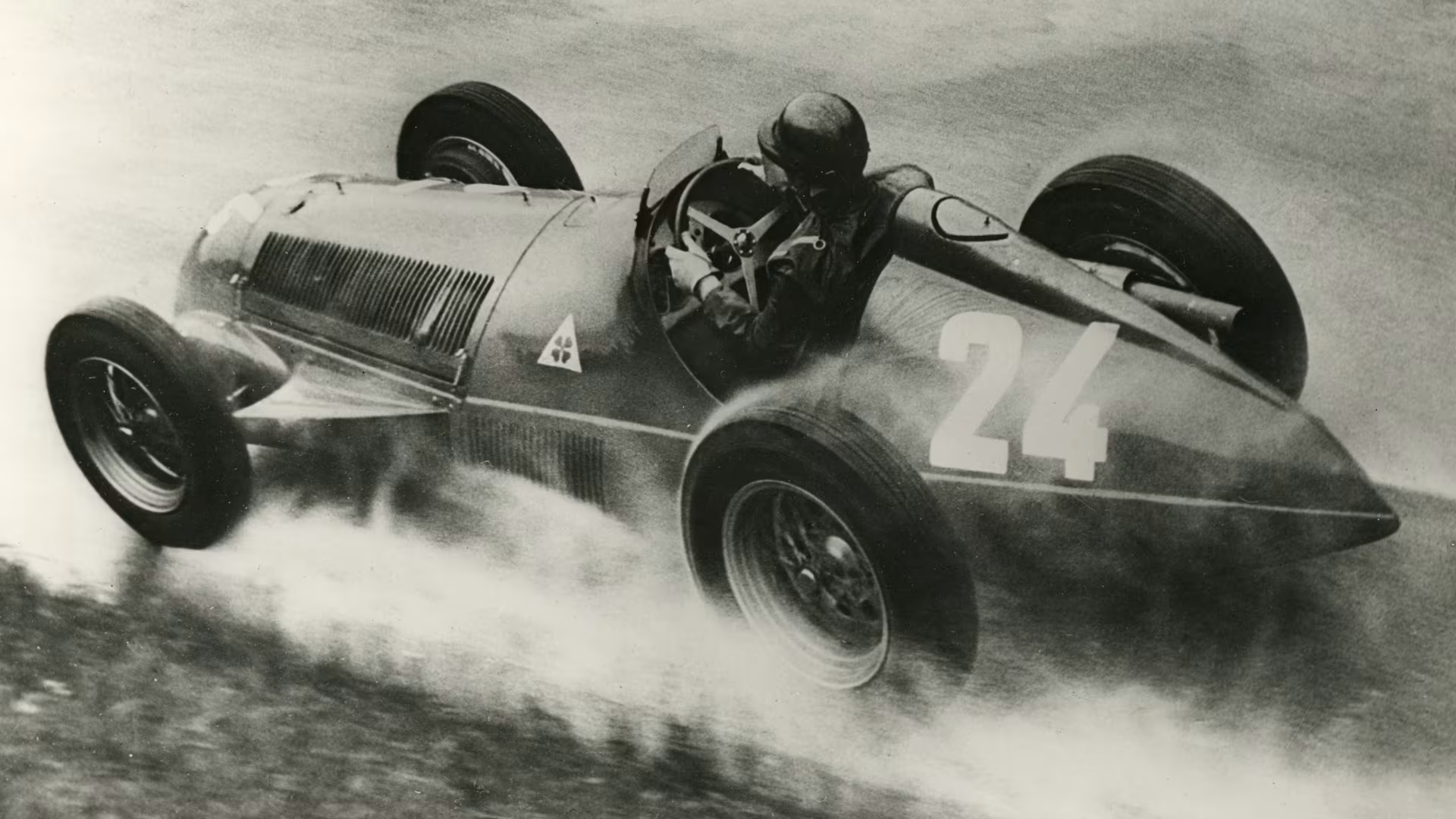
The 159A suffered a bruising baptism of fire in early non-championship outings: debuting at the Pau Grand Prix on 26 March 1951, Fangio took pole before retiring with a broken supercharger drive and brake failure, followed by another mechanical retirement at Bordeaux on 29 April. Yet when the World Championship opened on 27 May at Switzerland’s tree-lined, cobbled Bremgarten circuit under a torrential downpour, the 159A proved untouchable; Fangio took pole and charged back past Piero Taruffi’s Ferrari after a scheduled refuelling stop to claim victory, while Farina gambled on a non-stop run with an auxiliary tank to finish third. After Farina defeated Reg Parnell’s Ferrari at Northern Ireland’s Dundrod circuit to win the non-championship Ulster Trophy on 2 June, the circus arrived at Spa-Francorchamps on 17 June. Hurtling down the Masta kink at over 295 km/h (183 mph), the 159A’s savage thirst mandated two fuel and tyre stops; when a jammed rear wire wheel cost Fangio over 14 minutes in the pits, Farina delivered a faultless drive to secure the Belgian Grand Prix. The 159A’s dramatic swan song followed on 1 July at Reims-Gueux across a marathon 601.8 km (374 miles) under blistering Champagne sunshine. Alfa Corse entered four cars for Fangio, Farina, Consalvo Sanesi, and 53-year-old veteran Luigi Fagioli. When a failing magneto crippled Fangio’s mount, team management ordered Fagioli to hand over his healthy 159A during a pit stop. Fangio stormed back to win after more than 3 hours and 22 minutes, making Fagioli the oldest Grand Prix winner in history, though the humiliated Italian veteran quit Alfa Romeo on the spot.
Winning all three World Championship Grands Prix it contested alongside Farina’s non-championship Ulster Trophy triumph, the 159A defended the Alfetta bloodline’s supremacy where it mattered most. Yet the early mechanical failures at Pau and Bordeaux and the frantic pit stops at Spa and Reims convinced Satta Puliga that Ferrari would prevail the moment track temperatures allowed the 375 F1’s tyres to last full race distance. Barely two weeks after Reims, ahead of the British Grand Prix at Silverstone, the 159A chassis were rolled back into the Portello workshops and fitted with sprawling lateral pannier tanks flanking the cockpit to push fuel capacity beyond 300 litres (66 imperial gallons), mutating directly into the 159B before culminating in the stiffened, multi-tubular 159M that sealed Fangio’s maiden world title.
Brand
Produced from
Portal
Vehicle category
Model line
Model generation
Predecessor
Sucessor
Brand
Produced from
Portal
Vehicle category
Model line
Model generation
Predecessor
Sucessor
Submodel Overview
At 9,300 rpm, the supercharged straight-eight beneath the scarlet bonnet of the Alfa Romeo 159A did not merely roar; it emitted a metallic, ear-splitting shriek that tore through the pine forests of Bremgarten and the Ardennes while gulping methanol at a ruinous 160 litres per 100 kilometres (1.77 mpg). That mechanical fury was born not of arrogance, but of acute desperation. At the 1950 Formula One World Championship finale at Monza, Alberto Ascari had pushed Milan’s finest to the limit in the transitional, 4,101 cc (250.3 cu in) Ferrari 340 F1, before Aurelio Lampredi’s full 4,493 cc (274.2 cu in) Ferrari 375 F1 debuted at the non-championship Penya Rhin Grand Prix that October—a machine capable of running non-stop while the thirsty ‘Alfettas’ remained tethered to their pit stalls. Monza had also exposed the limits of the 350 bhp Alfa Romeo 158/50’s pre-war swing-axle rear suspension: when fitted with an experimental, nearly 400 bhp engine, Juan Manuel Fangio’s swing-axle chassis succumbed to violent camber changes and snap oversteer, whereas Giuseppe “Nino” Farina clinched the race and the inaugural World Championship driving a prototype 158 equipped with an experimental De Dion rear axle.
Deprived of state funds to build a clean-sheet successor over the winter of 1950–1951, technical director Orazio Satta Puliga and his right-hand man Giuseppe Busso standardised that De Dion layout across the existing 1938 chassis to create the early-season 159A specification. While overmatched supercharged rivals like the Maserati 4CLT/48 and Simca-Gordini T15 had been left behind by the horsepower war, the 4.5-litre (274.6 cu in), 260 bhp twin-ignition Talbot-Lago T26C-DA and T26C-GS lurked reliably in the background, and Britain’s complex BRM Type 15 V16 remained mired in teething troubles, leaving the 159A to square off directly against Maranello’s 380 bhp V12 juggernaut.
Extracting another 75 bhp from Gioacchino Colombo’s 13-year-old jewel required ferocious boost pressures. Displacing 1,479 cc (90.25 cu in) from a square-shouldered 58 mm by 70 mm (2.28 in by 2.76 in) bore and stroke, the straight-eight retained its one-piece elektron magnesium-alloy block, aluminium cylinder head, hemispherical combustion chambers, and gear-driven twin overhead camshafts. By fitting larger-capacity two-stage Roots superchargers, a new triple-choke Weber carburettor, and sodium-cooled exhaust valves, Busso pushed output to 425 bhp at 9,300 rpm, with chaotic over-rev peaks reaching 9,600 rpm. To tame this violence, the wayward swing axles were discarded in favour of the De Dion rear axle featuring a transverse tube passing behind the differential, located longitudinally by radius rods and laterally by a central vertical sliding block, and suspended via a transverse leaf spring paired with twin hydraulic and friction Houdaille and telescopic dampers. However, this newfound rear traction exposed alarming torsional flex in the carryover 1938 elliptical-section tubular steel ladder frame. Power reached the rear wheels via a four-speed transaxle whose exceptionally tall first gear forced drivers to slip the dry multi-plate clutch mercilessly off the line, while finned, 350 mm (13.8 in) duralumin drum brakes struggled to haul the car down from 300 km/h (186 mph).
Externally, the 159A wore a lower, more bulbous tail to house the De Dion assembly and enlarged primary fuel tank, fresh side cooling louvres, and twin stacked exhaust pipes running along the left flank. Unlike the later 159B with its bulging cockpit-side pannier tanks, the 159A maintained clean flanks by pairing its tail tank with a cowl-mounted saddle tank straddling the driver’s legs for a total capacity of 170 to 225 litres (37.4 to 49.5 imperial gallons). Inside the cramped cockpit, dominated by a massive central Jaeger rev counter scaled to 10,000 rpm, drivers endured suffocating heat radiating off the exhausts and transmission tunnel.
The 159A suffered a bruising baptism of fire in early non-championship outings: debuting at the Pau Grand Prix on 26 March 1951, Fangio took pole before retiring with a broken supercharger drive and brake failure, followed by another mechanical retirement at Bordeaux on 29 April. Yet when the World Championship opened on 27 May at Switzerland’s tree-lined, cobbled Bremgarten circuit under a torrential downpour, the 159A proved untouchable; Fangio took pole and charged back past Piero Taruffi’s Ferrari after a scheduled refuelling stop to claim victory, while Farina gambled on a non-stop run with an auxiliary tank to finish third. After Farina defeated Reg Parnell’s Ferrari at Northern Ireland’s Dundrod circuit to win the non-championship Ulster Trophy on 2 June, the circus arrived at Spa-Francorchamps on 17 June. Hurtling down the Masta kink at over 295 km/h (183 mph), the 159A’s savage thirst mandated two fuel and tyre stops; when a jammed rear wire wheel cost Fangio over 14 minutes in the pits, Farina delivered a faultless drive to secure the Belgian Grand Prix. The 159A’s dramatic swan song followed on 1 July at Reims-Gueux across a marathon 601.8 km (374 miles) under blistering Champagne sunshine. Alfa Corse entered four cars for Fangio, Farina, Consalvo Sanesi, and 53-year-old veteran Luigi Fagioli. When a failing magneto crippled Fangio’s mount, team management ordered Fagioli to hand over his healthy 159A during a pit stop. Fangio stormed back to win after more than 3 hours and 22 minutes, making Fagioli the oldest Grand Prix winner in history, though the humiliated Italian veteran quit Alfa Romeo on the spot.
Winning all three World Championship Grands Prix it contested alongside Farina’s non-championship Ulster Trophy triumph, the 159A defended the Alfetta bloodline’s supremacy where it mattered most. Yet the early mechanical failures at Pau and Bordeaux and the frantic pit stops at Spa and Reims convinced Satta Puliga that Ferrari would prevail the moment track temperatures allowed the 375 F1’s tyres to last full race distance. Barely two weeks after Reims, ahead of the British Grand Prix at Silverstone, the 159A chassis were rolled back into the Portello workshops and fitted with sprawling lateral pannier tanks flanking the cockpit to push fuel capacity beyond 300 litres (66 imperial gallons), mutating directly into the 159B before culminating in the stiffened, multi-tubular 159M that sealed Fangio’s maiden world title.
Tech Specs
Technical Specifications
Tech Specs
Technical Specifications
Engine
01
03
Internal combustion engine
Configuration
Alfa Romeo 158/159, Inline-8 (Straight-8)
Location
Front, longitudinally mounted
Construction
Elektron (magnesium alloy) block with nickel-chrome steel wet cylinder liners, aluminium alloy heads
Displacement (cc)
1,479 cc
Displacement (cu in)
90.3 cu in
Compression
6.5:1
Bore x Stroke
58.0 mm x 70.0 mm
Valvetrain
2 valves per cylinder, DOHC (gear-driven)
Fuel feed
1 x Weber twin-choke carburetor
Lubrication
Dry sump
Aspiration
Supercharged (Two-stage, twin Roots-type superchargers)
Output
Power (hp)
425 - 450 hp
Power (kW)
317 - 336 kW
Max power at
9,300 - 9,600 RPM
Torque (Nm)
~390 - 450 Nm
Torque (ft lbs)
~288 - 332 ft lbs
Max torque at
5,300 - 6,500 RPM
Drivetrain
02
03
Chassis
Type
Tubular ladder frame (twin elliptical main tubes)
Material
Steel
Body
Material
Aluminium
Transmission
Gearbox
Alfa Romeo 4-speed manual transaxle
Drive
Rear Wheel Drive (ZF-type Limited Slip Differential)
Suspension
Front
Independent, trailing arms, transverse leaf spring, hydraulic telescopic plus friction dampers
Rear
De Dion axle, radius rods, transverse leaf spring, hydraulic telescopic plus friction dampers
Steering
Type
Worm and sector
Brakes
Front
Finned hydraulic drum brakes Ø375 mm (14.75 in)
Rear
Finned hydraulic drum brakes Ø350 mm (13.75 in)
Wheels
Front
17" or 18" (Borrani centre-lock wire spoke wheels)
Rear
18" or 19" (Borrani centre-lock wire spoke wheels)
Tires
Front
5.50-17 or 5.50-18
Rear
7.00-18 or 7.00-19
Dimensions and performance
03
03
Dimensions
Length (mm)
4,280 mm
Length (in)
168.5 in
Width (mm)
1,473 mm
Width (in)
58.0 in
Height (mm)
1,164 mm
Height (in)
45.8 in
Wheelbase (mm)
2,502 mm
Wheelbase (in)
98.5 in
Weight (kg)
710 kg
Weight (lbs)
1,565 lbs
Performance
Power to weight
0.60 - 0.63 hp/kg
Top speed (km/h)
310 km/h
Top speed (mph)
193 mph
0-100 km/h (0-60 mph)
~3.7 s