
TOJ
Type
Foundation Year
Founder/s
Country
Headquarters
Brand Overview
In the kaleidoscopic, vibrant, and fiercely competitive world of 1970s European motorsport, the spotlight often fell upon the established British “garagistas” like Lola and Chevron, or the passionate Italian artisans like Abarth and Osella. Yet, nestled in the heart of West Germany, in the quiet town of Bruchsal, there existed a racing constructor that captured the zeitgeist of the era with a distinctively Teutonic flair. It was a brand defined by the gleaming gold livery of Warsteiner beer, the high-pitched scream of BMW engines, and the indomitable spirit of one man: Jörg Obermoser. The brand was TOJ, an acronym for Team Obermoser Jörg, and for a brief but glorious window of time, it represented the absolute pinnacle of German privateer engineering. To look back at TOJ is to uncover a story of ambition, aesthetic perfection, and the transition of a racing driver into a manufacturer who dared to take on the world’s best on the twisting tarmac of the Nürburgring and the high-speed straights of Le Mans.
The genesis of TOJ is inextricable from the career of Jörg Obermoser himself. A successful touring car driver who had cut his teeth wrestling Ford Escorts and BMW 2002s around the airfield circuits of Germany, Obermoser was a man of immense drive and business acumen. By the early 1970s, his attention had shifted to the burgeoning class of 2-litre sports prototypes. This category was the hotbed of European talent, a formula that combined lightweight, open-cockpit chassis with race-bred four-cylinder engines. Initially, Obermoser acted as the German distributor for the British marque GRD (Group Racing Developments). He raced their cars with success, but like all true perfectionists, he found himself wanting more. He saw flaws in the British designs, areas where reliability could be improved and aerodynamics refined. Rather than complain, he decided to build.
In 1974, the transition from customer to constructor began. Obermoser recruited the talented ex-Eifelland and ex-GRD designer Klaus Fiedler. The brief was simple: build a car that could beat the Chevrons and Lolas on their own terms. The result was the evolution of the GRD S73 into the first true TOJ sports cars. While the early models, the SS02 and SC03, showed promise, it was the TOJ SC204 that truly announced the brand’s arrival.
The SC204 was a thing of beauty. Low, wide, and draped in gold, it looked fast even when parked in the paddock. Under the engine cover sat the crown jewel of German engineering: the BMW M12/7 engine. This 2.0-litre, four-cylinder unit was a masterpiece, producing nearly 300 horsepower at ear-splitting rpms. It was the standard-bearer for the class, but in the back of the TOJ chassis, it seemed to find a particularly happy home. The chassis itself was a conventional but beautifully executed aluminium monocoque, stiff and predictable.
The mid-70s were the golden age for TOJ. The European 2-Litre Sports Car Championship was a ferocious battleground. TOJ entered the fray against the might of the French Alpine-Renault squad (with their turbocharged V6s) and the armada of British Chevrons. While the factory Alpines were often in a league of their own regarding raw power, TOJ established itself as the “best of the rest”, the king of the privateers. In the hands of Obermoser and other talented German drivers like Rolf Stommelen and Jürgen Barth, the cars were regular podium finishers. They possessed a reliability that their Italian rivals at Osella often lacked, a trait that spoke volumes about the build quality coming out of the Bruchsal workshop.
However, TOJ’s playground wasn’t limited to the European Championship. They found a spiritual home in the Interserie. Often described as the “European Can-Am”, the Interserie was a “run what you brung” championship that featured everything from retired Porsche 917s to modified Formula 1 cars fitted with fenders. In this land of giants, the nimble 2-litre TOJs punched well above their weight. On tight, technical tracks like the Nürburgring Betonschleife or the airfield at Mainz-Finthen, a well-driven TOJ SC204 or SC205 could embarrass cars with engines three times the size. In 1976, TOJ secured the Interserie title, a massive achievement that validated Obermoser’s vision.
The ambition of the team continued to grow. Not content with sports cars, Obermoser looked toward single-seaters. Formula 2 was the final stepping stone to Formula 1, and in 1976, TOJ launched the F201. It was a sleek, effective chassis, again powered by BMW. The car attracted serious talent. A young, moustachioed Finn named Keke Rosberg—years before he would become a Formula 1 World Champion—wrestled the TOJ F201 around the circuits of Europe. While the F2 project never achieved the dominance of the sports cars (struggling against the might of the factory March and Martini teams), it proved that TOJ was a serious constructor with the engineering depth to tackle open-wheel racing.
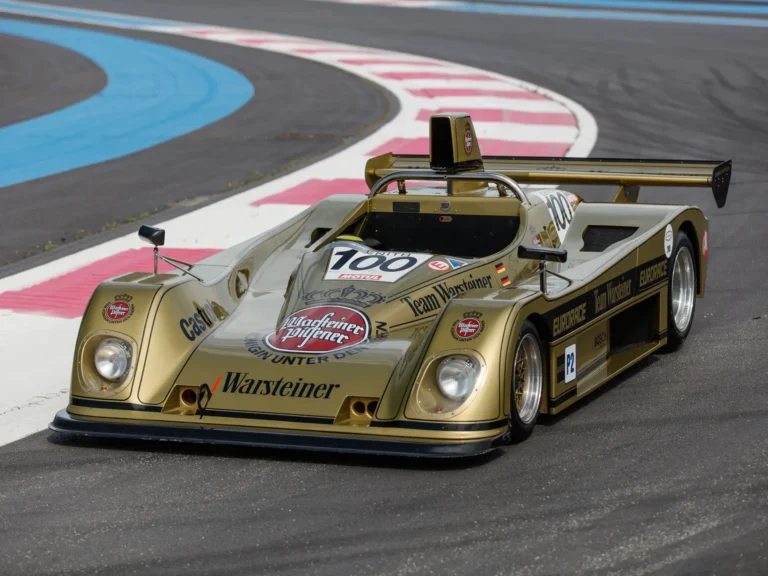
As the decade progressed, the regulations shifted, and so did TOJ. The SC301 and SC302 represented the step up to the big league: Group 6. These cars were designed to accommodate the legendary 3.0-litre Ford Cosworth DFV V8. This was no longer about fighting for class wins; this was about fighting for overall victories. The SC301, with its distinctive gold Warsteiner livery, looked every inch the Le Mans contender. And indeed, TOJ went to Le Mans. The 24 Hours of Le Mans is a cruel mistress to small manufacturers, and while TOJ never secured the overall win at La Sarthe, their presence on the grid alongside Porsche 936s and Renault-Alpines cemented their status as a legitimate manufacturer. The SC302, with its radical aerodynamics and massive rear wing, remains one of the most striking prototypes of the late 70s era.
But the life of a privateer constructor is a precarious one. The costs of racing were skyrocketing as the 1980s approached. Ground effect technology, carbon fibre, and turbocharging were changing the landscape, requiring budgets that small teams simply couldn’t generate. Jörg Obermoser, ever the pragmatist, saw the writing on the wall. He was a businessman first—he also ran a successful business importing Tamiya models and slot cars—and a team owner second. By the end of the 1970s, the TOJ project began to wind down. The assets and designs were eventually sold to a new entity, Modus, but the magic had faded.
Yet, the legacy of TOJ endures. In the world of historic racing today, a TOJ is a prized possession. To see an SC204 scream through the Craner Curves at Donington or tackle the rise at Eau Rouge is to be transported back to a time when racing was colorful, loud, and accessible. The gold Warsteiner livery remains one of the most iconic paint schemes in motorsport history, instantly recognizable and evocative of a specific time and place.
TOJ represents a uniquely German success story. It wasn’t backed by a massive corporation like Mercedes or Porsche. It was a “Mittelstand” racing team—efficient, high-quality, and fiercely competitive. Jörg Obermoser proved that with the right engine, the right designer, and enough determination, a small workshop in Bruchsal could build cars that made the entire continent sit up and take notice. They were the golden warriors of the 70s, the cars that proved you didn’t need to be Italian to have soul, or British to have engineering genius.
Type
Foundation Year
Country
Founder/s
Headquarters
Type
Foundation Year
Country
Founder/s
Headquarters
About this brand
In the kaleidoscopic, vibrant, and fiercely competitive world of 1970s European motorsport, the spotlight often fell upon the established British “garagistas” like Lola and Chevron, or the passionate Italian artisans like Abarth and Osella. Yet, nestled in the heart of West Germany, in the quiet town of Bruchsal, there existed a racing constructor that captured the zeitgeist of the era with a distinctively Teutonic flair. It was a brand defined by the gleaming gold livery of Warsteiner beer, the high-pitched scream of BMW engines, and the indomitable spirit of one man: Jörg Obermoser. The brand was TOJ, an acronym for Team Obermoser Jörg, and for a brief but glorious window of time, it represented the absolute pinnacle of German privateer engineering. To look back at TOJ is to uncover a story of ambition, aesthetic perfection, and the transition of a racing driver into a manufacturer who dared to take on the world’s best on the twisting tarmac of the Nürburgring and the high-speed straights of Le Mans.
The genesis of TOJ is inextricable from the career of Jörg Obermoser himself. A successful touring car driver who had cut his teeth wrestling Ford Escorts and BMW 2002s around the airfield circuits of Germany, Obermoser was a man of immense drive and business acumen. By the early 1970s, his attention had shifted to the burgeoning class of 2-litre sports prototypes. This category was the hotbed of European talent, a formula that combined lightweight, open-cockpit chassis with race-bred four-cylinder engines. Initially, Obermoser acted as the German distributor for the British marque GRD (Group Racing Developments). He raced their cars with success, but like all true perfectionists, he found himself wanting more. He saw flaws in the British designs, areas where reliability could be improved and aerodynamics refined. Rather than complain, he decided to build.
In 1974, the transition from customer to constructor began. Obermoser recruited the talented ex-Eifelland and ex-GRD designer Klaus Fiedler. The brief was simple: build a car that could beat the Chevrons and Lolas on their own terms. The result was the evolution of the GRD S73 into the first true TOJ sports cars. While the early models, the SS02 and SC03, showed promise, it was the TOJ SC204 that truly announced the brand’s arrival.
The SC204 was a thing of beauty. Low, wide, and draped in gold, it looked fast even when parked in the paddock. Under the engine cover sat the crown jewel of German engineering: the BMW M12/7 engine. This 2.0-litre, four-cylinder unit was a masterpiece, producing nearly 300 horsepower at ear-splitting rpms. It was the standard-bearer for the class, but in the back of the TOJ chassis, it seemed to find a particularly happy home. The chassis itself was a conventional but beautifully executed aluminium monocoque, stiff and predictable.
The mid-70s were the golden age for TOJ. The European 2-Litre Sports Car Championship was a ferocious battleground. TOJ entered the fray against the might of the French Alpine-Renault squad (with their turbocharged V6s) and the armada of British Chevrons. While the factory Alpines were often in a league of their own regarding raw power, TOJ established itself as the “best of the rest”, the king of the privateers. In the hands of Obermoser and other talented German drivers like Rolf Stommelen and Jürgen Barth, the cars were regular podium finishers. They possessed a reliability that their Italian rivals at Osella often lacked, a trait that spoke volumes about the build quality coming out of the Bruchsal workshop.
However, TOJ’s playground wasn’t limited to the European Championship. They found a spiritual home in the Interserie. Often described as the “European Can-Am”, the Interserie was a “run what you brung” championship that featured everything from retired Porsche 917s to modified Formula 1 cars fitted with fenders. In this land of giants, the nimble 2-litre TOJs punched well above their weight. On tight, technical tracks like the Nürburgring Betonschleife or the airfield at Mainz-Finthen, a well-driven TOJ SC204 or SC205 could embarrass cars with engines three times the size. In 1976, TOJ secured the Interserie title, a massive achievement that validated Obermoser’s vision.
The ambition of the team continued to grow. Not content with sports cars, Obermoser looked toward single-seaters. Formula 2 was the final stepping stone to Formula 1, and in 1976, TOJ launched the F201. It was a sleek, effective chassis, again powered by BMW. The car attracted serious talent. A young, moustachioed Finn named Keke Rosberg—years before he would become a Formula 1 World Champion—wrestled the TOJ F201 around the circuits of Europe. While the F2 project never achieved the dominance of the sports cars (struggling against the might of the factory March and Martini teams), it proved that TOJ was a serious constructor with the engineering depth to tackle open-wheel racing.
As the decade progressed, the regulations shifted, and so did TOJ. The SC301 and SC302 represented the step up to the big league: Group 6. These cars were designed to accommodate the legendary 3.0-litre Ford Cosworth DFV V8. This was no longer about fighting for class wins; this was about fighting for overall victories. The SC301, with its distinctive gold Warsteiner livery, looked every inch the Le Mans contender. And indeed, TOJ went to Le Mans. The 24 Hours of Le Mans is a cruel mistress to small manufacturers, and while TOJ never secured the overall win at La Sarthe, their presence on the grid alongside Porsche 936s and Renault-Alpines cemented their status as a legitimate manufacturer. The SC302, with its radical aerodynamics and massive rear wing, remains one of the most striking prototypes of the late 70s era.
But the life of a privateer constructor is a precarious one. The costs of racing were skyrocketing as the 1980s approached. Ground effect technology, carbon fibre, and turbocharging were changing the landscape, requiring budgets that small teams simply couldn’t generate. Jörg Obermoser, ever the pragmatist, saw the writing on the wall. He was a businessman first—he also ran a successful business importing Tamiya models and slot cars—and a team owner second. By the end of the 1970s, the TOJ project began to wind down. The assets and designs were eventually sold to a new entity, Modus, but the magic had faded.
Yet, the legacy of TOJ endures. In the world of historic racing today, a TOJ is a prized possession. To see an SC204 scream through the Craner Curves at Donington or tackle the rise at Eau Rouge is to be transported back to a time when racing was colorful, loud, and accessible. The gold Warsteiner livery remains one of the most iconic paint schemes in motorsport history, instantly recognizable and evocative of a specific time and place.
TOJ represents a uniquely German success story. It wasn’t backed by a massive corporation like Mercedes or Porsche. It was a “Mittelstand” racing team—efficient, high-quality, and fiercely competitive. Jörg Obermoser proved that with the right engine, the right designer, and enough determination, a small workshop in Bruchsal could build cars that made the entire continent sit up and take notice. They were the golden warriors of the 70s, the cars that proved you didn’t need to be Italian to have soul, or British to have engineering genius.
Submodels
Latest Variants
Model Lines