
Tiga
Type
Foundation Year
Founder/s
Country
Headquarters
Brand Overview
In the tangled, grease-stained genealogy of British race car manufacturers, there is a distinct lineage of the “Garagista”—the small, shed-based operations that defied the industrial giants. But amongst the Lolas, the Chevrons, and the Royales, one name stands apart, not just for its success, but for the unique pedigree of its parents. Most racing car companies were founded by engineers who wanted to be drivers, or businessmen who wanted to be team owners. Tiga, however, was born from the handshake of two bona fide Formula 1 drivers who decided that if they couldn’t find the perfect car to race, they would simply build it themselves. The name Tiga (pronounced “Ty-ga”) is a syllabic portmanteau of its founders: the Australian Tim Schenken and the New Zealander Howden Ganley. “Ti” for Tim, “Ga” for Ganley. It was an antipodean union forged in the fires of European competition, and for a glorious decade and a half, Tiga Race Cars was the backbone of the grid, the privateer’s best friend, and the undisputed king of the entry-level prototype.
The story begins in 1976. Both Schenken and Ganley had reached the pinnacle of the sport—Formula 1—but they possessed the pragmatic, hands-on mentality typical of racers from the Southern Hemisphere. They weren’t looking to build F1 cars; they saw a gap in the market for reliable, fast, and affordable customer cars in the junior categories. They set up shop in Maidenhead, England, initially focusing on Formula Ford. Their first car, the Tiga FF76, was a neat, effective machine, but it was merely the appetizer. The main course, the category that would define the brand’s soul, was Sports 2000.
Sports 2000 (S2000) was a class designed for open-cockpit, two-seater sports prototypes powered by the ubiquitous 2.0-liter Ford Pinto engine. It was intended to be the sports car equivalent of Formula Ford: slick tires, wings, but with a reliable, production-based engine. Tiga didn’t just enter this market; they swallowed it whole. The Tiga SC79 and its successor, the SC80, were masterpieces of packaging. They weren’t necessarily the most radical cars aerodynamically, but they were built by drivers, for drivers. This meant they were adjustable, they were robust, and they were forgiving at the limit. In the late 1970s and early 1980s, Tiga cars decimated the opposition in the UK and Europe. If you looked at a Sports 2000 grid at Brands Hatch or Thruxton in 1980, it was often a sea of Tiga chassis. They became the “Formula Ford of Sportscars”, producing over 400 chassis in total. This volume of production is staggering for a specialist manufacturer and speaks to the immense trust the racing community placed in Schenken and Ganley.
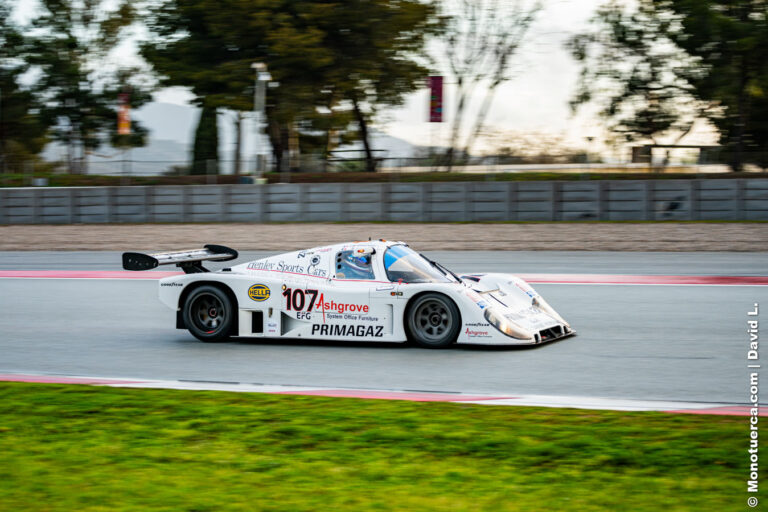
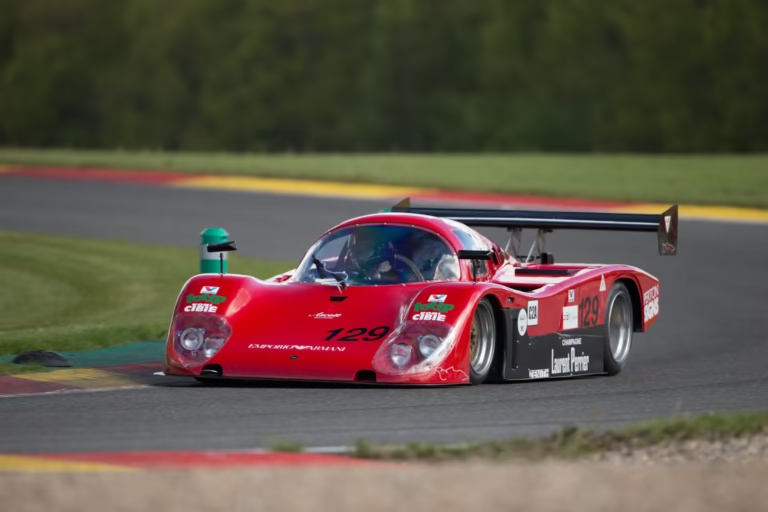
But the ambition of two F1 drivers could not be contained by the Pinto engine. As the 1980s progressed, the World Sportscar Championship introduced the Group C regulations, including a junior class for privateers known as Group C2 (originally C-Junior). This was the Wild West of endurance racing, a class where small teams could race at Le Mans on a fraction of the budget of Porsche or Jaguar. Tiga stepped up with the GC284 (Group C, 1984). It was a logical evolution of their Sports 2000 philosophy: a stiff aluminum honeycomb or sheet aluminum tub, decent aerodynamics, and the flexibility to accept a variety of engines, usually the Cosworth DFL or the Mazda rotary.
It was in this arena that Tiga achieved its most famous, and perhaps most ironic, success. One of their biggest customers was a British driver named Gordon Spice. Spice bought a Tiga GC284, fitted it with a Cosworth engine, and went racing. The car was quick. In 1985, at the 24 Hours of Le Mans, the Spice-Tiga GC85, driven by Gordon Spice, Ray Bellm, and Mark Galvin, won the C2 class. It was a monumental achievement. A small manufacturer founded by two ex-F1 drivers had beaten the world at the toughest race on earth. However, this victory planted the seeds of their own decline. Gordon Spice, realizing the potential of the car but wanting more control, decided to set up his own manufacturing outfit (Spice Engineering) the following year, becoming Tiga’s fiercest commercial rival.
While Europe was the prestige battleground, America was the gold rush. The IMSA GT Championship had created a class called “Camel Lights”, essentially the US equivalent of C2. Tiga attacked this market with the GT285 and GT286. In the US, the engine of choice wasn’t the vibrating Cosworth, but often the screaming Mazda 13B rotary or the Buick V6. The Tigas were perfect for the bumpy, tight American street circuits like Miami and Columbus. They were rugged. In 1987 and 1988, Tiga was a dominant force in IMSA Lights, locking horns with Spice and Argo. The Tiga GT286 became an icon of the series, recognizable by its enclosed wheel arches and aggressive, wedge-shaped nose.
What made Tiga special was the sheer variety of its output. They didn’t just build C2 cars and S2000s; they built Can-Am cars for the 2.0-liter class, Formula Atlantics, Formula Fords, and even dabbled in F1 consulting. They were the ultimate “jobbing” constructor. You could call Howden Ganley on a Tuesday, ask for a chassis that could take a Rover V8 or a turbocharged Ford engine, and they would figure it out. This flexibility meant that Tigas were powered by everything from Chevrolet V8s to Ferrari engines, Austin-Rover V6s, and Mazda rotaries.
However, as the late 80s approached, the tide began to turn. The arrival of Spice Engineering as a manufacturer changed the game. Spice cars were purpose-built around the Cosworth engine and carbon-fiber technology began to creep in, driving up costs. Tiga, still relying largely on aluminum construction and facing the loss of their biggest customer (Spice), struggled to keep pace with the rapid development curve. The company faced financial difficulties and ceased manufacturing in 1989. Schenken and Ganley moved on—Schenken to a high-ranking role in Australian motorsport administration and Ganley to the US—leaving behind a legacy that few can match in terms of volume.
Today, the Tiga legacy is experiencing a renaissance in historic racing. Because they built so many cars, and because those cars were built to be simple and durable, Tigas are the weapon of choice for modern vintage racers. Go to the Daytona Classic or the Le Mans Classic, and the grid is populated by SC80s and GC287s. They offer the visceral thrill of 1980s ground-effect racing without the stratospheric running costs of a Porsche 962.
Tiga is a reminder of a time when the barrier to entry in world-class motorsport was ingenuity, not just millions of dollars. It is the story of two men who swapped the steering wheel for the welding torch and provided the tools for a generation of drivers to realize their Le Mans dreams. They were the arms dealers of the amateur racer, the foundation upon which the thriving privateer scene of the 1980s was built. While they never challenged for outright F1 glory as a constructor, their impact on the grassroots and mid-tier levels of the sport was profound. Every driver who cut their teeth in a Sports 2000, every privateer who saw the chequered flag at Daytona in a Camel Lights car, owes a debt to the “Ti” and the “Ga.”
Type
Foundation Year
Country
Founder/s
Headquarters

Type
Foundation Year
Country
Founder/s
Headquarters
About this brand
In the tangled, grease-stained genealogy of British race car manufacturers, there is a distinct lineage of the “Garagista”—the small, shed-based operations that defied the industrial giants. But amongst the Lolas, the Chevrons, and the Royales, one name stands apart, not just for its success, but for the unique pedigree of its parents. Most racing car companies were founded by engineers who wanted to be drivers, or businessmen who wanted to be team owners. Tiga, however, was born from the handshake of two bona fide Formula 1 drivers who decided that if they couldn’t find the perfect car to race, they would simply build it themselves. The name Tiga (pronounced “Ty-ga”) is a syllabic portmanteau of its founders: the Australian Tim Schenken and the New Zealander Howden Ganley. “Ti” for Tim, “Ga” for Ganley. It was an antipodean union forged in the fires of European competition, and for a glorious decade and a half, Tiga Race Cars was the backbone of the grid, the privateer’s best friend, and the undisputed king of the entry-level prototype.
The story begins in 1976. Both Schenken and Ganley had reached the pinnacle of the sport—Formula 1—but they possessed the pragmatic, hands-on mentality typical of racers from the Southern Hemisphere. They weren’t looking to build F1 cars; they saw a gap in the market for reliable, fast, and affordable customer cars in the junior categories. They set up shop in Maidenhead, England, initially focusing on Formula Ford. Their first car, the Tiga FF76, was a neat, effective machine, but it was merely the appetizer. The main course, the category that would define the brand’s soul, was Sports 2000.
Sports 2000 (S2000) was a class designed for open-cockpit, two-seater sports prototypes powered by the ubiquitous 2.0-liter Ford Pinto engine. It was intended to be the sports car equivalent of Formula Ford: slick tires, wings, but with a reliable, production-based engine. Tiga didn’t just enter this market; they swallowed it whole. The Tiga SC79 and its successor, the SC80, were masterpieces of packaging. They weren’t necessarily the most radical cars aerodynamically, but they were built by drivers, for drivers. This meant they were adjustable, they were robust, and they were forgiving at the limit. In the late 1970s and early 1980s, Tiga cars decimated the opposition in the UK and Europe. If you looked at a Sports 2000 grid at Brands Hatch or Thruxton in 1980, it was often a sea of Tiga chassis. They became the “Formula Ford of Sportscars”, producing over 400 chassis in total. This volume of production is staggering for a specialist manufacturer and speaks to the immense trust the racing community placed in Schenken and Ganley.
But the ambition of two F1 drivers could not be contained by the Pinto engine. As the 1980s progressed, the World Sportscar Championship introduced the Group C regulations, including a junior class for privateers known as Group C2 (originally C-Junior). This was the Wild West of endurance racing, a class where small teams could race at Le Mans on a fraction of the budget of Porsche or Jaguar. Tiga stepped up with the GC284 (Group C, 1984). It was a logical evolution of their Sports 2000 philosophy: a stiff aluminum honeycomb or sheet aluminum tub, decent aerodynamics, and the flexibility to accept a variety of engines, usually the Cosworth DFL or the Mazda rotary.
It was in this arena that Tiga achieved its most famous, and perhaps most ironic, success. One of their biggest customers was a British driver named Gordon Spice. Spice bought a Tiga GC284, fitted it with a Cosworth engine, and went racing. The car was quick. In 1985, at the 24 Hours of Le Mans, the Spice-Tiga GC85, driven by Gordon Spice, Ray Bellm, and Mark Galvin, won the C2 class. It was a monumental achievement. A small manufacturer founded by two ex-F1 drivers had beaten the world at the toughest race on earth. However, this victory planted the seeds of their own decline. Gordon Spice, realizing the potential of the car but wanting more control, decided to set up his own manufacturing outfit (Spice Engineering) the following year, becoming Tiga’s fiercest commercial rival.
While Europe was the prestige battleground, America was the gold rush. The IMSA GT Championship had created a class called “Camel Lights”, essentially the US equivalent of C2. Tiga attacked this market with the GT285 and GT286. In the US, the engine of choice wasn’t the vibrating Cosworth, but often the screaming Mazda 13B rotary or the Buick V6. The Tigas were perfect for the bumpy, tight American street circuits like Miami and Columbus. They were rugged. In 1987 and 1988, Tiga was a dominant force in IMSA Lights, locking horns with Spice and Argo. The Tiga GT286 became an icon of the series, recognizable by its enclosed wheel arches and aggressive, wedge-shaped nose.
What made Tiga special was the sheer variety of its output. They didn’t just build C2 cars and S2000s; they built Can-Am cars for the 2.0-liter class, Formula Atlantics, Formula Fords, and even dabbled in F1 consulting. They were the ultimate “jobbing” constructor. You could call Howden Ganley on a Tuesday, ask for a chassis that could take a Rover V8 or a turbocharged Ford engine, and they would figure it out. This flexibility meant that Tigas were powered by everything from Chevrolet V8s to Ferrari engines, Austin-Rover V6s, and Mazda rotaries.
However, as the late 80s approached, the tide began to turn. The arrival of Spice Engineering as a manufacturer changed the game. Spice cars were purpose-built around the Cosworth engine and carbon-fiber technology began to creep in, driving up costs. Tiga, still relying largely on aluminum construction and facing the loss of their biggest customer (Spice), struggled to keep pace with the rapid development curve. The company faced financial difficulties and ceased manufacturing in 1989. Schenken and Ganley moved on—Schenken to a high-ranking role in Australian motorsport administration and Ganley to the US—leaving behind a legacy that few can match in terms of volume.
Today, the Tiga legacy is experiencing a renaissance in historic racing. Because they built so many cars, and because those cars were built to be simple and durable, Tigas are the weapon of choice for modern vintage racers. Go to the Daytona Classic or the Le Mans Classic, and the grid is populated by SC80s and GC287s. They offer the visceral thrill of 1980s ground-effect racing without the stratospheric running costs of a Porsche 962.
Tiga is a reminder of a time when the barrier to entry in world-class motorsport was ingenuity, not just millions of dollars. It is the story of two men who swapped the steering wheel for the welding torch and provided the tools for a generation of drivers to realize their Le Mans dreams. They were the arms dealers of the amateur racer, the foundation upon which the thriving privateer scene of the 1980s was built. While they never challenged for outright F1 glory as a constructor, their impact on the grassroots and mid-tier levels of the sport was profound. Every driver who cut their teeth in a Sports 2000, every privateer who saw the chequered flag at Daytona in a Camel Lights car, owes a debt to the “Ti” and the “Ga.”
Submodels
Latest Variants
Model Lines