
Deep in the volcanic spine of the Eifel mountains, the damp air perpetually holds the scent of pine needles and mist. Long before the era of sanitised pit lanes, this unforgiving topography gave life to a visceral spectacle that altered European motorsport forever: the ADAC Eifelrennen. Organised by the German automobile club, this was not a sterile, modern Grand Prix restricted to a single class, but rather a riotous, full-blooded festival of speed. On the very same weekend, the paddock throbbed with a mechanical symphony as fragile motorcycles, roaring touring cars, bespoke sports prototypes, and single-seaters all vied for glory. The sheer physical toll of wrestling these rudimentary machines through the forests, battling visual exhaustion against the low morning sun and the terrifying proximity of stone walls, defined a romantic, reckless era of racing. Crucially, the Eifelrennen was the primal catalyst that forced the creation of the most feared ribbon of tarmac on earth: the Nürburgring.
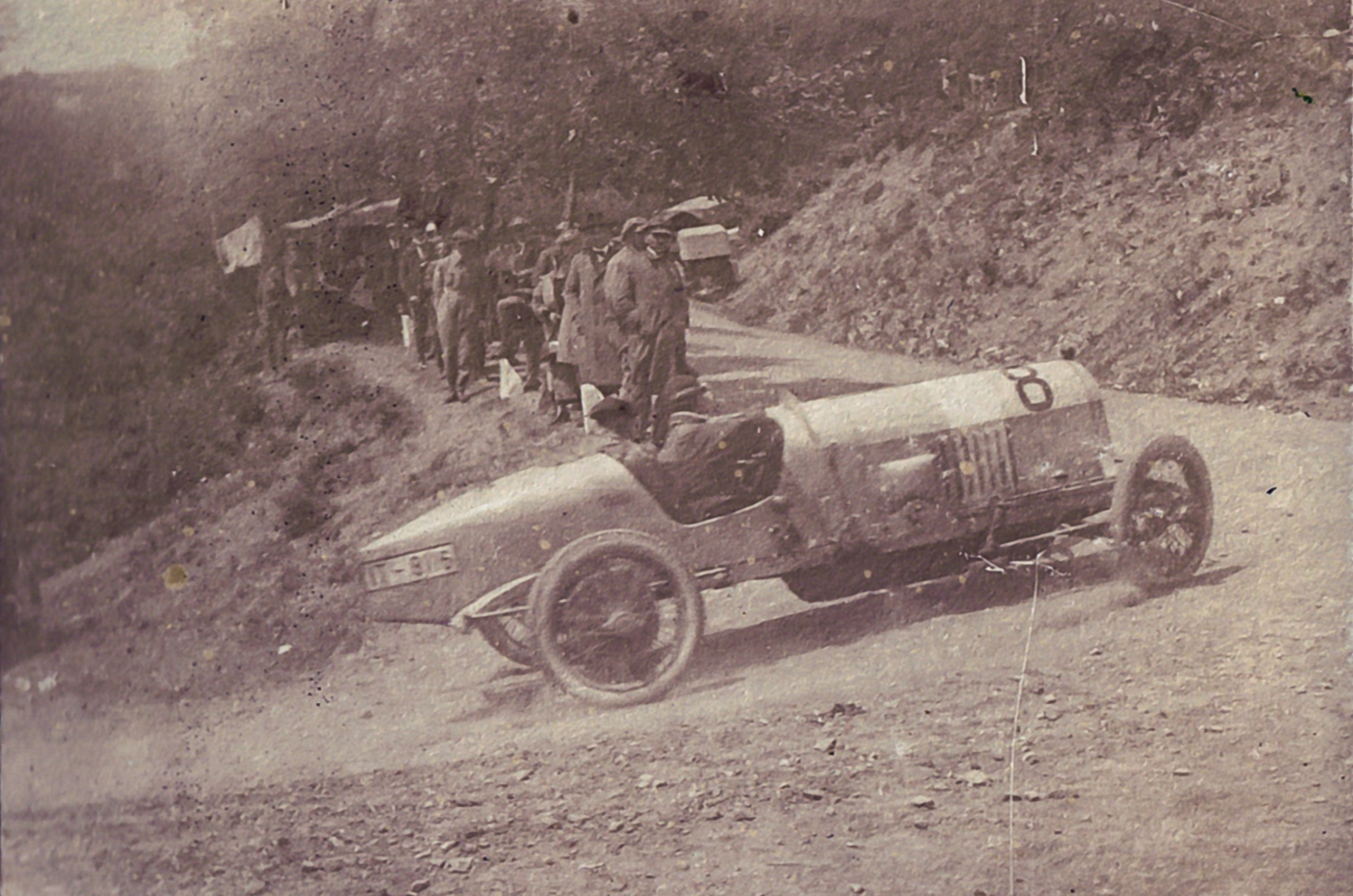
The genesis of this epic lay in the treacherous dust of 1922. The inaugural Eifelrennen did not enjoy the luxury of a closed circuit; instead, it terrorised the rural landscape on a 33.2 km (20.6 miles) loop of unpaved, deeply rutted public roads around the town of Nideggen. Competitors faced an apocalyptic gauntlet featuring 86 treacherous bends, brutal elevation changes totalling over 265 m (869 ft), and sheer precipices waiting to punish the slightest lapse in concentration. Despite the biblical clouds of dust and the terror of navigating narrow villages flat-out, the spectacle drew an astonishing 40,000 spectators. Yet, the raw speed of the advancing machinery quickly exposed the lethal inadequacy of these public dirt roads. The event proved far too perilous, prompting a government mandate to establish a dedicated, isolated proving ground to save the lives of both drivers and villagers.
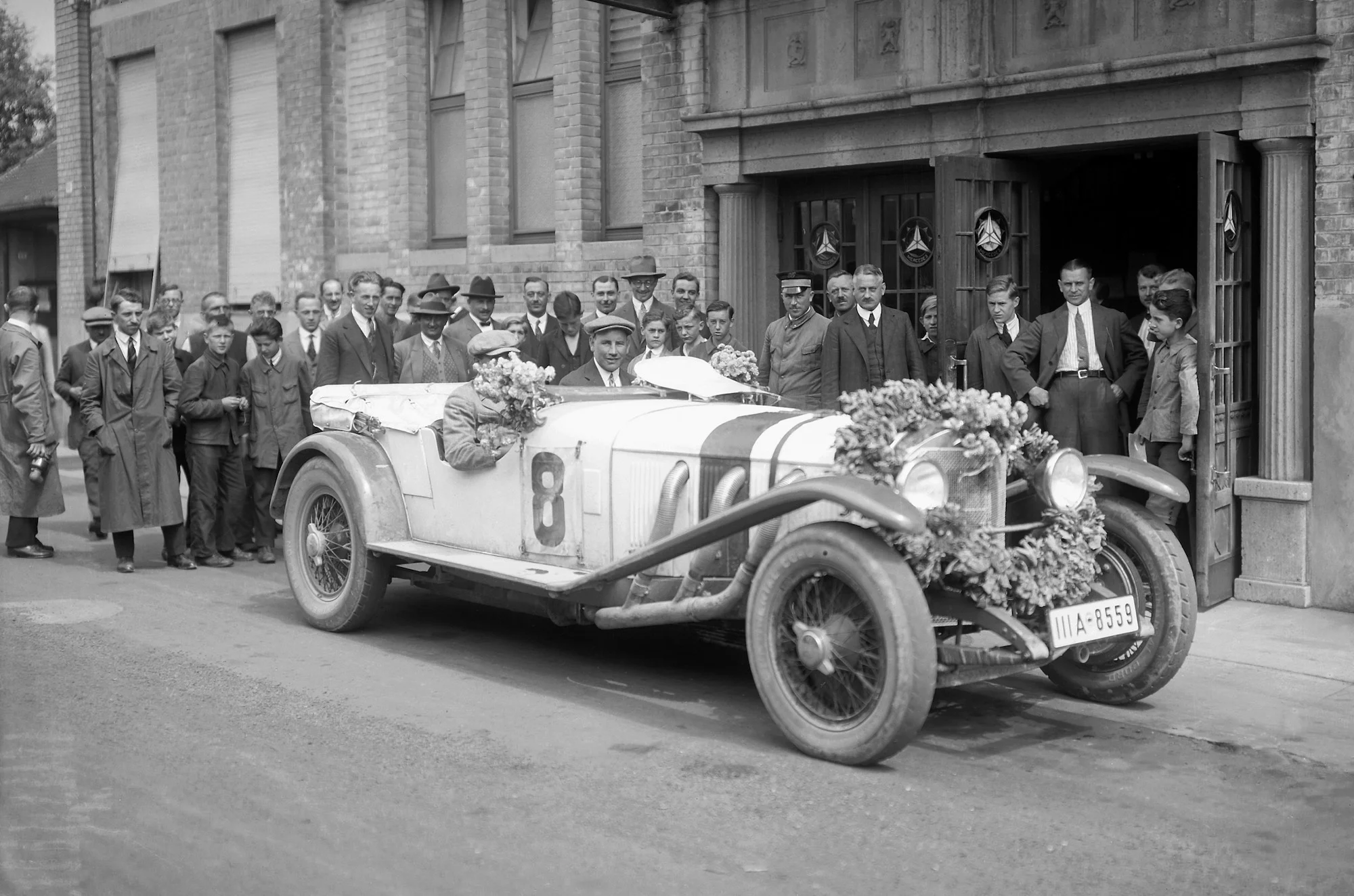
That monumental solution was the Nürburgring, a vast architectural marvel explicitly constructed to ensure the Eifelrennen could survive. In June 1927, the Eifelrennen proudly served as the inaugural meeting for this colossal 28.265 km (17.563 miles) track, which organically combined the daunting Nordschleife and the twisting Südschleife. The demanding new circuit forced drivers into a rhythm of ceaseless gear changes and heavy braking, filling the cockpits with the acrid stench of carbonised brake linings. It was here that the legendary Rudolf Caracciola, muscling a towering Mercedes-Benz Model S, conquered the official 172 corners to win the sports car race outright. Averaging 96.5 km/h (60.0 mph) over 12 punishing laps, Caracciola inaugurated a terrifyingly fast new epoch and cemented his status as the first true master of the mountain.
The mythology of the Eifelrennen arguably reached its absolute zenith in 1934, though history and legend have heavily blurred the facts. For decades, lore dictated that the draconian 750 kg (1653 lbs) maximum weight limit forced Mercedes-Benz team manager Alfred Neubauer to order his exhausted mechanics to sand away the white lead-based paint of the new W25 overnight, shedding a single excess kilogram to pass scrutineering. In reality, modern automotive historians regard this midnight drama as a paddock fabrication birthed from Neubauer’s highly embellished 1958 autobiography. The 1934 Eifelrennen was actually run under ‘Formula Libre’ regulations to attract a larger grid, meaning absolutely no maximum weight limit applied to this specific event. The cars were almost certainly designed and intended to run in bare aluminium to save weight long before they reached the Eifel mountains. Regardless of the myth’s veracity, Manfred von Brauchitsch drove the 354 hp (264 kW) machine with brutal precision to claim a resounding victory. Mesmerised by the sight of unpainted metal flashing through the pine trees, the press forever immortalised these machines as the “Silberpfeile”, or Silver Arrows.
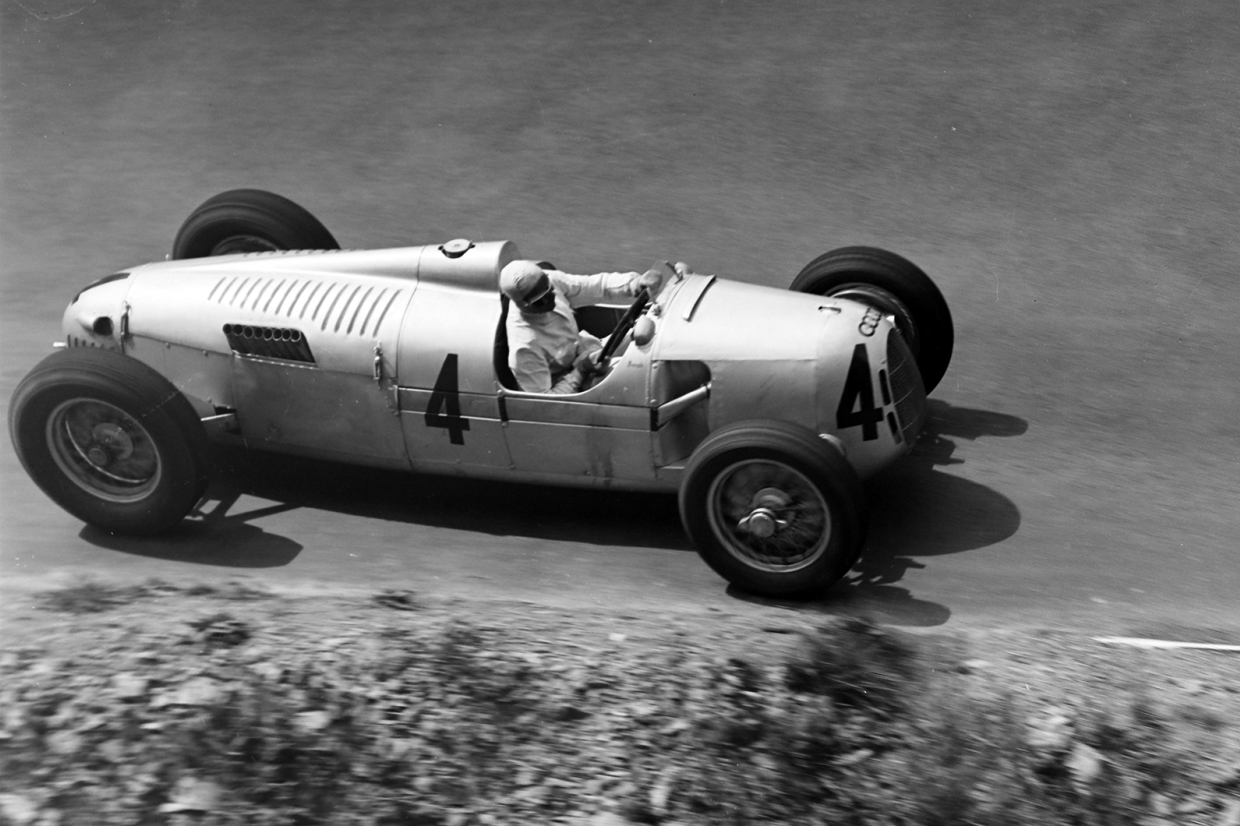
The unpredictable Eifel weather remained the greatest adversary, and in 1936, it delivered a suffocating meteorological nightmare. A dense, impenetrable fog swallowed the Nordschleife whole, dropping visibility to a matter of metres and leaving drivers staring blankly through their aero-screens. While seasoned veterans naturally lifted off the throttle, a young, fearless Bernd Rosemeyer did the unthinkable. Strapped into the cockpit of his mid-engined Auto Union Type C—a monstrous V16 producing 520 hp (388 kW)—Rosemeyer kept his foot pinned. Navigating almost entirely by memory and the deafening echo of his exhaust bouncing off the hedgerows, he annihilated the opposition. His supernatural car control in the blinding white wall earned him a title whispered with absolute reverence: the “Nebelmeister”, or Fog Master.
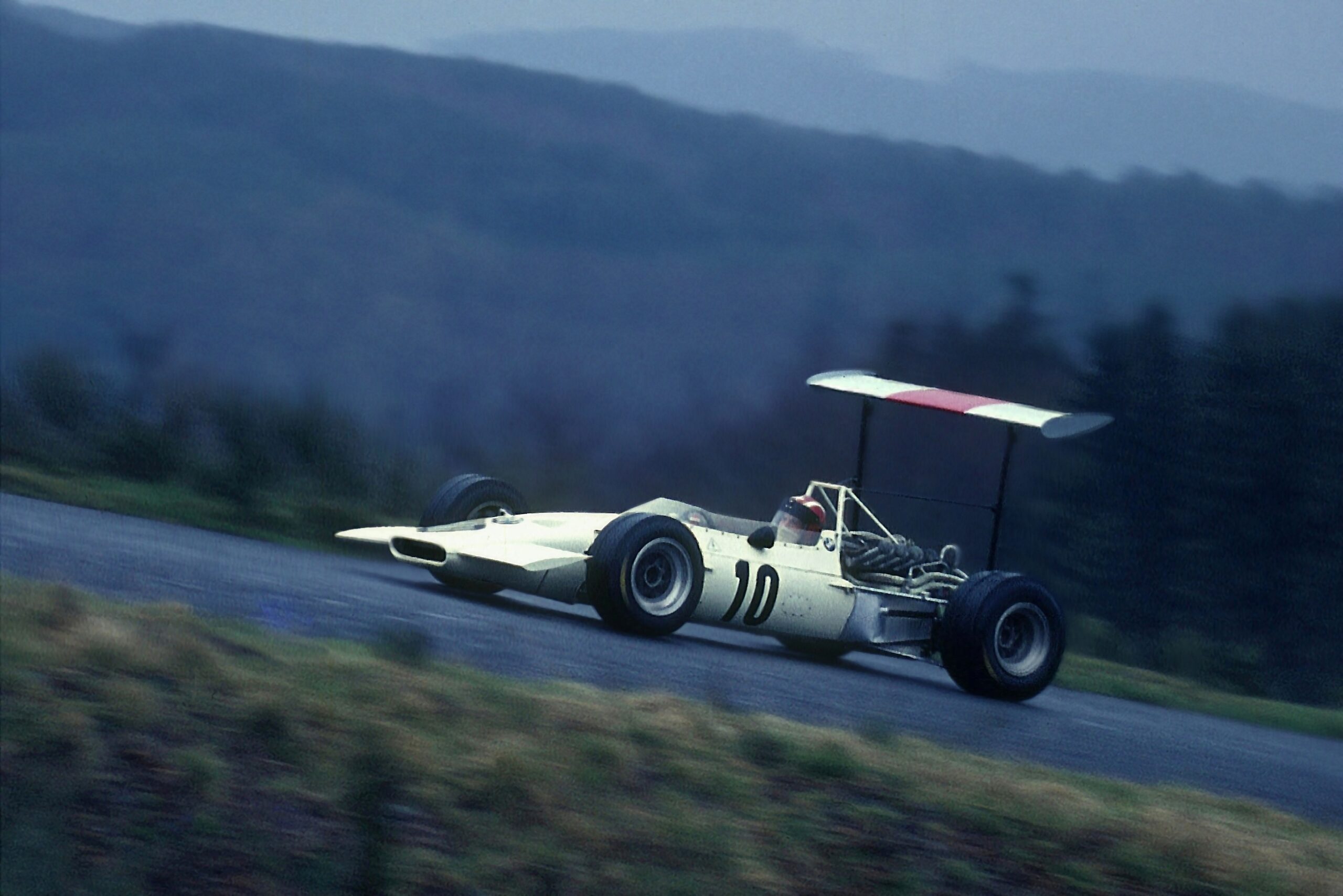
Following the devastation of the Second World War, the Eifelrennen was resurrected on 22 May 1949, with Karl Kling triumphing in a Veritas. As the decades progressed, while the German Grand Prix served as the nation’s official World Championship round, the Eifelrennen hosted highly prestigious non-championship Formula 1 races before evolving into the undisputed crown jewel of the European Formula 2 Championship. This era transformed the event into a gladiatorial arena where legendary F1 drivers arrived on their days off to engage in lethal, slipstreaming duels. The sight of maestros like Jim Clark, Jochen Rindt, and Jackie Stewart manhandling their featherweight, 1600 cc F2 chassis on the absolute ragged edge remains iconic. Launching all four wheels off the ground at the Flugplatz, their tyres screeching in protest against the abrasive tarmac, these drivers pushed mechanical grip to its very limits in a supreme display of analogue bravery.
Yet, the romance with the mountain could not outrun the relentless march of aerodynamic progress. By the early 1980s, the phenomenal downforce of Group C sports cars and modern single-seaters rendered the jumping, twisting Nordschleife grotesquely unsafe for top-tier international competition. Consequently, from 1984 onwards, the Eifelrennen was unceremoniously evicted from the Green Hell and relocated to the modern, comparatively sterile GP-Strecke. The race adapted to its sanitised confines; having already served as a cornerstone for the sensational Deutsche Rennsport Meisterschaft (DRM) during the 1970s, it now transitioned into a high-profile fixture for the fire-breathing touring cars of the DTM. The racing remained fiercely competitive, with heavily modified saloons rubbing door handles and relentlessly punishing the kerbs, yet the profound, terrifying magic of a cross-country epic had undeniably been lost.
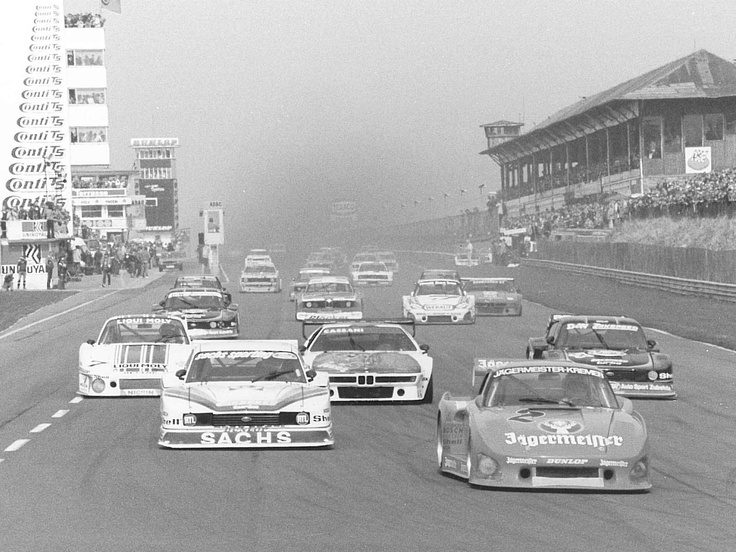
The ultimate demise of the Eifelrennen as a frontline competitive fixture was not marked by a single catastrophic tragedy, but rather by the silent, suffocating dictatorship of modern racing calendars. As the 20th century bled into the 21st, sprawling global championships strictly standardised their event formats and commercial branding. Sponsors demanded uniformity, leaving no commercial oxygen for an independent, historically named trophy to survive on its own merits. Passing gradually from top-tier single-seaters to national support series, the Eifelrennen slowly faded, finally slipping off the professional calendar entirely in 2003. Nevertheless, the soul of the race refuses to be extinguished.
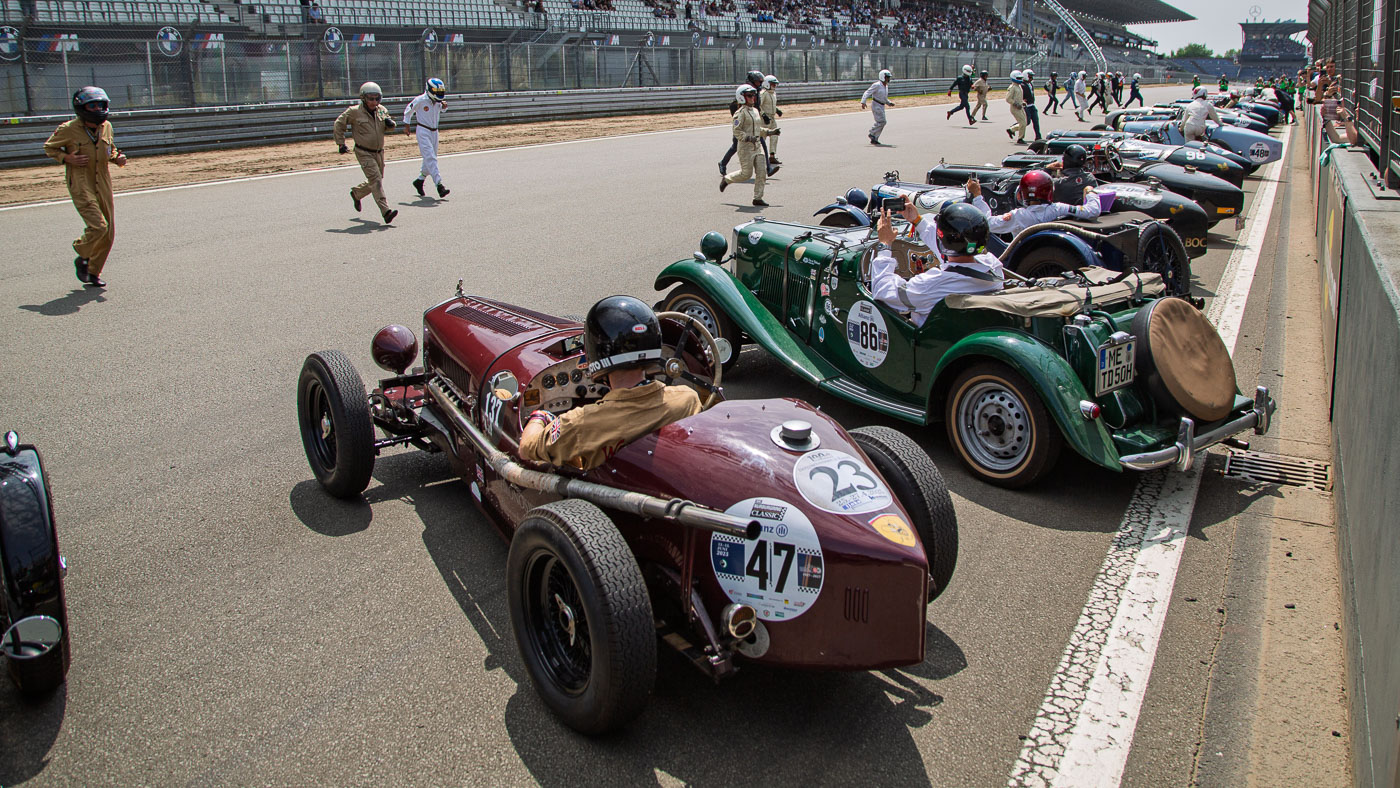
Today, the legacy survives in a beautifully nostalgic and celebratory reincarnation. Resurrected as the ADAC Eifelrennen (Nürburgring Classic), the historic name now graces one of the most vital classic motorsport festivals in Europe. Once again, the paddock is saturated with the intoxicating aroma of rich carburettor fuel, and historic grids roar away from the start line, chasing the ghosts of Caracciola, von Brauchitsch, and Rindt into the deep, echoing shadows of the Eifel forest.
Deep in the volcanic spine of the Eifel mountains, the damp air perpetually holds the scent of pine needles and mist. Long before the era of sanitised pit lanes, this unforgiving topography gave life to a visceral spectacle that altered European motorsport forever: the ADAC Eifelrennen. Organised by the German automobile club, this was not a sterile, modern Grand Prix restricted to a single class, but rather a riotous, full-blooded festival of speed. On the very same weekend, the paddock throbbed with a mechanical symphony as fragile motorcycles, roaring touring cars, bespoke sports prototypes, and single-seaters all vied for glory. The sheer physical toll of wrestling these rudimentary machines through the forests, battling visual exhaustion against the low morning sun and the terrifying proximity of stone walls, defined a romantic, reckless era of racing. Crucially, the Eifelrennen was the primal catalyst that forced the creation of the most feared ribbon of tarmac on earth: the Nürburgring.
The genesis of this epic lay in the treacherous dust of 1922. The inaugural Eifelrennen did not enjoy the luxury of a closed circuit; instead, it terrorised the rural landscape on a 33.2 km (20.6 miles) loop of unpaved, deeply rutted public roads around the town of Nideggen. Competitors faced an apocalyptic gauntlet featuring 86 treacherous bends, brutal elevation changes totalling over 265 m (869 ft), and sheer precipices waiting to punish the slightest lapse in concentration. Despite the biblical clouds of dust and the terror of navigating narrow villages flat-out, the spectacle drew an astonishing 40,000 spectators. Yet, the raw speed of the advancing machinery quickly exposed the lethal inadequacy of these public dirt roads. The event proved far too perilous, prompting a government mandate to establish a dedicated, isolated proving ground to save the lives of both drivers and villagers.
That monumental solution was the Nürburgring, a vast architectural marvel explicitly constructed to ensure the Eifelrennen could survive. In June 1927, the Eifelrennen proudly served as the inaugural meeting for this colossal 28.265 km (17.563 miles) track, which organically combined the daunting Nordschleife and the twisting Südschleife. The demanding new circuit forced drivers into a rhythm of ceaseless gear changes and heavy braking, filling the cockpits with the acrid stench of carbonised brake linings. It was here that the legendary Rudolf Caracciola, muscling a towering Mercedes-Benz Model S, conquered the official 172 corners to win the sports car race outright. Averaging 96.5 km/h (60.0 mph) over 12 punishing laps, Caracciola inaugurated a terrifyingly fast new epoch and cemented his status as the first true master of the mountain.
The mythology of the Eifelrennen arguably reached its absolute zenith in 1934, though history and legend have heavily blurred the facts. For decades, lore dictated that the draconian 750 kg (1653 lbs) maximum weight limit forced Mercedes-Benz team manager Alfred Neubauer to order his exhausted mechanics to sand away the white lead-based paint of the new W25 overnight, shedding a single excess kilogram to pass scrutineering. In reality, modern automotive historians regard this midnight drama as a paddock fabrication birthed from Neubauer’s highly embellished 1958 autobiography. The 1934 Eifelrennen was actually run under ‘Formula Libre’ regulations to attract a larger grid, meaning absolutely no maximum weight limit applied to this specific event. The cars were almost certainly designed and intended to run in bare aluminium to save weight long before they reached the Eifel mountains. Regardless of the myth’s veracity, Manfred von Brauchitsch drove the 354 hp (264 kW) machine with brutal precision to claim a resounding victory. Mesmerised by the sight of unpainted metal flashing through the pine trees, the press forever immortalised these machines as the “Silberpfeile”, or Silver Arrows.
The unpredictable Eifel weather remained the greatest adversary, and in 1936, it delivered a suffocating meteorological nightmare. A dense, impenetrable fog swallowed the Nordschleife whole, dropping visibility to a matter of metres and leaving drivers staring blankly through their aero-screens. While seasoned veterans naturally lifted off the throttle, a young, fearless Bernd Rosemeyer did the unthinkable. Strapped into the cockpit of his mid-engined Auto Union Type C—a monstrous V16 producing 520 hp (388 kW)—Rosemeyer kept his foot pinned. Navigating almost entirely by memory and the deafening echo of his exhaust bouncing off the hedgerows, he annihilated the opposition. His supernatural car control in the blinding white wall earned him a title whispered with absolute reverence: the “Nebelmeister”, or Fog Master.
Following the devastation of the Second World War, the Eifelrennen was resurrected on 22 May 1949, with Karl Kling triumphing in a Veritas. As the decades progressed, while the German Grand Prix served as the nation’s official World Championship round, the Eifelrennen hosted highly prestigious non-championship Formula 1 races before evolving into the undisputed crown jewel of the European Formula 2 Championship. This era transformed the event into a gladiatorial arena where legendary F1 drivers arrived on their days off to engage in lethal, slipstreaming duels. The sight of maestros like Jim Clark, Jochen Rindt, and Jackie Stewart manhandling their featherweight, 1600 cc F2 chassis on the absolute ragged edge remains iconic. Launching all four wheels off the ground at the Flugplatz, their tyres screeching in protest against the abrasive tarmac, these drivers pushed mechanical grip to its very limits in a supreme display of analogue bravery.
Yet, the romance with the mountain could not outrun the relentless march of aerodynamic progress. By the early 1980s, the phenomenal downforce of Group C sports cars and modern single-seaters rendered the jumping, twisting Nordschleife grotesquely unsafe for top-tier international competition. Consequently, from 1984 onwards, the Eifelrennen was unceremoniously evicted from the Green Hell and relocated to the modern, comparatively sterile GP-Strecke. The race adapted to its sanitised confines; having already served as a cornerstone for the sensational Deutsche Rennsport Meisterschaft (DRM) during the 1970s, it now transitioned into a high-profile fixture for the fire-breathing touring cars of the DTM. The racing remained fiercely competitive, with heavily modified saloons rubbing door handles and relentlessly punishing the kerbs, yet the profound, terrifying magic of a cross-country epic had undeniably been lost.
The ultimate demise of the Eifelrennen as a frontline competitive fixture was not marked by a single catastrophic tragedy, but rather by the silent, suffocating dictatorship of modern racing calendars. As the 20th century bled into the 21st, sprawling global championships strictly standardised their event formats and commercial branding. Sponsors demanded uniformity, leaving no commercial oxygen for an independent, historically named trophy to survive on its own merits. Passing gradually from top-tier single-seaters to national support series, the Eifelrennen slowly faded, finally slipping off the professional calendar entirely in 2003. Nevertheless, the soul of the race refuses to be extinguished.
Today, the legacy survives in a beautifully nostalgic and celebratory reincarnation. Resurrected as the ADAC Eifelrennen (Nürburgring Classic), the historic name now graces one of the most vital classic motorsport festivals in Europe. Once again, the paddock is saturated with the intoxicating aroma of rich carburettor fuel, and historic grids roar away from the start line, chasing the ghosts of Caracciola, von Brauchitsch, and Rindt into the deep, echoing shadows of the Eifel forest.