• Light
    Dark
    Light
    Dark
Skip to content
Monotuerca Monotuerca
  • Brands
  • Vehicles
  • Events
  • About us
  • Contact
  • Brands
  • Vehicles
  • Events
  • About us
  • Contact

© 2026 Monotuerca. All rights reserved

Cookie Policy | Privacy Policy | Terms and Conditions | FAQs | Shipping Information | Refund and Returns Policy

  • 0.00€ 0
    Cart review
    No products in the cart.
Monotuerca
/
Nürburgring

Nürburgring

Country

Germany

Location

Nürburg

Type

Permanent road course

First race

1927

Layouts

19

Track Overview

Deep within the damp, brooding forests of the Eifel mountains, the air hangs heavy with an intoxicating cocktail of vaporised brake pads, rich exhaust fumes, and crushed pine needles. The Nürburgring is no mere ribbon of tarmac; it is a living, breathing beast that has consumed the unprepared and immortalised the brave. Born from desperation, the circuit owes its existence to the severe economic depression that gripped the rural Eifel region following the First World War. In the early 1920s, a visionary local district administrator named Dr Otto Creutz proposed a colossal infrastructure project. With crucial backing from figures like Konrad Adenauer, Creutz sought to generate thousands of jobs and simultaneously replace the perilous Eifelrennen, which were previously contested on deadly public roads, with a dedicated, closed-course marvel.

Construction commenced in 1925 under the architectural direction of Gustav Eichler, employing some 2,500 labourers to carve a bespoke, grade-separated mountain circuit out of the ancient woodlands. What emerged was an ecosystem of speed that can be divided into five defining configurations. The original leviathan was the Gesamtstrecke, a 28.26 km (17.56 miles) track that seamlessly united the two main loops. The primary artery was the Nordschleife, or northern loop, measuring a punishing 22.8 km (14.1 miles) with over 70 corners. Its lesser-known sibling, the Südschleife, was a 7.7 km (4.8 miles) southern loop. Decades later, safety demands would birth the GP-Strecke, a modern 4.5 km (2.8 miles) Grand Prix circuit built in the 1980s, which is now routinely joined with the northern loop to create the Combined Layout, a monstrous 25.37 km (15.76 miles) endurance test.

When the mammoth 28.26 km (17.56 miles) Gesamtstrecke officially opened in June 1927, the inaugural sports car race was appropriately won by the formidable Rudolf Caracciola in a supercharged Mercedes-Benz S. However, the sheer scale of the combined circuit quickly proved utterly unmanageable for contemporary racing. The immense distances stretched medical assistance beyond reason, made the jobs of the track marshals virtually impossible, and left spectators waiting interminably in the grandstands for the cars to return. By the early 1930s, the organisers separated the tracks, relegating the Südschleife to minor national events and motorcycles, while the Nordschleife became the undisputed crucible of the German Grand Prix.

It was upon this northern loop, in 1935, that pre-war motorsport witnessed absolute perfection. Before a crowd of 300,000 spectators and the expectant hierarchy of the Nazi regime, nine mighty German Silver Arrows from Mercedes-Benz and Auto Union lined up to dominate their home soil. Yet, it was the Italian maestro Tazio Nuvolari, wrestling an ageing, underpowered Alfa Romeo P3, who drove with supernatural precision. Overcoming a calamitous two-minute delay in the pits, Nuvolari chased down the vastly superior German machinery and snatched an impossible victory on the final lap, leaving the grandstands in a state of stunned silence.

The post-war era ushered the Nordschleife into the Formula One World Championship, forging its reputation as the purest and most bloodthirsty arena in racing. It was here that Juan Manuel Fangio delivered his magnum opus in 1957. At 46 years old, driving a Maserati 250F, the Argentine suffered a disastrous pit stop that left him nearly a minute adrift of the leading Ferraris. Pushing beyond the known boundaries of physics, Fangio shattered the lap record nine consecutive times, hunting down his rivals to take the lead on the penultimate lap and secure his fifth World Championship. A decade later, the circuit’s mythical aura was permanently cemented. During the 1968 German Grand Prix, amidst a torrential storm and thick fog that barely allowed drivers to see beyond the bonnet of their cars, the Scottish virtuoso Jackie Stewart claimed victory by an astonishing margin of four minutes. Astounded by the claustrophobic terror of the dark Eifel woods, Stewart is universally credited with christening the track with its eternal moniker: the “Green Hell”. Though motorsport lore inextricably binds this title to his 1968 masterclass, no definitive contemporary written or audio record exists of him uttering the phrase that exact weekend, lending a fittingly mythological aura to its coinage.

To endure a lap of the Nordschleife is to submit to a brutal physical and psychological assault. The track features a staggering elevation change of approximately 300 m (984 ft), dropping from the windswept heights of Hohe Acht to the deep, shadowed valley at Breidscheid. The journey is punctuated by corners that command absolute reverence. The descent through the Fuchsröhre is a terrifying plunge into a dark funnel, where the violent compression at the bottom threatens to force the suspension straight through the aluminium chassis. Then there is the mythical Caracciola-Karussell. Since the 1930s, drivers have dropped their inside tyres into the rough, heavily scarred concrete slabs of a former drainage ditch, allowing centrifugal force to violently slingshot the car around the blind 180-degree hairpin. For sheer mechanical torture, engineers historically utilised the Steilstrecke, an abandoned straight cutting through the forest that features a staggering 27% gradient, originally designed to evaluate the limits of carburettors and handbrakes.

By the early 1970s, the aerodynamic evolution of Formula 1 cars rendered the tree-lined circuit lethally obsolete. The machines were simply too fast to fly inches from the timber. Led by Stewart, the drivers boycotted the circuit in 1970, forcing a massive safety upgrade that resulted in the continuous installation of triple-tier Armco barriers around the 22.8 km perimeter. While rudimentary metal fencing and thick hedges had previously shielded the most perilous bridges and pit areas, this was the first comprehensive steel armouring of the forest. Yet, the sheer brutality of the circuit could not be tamed by steel alone. During the 1976 race, the inevitable tragedy struck. Niki Lauda lost control at the fast kink before Bergwerk, his Ferrari bursting into a fiery inferno against the fencing. Though Lauda miraculously survived, that horrific incident ultimately sealed the fate of the Nordschleife. Formula 1 would never again race through the old woods.

To reclaim its position on the global stage, a highly sanitised, modern facility was required. In 1982, the bulldozers arrived, unceremoniously demolishing the Start-und-Ziel-Schleife and the northern connection points of the obsolete Südschleife. The vast majority of the 7.7 km (4.8 miles) southern loop was not crushed by machinery, but simply severed and abandoned to rot in the forest. Upon this scarred earth rose the GP-Strecke, inaugurated in 1984 with the famed Race of Champions. Pitting a grid of Formula 1 legends against one another, the event was contested in identical Mercedes-Benz 190E 2.3-16 saloons. Though visually stock, these machines were meticulously race-prepped by engineer Gerhard Lepler, featuring bolt-in roll cages, Recaro racing bucket seats, a shortened final drive ratio for sharper acceleration, stiffer suspension, wider Pirelli racing tyres, and modified exhausts. The race was won by a fiercely talented, relatively unknown Brazilian named Ayrton Senna, who thoroughly humbled the established elite, including Lauda. Yet, just before the modern era took hold, the old Nordschleife witnessed the ultimate lap. During the 1983 1000 km of Nürburgring, the fearless German driver Stefan Bellof wrestled his ground-effect Porsche 956 around the 20.8 km (12.9 miles) layout in an unfathomable 6:11.13. That suicidal, millimetre-perfect run stood as the absolute track record for 35 years, only broken in 2018 when Porsche unleashed the unrestricted 919 Evo prototype to finally shatter the ghostly benchmark.

Today, the entire complex exists in a state of fascinating duality, acting as both a graveyard and the epicentre of the motoring world. The Südschleife remains the only true ghost track. With its surviving ribbons of asphalt now cracked, heavily coated in moss, and slowly being devoured by the creeping forest, these silent, melancholy paths are used as secondary local roads or forestry access routes, serving as a sanctuary for urban explorers tracing the forgotten racing lines. Conversely, the Nordschleife has evolved into the ultimate high-stakes laboratory for the global automotive industry. From Monday to Friday, the secretive T13 complex bustles with engineers from marques like Porsche, BMW, and Ferrari. They wage a relentless, covert war to set production-car lap records, proving that a blistering time around the Green Hell is the most potent marketing currency in the modern sports car market. For endurance racing, the organisers boldly reconnected the modern GP-Strecke with the ancient Nordschleife, creating the Combined Layout. This 25.3 km (15.7 miles) behemoth hosts the legendary 24 Hours of Nürburgring, where over 130 cars battle simultaneously through the night, surrounded by a chaotic, smoke-filled festival of motorsport.

However, the most captivating aspect of the Nürburgring’s modern existence is the Touristenfahrten. On evenings and weekends, the Nordschleife functions legally as a one-way public toll road. Anyone with a valid driving licence can tap a card at the barrier and unleash their personal car, motorcycle, or even a lumbering caravan onto the hallowed tarmac. The rules of the German StVO (road traffic regulations) strictly apply, meaning that overtaking on the right is absolutely prohibited. While largely derestricted like rural stretches of the Autobahn, strict speed limits are heavily enforced in specific safety and noise-control zones, dropping to 50 km/h (31 mph) at the Breidscheid exit and on the Döttinger Höhe approach to the toll gates. As ordinary drivers navigate the blind crests, smelling their brakes overheat and feeling the terrifying proximity of the kerbs and barriers, they understand the true nature of this place. They learn first-hand why the asphalt of the Eifel mountains, forged in the fires of the 1920s and stained with the blood of legends, will forever remain the undisputed mecca of world motorsport.

Read more

Country

Germany

Location

Nürburg

Type

Permanent road course

First race

1927

Layouts

19

Country

Germany

Location

Nürburg

Type

Permanent road course

First race

1927

Layouts

19

Track Overview

Deep within the damp, brooding forests of the Eifel mountains, the air hangs heavy with an intoxicating cocktail of vaporised brake pads, rich exhaust fumes, and crushed pine needles. The Nürburgring is no mere ribbon of tarmac; it is a living, breathing beast that has consumed the unprepared and immortalised the brave. Born from desperation, the circuit owes its existence to the severe economic depression that gripped the rural Eifel region following the First World War. In the early 1920s, a visionary local district administrator named Dr Otto Creutz proposed a colossal infrastructure project. With crucial backing from figures like Konrad Adenauer, Creutz sought to generate thousands of jobs and simultaneously replace the perilous Eifelrennen, which were previously contested on deadly public roads, with a dedicated, closed-course marvel.

Construction commenced in 1925 under the architectural direction of Gustav Eichler, employing some 2,500 labourers to carve a bespoke, grade-separated mountain circuit out of the ancient woodlands. What emerged was an ecosystem of speed that can be divided into five defining configurations. The original leviathan was the Gesamtstrecke, a 28.26 km (17.56 miles) track that seamlessly united the two main loops. The primary artery was the Nordschleife, or northern loop, measuring a punishing 22.8 km (14.1 miles) with over 70 corners. Its lesser-known sibling, the Südschleife, was a 7.7 km (4.8 miles) southern loop. Decades later, safety demands would birth the GP-Strecke, a modern 4.5 km (2.8 miles) Grand Prix circuit built in the 1980s, which is now routinely joined with the northern loop to create the Combined Layout, a monstrous 25.37 km (15.76 miles) endurance test.

When the mammoth 28.26 km (17.56 miles) Gesamtstrecke officially opened in June 1927, the inaugural sports car race was appropriately won by the formidable Rudolf Caracciola in a supercharged Mercedes-Benz S. However, the sheer scale of the combined circuit quickly proved utterly unmanageable for contemporary racing. The immense distances stretched medical assistance beyond reason, made the jobs of the track marshals virtually impossible, and left spectators waiting interminably in the grandstands for the cars to return. By the early 1930s, the organisers separated the tracks, relegating the Südschleife to minor national events and motorcycles, while the Nordschleife became the undisputed crucible of the German Grand Prix.

It was upon this northern loop, in 1935, that pre-war motorsport witnessed absolute perfection. Before a crowd of 300,000 spectators and the expectant hierarchy of the Nazi regime, nine mighty German Silver Arrows from Mercedes-Benz and Auto Union lined up to dominate their home soil. Yet, it was the Italian maestro Tazio Nuvolari, wrestling an ageing, underpowered Alfa Romeo P3, who drove with supernatural precision. Overcoming a calamitous two-minute delay in the pits, Nuvolari chased down the vastly superior German machinery and snatched an impossible victory on the final lap, leaving the grandstands in a state of stunned silence.

The post-war era ushered the Nordschleife into the Formula One World Championship, forging its reputation as the purest and most bloodthirsty arena in racing. It was here that Juan Manuel Fangio delivered his magnum opus in 1957. At 46 years old, driving a Maserati 250F, the Argentine suffered a disastrous pit stop that left him nearly a minute adrift of the leading Ferraris. Pushing beyond the known boundaries of physics, Fangio shattered the lap record nine consecutive times, hunting down his rivals to take the lead on the penultimate lap and secure his fifth World Championship. A decade later, the circuit’s mythical aura was permanently cemented. During the 1968 German Grand Prix, amidst a torrential storm and thick fog that barely allowed drivers to see beyond the bonnet of their cars, the Scottish virtuoso Jackie Stewart claimed victory by an astonishing margin of four minutes. Astounded by the claustrophobic terror of the dark Eifel woods, Stewart is universally credited with christening the track with its eternal moniker: the “Green Hell”. Though motorsport lore inextricably binds this title to his 1968 masterclass, no definitive contemporary written or audio record exists of him uttering the phrase that exact weekend, lending a fittingly mythological aura to its coinage.

To endure a lap of the Nordschleife is to submit to a brutal physical and psychological assault. The track features a staggering elevation change of approximately 300 m (984 ft), dropping from the windswept heights of Hohe Acht to the deep, shadowed valley at Breidscheid. The journey is punctuated by corners that command absolute reverence. The descent through the Fuchsröhre is a terrifying plunge into a dark funnel, where the violent compression at the bottom threatens to force the suspension straight through the aluminium chassis. Then there is the mythical Caracciola-Karussell. Since the 1930s, drivers have dropped their inside tyres into the rough, heavily scarred concrete slabs of a former drainage ditch, allowing centrifugal force to violently slingshot the car around the blind 180-degree hairpin. For sheer mechanical torture, engineers historically utilised the Steilstrecke, an abandoned straight cutting through the forest that features a staggering 27% gradient, originally designed to evaluate the limits of carburettors and handbrakes.

By the early 1970s, the aerodynamic evolution of Formula 1 cars rendered the tree-lined circuit lethally obsolete. The machines were simply too fast to fly inches from the timber. Led by Stewart, the drivers boycotted the circuit in 1970, forcing a massive safety upgrade that resulted in the continuous installation of triple-tier Armco barriers around the 22.8 km perimeter. While rudimentary metal fencing and thick hedges had previously shielded the most perilous bridges and pit areas, this was the first comprehensive steel armouring of the forest. Yet, the sheer brutality of the circuit could not be tamed by steel alone. During the 1976 race, the inevitable tragedy struck. Niki Lauda lost control at the fast kink before Bergwerk, his Ferrari bursting into a fiery inferno against the fencing. Though Lauda miraculously survived, that horrific incident ultimately sealed the fate of the Nordschleife. Formula 1 would never again race through the old woods.

To reclaim its position on the global stage, a highly sanitised, modern facility was required. In 1982, the bulldozers arrived, unceremoniously demolishing the Start-und-Ziel-Schleife and the northern connection points of the obsolete Südschleife. The vast majority of the 7.7 km (4.8 miles) southern loop was not crushed by machinery, but simply severed and abandoned to rot in the forest. Upon this scarred earth rose the GP-Strecke, inaugurated in 1984 with the famed Race of Champions. Pitting a grid of Formula 1 legends against one another, the event was contested in identical Mercedes-Benz 190E 2.3-16 saloons. Though visually stock, these machines were meticulously race-prepped by engineer Gerhard Lepler, featuring bolt-in roll cages, Recaro racing bucket seats, a shortened final drive ratio for sharper acceleration, stiffer suspension, wider Pirelli racing tyres, and modified exhausts. The race was won by a fiercely talented, relatively unknown Brazilian named Ayrton Senna, who thoroughly humbled the established elite, including Lauda. Yet, just before the modern era took hold, the old Nordschleife witnessed the ultimate lap. During the 1983 1000 km of Nürburgring, the fearless German driver Stefan Bellof wrestled his ground-effect Porsche 956 around the 20.8 km (12.9 miles) layout in an unfathomable 6:11.13. That suicidal, millimetre-perfect run stood as the absolute track record for 35 years, only broken in 2018 when Porsche unleashed the unrestricted 919 Evo prototype to finally shatter the ghostly benchmark.

Today, the entire complex exists in a state of fascinating duality, acting as both a graveyard and the epicentre of the motoring world. The Südschleife remains the only true ghost track. With its surviving ribbons of asphalt now cracked, heavily coated in moss, and slowly being devoured by the creeping forest, these silent, melancholy paths are used as secondary local roads or forestry access routes, serving as a sanctuary for urban explorers tracing the forgotten racing lines. Conversely, the Nordschleife has evolved into the ultimate high-stakes laboratory for the global automotive industry. From Monday to Friday, the secretive T13 complex bustles with engineers from marques like Porsche, BMW, and Ferrari. They wage a relentless, covert war to set production-car lap records, proving that a blistering time around the Green Hell is the most potent marketing currency in the modern sports car market. For endurance racing, the organisers boldly reconnected the modern GP-Strecke with the ancient Nordschleife, creating the Combined Layout. This 25.3 km (15.7 miles) behemoth hosts the legendary 24 Hours of Nürburgring, where over 130 cars battle simultaneously through the night, surrounded by a chaotic, smoke-filled festival of motorsport.

However, the most captivating aspect of the Nürburgring’s modern existence is the Touristenfahrten. On evenings and weekends, the Nordschleife functions legally as a one-way public toll road. Anyone with a valid driving licence can tap a card at the barrier and unleash their personal car, motorcycle, or even a lumbering caravan onto the hallowed tarmac. The rules of the German StVO (road traffic regulations) strictly apply, meaning that overtaking on the right is absolutely prohibited. While largely derestricted like rural stretches of the Autobahn, strict speed limits are heavily enforced in specific safety and noise-control zones, dropping to 50 km/h (31 mph) at the Breidscheid exit and on the Döttinger Höhe approach to the toll gates. As ordinary drivers navigate the blind crests, smelling their brakes overheat and feeling the terrifying proximity of the kerbs and barriers, they understand the true nature of this place. They learn first-hand why the asphalt of the Eifel mountains, forged in the fires of the 1920s and stained with the blood of legends, will forever remain the undisputed mecca of world motorsport.

Read more
Gallery not found.

Editions

Race Editions List

Submodels

All Variants

See All
No vehicles have been published for this brand yet
Load more

Layouts

Track layouts

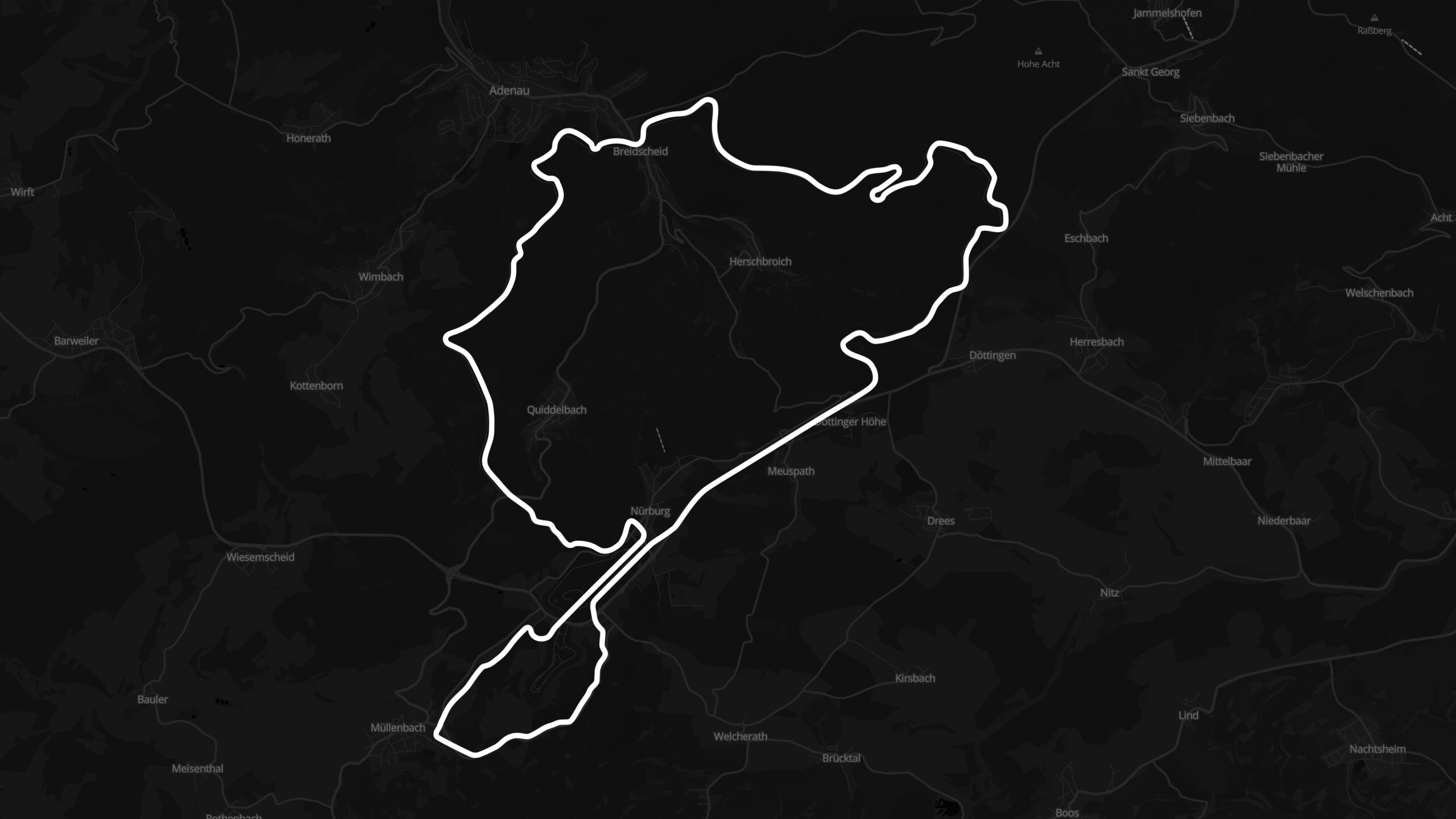
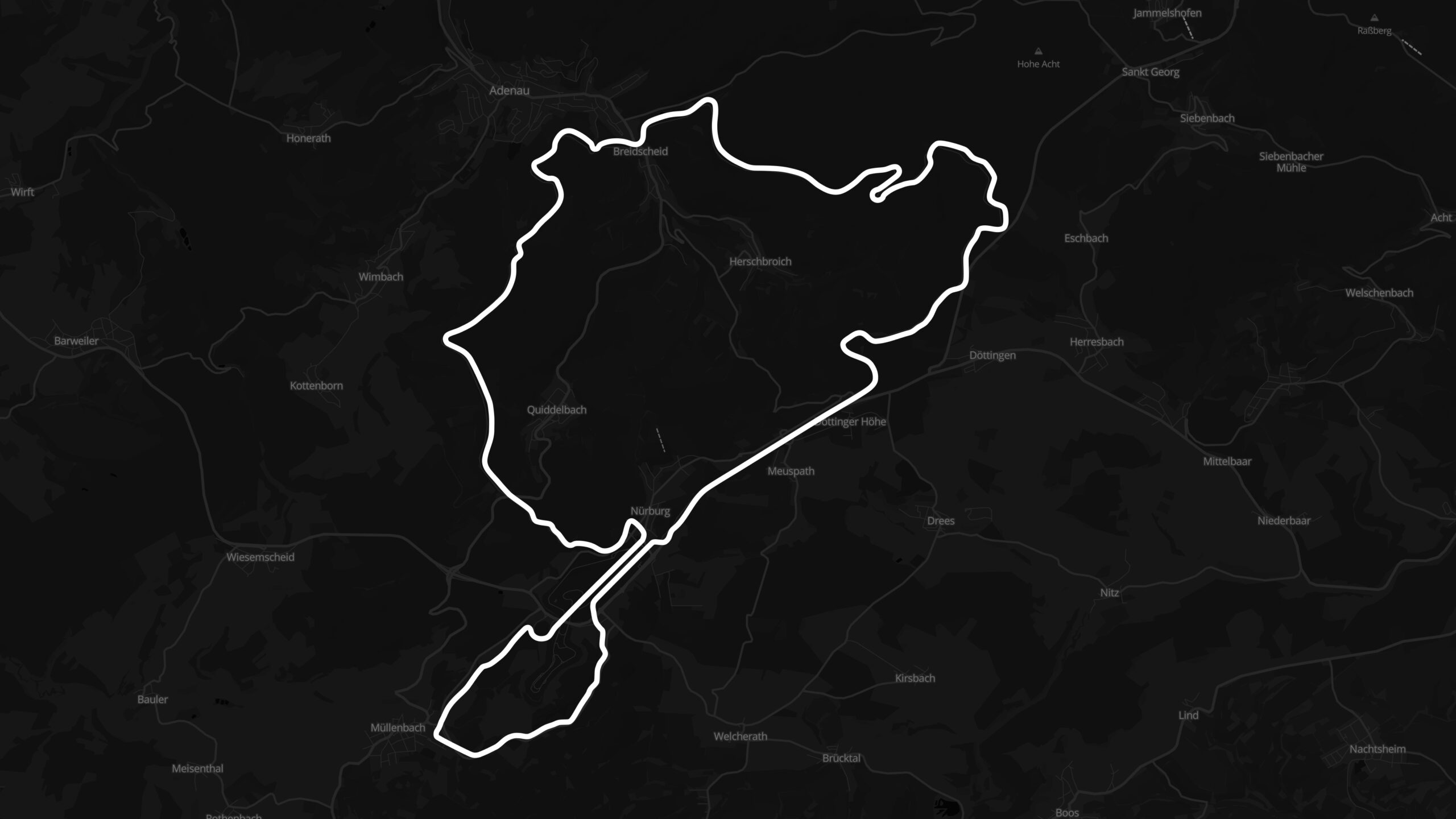
Nordschleife

1927 Nürburgring Nordschleife

22.81 km / 14.17 mi

+ 70 corners
Clockwise
Permanent road track
1927 Nordschleiffe scaled
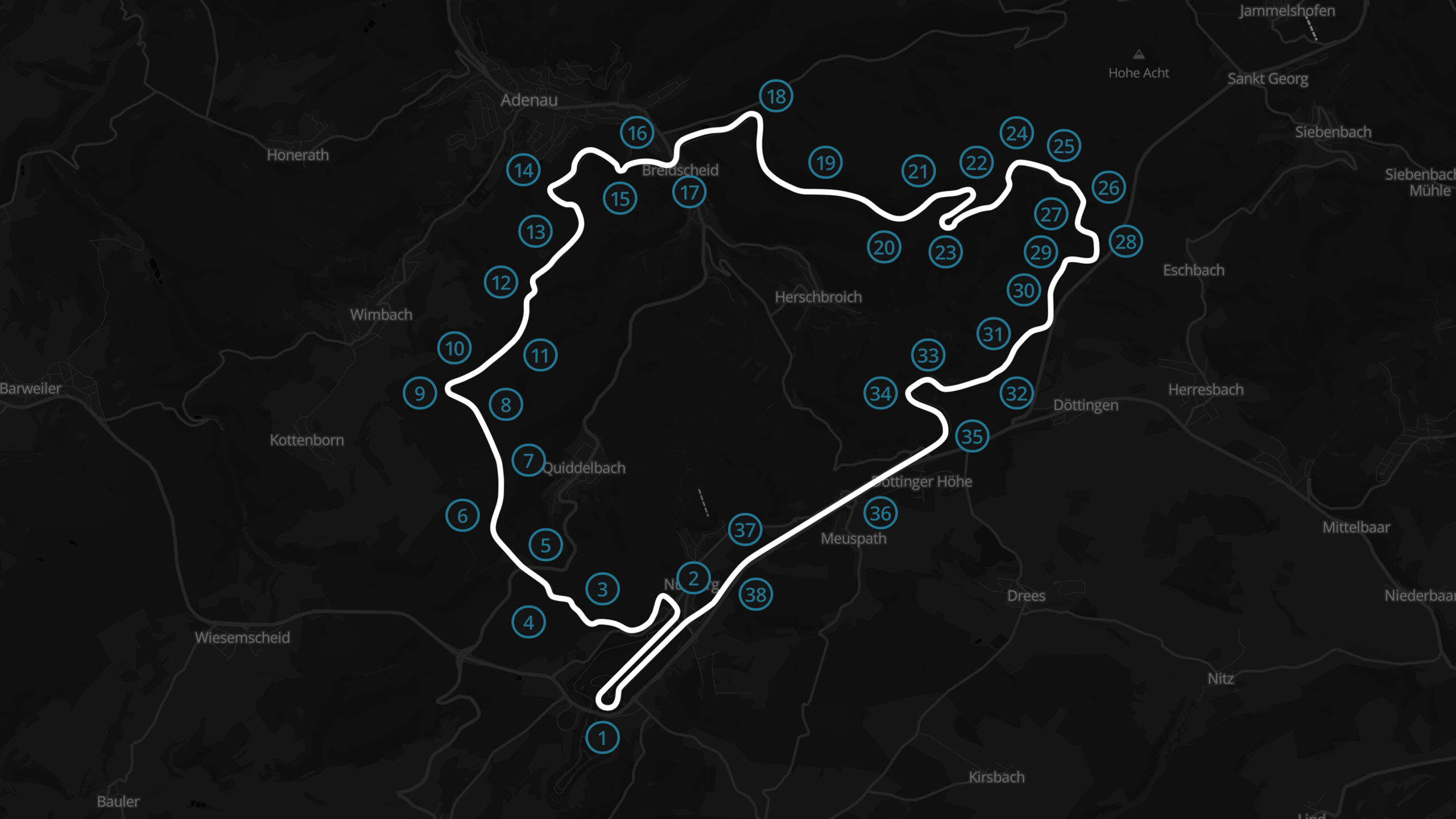
1927 Nordschleife
1

Süd kehre

2

Nord kehre

3

Hatzenbach

4

Hoheneichen

5

Quiddelbacher-Höhe

6

Flugplatz

7

Kottenborn

8

Schwedenkreuz

9

Aremberg

10

Poststraße

11

Fuchsröhre

12

Adenauer Forst

13

Metzgesfeld

14

Kallenhard

15

Wehrseifen

16

Exmühle

17

Ausfahrt Breidscheid

18

Bergwerk

19

Kesselchen

20

Mutkurve

21

Klostertal

22

Steilstrecke

23

Karussell

24

Hohe Acht

25

Hedwigshöhe

26

Wippermann

27

Eschbach

28

Brünnchen

29

Eiskurve

30

Pflanzgarten I

31

Sprunghügel

32

Pflanzgarten II

33

Schwalbenschwanz

34

Kleines Karussell

35

Galgenkopf

36

Döttinger Höhe

37

Antoniusbuche

38

Tiergarten

The original Nordschleife stretched an imposing 22.81 km (14.17 miles) through the Eifel mountains. This fearsome, narrow ribbon of tarmac featured over 170 corners, dramatic elevation changes, and minimal safety infrastructure. Drivers navigated tight hairpin bends, blind crests, and the vast Döttinger Höhe straight bordered only by hedgerows and steep drops. Iconic sections like the steeply banked Karussell and the airborne leaps at Flugplatz established its reputation as a punishing crucible. However, as motorsport advanced and vehicle speeds increased dramatically into the 1960s, the circuit’s rustic, unforgiving nature became perilously obsolete. The lack of run-off areas and modern barriers ultimately forced essential safety modifications, bringing an end to the track’s most primal and notoriously dangerous configuration.

1967 Nürburgring Nordschleife

22.83 km / 14.19 mi

+ 70 corners
Clockwise
Permanent road track
1927 Nordschleiffe scaled
1967 Nordschleife
1

Süd kehre

2

Nord kehre

3

Hatzenbach

4

Hoheneichen

5

Quiddelbacher-Höhe

6

Flugplatz

7

Kottenborn

8

Schwedenkreuz

9

Aremberg

10

Poststraße

11

Fuchsröhre

12

Adenauer Forst

13

Metzgesfeld

14

Kallenhard

15

Wehrseifen

16

Exmühle

17

Ausfahrt Breidscheid

18

Bergwerk

19

Kesselchen

20

Mutkurve

21

Klostertal

22

Steilstrecke

23

Karussell

24

Hohe Acht

25

Hedwigshöhe

26

Wippermann

27

Eschbach

28

Brünnchen

29

Eiskurve

30

Pflanzgarten I

31

Sprunghügel

32

Pflanzgarten II

33

Schwalbenschwanz

34

Kleines Karussell

35

Galgenkopf

36

Döttinger Höhe

37

Antoniusbuche

38

Tiergarten

39

Hohenrain

To address escalating speeds as cars approached the pit lane, a crucial modification was introduced in 1967: the Hohenrain chicane. This alteration slightly extended the track to 22.83 km (14.19 miles) and successfully decelerated vehicles at the end of the Döttinger Höhe straight before the start/finish loop. During this era, the circuit underwent intense scrutiny, culminating in a Formula 1 driver boycott in 1970. Consequently, extensive renovations were executed, including the installation of Armco barriers, the smoothing of notorious jumps, and the widening of certain verges. Despite these updates, the fundamental layout retained its treacherous character. The sheer length of the track made adequate medical response times nearly impossible, a fatal flaw brutally highlighted by Niki Lauda’s fiery crash in 1976. This catastrophic incident effectively ended the Nordschleife’s tenure as a Grand Prix venue, necessitating a radical reinvention of the facilities.

1983 Nürburgring Nordschleife

20.83 km / 12.94 mi

+ 70 corners
Clockwise
Permanent road track
1927 Nordschleiffe scaled
1983 Nordschleife
1

Nord kehre

2

Hatzenbach

3

Hoheneichen

4

Quiddelbacher-Höhe

5

Flugplatz

6

Kottenborn

7

Schwedenkreuz

8

Aremberg

9

Poststraße

10

Fuchsröhre

11

Adenauer Forst

12

Metzgesfeld

13

Kallenhard

14

Wehrseifen

15

Exmühle

16

Ausfahrt Breidscheid

17

Bergwerk

18

Kesselchen

19

Mutkurve

20

Klostertal

21

Steilstrecke

22

Karussell

23

Hohe Acht

24

Hedwigshöhe

25

Wippermann

26

Eschbach

27

Brünnchen

28

Eiskurve

29

Pflanzgarten I

30

Sprunghügel

31

Pflanzgarten II

32

Schwalbenschwanz

33

Kleines Karussell

34

Galgenkopf

35

Döttinger Höhe

36

Antoniusbuche

37

Tiergarten

38

Hohenrain

The 1983 season marked a bizarre, transitional phase for the Nordschleife, necessitated by the demolition of the old Start-und-Ziel-Schleife loop to construct the modern Grand Prix circuit. Stripped of its traditional pit facilities, the track was temporarily reduced to 20.83 km (12.94 miles). A makeshift pit lane was hurriedly established along the short bypass connecting the Hohenrain chicane to the Hatzenbach curve, rendering the layout strictly a stopgap solution. Despite its heavily compromised nature, this configuration hosted the 1983 1000 km of Nürburgring. It was on this precise, shortened layout that Stefan Bellof delivered his legendary, seemingly untouchable qualifying lap of 6 minutes and 11.13 seconds in a Porsche 956. Once the new Grand Prix track was completed for the 1984 season, this temporary start/finish bypass was abandoned, closing a brief but historically monumental chapter in endurance racing.

1984 Nürburgring Nordschleife

20.83 km / 12.94 mi

+ 70 corners
Clockwise
Permanent road track
1927 Nordschleiffe scaled
1983 Nordschleife
1

Sabine-Schmitz kurve

2

Hatzenbach

3

Hoheneichen

4

Quiddelbacher-Höhe

5

Flugplatz

6

Kottenborn

7

Schwedenkreuz

8

Aremberg

9

Poststraße

10

Fuchsröhre

11

Adenauer Forst

12

Metzgesfeld

13

Kallenhard

14

Wehrseifen

15

Exmühle

16

Ausfahrt Breidscheid

17

Bergwerk

18

Kesselchen

19

Mutkurve

20

Klostertal

21

Steilstrecke

22

Caracciola Karussell

23

Hohe Acht

24

Hedwigshöhe

25

Wippermann

26

Eschbach

27

Brünnchen

28

Eiskurve

29

Pflanzgarten

30

Sprunghügel

31

Stefan Bellof-S

32

Schwalbenschwanz

33

Kleines Karussell

34

Galgenkopf

35

Döttinger Höhe

36

Antoniusbuche

37

Tiergarten

38

Hohenrain

With the inauguration of the clinical new Grand Prix circuit in 1984, the Nordschleife was relegated to a secondary, albeit legendary, role. The permanent track length stabilised at 20.83 km (12.94 miles), seamlessly bypassing the newly constructed arena via a dedicated connection road. While top-tier single-seaters never returned, this configuration found renewed purpose hosting touring cars, endurance events, and public track days. For major spectacles like the Nürburgring 24 Hours, the Nordschleife is combined with the modern Grand Prix track, forming an immense 25.37 km (15.76 miles) endurance layout. Although safety measures, kerbs, and tarmac quality have seen continuous modernisations, the circuit’s defining characteristics—the twisting descent of Fuchsröhre, the banked Karussell, and the blistering Döttinger Höhe—remain intact. Today, it stands globally as the ultimate testing ground for manufacturer prototypes and the most formidable challenge in production car racing.

Südschleife

1927 Nürburgring Südschleife

7.74 km / 4.81 mi

25 corners
Clockwise
Permanent road track
1927 Nordschleiffe scaled
1927 Sudschleife
1

Bränkekopf

2

Aschenschlag

3

Seifgen

4

Bocksberg

5

Müllenbach

6

Rassrück

7

Scharfer Kopf

8

Gegengerade

9

Nord kehre

Opened in 1927 simultaneously with its more famous northern counterpart, the original Südschleife measured 7.74 km (4.81 miles) in length. Constructed to host motorcycle events, smaller club races, and to form the colossal 28.26 km (17.56 miles) Gesamtstrecke when combined with the Nordschleife, it presented a relentless driving challenge. The layout swept southwards from the shared start/finish loop, initiating a blisteringly fast and steep downhill plunge through thick forest towards the village of Müllenbach. After navigating the tight Müllenbachkurve hairpin, drivers faced a gruelling uphill climb back towards the pits, conquering daunting sections like the Bocksberg and Scharfer Kopf curves. Though it hosted the 1960 Formula Two German Grand Prix, the track was remarkably narrow, largely devoid of run-off areas, and lined with menacing trees. As vehicle speeds skyrocketed throughout the 1960s, this unyielding and rustic character made the loop increasingly perilous for top-tier motorsport.

1973 Nürburgring Südschleife

7.74 km / 4.81 mi

27 corners
Clockwise
Permanent road track
1927 Nordschleiffe scaled
1973 Sudschleife
1

Bränkekopf

2

Aschenschlag

3

Seifgen

4

Bocksberg

5

Müllenbach

6

Rassrück

7

Scharfer Kopf

8

Gegengerade

9

Nord kehre

During the second wave of Nürburgring safety modernisations, the Südschleife underwent a crucial, albeit final, layout alteration in 1973. To address pressing safety concerns regarding the dangerously fast entry into the southern loop, the track’s initial connection (Anbindung) from the shared Start-und-Ziel-Schleife was fundamentally redesigned. Previously, vehicles plunged straight down towards Müllenbach immediately after navigating the pit straight’s initial left-hand curve. To artificially reduce approach speeds before this perilous descent, authorities relocated the entrance prior to the Südkehre, introducing a distinct ‘S’ curve chicane at the very beginning of the layout. While this modification altered the circuit’s rhythm, it maintained the traditional 7.74 km (4.81 miles) distance. Despite this safety intervention, the unforgiving, tree-lined Südschleife was excluded from the extensive Armco barrier upgrades applied to the Nordschleife. Deemed entirely obsolete for professional motorsport, the loop fell into gradual disrepair before being partially demolished in 1982.

Gesamtstrecke (Nordschleife + Südschleife)

1927 Nürburgring Gesamtstrecke

28.26 km / 17.56 mi

+ 70 corners
Clockwise
Permanent road track
1927 Nordschleiffe scaled
1927 Nürburgring Gesamtstrecke
1

Bränkekopf

2

Aschenschlag

3

Seifgen

4

Bocksberg

5

Müllenbach

6

Rassrück

7

Scharfer Kopf

8

Gegenrerade

9

Nord kehre

10

Hatzenbach

11

Hoheneichen

12

Quiddelbacher-Höhe

13

Flugplatz

14

Kottenborn

15

Schwedenkreuz

16

Aremberg

17

Poststraße

18

Fuchsröhre

19

Adenauer Forst

20

Metzgesfeld

21

Kallenhard

22

Wehrseifen

23

Exmühle

24

Ausfahrt Breidscheid

25

Bergwerk

26

Kesselchen

27

Mutkurve

28

Klostertal

29

Karussell

30

Hohe Acht

31

Hedwigshöhe

32

Wippermann

33

Eschbach

34

Brünnchen

35

Eiskurve

36

Pflanzgarten I

37

Sprunghügel

38

Pflanzgarten II

39

Schwalbenschwanz

40

Kleines Karussell

41

Galgenkopf

42

Döttinger Höhe

43

Antoniusbuche

44

Tiergarten

Envisioned as the ultimate automotive proving ground, the original Gesamtstrecke combined the Nordschleife, the Südschleife, and the shared Start-und-Ziel-Schleife loop to forge a colossal 28.26 km (17.56 miles) marathon circuit. This immense configuration forced drivers to conquer the soaring, airborne crests of the northern Eifel mountains before immediately plunging into the dark, steep forest descent towards Müllenbach in the south. It hosted the inaugural Eifelrennen in 1927 and the earliest German Grands Prix, but the sheer logistical nightmare of marshalling such a vast distance saw top-tier single-seaters retreat to the Nordschleife alone by 1931.

Nevertheless, the full circuit remained the definitive crucible for ultra-endurance racing. During the 1960s, it gained legendary notoriety as the battlefield for the brutal Marathon de la Route, an agonising 84-hour reliability trial that pushed both machinery and human endurance to their absolute breaking points.

1967 Nürburgring Gesamtstrecke

28.28 km / 17.57 mi

+ 70 corners
Clockwise
Permanent road track
1927 Nordschleiffe scaled
1967 Nürburgring Gesamtstrecke
1

Bränkekopf

2

Aschenschlag

3

Seifgen

4

Bocksberg

5

Müllenbach

6

Rassrück

7

Scharfer Kopf

8

Gegenrerade

9

Nord kehre

10

Hatzenbach

11

Hoheneichen

12

Quiddelbacher-Höhe

13

Flugplatz

14

Kottenborn

15

Schwedenkreuz

16

Aremberg

17

Poststraße

18

Fuchsröhre

19

Adenauer Forst

20

Metzgesfeld

21

Kallenhard

22

Wehrseifen

23

Exmühle

24

Ausfahrt Breidscheid

25

Bergwerk

26

Kesselchen

27

Mutkurve

28

Klostertal

29

Karussell

30

Hohe Acht

31

Hedwigshöhe

32

Wippermann

33

Eschbach

34

Brünnchen

35

Eiskurve

36

Pflanzgarten I

37

Sprunghügel

38

Pflanzgarten II

39

Schwalbenschwanz

40

Kleines Karussell

41

Galgenkopf

42

Döttinger Höhe

43

Antoniusbuche

44

Tiergarten

45

Hohenrain

The immense combined layout underwent its first permanent alteration in 1967 with the introduction of the Hohenrain chicane. Installed at the conclusion of the Nordschleife to artificially decelerate cars approaching the shared pit lane, this crucial safety measure slightly extended the total distance to 28.28 km (17.57 miles). Despite this intervention, the Gesamtstrecke was rapidly becoming a relic of a bygone motorsport era. As vehicle performance skyrocketed, the stark contrast in safety between the two halves of the track grew perilous; while the Nordschleife began receiving modern Armco barriers and smoothed crests in 1970, the southern loop was deliberately neglected. The circuit hosted its final major international competitions, including the last Marathon de la Route, in 1971. By the time the approach to the Südschleife was redesigned with a slower ‘S’ curve in 1973, the full layout was entirely obsolete, permanently abandoned by professional racing due to insurmountable safety deficiencies.

Start-und-Ziel-Schleife (Betonschleife)

1927 Nürburgring Start-und-Ziel-Schleife (Betonschleife)

2.24 km / 1.39 mi

3 corners
Clockwise
Permanent road track
1927 Nordschleiffe scaled
1927 Betonschleife
1

Südkehre

2

Nordkehre

3

Betonkehre

Conceived in 1927 as the vital central hub of the immense Nürburgring complex, the Betonschleife (Concrete Loop) measured a compact 2.24 km (1.39 miles). Officially designated as the Start-und-Ziel-Schleife, it functioned as the primary pit and paddock facility linking the Nordschleife and Südschleife. The circuit derived its colloquial name from its original concrete surface, specifically engineered to withstand the intense mechanical stress of grid starts and concentrated pit lane traffic. The layout was relatively simple, bypassing the mountainous northern and southern descents via the sweeping left-hand Südkehre and the right-hand Nordkehre to form a continuous, fast oval-like arena. While serving primarily as the starting grid and grandstand focal point for major international events, it frequently hosted independent minor club races, motorcycle warm-ups, and manufacturer testing. The loop remained fundamentally intact for over half a century until it was completely demolished in 1982, erasing the original pit complex to construct the modern Grand Prix circuit.

Grand Prix Circuit

Grand Prix Circuit + F1 Chicane

Grand Prix Circuit + Mercedes Arena + F1 Chicane

Grand Prix Circuit + Mercedes Arena

Sprint Circuit

Sprint Circuit + F1 Chicane

Sprint Circuit + Mercedes Arena + F1 Chicane

Sprint Circuit + Mercedes Arena

Combined Circuit (Nordschleife + Grand Prix Circuit)

Combined Circuit (Nordschleife + Grand Prix Circuit + Mercedes Arena)

Combined Circuit (Nordschleife + Sprint Circuit)

Combined Circuit (Nordschleife + Sprint Circuit + Mercedes Arena)

Müllenbachschleife

Rallycross Circuit

© 2026 Monotuerca. All rights reserved
Cookie Policy | Privacy Policy | Terms and Conditions | FAQs | Shipping Information | Refund and Returns Policy